Remote control for Kenyan rental property
Diaspora landlord property management software Kenya owners can rely on should provide more than a cloud login. The real requirement is independent visibility: a way to verify rent status, tenant balances, expenses, repairs, occupancy, approvals and owner payouts without waiting for a caretaker or agent to prepare an informal WhatsApp summary. Distance creates risk only when the owner cannot see the records behind decisions.
A landlord in London, Toronto, Dubai, Doha, Melbourne or another country may receive a monthly spreadsheet and still have basic unanswered questions. Which tenants paid? Were M-Pesa transactions matched to the correct units? Why did maintenance cost increase? Is a reported vacancy confirmed? Which expenses were approved, and does the owner payout reconcile to the statement? This guide explains the controls diaspora owners should demand and how to test RentalDesk using real remote-management scenarios.

Why remote landlords lose visibility
Most problems begin with dependency on one person. The caretaker knows occupancy. The agent collects or monitors rent. An accountant prepares a statement. Contractors report repairs. The owner receives selected information from each person but cannot compare it in one system. If a report is late or someone leaves, the history becomes difficult to reconstruct.
Time-zone differences make informal management harder. An urgent question in Kenya may arrive while the owner is asleep. By the time the owner replies, a contractor is waiting, a tenant is frustrated or a manager has already made a decision. Without agreed approval limits and digital evidence, every repair becomes either a delay or a blank cheque.
Remote owners also face information overload. Hundreds of messages do not equal control. A useful system should highlight exceptions: unpaid or part-paid tenants, unmatched payments, unusual expenses, overdue maintenance, expiring leases, confirmed vacancies and owner statements awaiting review. The owner should see what needs a decision without operating the property hour by hour.
The difference between remote access and remote control
Remote access means the owner can sign in. Remote control means the information is current, properly classified and traceable. A dashboard showing KES 500,000 collected is not enough if receipts are unmatched or expenses have not been posted. The owner needs the ability to move from a summary to supporting records appropriate to their role.
Control also depends on responsibility. The system should show who manages each property, who reviewed payments, who approved an expense and who closed a maintenance issue. When an amount changes, the audit history should preserve the reason. The owner should not need full administrator power to verify performance.
Finally, control includes boundaries. Staff should not share one login with the owner. Caretakers should not see owner banking details. Contractors should not access tenant financial records. RentalDesk’s role-based access and approval and audit controls are essential parts of a diaspora demonstration.
Essential software features for diaspora landlords
The right system should connect daily Kenyan rental operations with owner-level oversight. At minimum, evaluate:
- Live rent status: paid, part-paid, unpaid and overdue positions by tenant, unit and property.
- M-Pesa and bank reconciliation: matched payments, unresolved references, reversals and allocation exceptions remain visible.
- Tenant and lease records: occupancy, lease dates, deposits, invoices, receipts and balances are connected.
- Owner statements: rent, arrears, expenses, management fees and payouts can be explained from source records.
- Expense approval: quotations, purpose, property, evidence, approval status and final invoice are traceable.
- Maintenance tracking: request, diagnosis, approval, contractor, progress and before-and-after evidence form one history.
- Occupancy controls: move-ins, move-outs, vacancies, keys and inspection evidence require review.
- Alerts and exceptions: the owner sees unusual or overdue work without reading every routine update.
- Document access: authorised leases, reports and supporting files remain retrievable.
- Audit history: important changes identify the user, time and reason.
Do not assume every report, alert or approval is included in every plan. Review the RentalDesk feature suite and ask which capabilities need configuration, integration or a portfolio-specific process.
How diaspora owners should verify M-Pesa rent
Receiving rent through M-Pesa is convenient, but a payment message is not a complete ledger. Tenants may use another person’s phone, pay partially, enter the wrong account reference, combine balances or send money twice. Reversals and delayed confirmations also need handling. The system should capture incoming transactions, match confident references and send uncertain payments to a review queue.
The owner does not need access to secret integration credentials or every transaction payload. They need a trustworthy collection view and an exception report. For each unresolved payment, the management team should record the reason, responsible reviewer and next action. Once matched, the payment should update the tenant balance and feed owner reporting without manual retyping.
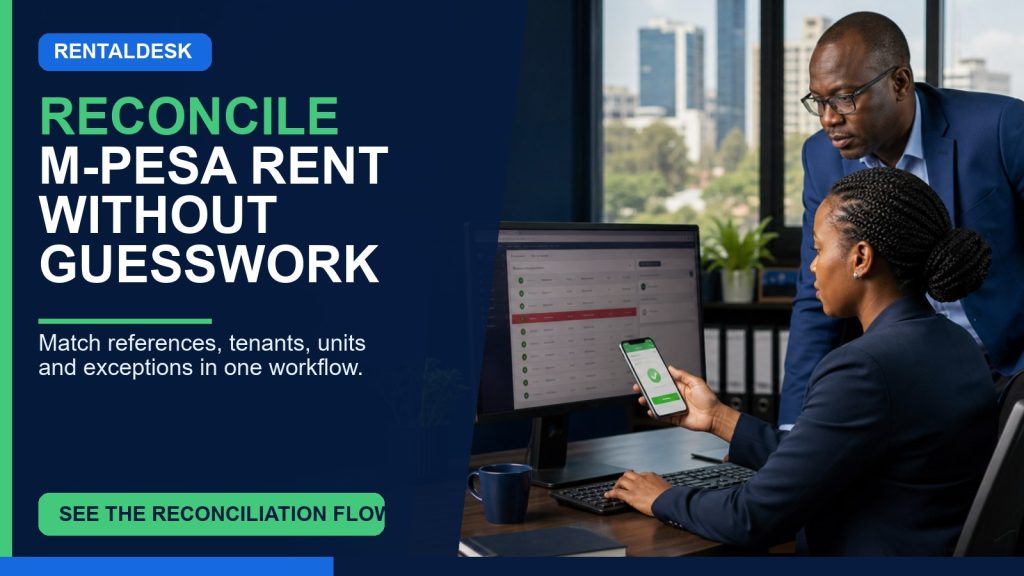
Use the M-Pesa rent payment overview and reconciliation guide during evaluation. Ask the presenter to demonstrate a normal payment, a partial payment, an incorrect reference and a duplicate. The month-end statement should reflect the resolved ledger, not a separate spreadsheet.
Owner statements that answer questions before they are asked
A diaspora owner statement should be timely, consistent and traceable. It should show opening position where relevant, rent billed, rent received, outstanding balances, approved expenses, management fees, advances or other authorised movements, owner payout and closing position. Labels need to be understandable without a call to the accountant.
Every major figure should lead back to source records. The owner should be able to identify which property and period an expense relates to, which tenants make up arrears and how the payout was calculated. Supporting documents should be available under controlled access. If a correction occurs after issue, the new version and explanation should be preserved.
RentalDesk’s owner statements feature and monthly owner reporting guide show the expected operating outcome. In a demo, use a month with partial rent, one unmatched payment and an approved repair. Perfect sample data hides the controls a remote owner most needs.
Repair approval without remote micromanagement
Diaspora landlords often face two bad options: delay every repair while requesting more information, or approve every request because they cannot verify it. A structured workflow creates sensible middle ground. Start with approval limits by cost, urgency and property. Routine work below an agreed threshold may follow a delegated process; larger or unusual costs require owner approval.
Each request should identify the unit, reported problem, evidence, urgency and responsible manager. Quotations should remain separate from approved amounts and final invoices. The owner can compare options, ask questions and record a decision. Completion evidence then closes the loop. Emergency work needs its own rule with prompt notification and later documentation.
The maintenance management workflow should be demonstrated end to end. Ask how the system prevents a caretaker from approving their own request, how repeat faults are identified and how the final cost reaches the owner statement. Remote approval is useful only when it produces an accountable record.
Controlling caretakers and agents without destroying trust
Good software is not designed around suspicion. It makes responsibilities clear so honest staff can work efficiently and owners can review outcomes without repeated accusations. Assign individual accounts, properties and roles. Let caretakers record site facts and managers handle operational decisions. Keep reconciliation and sensitive finance actions with authorised users.
Shared passwords weaken everyone. The owner cannot tell who changed a record, and staff may see information outside their duties. Use individual access, multi-factor security where available, prompt account removal and periodic permission review. Changes to payout details, user roles and other sensitive settings should receive additional control.
Measure performance through agreed service indicators: rent reconciliation turnaround, owner-statement date, maintenance response time, unresolved exceptions, vacancy days and tasks overdue. These measures create a professional conversation about service instead of relying on constant check-in calls.
Agree how urgent communication will work outside the platform as well. The system should remain the official record, while a defined phone or messaging escalation can handle genuine emergencies. After the immediate response, the local team should document the incident, decision and cost so the owner history does not end with an unexplained late-night call.
Remote occupancy, inspections and tenant deposits
An owner abroad should not discover a vacancy only when income falls. Move-in and move-out workflows should record dates, authorised users, lease status, keys, meter readings and property condition. A caretaker may report an event, but a manager should verify it before billing and occupancy records change.
Deposits need their own traceable balance. The owner should be able to see that a deposit was received and understand the closing result without gaining unnecessary access to tenant documents. Proposed deductions should connect to inspection evidence and approval. Refunds should show authorised amount and actual payment reference.
RentalDesk’s tenant management and documents and files workflows should be tested together. Ask to compare move-in and move-out evidence, then trace the effect on the tenant’s closing statement and unit status.
Security and privacy questions for an owner abroad
Property records contain personal and financial information. Ask how data is protected in transit and storage, how backups are handled, where support access is controlled and what happens when a device or staff account is compromised. Review account recovery and notification contacts so a foreign number or time zone does not prevent urgent action.
Permissions should follow least privilege. The owner portal should expose authorised portfolio records, not other clients. Caretakers and contractors should see only assigned work. Exports should be controlled, and important activity should be logged. The business using the system still needs appropriate privacy, retention and staff procedures; software alone does not create compliance.
Never share the owner’s administrator password through chat. Create separate named users. Review access at least quarterly and immediately after staff or agency changes. Ask the vendor to explain support escalation if the owner cannot sign in while abroad.
A practical diaspora onboarding plan
- Inventory the portfolio. Confirm owners, properties, units, occupants, leases, deposits, recurring charges and managers.
- Reconcile opening balances. Approve a dated rent, deposit, arrears and owner position before migration.
- Map payment references. Define Paybill, Till, STK, bank or manual channels and how tenant accounts will be identified.
- Configure roles. Create separate owner, manager, finance and caretaker access with assigned properties.
- Set approval limits. Agree routine, major and emergency maintenance rules and evidence requirements.
- Design owner reports. Confirm period, delivery date, currencies, expense detail, payout workflow and exception reporting.
- Run one month in parallel. Compare new-system reports with approved source records and resolve differences.
- Test remote scenarios. Practise a repair approval, unmatched M-Pesa payment, tenant move-out and password recovery.
- Sign off and review. Record remaining exceptions and hold a 30-day service review with the owner and local team.
A rushed import can give the owner a modern dashboard with unreliable opening numbers. Assisted onboarding should include verification and training, not only file upload.
Questions to ask during a diaspora-landlord demo
Attend the demonstration from the same type of device and connection you will normally use abroad. Ask the local manager to join with their own role. The vendor should show how both parties see the same underlying event with different permissions.
- Can the owner trace collections, arrears, expenses and payouts by property?
- What does an unmatched M-Pesa payment look like to the manager and to the owner?
- Can repair quotations and evidence be reviewed before approval?
- How are changes to payout details protected and recorded?
- Can the owner identify vacancies, expiring leases and unresolved move-outs?
- Which reports can be scheduled, downloaded or shared securely?
- How are old staff accounts disabled while preserving history?
- What support is available across time zones, and what response process is agreed?
Use sample data with one mistake. A demonstration that resolves a wrong payment or disputed repair proves more than a dashboard containing perfect records.
Frequently asked questions
Can I manage Kenyan rental property while living abroad?
Yes, provided the local operating process is reliable. Software can centralise rent, tenant, maintenance and reporting records, while authorised local staff carry out physical work.
Does diaspora property software replace a caretaker or agent?
No. It gives owners and local teams one accountable workspace. Physical inspections, repairs, tenant service and other local responsibilities still need qualified and trusted people.
Can I see M-Pesa rent from another country?
RentalDesk can provide rent and reconciliation visibility through authorised access. Ask how your exact M-Pesa setup, references and exceptions will be configured.
Can I approve maintenance remotely?
A structured workflow can present the request, evidence, quotation and approval status. Define limits and emergency procedures so routine work does not wait unnecessarily.
Will I receive landlord statements?
RentalDesk supports owner-statement workflows. Confirm the layout, reporting period, supporting detail and delivery process during onboarding.
How do I stop staff from seeing sensitive owner information?
Use individual role-based accounts, property assignments, approval controls and periodic access reviews. Never share one administrator login.
Is online access alone enough?
No. Reliable remote control requires current data, reconciliation habits, verified opening balances, staff accountability and defined response processes.
Build a remote-control demonstration around your property
Request a RentalDesk diaspora-landlord demonstration using one property, a realistic month’s rent, an unmatched M-Pesa transaction, a repair requiring approval and a landlord payout. Compare the available RentalDesk pricing options and ask for an onboarding scope that includes opening-balance verification, named user roles and owner-report sign-off. Diaspora landlord property management software should help you ask fewer emergency questions because the underlying records are already visible and accountable.