
A tenant request reference gives a property team one stable way to identify a reported issue across calls, messages, visits, and follow-up. Without it, “the leak we discussed” can refer to several units or several different incidents. A clear reference helps staff connect the original report with the current status while avoiding unnecessary repetition of private tenant details in every conversation.
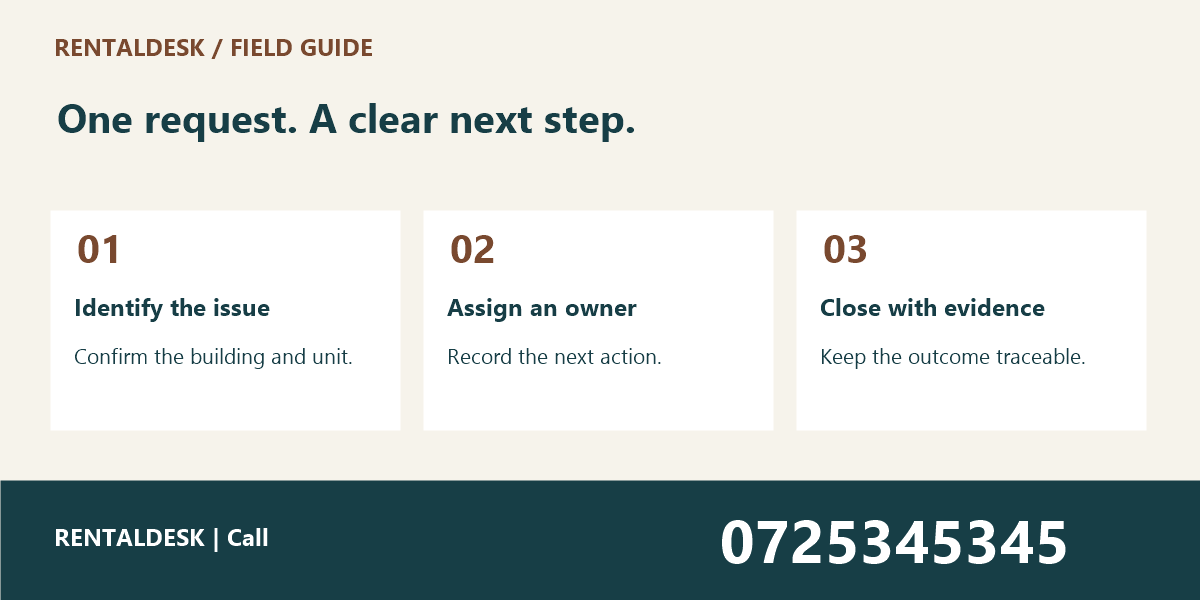
This guide explains seven practical rules for Kenyan rental teams handling maintenance and everyday administration. The reference is a coordination tool, not proof that a request has been approved or completed. To discuss organising your property workflow, explore RentalDesk or call 0725345345.
1. Tenant Request Reference: Create one reference for one defined request
Start by describing the issue clearly enough to distinguish it from other work. A tenant may report a leaking tap and ask a separate question about a receipt in the same message. Those matters may need different owners and processes. Decide how your team separates requests rather than placing unrelated tasks under one vague label.
Use a reference format your system can maintain consistently. It may be generated automatically or assigned through a controlled manual process. Avoid asking each staff member to invent their own numbering style. The useful property is a reliable connection to the saved record, not an elaborate code that looks technical.
Check whether the issue already has a tenant request reference before creating another. A tenant may call after sending a message, and two colleagues may each start a record. Search the current requests for the correct property and symptom, then link the follow-up where appropriate.
Do not merge requests solely because they involve the same tenant. A new fault after an earlier repair may deserve a new record linked to the previous one. Keep the relationship clear so that the team can understand recurrence without losing the distinct dates and outcomes.
2. Tenant Request Reference: Connect the reference to the correct unit
Record the approved building and unit identifiers alongside the request. Similar unit numbers across several properties make shorthand risky. A reference is useful only if it points to the correct location and person through the authorised record.
Confirm the location before assigning a contractor or arranging a visit. A message forwarded without its original context can lose the building name. If the information is incomplete, ask through the appropriate channel and keep the request pending rather than guessing from the sender’s display name.
Keep private identifying details in the protected record instead of embedding them in the reference itself. A code does not need to include a tenant’s phone number, identity number, or full name to be useful. References may appear in subject lines and message notifications, so minimise unnecessary exposure.
The tenant contact change guide is relevant when the person reporting an issue supplies a new number. Verify the contact update separately before using that destination for private follow-up. The tenant request reference can remain stable while the approved contact record changes.
3. Tenant Request Reference: Acknowledge receipt with the same reference
Send a concise acknowledgement through the agreed channel. Identify the request, state that it has been received, and explain the next expected step. Do not imply approval, a repair booking, or a guaranteed resolution merely because the office has created a record.
Use the same tenant request reference in later messages. This helps the recipient and staff find the conversation without repeating the entire history. Keep the reference short enough to read and copy accurately, and avoid changing it each time responsibility passes to another colleague.
State what the tenant should do if they need to add information. For example, they can quote the reference when contacting the office. Do not ask them to send sensitive documents to an open group or an unrelated account simply to keep the thread together.
If a request concerns an urgent hazard or other serious issue, follow the appropriate response process immediately. Assigning a reference should not delay escalation. The administrative record supports the response; it is not a reason to wait until every field has been completed.
4. Tenant Request Reference: Give the request an owner and a next action
Assign responsibility to a role or person who can move the request forward. “Office” may be too broad when several staff assume someone else is handling it. The owner should know what decision or action is required next and how to escalate a dependency they cannot resolve.
Keep status labels specific. “Received,” “awaiting information,” “visit arranged,” and “awaiting verification” describe different stages. A tenant request reference should lead to a record that explains the current position, not simply a long message history with no clear next step.
Record a review date or expected update point that the team can realistically meet. Avoid promising a completion time before the scope and resources are known. A reliable update commitment can still help the tenant understand what will happen next while the technical or administrative issue is assessed.
For custom request handling, Zama describes business portal and software services. Useful requirements include stable references, ownership, status history, permissions, and clear notifications. Confirm the actual workflow with your provider rather than assuming a generic form automatically delivers all those controls.
5. Tenant Request Reference: Link appointments, documents, and work records
Use the reference to connect the request with related appointments and documents. A maintenance visit, supplier quote, and completion report may each have their own identifier. The tenant request reference should make the relationship visible without forcing all records to share one unsuitable number.
The repair completion evidence guide explains how to document what was done and checked. Link that evidence to the original request so a reviewer can compare the outcome with the reported symptom. Attendance alone should not close a request that still needs verification.
For account-document questions, use the appropriate separate review process. The rent receipt correction guide distinguishes a document error from a payment-record issue. A shared reference helps coordination, but it does not authorise an unreviewed financial adjustment.
If a commercial tenant reports a problem affecting a booking or till task, record the actual symptom and responsible service. PRIM and Vega describe salon and retail systems respectively. Their role may differ from the landlord’s maintenance responsibility, so clarify ownership instead of assuming every business-system issue belongs to the property team.
6. Tenant Request Reference: Keep updates factual and easy to follow
Record what changed, when, and who provided the information. A short dated note is usually more useful than a copied conversation containing several unrelated messages. Keep the original evidence where required, but summarise the operational point clearly in the request record.
Separate observations from conclusions. “Contractor attended and requested a replacement part” does not mean “repair completed.” “Tenant has not replied” does not mean “tenant approved closure.” Accurate wording helps the next colleague continue the work without inheriting an unsupported assumption.
When a request is transferred, record the new owner and unresolved actions. Do not simply forward the tenant’s message and assume responsibility has moved. The receiving person should acknowledge the handover through your normal process, and the source record should show who now owns the next step.
Use the tenant request reference in internal notes, but do not treat possession of the reference as proof of identity. Someone quoting a code should not automatically receive private account or tenancy information. Continue using the appropriate verification and access controls for the information being requested.
7. Tenant Request Reference: Close the request with a clear outcome
Before closure, check that the record answers the original question or explains the completed action. State the outcome and any remaining limitation. If the issue needs a later review, record that task with an owner rather than hiding it inside a general closure note.
Notify the tenant through the verified channel where appropriate. A short message can identify the tenant request reference, explain what was done, and describe how to report a continuing problem. Avoid sending a full internal file when the recipient only needs the practical outcome.
Keep the history required by your organisation’s policy. Closing a request should not erase the original report, significant updates, or supporting evidence needed to understand it. At the same time, avoid retaining unrelated personal material merely because it arrived in the same message thread.
Review recurring requests by theme. Several reports about the same area may justify a broader investigation, while repeated duplicate records may indicate an intake problem. Use the evidence to improve the process instead of changing references or statuses merely to make the open list appear shorter.
A fictional tenant request reference example
Imagine a tenant reports that a kitchen cupboard door will not close. The office creates request R204, confirms the building and unit, and acknowledges receipt. The coordinator assigns a review task, then links the agreed maintenance appointment to R204 when the visit is arranged.
After the visit, the contractor reports that the hinge was adjusted. The completion check is recorded, and the tenant’s relevant feedback is added through the normal process. The coordinator can then assess closure using the original symptom and the documented outcome.
If the same tenant also asks for a receipt copy, the office handles that through the appropriate document process and links it where useful. It should not disappear inside the cupboard repair notes. Clear separation lets each request reach an accurate outcome without confusing responsibilities.
Tenant Request Reference: Keep a small intake checklist
Useful fields include reference, date received, property, unit, verified contact record, short description, category, urgency assessment, owner, current status, next action, review date, related records, and closure outcome. Collect only the information needed for the request and the approved workflow.
Test the checklist with fictional examples before rolling it out. Include a duplicate report, a request with an unclear location, and a case that needs transfer to another team. Ask staff to explain what they would record and what they would escalate. This reveals gaps in definitions before real tenants encounter them.
Make the process easy to use across channels. A call, email, or message should lead to the same source record rather than separate unofficial lists. The tenant request reference provides continuity even when the communication channel changes.
Tenant Request Reference: Frequently asked questions
Should a tenant request reference contain the tenant’s name?
It does not need to. A stable code linked to the authorised record can identify the request without exposing personal details in every subject line or notification. Follow your organisation’s naming and data-handling rules.
Can one tenant request reference cover several repairs?
It can if your workflow keeps each item, owner, and outcome clear. When tasks require different processes or timelines, separate linked records may be easier to manage. Choose the structure that prevents incomplete work from being hidden.
What if the tenant does not know the reference?
Use the approved lookup and verification process to find the request. Do not make the code a barrier to legitimate help. Once the record is identified, continue the conversation with the same reference so later follow-up is easier.
Tenant Request Reference: Check a request during a shift handover
At handover, ask the incoming colleague to identify the next action from the saved request. They should know whether the team is waiting for information, arranging a visit, reviewing evidence, or communicating an outcome. If they cannot tell, replace a vague status with a factual note and a named owner.
Check whether the tenant has supplied new information through another channel. Link the relevant update to the existing record after the appropriate verification, rather than creating a competing version of the issue. Keep unrelated matters separate so that one request does not become a catch-all conversation.
The outgoing colleague should make unresolved decisions visible. A note that simply says “please follow up” transfers uncertainty without explaining the task. State what question needs answering and which person or record can provide the information.
What belongs in a tenant request reference handover?
Include the original issue, current owner, verified updates, related tasks, next action, and review date. Keep the tenant request reference record in the agreed location and make the next action clear to the incoming colleague. Resolve missing context before responsibility changes.
Tenant Request Reference: Make follow-up consistent across the team
A tenant request reference is useful when it connects a clear issue with the correct unit, owner, evidence, and outcome. Keep updates factual and responsibilities visible. To discuss a practical rental workflow with RentalDesk, call 0725345345.