Property management software for agencies is the operating system that determines whether a Kenyan property management firm scales or collapses under the weight of its own client list. A firm managing three landlords on spreadsheets can survive on memory and WhatsApp. A firm managing thirty landlords, five hundred units, and properties spread across Nairobi, Mombasa, and Kisumu cannot. The moment the portfolio crosses a certain threshold, the informal systems that worked at three clients actively sabotage the business at thirty. Records get mixed up between owners. Statements go missing.
Management fees are calculated on the wrong base. A single misplaced receipt can erode the trust of a landlord whose portfolio represents a significant share of agency revenue. The property management software for agencies that prevents that collapse is not a scaled-up landlord tool. It is an operating model with clear boundaries, automated reconciliation, and per-owner reporting that landlords can trust.
Why Agencies Need Specialised Software, Not Landlord Tools
The conversation about property management software for agencies must begin with a distinction that the market often blurs. A landlord tool manages one owner’s properties. An agency tool manages many owners’ properties simultaneously, without allowing one owner’s data to leak into another’s reports. This is not a cosmetic difference. It is an architectural requirement.
A landlord with five units needs to track rent, arrears, and maintenance. An agency managing five hundred units across thirty owners needs to track all of that, plus the owner boundary. Every lease, charge, receipt, expense, task, and report must have an unambiguous destination. A payment must be attributed not just to the right tenant, but to the right property and the right owner. A report must be generated for the correct client, not for the agency’s consolidated total. An agency that cannot enforce this boundary is not running a professional operation. It is running a shared spreadsheet with logins.
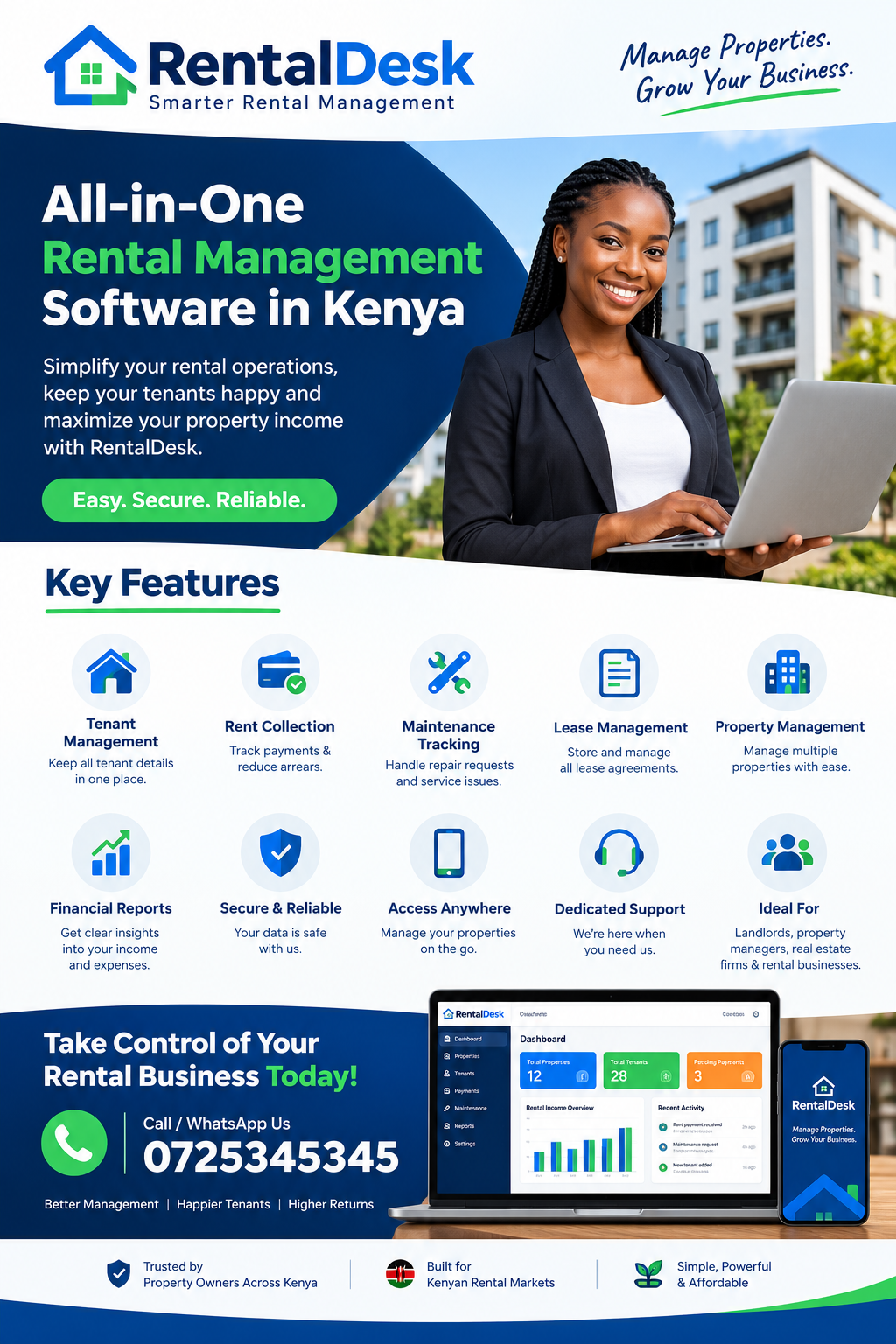
RentalDesk is built around this distinction. The platform is designed for agencies managing residential, commercial, and mixed-use properties, combining tenant management, automated rent collection, financial reporting, maintenance tracking, and portfolio oversight into one secure system. The owner boundary is not an add-on. It is the foundation of the data model.
The Multi-Owner Hierarchy: The Foundation of Agency Software
The first requirement of property management software for agencies is a clean owner-to-property-to-unit hierarchy. The agency sits at the top. Below that, each owner or client. Below that, each property. Below that, each unit. Below that, each lease. Below that, each transaction.
This hierarchy sounds obvious, but most agency failures originate from its absence. A property with no owner link disappears from client reports but remains in consolidated totals. A payment allocated to the right tenant but the wrong owner creates a reconciliation problem at month-end. A staff member assigned to Owner A can see Owner B’s records because the access controls were never scoped to the owner level.
RentalDesk enables agencies to manage multiple landlords, properties, tenants, leases, invoices, maintenance requests, and financial records from one centralised dashboard. Each property remains organised within the correct owner’s portfolio, and each report is generated for the correct recipient. The hierarchy is not a reporting view layered on top of the data. It is the structure that determines how every record is stored and retrieved.
M-Pesa Reconciliation Across Multiple Portfolios
The second requirement of property management software for agencies is M-Pesa reconciliation that respects the owner boundary. In Kenya, roughly the majority of tenant payments arrive through mobile money. An agency that cannot reconcile M-Pesa automatically is not managing a portfolio. It is managing a queue of screenshots.
The challenge is not simply matching a payment to a tenant. It is matching the payment to the correct tenant, the correct unit, the correct property, and the correct owner. A payment that is reconciled to the tenant but not to the owner creates a reporting problem. The tenant’s balance is correct, but the owner’s statement is wrong.
RentalDesk connects to Safaricom’s Daraja API with Instant Payment Notification callbacks. When a tenant pays via Paybill or STK Push, the system extracts the amount, phone number, account reference, and transaction ID, matches the reference to the correct tenant and unit, credits the account, generates a receipt, and updates the dashboard in real time. The payment flows through to the correct owner’s records without manual intervention. The reconciliation logic preserves the owner boundary at every step.
Automated Invoicing and Reminders Across the Portfolio
The third requirement of property management software for agencies is automated invoicing and reminders that run across every property, every owner, and every tenant without human effort. An agency that raises invoices manually spends the first week of every month on data entry. An agency that sends reminders manually sends them inconsistently, and the tenants who need reminding most are the ones who slip through the gaps.
RentalDesk enables agencies to automate rent invoicing, collect payments through M-Pesa, reconcile transactions automatically, and generate digital receipts. The reminder ladder escalates predictably: a friendly heads-up before the due date, a neutral reminder on the day, a firmer message after, a factual reminder once the word “arrears” becomes appropriate, and a formal notice at a defined threshold. The agency does not need to remember which tenant is at which stage. The system does.
For an agency managing multiple owners, the critical requirement is that reminders are scoped correctly. A tenant in Owner A’s building should receive a reminder that references Owner A’s property, not the agency’s consolidated portfolio. RentalDesk generates reminders from the lease and invoice record, so the correct details flow through automatically.
Owner Statements and Per-Landlord Reporting
The fourth requirement of property management software for agencies is owner-ready reporting. The software is judged by the quality of the statement that goes to the landlord. A consolidated total is not a statement. A PDF that lists every transaction across every owner is not a statement. A statement is a document that shows one owner what happened on their properties, in a format they can read and verify.
RentalDesk generates statements and reports per property and per owner automatically, so managers can share clear, up-to-date income and balance reports with each landlord without manual bookkeeping. The statement shows rent collected, arrears outstanding, expenses incurred, management fees deducted, and the net remittance. The figures reconcile to the same ledger used for daily operations. Nothing is reconstructed.
The agency can deliver these statements through the platform, and the landlord can log in to view performance without calling the agency. This reduces the routine enquiries that consume staff time and builds the trust that keeps clients.
Role-Based Access and Client Confidentiality
The fifth requirement of property management software for agencies is access control. An agency holds data belonging to multiple landlords, and some of those landlords may be competitors. The software must enforce boundaries not just in reports, but in the screens that staff see.
RentalDesk supports role-based access controls and permissions. Property managers, accountants, caretakers, and client viewers each see only what their role requires. A property manager assigned to Owner A’s portfolio cannot search for Owner B’s records. A caretaker can record a cash receipt but cannot reallocate an M-Pesa transaction. An accountant can reconcile payments but cannot change the management fee structure. A client viewer can see their own statements but cannot edit anything.
Every action is logged with a timestamp and user identification. If a dispute arises about how a payment was handled, the agency can demonstrate who did what and when. This audit trail is not a feature. It is the control that makes delegation safe.
Maintenance Tracking Across Multiple Properties
The sixth requirement of property management software for agencies is maintenance tracking that works across a portfolio. An agency managing fifty buildings cannot rely on phone calls and WhatsApp threads to track repairs. A request that is logged in one building’s group chat is invisible to the manager responsible for another building. A contractor who was authorised for one owner’s repair may not be authorised for another’s.
RentalDesk allows tenants to submit maintenance requests through the tenant portal with photos and descriptions. The agency assigns requests to vendors, approves quotations, tracks progress, and records completion with evidence. The request is linked to the correct property, unit, and owner. The expense is recorded against the correct statement period.
For an agency, this structure matters because maintenance costs are a frequent source of owner questions. An owner who sees a repair charge on their statement can see the request, the quotation, the approval, and the completion photo. The agency does not need to reconstruct the story from memory.
Arrears Tracking and Recovery Across Portfolios
The seventh requirement of property management software for agencies is arrears tracking that shows the agency where to act. A single arrears total across a five-hundred-unit portfolio is useless. An ageing breakdown by owner, by property, and by tenant tells the agency which balances are recoverable and which are bleeding out.
RentalDesk provides automated arrears reports, ageing analysis categorising balances by 1–7, 8–30, 31–60, and 60+ days, and payment behaviour analysis. The dashboard surfaces the 60+ day cases so the agency acts on what matters rather than treating every arrears case identically. Payment behaviour analysis shows average days late, frequency of late payment, and the arrears trend for each tenant — the metrics that inform tenancy renewal decisions.
For an agency, the ageing report is also a client management tool. An owner whose property has no arrears sees a clean statement. An owner whose property has arrears sees the ageing breakdown and the actions taken. The conversation becomes specific and evidence-based.
Financial Reporting and KRA Compliance
The eighth requirement of property management software for agencies is financial reporting that supports KRA compliance. The Kenya Revenue Authority launched the Electronic Rental Income Tax System in April 2025, and the Draft Income Tax (Residential Rental Income Tax) Regulations 2026 propose making registration on the platform mandatory for every landlord within the monthly rental income band. An agency that manages properties for multiple owners must be able to produce the records that each owner needs to file.
RentalDesk generates rent collection reports, income versus expense reports, arrears ageing reports, and audit-ready financial statements from the same verified records used for daily operations. The figures that appear in a KRA return are the same figures that appear in the owner statement and the rent register. The agency does not need to reconstruct anything at year-end.
For agencies managing commercial properties, the reporting must also support VAT compliance. Commercial rent is subject to VAT at 16% where the landlord’s taxable turnover exceeds KSh 5 million. RentalDesk separates residential and commercial units so that the correct treatment is applied to each.
Pricing: What Agencies Actually Pay
The pricing of property management software for agencies in Kenya varies by unit capacity, feature set, and vendor. RentalDesk publishes three plans.
The Free Lite plan costs KES 0 forever and supports one property with up to five units and one account owner. It includes basic tenant records and invoices, balances and basic reports, and manual payment tracking. It does not include M-Pesa automation, SMS, bulk import, team accounts, advanced reports, or priority support.
The Starter Plan costs KES 5,000 per month and supports up to 99 units. It includes M-Pesa collection and reconciliation, SMS reminders, bulk import, staff accounts, and advanced reports. This is the plan for agencies transitioning from manual to automated collection.
The Estate Manager plan costs KES 9,500 per month and supports 100 to 999 units. It includes everything in Starter plus multi-property operations, role controls, advanced analytics, exports, and priority support. This is built for agencies managing larger multi-property portfolios.
Quarterly billing includes 5% off and yearly billing includes 10% off the base monthly rate. For an agency managing 500 units, the Estate Manager plan works out to KSh 19 per unit per month. The market range for property management software in Kenya runs from free for small portfolios to roughly KSh 1,500–12,000+ per month depending on units and features, plus quote-based enterprise plans. RentalDesk sits in the middle of that range, with a clear upgrade path.
What to Test Before Committing
Feature lists tell you what a product claims. Scenarios tell you what it does. Before selecting property management software for agencies, run these tests with your own data.
Test a payment that arrives with a mistyped reference and confirm that it enters a reconciliation queue rather than being auto-posted or lost. Test a part-payment against an open invoice and confirm that the balance remains visible. Test a month-end close and confirm that the owner statements reconcile to the payment records. Test the access controls by logging in as a property manager assigned to one owner and attempting to search for another owner’s records. Test the caretaker view on a basic Android phone. Test the export — download the full ledger and confirm that it opens in a usable format.
Any platform that passes these tests is worth serious consideration. Any platform that fails two or more will fail in production.
Common Mistakes Agencies Make When Choosing Software
The property management software for agencies journey has predictable failure modes. Running one spreadsheet per landlord is the first. The files do not talk to each other, and the director cannot see the agency-wide position without asking every accountant. Failing to define the owner hierarchy before migrating data is the second. A property with no owner link disappears from client reports but remains in consolidated totals.
Not separating client money is the third. Mixing client money with agency operating funds is both a compliance risk and a trust risk. Skipping the pilot is the fourth. Onboarding every owner at once means errors surface in live reporting. Failing to enforce role-based access is the fifth. Client confidentiality depends on access controls, not on good intentions.
How RentalDesk Supports Agencies
RentalDesk is built specifically for Kenyan property agencies, estate managers, and companies that manage properties for many landlords. The platform supports multi-owner reporting, staff roles, rent collection, arrears tracking, utility billing, maintenance records, and agency-level oversight from one dashboard.
The owner hierarchy maintains a clear boundary around each owner’s records while giving authorised managers a consolidated view of the agency’s work. Per-owner statements are generated from the same verified records used for daily operations. M-Pesa and bank payments are reconciled automatically. Automated invoicing and reminders run across the portfolio. Arrears are categorised by age with dashboard visibility. Role-based access ensures that caretakers, managers, and accountants see only what they need to see. Every action is logged with a timestamp and user identification.
For agencies evaluating property management software for agencies, the question is not whether the platform has the longest feature list. It is whether the platform enforces the owner boundary, reconciles M-Pesa automatically, generates owner-ready statements, and provides the access controls that make delegation safe. RentalDesk is built around those four requirements.
How to Get Started
Implementing property management software for agencies is straightforward with RentalDesk .
Step 1: Sign up. Visit RentalDesk and create your agency account. Choose a plan that matches your portfolio size. The Estate Manager plan supports 100–999 units with multi-property operations and role controls.
Step 2: Define the owner hierarchy. Record each landlord, each property, and each unit. Make the owner link mandatory for every property.
Step 3: Configure M-Pesa collection. Connect your Paybill so that payments reconcile automatically and flow to the correct owner’s records.
Step 4: Configure role-based access. Create user accounts for property managers, accountants, caretakers, and client viewers. Scope access to the correct portfolios.
Step 5: Run a pilot with one owner. Process one full billing period for a single landlord and reconcile the statements against the underlying records.
Step 6: Roll out in batches. Onboard owners in controlled groups, with a reconciliation deadline and sign-off for each batch.
Step 7: Review the exception queue daily. Reconciliation exceptions, arrears, and maintenance requests should be reviewed each morning.
The Future of Agency Property Management in Kenya
The property management software for agencies landscape is moving in a clear direction. Government tax infrastructure is integrating with property management platforms, which means agency records will increasingly connect to landlord compliance reporting. The Estate Agents Registration Board continues to enforce licensing and client account requirements. Digital platforms are making it easier for agencies to scale without adding administrative headcount.
The agencies that adopt a structured operating model early will not simply have tidier records. They will have lower leakage, faster reconciliation, stronger landlord relationships, and a business that can onboard a corporate client without rebuilding its systems. RentalDesk provides the structured platform that makes property management software for agencies work in Kenya — not as a collection of spreadsheets held together by memory, but as a governed operating model with clear boundaries, automated reconciliation, and per-owner reporting that landlords can trust.
- Property management software for agencies
- Property management software for agencies
- Property management software for agencies
- Property management software for agencies
- Property management software for agencies
- Property management software for agencies
- Property management software for agencies
- Property management software for agencies
- Property management software for agencies
- Property management software for agencies
- Property management software for agencies