
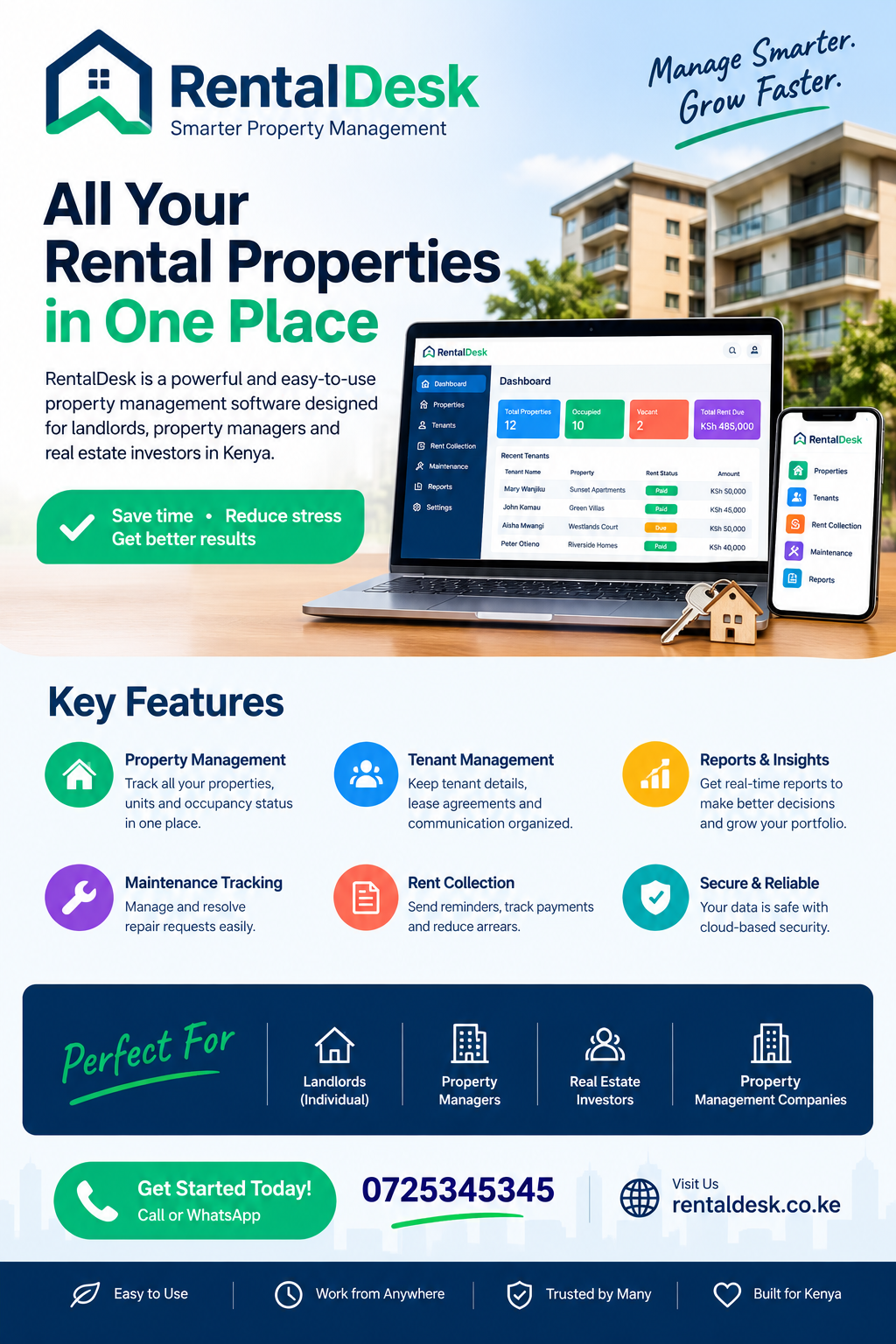
Multi Property Management Software Kenya: A Complete Guide to Managing Multiple Properties
Managing several rental properties can quickly become complicated when every building has different tenants, rental rates, payment dates, maintenance needs and expenses. For landlords, real estate investors and property management companies in Kenya, using spreadsheets, notebooks and separate payment records can make it difficult to maintain accurate information. Multi Property Management Software Kenya provides a useful starting point for understanding how digital tools can simplify the management of multiple rental units, improve financial visibility and support better decisions.
Property ownership can be a valuable investment, but managing a growing portfolio requires more than finding tenants and collecting rent. Owners must monitor occupancy, follow up on arrears, issue receipts, coordinate repairs, maintain tenancy records and understand the financial performance of each property. These responsibilities become more demanding when properties are spread across different neighbourhoods or towns.
A landlord with one apartment building might manage most activities personally. However, an investor with several apartment blocks, residential houses, commercial units and bedsitters may need a more organised system to avoid confusion. A missed payment can affect cash flow, an undocumented repair can create accounting problems, and an outdated tenant record can lead to unnecessary disputes.
This guide explains how property management software works, which features matter when managing several buildings, how to improve rent collection, what to consider when comparing solutions and how Kenyan property owners can introduce digital management without unnecessarily complicating their operations.
1. Understanding Multi-Property Management
Multi-property management involves overseeing two or more rental properties while maintaining control over the income, expenses, tenants and operational responsibilities associated with each one. The properties may be located in the same estate or distributed across different locations.
For example, an investor might own an apartment building in Nairobi, rental houses in Kiambu and commercial premises in Nakuru. Each property may have its own tenants, utility arrangements, maintenance requirements and rental agreements. Although the properties belong to the same investor, their records must remain distinguishable.
A structured digital approach makes this easier. Multi Property Management Software Kenya is a relevant search term for owners exploring ways to coordinate several properties through organised digital records rather than relying entirely on manual processes.
What makes managing multiple properties challenging?
Several recurring responsibilities make property management demanding:
-
Rent collection: Tracking expected rent, received payments, outstanding balances and payment dates.
-
Tenant administration: Maintaining contact details, tenancy agreements, deposits and occupancy information.
-
Property maintenance: Recording repair requests, assigning service providers and tracking completion.
-
Financial reporting: Comparing rental income, operating expenses and outstanding arrears.
-
Documentation: Keeping invoices, receipts, inspection reports and contracts organised.
-
Occupancy management: Identifying vacant units and monitoring upcoming move-ins and move-outs.
-
Communication: Sharing payment reminders, maintenance updates and notices with tenants.
When information is scattered across notebooks, messaging applications, email accounts and spreadsheets, it becomes harder to establish a reliable picture of the portfolio.
A centralised system helps bring these activities together. Instead of searching through different records whenever a tenant asks about a payment, a property manager can consult the relevant account and review the available information.
The difference between managing one property and several
Managing one building allows the owner to become familiar with its tenants and expenses. With multiple buildings, however, familiarity is not enough. The owner needs a repeatable process that works consistently across the entire portfolio.
| Management responsibility | One property | Multiple properties |
|---|---|---|
| Rent tracking | A single rent register may suffice | Separate records and consolidated reporting are needed |
| Tenant records | Relatively straightforward | Must be organised by property and unit |
| Maintenance | A small number of requests | Requests require prioritisation and assignment |
| Financial reporting | One property statement | Individual and portfolio-wide reports |
| Vacancy monitoring | A single occupancy list | Several occupancy lists updated consistently |
| Staff coordination | May be handled by the owner | May involve caretakers, accountants and agents |
The important difference is the volume of information and the need to compare performance across different locations.
2. What Property Management Software Does
Property management software is a digital system designed to help landlords and property managers organise the administrative and operational activities associated with rental properties.
Depending on the product, it may support tenant registration, rent schedules, payment records, expense tracking, maintenance requests, document storage and financial reports. Some systems also offer automated reminders, user permissions and integrations with payment services.
The exact capabilities differ between providers. Property owners should therefore evaluate what a particular system actually supports instead of assuming every product includes every feature.
When comparing Multi Property Management Software Kenya, landlords should examine how easily the system separates properties while allowing authorised users to view information across the wider portfolio.
Centralised information
A centralised system stores relevant property records in one organised environment. The property manager can navigate from the overall portfolio to an individual building and then to a specific unit.
For example, a portfolio might be arranged as follows:
-
Portfolio: All properties managed by the owner.
-
Property: An apartment block in Nairobi.
-
Unit: Apartment 3B.
-
Tenant: The person occupying that apartment.
-
Account: The tenant’s rent schedule, payments and outstanding balance.
-
Documents: The tenancy agreement, inspection notes and other relevant records.
This structure reduces the likelihood of mixing information belonging to different tenants or buildings.
Portfolio-wide and property-specific views
A good system should help users answer two different questions.
First, how is the entire portfolio performing? This requires a consolidated view of rent billed, payments received, outstanding balances, vacancies and recorded expenses.
Second, what is happening at a particular property? This requires more detailed information about individual units, tenant accounts, repair requests and local operating costs.
Both views are important. A property with strong rental income may still have unusually high maintenance expenses, while another may appear profitable because its outstanding bills have not yet been recorded.
Better coordination between staff
A property manager may work with caretakers, accountants, letting agents, maintenance contractors and owners. Digital records can help these people coordinate responsibilities, provided the software supports appropriate access permissions.
A caretaker might need to record a repair request without seeing confidential financial information. An accountant may need payment and expense records, while the owner may require access to consolidated reports.
These arrangements should be configured according to actual responsibilities and the capabilities of the chosen product.
3. Why Kenyan Property Owners Need a Structured System
Kenya’s rental market includes bedsitters, single rooms, apartments, townhouses, standalone homes, office premises and retail spaces. These property types can have different payment arrangements, tenant expectations and maintenance requirements.
A landlord managing residential units in Ruiru may deal with a different set of operational concerns from a company managing commercial premises in Nairobi’s central business district. An investor with properties in several counties must also coordinate information across locations.
For many owners, Multi Property Management Software Kenya represents an approach to improving consistency without requiring every property to operate independently.
Handling different rent schedules
Some tenants pay monthly, while other arrangements may involve different billing periods or agreed payment dates. A property manager needs to know what each tenant owes and when the amount is due.
A central rent schedule can help distinguish:
-
Rent expected during the current month.
-
Payments already recorded.
-
Partially settled balances.
-
Outstanding amounts from previous periods.
-
Adjustments approved under the tenancy agreement.
-
Accounts requiring follow-up.
The system should reflect the actual agreement with each tenant. It should not automatically apply the same terms to every unit when rental arrangements differ.
Supporting M-Pesa and other payment methods
M-Pesa is widely used in Kenya, making mobile payments relevant to many rental businesses. Depending on the provider, software may support payment integrations, transaction imports, reconciliation or manual recording of payments received through supported channels.
Property owners should confirm precisely how an integration works. Receiving money through a payment service does not necessarily mean every transaction will automatically be matched to the correct tenant account.
A reliable reconciliation process should establish the payer, amount, transaction reference, relevant property and payment period before the account is updated.
Managing properties in different towns
Geographical separation increases the importance of accurate reporting. An owner who cannot visit every building regularly needs dependable records to understand occupancy, maintenance activity and financial performance.
A digital system can make it easier to compare properties without travelling between them. However, its usefulness depends on timely updates from the people responsible for managing each location.
4. Essential Features to Look For
Not every property management product is suitable for every portfolio. A small landlord may need straightforward rent tracking, while a property management company may require advanced user permissions, consolidated reporting and more detailed financial controls.
Before selecting Multi Property Management Software Kenya, list the daily activities that cause the most difficulty and assess how the available features would address them.
Property and unit registration
The system should allow the owner to register several properties and organise their units clearly.
Useful information may include:
-
Property name and location.
-
Property category.
-
Number of units.
-
Unit identifiers.
-
Rental rates and billing arrangements.
-
Occupancy status.
-
Relevant property-specific notes.
A consistent naming structure is particularly useful when two buildings have similar names or when several units use similar numbers.
Tenant management
Tenant records should contain the information needed to administer the tenancy, subject to appropriate privacy and access controls.
Depending on the system and the business’s requirements, records may include tenant contact information, unit allocation, tenancy dates, agreed rent, deposit details and relevant correspondence.
The system should make it possible to identify the correct tenant quickly without exposing private information unnecessarily.
Rent invoicing and receipts
A rent management feature should help users establish what is payable, issue clear billing records and document payments.
Receipts should correspond to actual payments rather than merely showing amounts billed. If a tenant pays only part of the outstanding balance, the record should reflect the amount received and the remaining balance accurately.
Arrears monitoring
Arrears reporting identifies accounts with unpaid balances. Ideally, a manager can review outstanding amounts by tenant, unit, building and payment period.
A useful report should distinguish a current month’s unpaid rent from older balances and should reflect any approved credits or adjustments.
Expense management
Property-related expenses can include plumbing, electrical repairs, cleaning, security, waste collection, common-area maintenance and other operating costs.
Recording these expenses against the correct property helps the owner understand which buildings consume the most resources.
Financial reports
Reports should help users evaluate performance rather than simply display large amounts of data. At minimum, assess whether the system can provide clear summaries of rent billed, rent received, arrears and recorded expenses.
Where supported, reports should also be exportable for further review and accounting purposes.
Maintenance tracking
A maintenance module may allow users to record the problem, affected unit, date reported, urgency, assigned contractor, estimated cost and completion status.
The ability to attach photographs, quotations or invoices can also help create a useful history of repairs.
Document storage
Tenancy agreements, inspection reports, payment evidence, invoices and other documents should be organised so that authorised users can find them when needed.
Document storage should include suitable access restrictions and backup arrangements.
User permissions
The software should allow access to be limited according to staff responsibilities. Property managers should consider whether the system provides individual accounts, permission controls and records of important changes.
A shared password for every employee makes it harder to control access and identify who changed a record.
5. How to Organise Multiple Properties Efficiently
Software is only as useful as the information entered into it. Before migrating records, property owners should establish a clear structure for their buildings, units, tenants and financial accounts.
For a portfolio using Multi Property Management Software Kenya, an organised setup can reduce confusion and make subsequent reporting more meaningful.
Step 1: Create a complete property register
Start by listing every property currently owned or managed. Include the property’s name, location, type and responsible manager.
Do not rely on memory to establish the portfolio. Even a property that is temporarily vacant or undergoing repairs should be included where it remains part of the managed portfolio.
Step 2: Assign unique unit identifiers
Each unit should have a consistent identifier. For example, an apartment building might use A-101, A-102 and A-103, while a separate building might use B-101 and B-102.
The identifiers should remain consistent across rent registers, maintenance records, inspection reports and tenancy documents.
Step 3: Verify tenant information
Review existing tenant records and identify missing or outdated details. Confirm unit allocations, agreed rental amounts, payment schedules and tenancy dates against available documentation.
Avoid carrying inaccurate balances into the new system. Where historical records are unclear, investigate and document the uncertainty rather than entering an unsupported amount.
Step 4: Reconcile opening balances
Before relying on the software for arrears reporting, establish the amount owed by each tenant as of an agreed date.
Compare rent records with available receipts, bank statements, payment references and other reliable evidence. Investigate discrepancies before treating the opening balance as final.
Step 5: Record expenses and recurring obligations
Add known recurring costs and establish a consistent method for recording new expenses. Where the software supports categories, use categories that reflect the actual needs of the portfolio.
Step 6: Test the system before full adoption
Select a small group of units and test the main processes. Create tenant records, issue sample billing records, record payments, generate receipts and review reports.
Check that balances change correctly and that property-level reports do not accidentally include transactions belonging to another building.
Step 7: Train the people who will use it
Explain the steps required to update records and assign responsibility for each task. Staff should understand when to record payments, how to document maintenance and whom to contact when they identify an error.
A written procedure can help ensure that the system remains accurate when employees are absent or responsibilities change.
6. Improving Rent Collection Across Several Buildings
Rent collection is one of the most important responsibilities in rental property management. Even when a property has reliable tenants, delays, partial payments and missing transaction references can make financial administration difficult.
A portfolio manager needs to know how much rent was expected, how much was collected, which accounts remain outstanding and whether the money received has been allocated correctly.
Using Multi Property Management Software Kenya as a research topic, property owners can explore the processes and digital tools that help create a more organised rent collection routine.
Establish a consistent billing calendar
Every tenant should have a clear rental amount, payment period and due date based on the applicable tenancy agreement. A billing calendar helps the management team know when invoices or statements should be issued and when outstanding balances should be reviewed.
The calendar should accommodate different arrangements rather than forcing every tenant onto an identical schedule.
Record every payment accurately
Whenever rent is received, the payment record should identify the relevant tenant and unit, amount, date, payment channel and transaction reference where available.
For example, if a tenant owes KSh 15,000 and pays KSh 10,000, the outstanding balance should reflect the remaining KSh 5,000, assuming no other adjustments apply.
The manager should not mark the account as fully paid simply because a payment was received.
Use reminders responsibly
Payment reminders can reduce the time spent contacting tenants individually. A system may support scheduled notifications or allow staff to generate reminders for selected accounts.
Reminders should be polite, accurate and consistent with the tenancy agreement and applicable law. Before sending one, the manager should check for recently received payments that have not yet been reconciled.
Review arrears reports regularly
A weekly review can help the team identify outstanding balances before they accumulate. Larger portfolios may require more frequent monitoring, depending on transaction volumes and internal procedures.
A useful arrears report should answer three questions:
-
Which accounts have outstanding balances?
-
How much is outstanding for each account?
-
What action has been taken to resolve the balance?
The management team should record follow-up actions without making unsupported assumptions about why a tenant has not paid.
Keep payment evidence
Receipts, transaction references and bank records provide evidence when payment disputes arise. Store relevant records securely and make sure that corrections to financial entries are properly documented.
7. Managing Tenants and Occupancy
A property can generate income only when its units are occupied under workable rental arrangements and the associated payments are properly administered. Tenant management therefore extends beyond keeping a list of names and telephone numbers.
A portfolio owner considering Multi Property Management Software Kenya should look at how tenant records connect to occupancy information, rental billing and the documents associated with each tenancy.
Maintain accurate occupancy records
Each unit should have a clear status, such as occupied, vacant, reserved or under maintenance, depending on the system’s available options.
Occupancy information should be updated promptly when a tenancy begins or ends. Otherwise, the manager might attempt to allocate an already occupied unit or incorrectly report a property as fully occupied.
Track tenancy dates
A tenancy register can help identify agreements approaching their end dates and arrangements that require review.
The management team should confirm relevant notice periods, renewal terms and other contractual requirements before contacting tenants. The software should support administration rather than make legal decisions on its own.
Improve tenant communication
A consistent communication process makes it easier to handle rent enquiries, maintenance reports and general notices.
Where supported, communication records can show when a request was received, who responded and what action followed. Sensitive discussions should remain restricted to authorised personnel.
Manage move-ins and move-outs
A documented move-in process may include recording the unit’s condition, confirming agreed payments, completing the tenancy documentation and handing over keys.
At move-out, staff may need to inspect the unit, document damage, record outstanding charges and process any deposit matters in accordance with the tenancy agreement and applicable law.
For a portfolio using Multi Property Management Software Kenya, these processes can be evaluated as part of a broader plan for keeping tenancy records consistent across multiple buildings.
8. Maintenance Management and Property Inspections
Maintenance problems can affect tenant satisfaction, building safety and rental income. A leaking pipe, faulty electrical installation or damaged common area may require prompt attention, while minor cosmetic issues can often be scheduled for later work.
Without a central record, managers may struggle to determine which issues are urgent, which contractor is responsible and whether the repair has been completed.
Create a maintenance request process
Every reported problem should be recorded with enough information for the team to assess it.
Useful details include:
-
The property and affected unit.
-
A description of the problem.
-
The date the issue was reported.
-
The urgency and any immediate safety concerns.
-
The person assigned to handle the issue.
-
Quotations, approvals and actual costs.
-
The completion date and supporting evidence.
The appropriate response depends on the nature of the problem. Issues involving immediate danger should be escalated promptly rather than left waiting in an ordinary maintenance queue.
Compare maintenance expenses
A property manager should be able to review maintenance costs by building and, where practical, by type of repair.
Suppose one apartment block repeatedly incurs plumbing costs. Reviewing its repair history may reveal a recurring problem that requires a more durable solution than repeated small repairs.
A report can identify the pattern, but a qualified professional may still need to inspect the building and recommend the appropriate work.
Plan preventive maintenance
Preventive maintenance involves addressing foreseeable problems before they cause larger disruptions. Depending on the building, this may include scheduled inspections of water systems, electrical installations, roofs, drainage and shared facilities.
The schedule should reflect the property’s condition, equipment and relevant professional advice.
Document inspections
Inspection reports can record the condition of units and common areas at specific dates. Photographs, notes and contractor reports can provide useful evidence when reviewing repairs or comparing the condition of a property over time.
When assessing Multi Property Management Software Kenya, owners should establish whether inspection records and maintenance documents can be associated with the correct property and unit.
9. Financial Reporting for a Rental Portfolio
Owning multiple properties does not automatically guarantee strong returns. Rental income must be assessed alongside vacancies, repairs, service costs, taxes and other relevant expenses.
Accurate reporting helps owners distinguish between money expected, money received and the costs associated with operating the portfolio.
Understand the difference between billed and collected rent
Billed rent represents amounts charged under the applicable rental arrangements. Collected rent represents payments actually received and recorded.
These figures may differ because of arrears, partial payments, vacancies, credits or other adjustments.
A report should not treat all billed rent as cash already available to the business.
Track expenses by property
Expenses should be assigned to the correct building whenever the available records allow it.
Common categories may include:
-
Repairs and maintenance.
-
Cleaning and waste collection.
-
Security services.
-
Common-area electricity and water.
-
Management and administration costs.
-
Insurance and other relevant operating expenses.
-
Professional services and compliance-related costs.
The correct categories depend on the owner’s accounting arrangements and the nature of the property.
Measure property performance
A useful monthly report can compare rent billed, rent collected, recorded operating expenses, arrears and occupancy.
For example, consider two buildings with the same scheduled monthly rent. Building A collects most of the rent and has moderate maintenance costs. Building B has persistent arrears and repeated repair expenses.
Although both buildings have similar scheduled income, their actual financial performance may be very different.
Review cash flow
Cash flow reporting helps owners understand when money is expected to enter or leave the business. This matters when rent is collected monthly but substantial expenses occur irregularly.
A forecast should clearly distinguish confirmed payments and known obligations from estimates. Property owners should avoid making spending commitments solely because a report shows rent that has been billed but not collected.
Maintain supporting records
Reports become more reliable when transactions are supported by invoices, receipts, payment references and other appropriate documents.
When reviewing Multi Property Management Software Kenya, ask whether its reporting functions can support the level of detail required by the owner’s accounting process.
10. Managing Service Charges and Shared Costs
Some properties have shared facilities and expenses that cannot be assigned entirely to one tenant. These may include cleaning, security, shared water systems, lifts, waste collection and maintenance of common areas.
The method for recovering these costs depends on the applicable agreements, ownership structure and legal requirements.
Separate rental income from service charges
Where service charges apply, records should distinguish them from rent. Combining unrelated amounts into one figure can make it harder to explain charges and reconcile payments.
The management team should maintain clear supporting documentation for amounts charged and expenses incurred.
Document shared expenses
Keep invoices and records showing what was paid, when it was paid and which property the expense relates to.
If a cost covers several buildings, document the allocation method. An unexplained allocation can create disputes between owners, tenants or other parties.
Provide clear statements
Statements should explain the relevant billing period, charges, payments, adjustments and outstanding balance. Where required, supporting documents should be made available through an appropriate process.
Owners evaluating Multi Property Management Software Kenya should check whether the software can represent their particular service-charge arrangements accurately rather than assuming that every property uses the same model.
11. Security, Privacy and Data Protection
Rental property records may contain personal contact details, tenancy agreements, payment histories and other confidential information. Protecting this information is an important management responsibility.
Choosing software should therefore involve more than comparing features and prices. Owners should understand how access is controlled, how records are protected and what happens when an employee leaves the business.
Use individual user accounts
Where possible, give every staff member an individual account with permissions appropriate to their role.
This helps prevent unnecessary access and makes it easier to investigate changes to records.
Protect passwords and devices
Staff should use strong passwords and avoid sharing login credentials. Devices used to access financial or tenant records should be protected against unauthorised access.
Where the provider offers additional authentication controls, assess whether they suit the organisation’s security requirements.
Understand backups and recovery
Ask the provider how frequently data is backed up, how restoration works and what procedures exist for service interruptions.
A backup is useful only if the business can recover the information when needed. Owners should understand the provider’s arrangements rather than assuming their data is automatically recoverable.
Consider Kenyan data protection requirements
Property managers handling personal information should assess their obligations under Kenya’s Data Protection Act, 2019, and applicable regulations. Depending on the circumstances, obligations may concern lawful processing, transparency, security, retention and individuals’ rights.
The relevant requirements depend on the organisation’s activities and circumstances. For complex cases, seek advice from a qualified professional or the appropriate regulatory authority.
Plan for staff changes
When an employee leaves, review their access to the system and remove permissions that are no longer required. Keep the business’s important records accessible to authorised personnel rather than relying on an individual employee’s account.
12. Choosing the Right Software for Your Business
A solution that works for a landlord with ten units may not meet the needs of a company managing hundreds of units across different counties. The right choice depends on portfolio size, operational complexity, budget and the tasks the business needs to control.
When comparing Multi Property Management Software Kenya, use a practical evaluation process instead of choosing a product based solely on promotional claims.
Assess your current problems
Write down the activities that consume the most time or produce the most errors.
For example:
-
Rent payments are difficult to reconcile.
-
Tenancy agreements are scattered across devices.
-
Property expenses are not assigned consistently.
-
Caretakers submit maintenance reports late.
-
Owners cannot compare financial performance easily.
-
Vacancies are discovered too late.
Rank these issues by their operational impact. A useful system should address the most important problems first.
Check property and unit limits
Confirm how many properties, units and users the plan supports. Ask whether adding another building requires a different subscription and whether there are limits on documents, transactions or reports.
Do not assume that a low advertised starting price covers the entire portfolio.
Evaluate usability
A system may have many features but still be unsuitable if the staff find it difficult to use.
Ask for a demonstration based on realistic tasks. Test how long it takes to register a unit, find a tenant, record a payment and generate a report.
Confirm payment functionality
If mobile payments or bank reconciliation are essential, establish how the product handles them.
Ask which payment methods are supported, whether integrations attract additional fees, how transactions are matched and how failed or duplicated transactions are handled.
Review reporting options
The reports should match the questions management needs to answer. Check whether users can see individual property performance, consolidated figures and the underlying transactions supporting those figures.
Check support and training
Find out how the provider handles technical problems, onboarding, user questions and service interruptions.
Clarify the available support channels and any charges for training or additional assistance.
Consider data access and portability
Before committing, establish how records can be exported and what happens if the business stops using the service.
The ability to retrieve essential financial and tenancy information can reduce the disruption involved in changing providers.
13. Understanding Software Pricing and Total Cost
Software pricing can vary according to the number of units, features, users and level of support. Some providers charge a subscription, while others may offer different pricing structures.
It is important to compare the total cost of operating the system rather than looking only at its headline price.
Costs to investigate
Ask whether the quoted price includes:
-
Setup and onboarding.
-
Property and tenant registration.
-
Staff training.
-
Additional user accounts.
-
Payment integrations.
-
SMS notifications.
-
Document storage.
-
Report exports.
-
Technical support.
-
Data migration.
-
Applicable taxes.
Not every provider charges for all these items. The purpose of the checklist is to identify what applies before making a commitment.
Compare cost with operational value
Suppose a property manager spends many hours each month reconciling rent and preparing reports. A suitable system may reduce that workload, although the actual savings depend on the quality of implementation and how staff use it.
A practical comparison should consider subscription fees, implementation time, training, ongoing administration and the expected reduction in avoidable errors.
Avoid paying for unnecessary complexity
A small portfolio may not require advanced workflows or specialised integrations. On the other hand, a large portfolio may outgrow a basic tool that cannot separate multiple properties or provide useful consolidated reports.
Select a system that meets current requirements and can accommodate realistic future growth.
For buyers researching Multi Property Management Software Kenya, a written comparison of total costs and essential capabilities can make the selection process more objective.
14. Common Mistakes to Avoid
Implementing software does not automatically fix weak management practices. Several mistakes can limit the benefits of an otherwise suitable system.
Entering unverified data
Importing old spreadsheets without checking tenant details and outstanding balances can create inaccurate reports.
Review the source records before migration and document any unresolved differences.
Mixing properties and accounts
When a transaction is assigned to the wrong building or tenant, the resulting report may be misleading. Consistent property and unit identifiers help reduce this risk.
Ignoring small expenses
Repeated minor costs can add up over time. Record relevant expenses promptly and attach supporting documents where appropriate.
Giving everyone full access
Staff should not automatically receive permission to view or edit every record. Use role-appropriate permissions wherever the software allows it.
Failing to reconcile payments
Payment records should be checked against reliable evidence. An apparent discrepancy should be investigated rather than ignored.
Neglecting staff training
If employees do not understand the system, they may continue using old spreadsheets and enter information inconsistently.
Provide practical training and establish clear procedures for common tasks.
Relying on reports without reviewing them
Automated reports can still contain errors when source data is incomplete or incorrectly classified. Review unusual balances, missing entries and unexpected changes before making significant decisions.
Choosing based on price alone
A cheap tool that cannot handle the portfolio’s essential requirements may create more work than it saves.
Evaluate usability, reporting, support, data security and total operating cost alongside the subscription fee.
15. How Software Supports Portfolio Growth
As a rental business expands, administrative demands generally increase. More units mean additional tenant accounts, payment transactions, maintenance requests and records to maintain.
A scalable management process helps the owner grow without relying entirely on memory or increasing manual work at the same rate as the portfolio.
Standardise procedures across buildings
Use consistent processes for tenant registration, payment reconciliation, maintenance reporting and financial reviews.
Standardisation makes it easier to train new employees and identify differences between properties.
Establish meaningful performance indicators
Owners can monitor indicators such as:
-
Occupancy rate.
-
Rent collection rate.
-
Outstanding arrears.
-
Average time taken to resolve maintenance requests.
-
Recorded operating expenses by property.
-
Vacant-unit turnaround time.
These indicators should be calculated consistently and interpreted in context. For example, a temporary vacancy during major renovation may require a different response from a vacancy caused by poor demand.
Use data to guide investment decisions
Historical records can help owners identify recurring maintenance costs, compare buildings and estimate future operating needs.
However, past performance does not guarantee future returns. Investment decisions should also consider location, property condition, financing, market conditions and other relevant factors.
Improve management oversight
Consolidated reports can help owners identify issues that require attention without personally reviewing every transaction.
The management team can then investigate unusual balances, delayed repairs or persistent vacancies and assign follow-up actions.
16. A Practical Implementation Plan for Kenyan Landlords
A structured rollout is often more effective than introducing every feature at once. The following plan can help a landlord or property management company move from manual administration to a more organised process.
Phase one: Prepare the records
Create a complete list of properties, units, tenants, rental arrangements and relevant documents. Verify opening balances and identify missing information.
Phase two: Select and configure the system
Compare suitable providers, confirm pricing and configure the portfolio structure. Set up user accounts and access permissions.
Phase three: Test important workflows
Test tenant registration, rent billing, payment recording, receipts, expense entry and reporting. Confirm that transactions are assigned to the correct property.
Phase four: Train staff
Train everyone who will use the system. Provide written instructions for routine tasks and explain how errors should be reported and corrected.
Phase five: Begin routine operations
Start recording current transactions consistently. During the transition, reconcile the new records against the existing process until management is confident that the information is accurate.
Phase six: Review and improve
After the initial rollout, collect feedback from staff and identify any process that remains confusing or unnecessarily time-consuming.
For an owner exploring Multi Property Management Software Kenya, this phased approach offers a practical way to assess implementation readiness before moving an entire portfolio onto a new platform.
17. Realistic Examples of Multi-Property Management
Different landlords face different administrative challenges. The following examples illustrate how a structured digital process can help without assuming that every property operates in the same way.
Example one: An investor with three apartment blocks
An investor owns three apartment blocks with separate caretakers. Previously, each caretaker maintained a different rent register and submitted monthly summaries.
The investor struggled to compare collections because the records used different formats.
The improved process is to use consistent unit identifiers, a standard payment recording procedure and monthly property-level reports. The investor can then review the buildings individually and together.
Example two: A landlord managing properties in two counties
A landlord owns rental units in Nairobi and Nakuru but visits each location only occasionally.
By maintaining current occupancy records, repair histories and payment information, the landlord can review routine management activity remotely. Local staff remain responsible for reporting issues and carrying out approved tasks.
The system does not replace physical inspections, but it makes information available between visits.
Example three: A property manager handling commercial and residential tenants
A management company oversees residential apartments and commercial premises. The two property categories have different agreements, billing arrangements and maintenance needs.
The company should establish separate property records and appropriate billing rules. Reports should preserve the distinctions between the two categories while allowing management to review the overall portfolio.
Example four: A landlord with recurring rent arrears
A landlord notices that several accounts repeatedly fall behind on rent.
Instead of depending on occasional manual checks, the management team reviews arrears reports regularly, verifies payments and documents follow-up actions.
The resulting records make it easier to identify recurring issues and decide which accounts need attention.
These examples demonstrate that successful implementation depends on reliable processes, accurate data and clear responsibility—not simply on purchasing software.
18. Questions to Ask Before Purchasing
Before choosing a provider, prepare questions that relate directly to your portfolio.
| Area | Questions to ask |
|---|---|
| Portfolio structure | Can I manage several buildings and their individual units? |
| Tenant records | Can I maintain separate tenancy records for each unit? |
| Rent collection | Can the system record partial payments and outstanding balances? |
| Payments | Which mobile payment and bank workflows are supported? |
| Expenses | Can I allocate expenses to the correct property? |
| Reporting | Can I generate property-level and consolidated reports? |
| Maintenance | Can staff record, assign and close repair requests? |
| Security | Can I restrict access according to staff responsibilities? |
| Data recovery | What backup and recovery arrangements are available? |
| Pricing | What additional charges may apply as the portfolio grows? |
| Support | What training and technical support are included? |
| Data portability | Can I export my records if I change providers? |
Ask the provider to demonstrate the relevant tasks instead of relying only on verbal assurances. A short demonstration using sample properties can reveal usability issues before a purchase is made.
19. Frequently Asked Questions
What is multi-property management software?
It is a digital tool that helps landlords and property managers organise several rental properties in one system. Depending on the product, it can support tenant records, rent billing, payment tracking, expense management, maintenance and financial reporting.
Who should use Multi Property Management Software Kenya?
Landlords, property investors, estate managers and property management companies may benefit when they need to coordinate several buildings or rental units. The appropriate solution depends on the portfolio’s size, complexity and operational needs.
Can property management software help with rent collection in Kenya?
Yes, where the chosen system supports the required rent tracking and payment workflows. It may help record amounts due, document payments, identify arrears and reconcile transactions. Owners should verify whether M-Pesa integration is available and how it operates.
Can I manage properties in different towns using one system?
Some products allow users to organise multiple properties within one account. Confirm that the selected plan supports your number of properties and provides appropriate location-specific records and consolidated reporting.
Does property management software automatically collect rent?
Not necessarily. Some systems may integrate with supported payment services, while others mainly record payments received through external channels. Confirm the provider’s actual capabilities before assuming that payments will be collected or reconciled automatically.
How does software help reduce rent arrears?
It can make outstanding balances easier to identify, support payment reminders and maintain a record of follow-up actions. It cannot guarantee that tenants will pay on time, so managers still need effective communication and appropriate procedures.
Is property management software suitable for a small landlord?
It can be, especially when a landlord manages several units and wants more reliable records. However, a landlord with only a few straightforward rentals should compare the cost and complexity against the practical benefits.
How much does property management software cost in Kenya?
Prices depend on the provider, features, portfolio size, users and additional services. Request a current quotation and confirm setup charges, training, integrations, support and any usage limits before committing.
Is tenant information safe in property management software?
Security depends on the provider’s controls and how the business uses the system. Assess access permissions, authentication, backup arrangements, data handling and applicable Kenyan data protection obligations before uploading sensitive records.
What should I do before switching from spreadsheets?
Verify property and tenant records, reconcile outstanding balances, organise documents and identify missing information. Test the new system with a small set of units before moving the entire portfolio.
20. Final Thoughts: Building a More Organised Rental Business
Managing several rental properties requires consistent records, reliable payment tracking, clear communication and regular financial reviews. As a portfolio grows, manual processes can become difficult to maintain, particularly when buildings have different tenants, rental terms and operating expenses.
The right software can bring important information together, make outstanding balances easier to review, improve maintenance coordination and help owners compare property performance. These benefits depend on selecting a suitable product and maintaining accurate records.
For Kenyan landlords and property managers researching Multi Property Management Software Kenya, the best starting point is to identify the biggest administrative problems and establish which features would address them. Compare providers carefully, confirm their actual capabilities and calculate the total cost of implementation.
Next, prepare reliable property and tenant records, establish clear responsibilities and test the main workflows before fully adopting the system. Review the reports regularly and correct errors promptly. Protect confidential information and ensure that financial decisions are based on verified records rather than assumptions.
A well-managed rental portfolio is built through sound procedures, responsible financial administration and consistent attention to tenants and property conditions. Digital tools can support those goals by making essential information easier to access and manage. With an appropriate system and a disciplined approach, landlords can spend less time searching for records and more time improving the performance and long-term condition of their properties.
Multi Property Management Software Kenya
Multi Property Management Software Kenya
Multi Property Management Software Kenya
Multi Property Management Software Kenya
Multi Property Management Software Kenya
Multi Property Management Software Kenya
Multi Property Management Software Kenya
Multi Property Management Software Kenya
Multi Property Management Software Kenya
Multi Property Management Software Kenya
Multi Property Management Software Kenya
Multi Property Management Software Kenya
Multi Property Management Software Kenya
Multi Property Management Software Kenya
Multi Property Management Software Kenya
Multi Property Management Software Kenya
Multi Property Management Software Kenya
Multi Property Management Software Kenya
Multi Property Management Software Kenya
Multi Property Management Software Kenya
Multi Property Management Software Kenya
Multi Property Management Software Kenya
Multi Property Management Software Kenya
Multi Property Management Software Kenya
Multi Property Management Software Kenya
Multi Property Management Software Kenya
Multi Property Management Software Kenya
Multi Property Management Software Kenya
Multi Property Management Software Kenya
Multi Property Management Software Kenya
Multi Property Management Software Kenya
Multi Property Management Software Kenya
Multi Property Management Software Kenya
Multi Property Management Software Kenya
Multi Property Management Software Kenya
Multi Property Management Software Kenya
Multi Property Management Software Kenya
Multi Property Management Software Kenya
Multi Property Management Software Kenya
Multi Property Management Software Kenya
Multi Property Management Software Kenya
Multi Property Management Software Kenya
Multi Property Management Software Kenya
Multi Property Management Software Kenya
Multi Property Management Software Kenya
Multi Property Management Software Kenya
Multi Property Management Software Kenya
Multi Property Management Software Kenya
Multi Property Management Software Kenya
Multi Property Management Software Kenya
Multi Property Management Software Kenya
Multi Property Management Software Kenya
Multi Property Management Software Kenya
Multi Property Management Software Kenya
Multi Property Management Software Kenya