
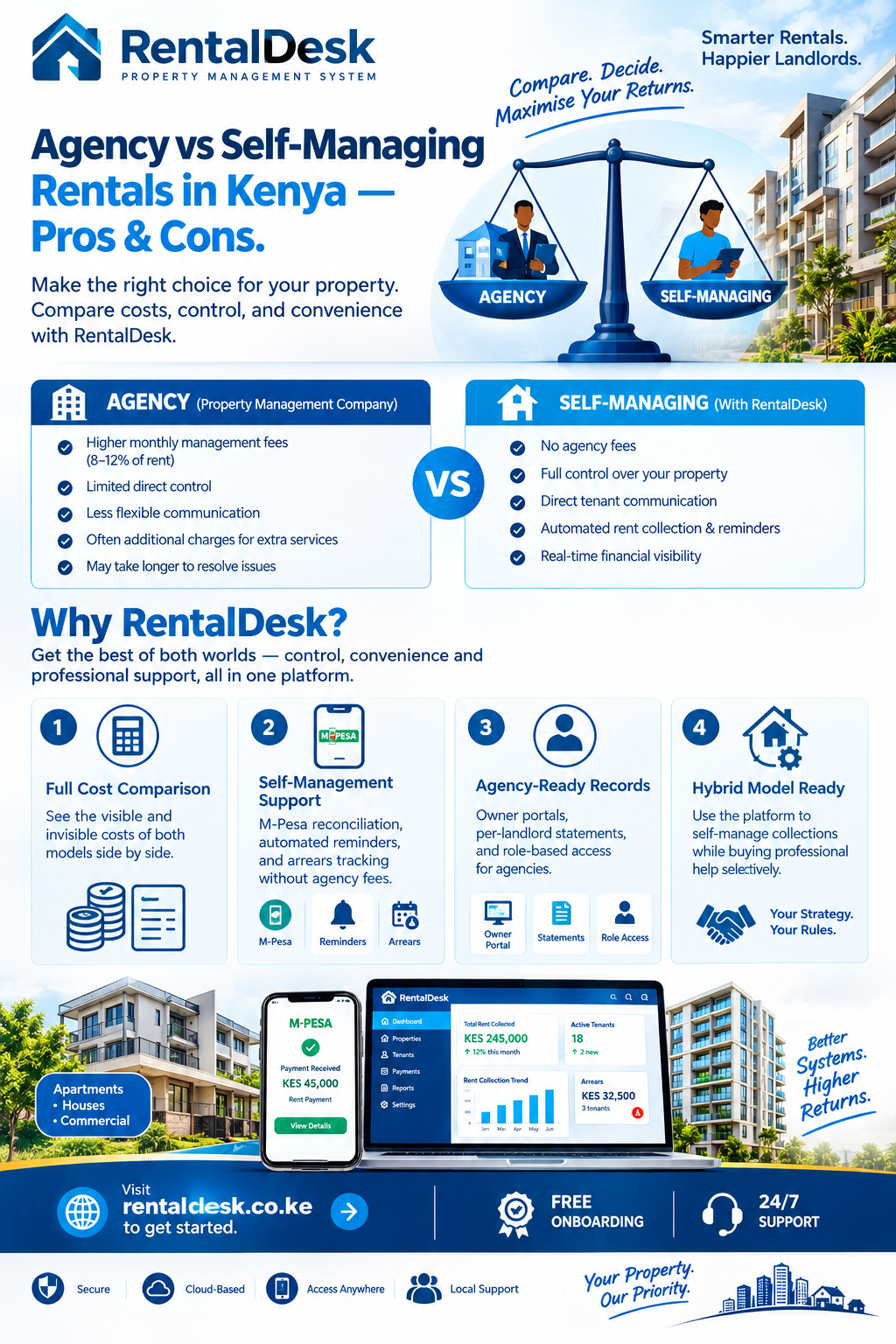
Agency vs self-managing rentals in Kenya pros & cons is the decision that determines whether your property becomes a passive income stream or a second job. It is also the decision most landlords get wrong, not because they choose the wrong option, but because they choose without understanding what each option actually demands. The agency path hands over the work and takes a percentage.
The self-managing path keeps the percentage and takes the work. Neither is universally better. The right answer depends on four variables: where you live, how many units you own, whether you have the temperament for enforcement, and whether you can maintain records that would survive a dispute. This guide examines both paths honestly, including the costs that never appear on a fee schedule.
The Real Question Behind Agency vs Self-Managing Rentals in Kenya
The conversation about agency vs self-managing rentals in Kenya pros & cons usually starts with fees. A property manager charges between 5% and 10% of gross rent monthly, plus a tenant placement fee of 50% to 100% of one month’s rent, and sometimes a lease renewal fee of 25% to 50% of one month’s rent. On a KSh 30,000 unit, that is KSh 1,500 to KSh 3,000 monthly, plus KSh 15,000 to KSh 30,000 every time a tenant changes.
Self-management avoids those fees entirely. That is the visible saving. The invisible costs are time, stress, delayed maintenance, and compounding legal risk. A landlord who spends five hours a week managing three units is effectively paying themselves a wage they never calculated. A landlord who mishandles an eviction because they did not know the law pays far more than any management fee.
The honest comparison in agency vs self-managing rentals in Kenya pros & cons is not “fee versus no fee.” It is “visible cost versus invisible cost,” and the invisible cost is usually larger than landlords estimate.
Self-Managing: What It Actually Entails
Self-management does not mean doing all the work yourself. It means being the decision-maker for all the work. The operations that must be covered include rent collection, marketing vacant units, cleaning and maintenance coordination, handling evictions, tenant screening, lease administration, and record-keeping.
Many landlords initially picture self-management as collecting rent on M-Pesa and calling a plumber occasionally. That picture omits the harder parts. Rent collection involves capturing payments, tracking arrears, managing defaults, and reconciling M-Pesa messages against tenant records. Marketing a vacant unit involves taking photographs, posting on local Facebook groups and property platforms, and responding to enquiries quickly enough to fill the unit before the void period compounds. Maintenance coordination involves finding trustworthy plumbers and electricians who will not overcharge, and supervising their work when you cannot be present.
Evictions are where self-management becomes genuinely risky. The law governs every step, and one mistake can land the landlord in court. Self-help eviction — changing locks, removing doors, disconnecting utilities — is illegal regardless of how much rent is owed, and courts have awarded punitive damages against landlords who resort to it. Any landlord considering agency vs self-managing rentals in Kenya pros & cons must weigh this legal exposure seriously.
Pros of Self-Managing Rentals in Kenya
You keep the full rent. No management fee is deducted. On a portfolio generating KSh 500,000 monthly, avoiding a 10% fee saves KSh 50,000 every month — KSh 600,000 annually. That is the single strongest argument for self-management.
You have direct control. No intermediary decides who rents your property, what repairs are approved, or how arrears are pursued. Landlords meeting the right conditions often outperform agency-managed neighbours because nobody protects an investment like its owner.
You build direct tenant relationships. You know your tenants. You understand their payment patterns. When a tenant is struggling, you hear it first-hand rather than through a manager’s summary.
You avoid agency overhead. No monthly statements to review, no fee disputes, no misalignment between your priorities and the agency’s.
You learn the business. Managing your own property teaches you tenant screening, lease enforcement, maintenance coordination, and legal compliance. That knowledge compounds across every future property you acquire.
Cons of Self-Managing Rentals in Kenya
It is time-intensive. Self-managing rental properties can be very time-consuming, especially for landlords who have other jobs, businesses, or live far from the property. A single maintenance emergency at midnight is your problem, not a manager’s.
Emotional decision-making is a real risk. The tenant who becomes a friend. The family that “just needs this month.” The boundaries that dissolve one exception at a time. Self-managing landlords who cannot enforce terms without guilt consistently underperform.
Legal exposure is higher. Evictions, deposit disputes, and lease enforcement all require knowledge of Kenyan tenancy law. A landlord who issues an invalid notice or pursues an unlawful eviction can end up paying damages rather than recovering rent.
Record-keeping is often neglected. Many owners keep only mental records, which means they lose track of arrears, deposits, and payment history. At the first dispute, tax filing, or loan application, the absence of records becomes expensive.
Absentee landlords suffer at double distance. If you live abroad or in another county, self-management means collections delegated to whoever is present, verification delegated to nobody, and the property’s reality arriving seasonally — if at all.
Using a Property Management Agency: What You Get
A professional property manager handles tenant sourcing and vetting, rent collection and remittance, maintenance coordination, financial reporting, and compliance with tenancy laws. The scope covers the operational, financial, and legal dimensions of property management.
The agency model works on incentives. Most managers charge a percentage of rent actually collected, which means they earn when you earn. That alignment matters. An agency that fails to collect rent does not get paid. An agency that loses tenants to vacancy does not get paid. The commercial incentive is to keep units occupied and rent flowing.
For diaspora landlords, the agency is not optional. Professional property management is essential when the owner cannot be physically present, because without a trusted local partner, the property is vulnerable to mismanagement, illegal occupation, and expensive neglect.
Pros of Using an Agency in Kenya
Structured rent collection and enforcement. Agencies have systems for early detection of arrears and formal enforcement procedures. Delayed enforcement encourages chronic non-payment; agencies enforce on schedule.
Better tenant quality through screening. Professional marketing and tenant screening fill vacancies faster and attract better tenants who pay market rates. Poor screening leads to rent defaults, property damage, and legal disputes.
Reduced vacancy periods. Agencies understand local rental markets and can price units accurately to minimise voids. Professional management can increase rental income by 15% to 25% through better tenant management, reduced vacancies, and proactive maintenance.
Legal protection. Professional managers understand landlord-tenant law and ensure compliance, reducing the risk of unlawful eviction claims and deposit disputes.
Remote management. For diaspora landlords, the agency is the local presence. They handle inspections, maintenance, tenant relations, and enforcement on the owner’s behalf.
Better records and reporting. Agencies provide monthly statements showing income, expenses, and occupancy. These records support tax filing, loan applications, and dispute resolution.
Cons of Using an Agency in Kenya
The fee reduces net yield. A management fee of 5% to 10% of gross rent directly reduces the landlord’s net income. On a KSh 30,000 unit, that is KSh 1,500 to KSh 3,000 monthly, or KSh 18,000 to KSh 36,000 annually.
One-off fees are substantial. Tenant placement fees of 50% to 100% of one month’s rent, and lease renewal fees of 25% to 50%, add to the cost of every tenancy change.
You lose direct control. The agency decides who rents your property, approves repairs within their authority, and handles tenant communication. Your preferences are mediated through a management agreement.
Quality varies enormously. The cheapest manager is rarely the best value. A single bad tenant or a long void period costs far more than the difference in a management rate. Choosing the wrong agency is worse than self-managing.
Contract terms can be restrictive. Notice periods, exit terms, and what is excluded from the fee all matter. A vague or verbal-only fee agreement is a red flag.
Cost Comparison: The Real Numbers
The visible cost of agency management is straightforward. The visible cost of self-management is zero. The invisible costs are where the comparison becomes honest.
| Factor | Self-Managed | Agency-Managed |
|---|---|---|
| Management fee | KSh 0 | 5–10% of gross rent |
| Tenant placement | Your time | 50–100% of one month’s rent |
| Lease renewal | Your time | 25–50% of one month’s rent |
| Time cost | 5–15 hours monthly | 1–2 hours monthly |
| Vacancy risk | Higher (slower marketing) | Lower (professional marketing) |
| Legal risk | Higher (no compliance support) | Lower (compliance expertise) |
| Record quality | Variable | Standardised |
The fee is real. But the cost of a single bad tenant, a long vacancy, or an unlawful eviction typically exceeds a full year of management fees. A landlord evaluating agency vs self-managing rentals in Kenya pros & cons should calculate the cost of their own time honestly, and then add the cost of one avoidable legal mistake.
The Hybrid Model: The Middle Path
Many successful landlords do not choose one path exclusively. They run a hybrid: self-managed collections through structured systems, with professional help bought selectively — a lawyer for lease drafting, a bookkeeper for year-end, a trusted fundi list for maintenance. The hybrid captures self-management’s economics while outsourcing its weakest points, and it is the shape most durable self-managing landlords eventually take.
A landlord with five units might self-manage rent collection using a digital platform, hire a lawyer to draft and review lease agreements, and engage an accountant for tax filing. The agency is not appointed, but professional support is bought where it matters most.
This hybrid is now easier to run because property management software provides the structure that self-managing landlords previously lacked. A platform that handles M-Pesa reconciliation, automated reminders, arrears tracking, and financial reporting gives the self-managing landlord the operational backbone of an agency without the agency fee.
Which Model Fits Which Landlord
The decision in agency vs self-managing rentals in Kenya pros & cons is not philosophical. It is situational. Four conditions determine whether self-management is viable.
Proximity. Do you live near the property or pass it routinely? If you are in the same city, self-management is practical. If you are abroad or in another county, the agency becomes essential.
Scale. A handful of units is manageable. Twenty units across three buildings is an agency’s workload. Self-management works at small scale and fails at large scale.
Structure. Do you keep records, run routines, and finish what you start? Self-management rewards discipline and punishes improvisation.
Temperament. Can you chase arrears without anger and enforce terms without guilt? The arrears conversation is where self-managing landlords most often fail.
Landlords who meet all four conditions typically outperform agency-managed properties, because nobody protects an investment like its owner. Landlords who fail any one of them should consider the agency path seriously.
Tenant Screening: The Divergence Point
Tenant screening is where the two models diverge most sharply. An agency has a standardised screening process: employment verification, income assessment, previous landlord references, and documented decision criteria. Kenyan landlords are increasingly demanding proof of employment, financial statements, and verified mobile money or bank statements before signing a tenancy agreement.
A self-managing landlord can perform the same screening, but consistency is harder. Without a documented process, decisions become impressionistic. A tenant who presents well but has a weak payment history may be accepted because the landlord has no structured way to assess risk.
RentalDesk helps both models by maintaining tenant records, payment history, and screening documentation in one place. A self-managing landlord using the platform has the same behavioural data an agency would have. The difference is who acts on it.
Legal Compliance: The Hidden Risk of Self-Management
The legal dimension is where the agency vs self-managing rentals in Kenya pros & cons decision has the highest stakes. Kenyan tenancy law includes the Rent Restriction Act for controlled residential tenancies, the Landlord and Tenant (Shops, Hotels and Catering Establishments) Act for controlled commercial tenancies, and the Distress for Rent Act for rent recovery.
Self-help eviction is illegal. Section 7 of Cap 301 prohibits landlords from evicting tenants or interfering with their tenancy outside the framework established by the Act. Any landlord who changes locks, removes doors, or disconnects utilities faces damages that typically exceed the rent owed.
An agency that understands these rules protects the landlord from costly mistakes. A self-managing landlord who has not studied the law is exposed. This is not an argument against self-management. It is an argument for legal knowledge or legal support, whichever path the landlord chooses.
The Role of Technology in Both Models
The gap between agency and self-management has narrowed because of technology. A self-managing landlord using a property management platform has access to the same operational tools an agency uses: automated M-Pesa reconciliation, automated rent reminders, digital receipts, arrears aging, and financial reporting.
RentalDesk provides this infrastructure. A self-managing landlord can collect rent through M-Pesa Paybill, reconcile payments automatically, send reminders without manual effort, generate receipts instantly, and track arrears by age. The operational burden that once justified the agency fee is substantially reduced when the system does the work.
The agency still brings tenant screening expertise, legal compliance knowledge, maintenance vendor networks, and local market intelligence. Those are real advantages. But the administrative layer — the invoicing, receipting, reconciliation, and reporting — is now available to anyone with a laptop or a phone.
Common Mistakes in the Decision
The agency vs self-managing rentals in Kenya pros & cons decision has predictable failure modes.
Choosing on fee alone. A landlord who self-manages to save 10% but loses 20% to vacancies and arrears has made a financial mistake. The fee is not the whole cost.
Choosing an agency on price. The cheapest manager is rarely the best value. A single bad tenant or long void exceeds the fee difference.
Self-managing without systems. A landlord who self-manages with a notebook and a WhatsApp account is not saving money. They are deferring costs that will surface at the first dispute or tax filing.
Failing to review the agency agreement. Vague or verbal-only fee agreements, unclear notice periods, and undefined exit terms are red flags. The agreement determines the relationship.
Refusing to switch when the model fails. A self-managing landlord who consistently struggles with arrears or maintenance should recognise the pattern and consider professional help. An agency-managed landlord whose manager consistently underperforms should review the contract and consider alternatives.
How RentalDesk Supports Both Models
RentalDesk is built for the Kenyan market and works whether you self-manage or use an agency.
For self-managing landlords. The platform provides the operational backbone: M-Pesa reconciliation, automated invoicing, rent reminders, digital receipts, arrears aging, tenant records, maintenance tracking, and financial reporting. You keep the fee and gain the structure.
For agency-managed portfolios. The platform supports multi-landlord reporting, owner portals, role-based access, and client account separation. The agency can generate per-landlord statements from verified records, and the landlord can log in to see performance without calling the agent.
For hybrid models. The landlord can self-manage collections using the platform while engaging professional support for legal drafting, tax filing, and major repairs. The system holds the records that make the hybrid work.
How to Get Started
Implementing a structured approach to agency vs self-managing rentals in Kenya pros & cons is straightforward with RentalDesk .
Step 1: Sign up. Visit RentalDesk and create your account. Choose a plan that matches your portfolio size.
Step 2: Set up your properties and tenants. Add properties, units, and tenant records with lease agreements, rent amounts, and payment schedules.
Step 3: Configure M-Pesa collection. Connect your Paybill so that payments reconcile automatically and receipts generate on receipt.
Step 4: Set the reminder ladder. Configure the timing and tone of reminders before and after the due date.
Step 5: Configure arrears tracking. Define aging buckets (1–7, 8–30, 31–60, 60+ days) and escalation thresholds.
Step 6: Run a pilot. Process one full billing period for a single property and count the manual interventions.
Step 7: Go live. Roll out to the full portfolio and review the exception queue each morning.
The Future of Property Management in Kenya
The agency vs self-managing rentals in Kenya pros & cons landscape is moving in a clear direction. Government tax infrastructure is integrating with property management platforms. M-Pesa remains the dominant collection rail. Technology is narrowing the operational gap between self-management and agency management.
The landlords who succeed will not be those who chose one path over the other on principle. They will be those who assessed their proximity, scale, structure, and temperament honestly, and chose the model that fits. RentalDesk provides the structured platform that makes either model work — giving self-managing landlords the operational backbone of an agency, and giving agency-managed portfolios the verified records that make owner reporting trustworthy.
- Agency vs self-managing rentals in Kenya pros & cons
- Agency vs self-managing rentals in Kenya pros & cons
- Agency vs self-managing rentals in Kenya pros & cons
- Agency vs self-managing rentals in Kenya pros & cons
- Agency vs self-managing rentals in Kenya pros & cons
- Agency vs self-managing rentals in Kenya pros & cons
- Agency vs self-managing rentals in Kenya pros & cons
- Agency vs self-managing rentals in Kenya pros & cons
- Agency vs self-managing rentals in Kenya pros & cons
- Agency vs self-managing rentals in Kenya pros & cons
- Agency vs self-managing rentals in Kenya pros & cons
- Agency vs self-managing rentals in Kenya pros & cons
- Agency vs self-managing rentals in Kenya pros & cons
- Agency vs self-managing rentals in Kenya pros & cons
- Agency vs self-managing rentals in Kenya pros & cons
- Agency vs self-managing rentals in Kenya pros & cons
- Agency vs self-managing rentals in Kenya pros & cons
- Agency vs self-managing rentals in Kenya pros & cons
- Agency vs self-managing rentals in Kenya pros & cons
- Agency vs self-managing rentals in Kenya pros & cons
- Agency vs self-managing rentals in Kenya pros & cons
- Agency vs self-managing rentals in Kenya pros & cons