
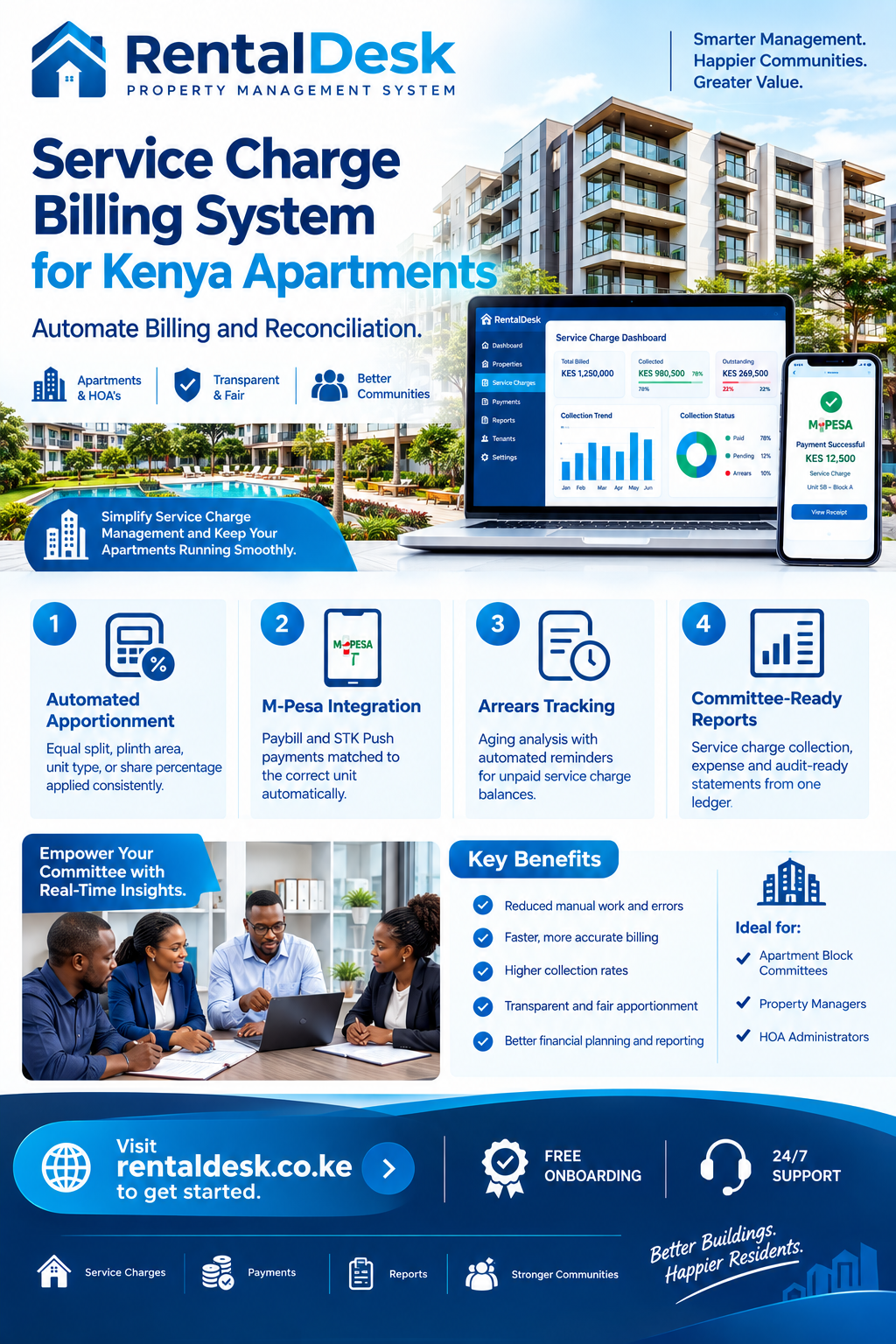
Service charge billing system for Kenya apartments is the operational backbone that determines whether a shared residential community runs smoothly or dissolves into monthly arguments about money. In an apartment block, service charge is the recurring amount each unit is billed to pay for shared costs — security, garbage collection, common-area cleaning and lighting, water and borehole running costs, lifts, landscaping, insurance, and the managing agent’s fee. It is separate from rent: rent is income for the unit’s owner, while service charge is a contribution to a common pot that is spent on the property itself and accounted for on behalf of all owners.
The difference matters because service charge money is not the landlord’s money. It is held in trust for the community. A properly implemented service charge billing system for Kenya apartments makes that distinction visible in every invoice, receipt, and reconciliation report.
Why Service Charge Billing Breaks Down in Kenyan Apartments
The conversation around a service charge billing system for Kenya apartments must begin with the failure modes that make service charge the most contentious line item in Kenyan apartment living.
Problems usually begin before year-end. The approved budget is not loaded into the billing system. Suppliers are paid under inconsistent categories. An invoice covers two buildings but is charged entirely to one. Staff change floor areas without an effective date. A new occupier is billed using the previous tenant’s dates. Vacancy treatment is applied differently by each manager. Then reconciliation becomes a reconstruction exercise. Finance exports payments, property management supplies a budget, facilities sends invoices, and leasing provides occupation dates. No one owns the complete record. The team may produce a total, but an owner, occupier, or auditor cannot trace it efficiently.
For apartment blocks specifically, the problem is compounded by density. A 48-unit apartment building in Nairobi has 48 households contributing to the same pot, 48 opinions about how it should be spent, and 48 opportunities for a billing error to become a dispute. A service charge billing system for Kenya apartments that does not maintain the source records, rules, versions, approvals, and explanations behind the arithmetic will fail at exactly the moment it is needed most.
How Service Charge Is Calculated in Kenya
The arithmetic of service charge billing is always the same three steps: agree the annual budget, divide it by an agreed basis, then divide by twelve. What estates and apartment blocks argue about is the basis — and there are only four in common use in Kenya.
Equal Split
Annual budget ÷ number of units ÷ 12. This suits courts and gated estates where the units are near-identical in size and use the same services. The risk is that owners of the smallest units subsidise the largest ones. The moment unit sizes diverge, this is the basis that produces disputes.
Plinth Area (Per Square Metre)
Annual budget ÷ total lettable area × unit area ÷ 12. This suits apartment blocks and mixed developments where a two-bedroom and a bedsitter sit in the same building. The requirement is accurate, agreed areas for every unit before you start. Re-measuring after the fact re-opens every bill you have already issued.
Per Unit Type
A published rate for each unit type — bedsitter, 1-bed, 2-bed, 3-bed. This suits estates with a handful of standard unit types, where residents want a rate they can recite. The risk is that the rates must still add up to the budget. Setting them by feel rather than from the budget is how an estate ends the year short.
Share or Unit Entitlement
Annual budget × the unit’s share percentage ÷ 12. This suits developments where sale agreements, the sectional properties register, or the management company’s articles already fix each unit’s share. The percentages are a legal document, not a committee decision. Bill the shares as written, and change them only the way the constitution allows.
A service charge billing system for Kenya apartments must support the chosen basis and apply it consistently. The choice of basis does not change what the block collects — it changes who pays it. Under an equal split, a one-bedroom owner may pay KSh 6,000 a month more than their floor area accounts for, and a three-bedroom owner pays KSh 3,000 less. That gap is the single most common cause of a service charge dispute, and it is worth settling in writing before the first invoice rather than at an AGM two years in.
The Service Charge Budget That Residents Can Read
A budget residents can read is a budget residents pay. In a Kenyan apartment block, the budget typically covers security, garbage collection, common-area cleaning and lighting, water and borehole running costs, lifts, landscaping, insurance, and the managing agent’s fee.
RentalDesk allows service charge categories to be configured separately for each apartment block. Each cost centre — security, cleaning, utilities, common-area maintenance, insurance, management costs, and planned works — is recorded with its budget amount, assumptions, and approval status. When the budget is agreed, the recurring charges are configured once and the invoices generate automatically every month.
A service charge billing system for Kenya apartments that does not itemise charges will generate disputes because residents cannot see what they are paying for. Itemisation is not a nicety. It is the transparency that makes collection possible.
M-Pesa Integration: The Collection Rail for Apartments
Kenya runs on M-Pesa, and apartment service charge collection should too. The majority of residents expect to pay service charges through mobile money. A service charge billing system for Kenya apartments must integrate directly with M-Pesa Paybill so that payments are captured and matched automatically.
RentalDesk connects to Safaricom’s Daraja API with Instant Payment Notification callbacks. When a resident pays service charge via Paybill, the system extracts the amount, phone number, account reference, and transaction ID, matches the reference to the correct unit and resident, credits the account, generates a receipt, and updates the dashboard in real time. No more manual confirmation messages. No more screenshots pasted into a WhatsApp group. No more reconciliation mysteries at month-end.
The system also supports STK Push. Residents receive a payment prompt directly on their phone when they click “Pay Service Charge” on their invoice. They enter their PIN and the payment completes. This convenience improves collection rates because it removes the friction between intention and payment.
Service Charge vs Rent: Keeping the Ledgers Separate
A service charge billing system for Kenya apartments must keep service charge separate from rent. They are legally distinct. Rent is income for the unit’s owner. Service charge is a contribution to a common pot. Mixing them in one undifferentiated ledger creates accounting confusion and, in some cases, legal exposure.
RentalDesk maintains service charge balances separately from rent balances. When a resident pays, the payment is allocated to the correct charge — service charge, water, garbage, or rent — based on the invoice. The resident statement shows both positions clearly. The property manager can see at a glance how much service charge has been collected and how much remains outstanding.
For apartment blocks where some units are owner-occupied and others are rented, the distinction is even more important. The owner-occupier pays service charge directly. The tenant pays rent to the landlord, and the landlord pays service charge from the rent collected. A service charge billing system for Kenya apartments that does not distinguish between these relationships will create reporting errors that surface at the worst possible time.
Arrears Tracking and Aging Analysis for Service Charge
Service charge arrears are the single most common financial problem in Kenyan apartment blocks. Residents who do not pay become a burden on those who do, and the block’s ability to maintain security, garbage collection, and common areas degrades.
A service charge billing system for Kenya apartments should track arrears with aging analysis, categorising balances by 1–7 days, 8–30 days, 31–60 days, and 60+ days. The longer a balance sits unpaid, the lower the probability of full recovery. The system should surface the 60+ day cases on the dashboard so the committee or manager can act on what matters rather than treating every arrears case identically.
RentalDesk provides automated arrears reports, aging analysis, and payment behaviour analysis. Residents who are behind on service charges are visible on the dashboard with their full payment history attached. The system also supports automated reminders sent via SMS and email, escalating from a friendly heads-up to a formal notice.
Automated Invoicing and Reminders for Apartment Blocks
Service charge billing is a recurring administrative task that must happen every month without fail. In a manual system, invoices are generated unit by unit. Amounts are copied from last month’s spreadsheet. Some residents are missed. Others are billed the wrong amount.
A service charge billing system for Kenya apartments automates this entirely. It generates invoices in bulk for all eligible residents based on the recurring charges configured for each unit type or plinth area. It sends the invoices via SMS, email, or the resident portal. It tracks which invoices have been paid, which are part-paid, and which are unpaid.
RentalDesk generates recurring service charge invoices automatically from the configured charge rules. The reminder ladder escalates predictably. A friendly heads-up before the due date. A neutral reminder on the day. A firmer message a day or two after. Most arrears are recovered at the first polite reminder, because most late payments are not deliberate defaults.
Utility Billing Alongside Service Charge
Many Kenyan apartment blocks manage shared utilities in addition to service charge. Water is billed to the block and then recovered from residents. Garbage collection is charged as a fixed fee. Electricity may be sub-metered. Security is a core service funded by the service charge.
A service charge billing system for Kenya apartments should handle utility billing within the same workflow. Meter readings are recorded per unit, consumption is calculated, and automated bills are generated. Where utilities are metered, the system should flag anomalies — a sudden spike in consumption might indicate a leak, and the system should surface it before the resident receives a bill they will dispute.
RentalDesk maintains utility accounts and meter readings alongside service charge accounts. The resident statement shows the complete position — service charge, water, garbage, and any other charges — so there is no ambiguity about what is owed.
Service Charge Reconciliation: The Year-End Proof
Service charge reconciliation is where the system proves whether it was working all year. At the end of the period, an authorised reviewer should be able to answer: Which cost categories were included in the approved budget? How much was billed and collected from each contributing party? Which actual expenses entered the recoverable cost pool? Which invoices, approvals, and payment records support those expenses? What allocation rule applied to each unit? How were vacancies, caps, exclusions, and part-year occupation handled? Why does each account have an additional charge, credit, or balance carried forward?
A spreadsheet can produce the arithmetic. The platform’s value is maintaining the source records, rules, versions, approvals, and explanations behind the arithmetic. RentalDesk maintains the full chain from approved budget to billed amount to collected payment to actual expense. The reconciliation report is generated from the same verified records used for daily operations. Nothing has to be rebuilt, and nothing is inconsistent between reports.
Resident Statements and Transparency
A service charge billing system for Kenya apartments must generate resident statements that show the complete payment history for each unit. The statement should show every invoice raised, every payment received, every adjustment made, and the running balance. When a resident queries their balance, the statement answers the question with evidence rather than assertion.
RentalDesk generates resident statements on demand, covering any date range. The statement shows the service charge position, utility balances, and rent (where applicable) in one document. When a dispute arises, the statement is the evidence. When a committee meeting requires transparency, the statement is the proof.
Legal Requirements for Service Charge Billing in Kenya
The service charge billing system for Kenya apartments must operate within a legal framework that governs how service charges are levied, collected, and enforced.
Service charge represents actual or genuine expenses incurred for management of common areas. A contractual obligation to pay for such services should be based on actual proof of provision of services and receipts evidencing payment against which a reimbursement can be sought. This means the billing system must maintain the supporting documentation — invoices, receipts, approvals — for every expense charged to the service charge pool.
In some apartment agreements, outstanding service monies attract interest. One case noted that Clause 16.2 provides that outstanding service monies attract 6% interest. A service charge billing system for Kenya apartments should support the configuration of interest on arrears where the agreement provides for it.
Clearance certificates are also common. One agreement required that no shareholder would be allowed to sell and transfer their property until a Clearance Certificate of all Service Charge paid in full is obtained from the Management Committee. A billing system that can generate a clearance certificate showing the service charge position for any unit is a practical requirement for apartment blocks where units are sold and transferred.
Role-Based Access for Apartment Committees
A service charge billing system for Kenya apartments must enforce role-based access, because apartment blocks involve multiple stakeholders with different information needs. The committee needs financial reports. The manager needs operational data. The caretaker needs task lists. The resident needs their own statement.
RentalDesk allows different permissions for committee members, property managers, caretakers, and residents. Each user sees only what their role requires. A caretaker may need to see which units are behind so they can follow up. They do not need to see the total service charge collected or the expense breakdown. A committee member may need to see the full financial position. A resident sees only their own account.
Every action taken within the system is logged with a timestamp and user identification. If a dispute arises about how service charge money was handled, the committee can demonstrate who accessed the records and when.
Common Implementation Mistakes
The service charge billing system for Kenya apartments journey has predictable failure modes. Migrating unclean data — disputed balances, inconsistent unit numbering, incorrect plinth areas — means the invoices generated from it will be disputed. Failing to define the apportionment basis before billing means residents in identical units pay different amounts. Skipping the parallel run means configuration issues are discovered in production rather than in a controlled test. Turning off reminders means the automation ends at the invoice. Leaving the ledger disconnected from M-Pesa reconciliation means the balance the resident sees does not match the balance the committee holds.
How RentalDesk Delivers Service Charge Billing for Kenya Apartments
RentalDesk is built specifically for the Kenyan market, and service charge billing sits at the centre of the platform.
Charge rule configuration. Service charge categories are configured per apartment block, with the apportionment basis — equal split, plinth area, unit type, or share percentage — applied consistently.
Bulk invoice generation. Invoices are generated for all eligible units automatically each billing period, based on the configured charge rules.
M-Pesa integration. Service charge payments via Paybill and STK Push are captured and matched to the correct unit automatically, with real-time reconciliation.
Utility billing. Meter readings are recorded per unit, consumption is calculated, and automated bills are generated alongside service charge.
Arrears tracking. Balances are categorised by age (1–7, 8–30, 31–60, 60+ days) with dashboard visibility and automated reminders.
Resident portal. Residents can view their service charge balance, download receipts, see invoices, receive announcements, and submit maintenance requests.
Committee reporting. Service charge collection reports, income versus expense reports, arrears summaries, and audit-ready financial statements are generated from verified records.
Role-based access. Committee members, managers, caretakers, and residents see only what their role requires, with every action logged.
How to Get Started
Implementing a service charge billing system for Kenya apartments is straightforward with RentalDesk .
Step 1: Sign up. Visit RentalDesk and create your account. Choose a plan that matches your apartment portfolio size.
Step 2: Define the apportionment basis. Agree whether service charge will be split equally, by plinth area, by unit type, or by share percentage, and record it in writing.
Step 3: Set up units and residents. Add each apartment unit, its plinth area or unit type, and the current resident or owner.
Step 4: Configure service charge categories. Create the cost centres — security, cleaning, utilities, lifts, insurance, management — with their budget amounts.
Step 5: Configure M-Pesa collection. Connect your Paybill so that service charge payments reconcile automatically.
Step 6: Run a pilot billing cycle. Process one full month for a single block and confirm that invoices, calculations, and receipts are correct.
Step 7: Go live. Roll out to the full apartment portfolio and review the arrears aging report each month.
The Future of Service Charge Billing in Kenya
The service charge billing system for Kenya apartments landscape is moving toward greater transparency and digitisation. The Sectional Properties Act, 2020, empowers owner corporations to use digital platforms for voting and communication. Government tax infrastructure is integrating with property management platforms. And residents increasingly expect the same digital convenience from their apartment block that they get from every other service provider.
The apartment blocks that adopt a structured service charge billing system early will not simply have tidier records. They will have higher collection rates, fewer disputes, stronger committee governance, and a community that trusts the numbers.
RentalDesk provides the structured platform that makes a service charge billing system for Kenya apartments work — not as a collection of spreadsheets held together by memory, but as a governed operating model with automated billing, M-Pesa reconciliation, and committee-ready reporting.
- Service charge billing system for Kenya apartments
- Service charge billing system for Kenya apartments
- Service charge billing system for Kenya apartments
- Service charge billing system for Kenya apartments
- Service charge billing system for Kenya apartments
- Service charge billing system for Kenya apartments
- Service charge billing system for Kenya apartments
- Service charge billing system for Kenya apartments
- Service charge billing system for Kenya apartments
- Service charge billing system for Kenya apartments