
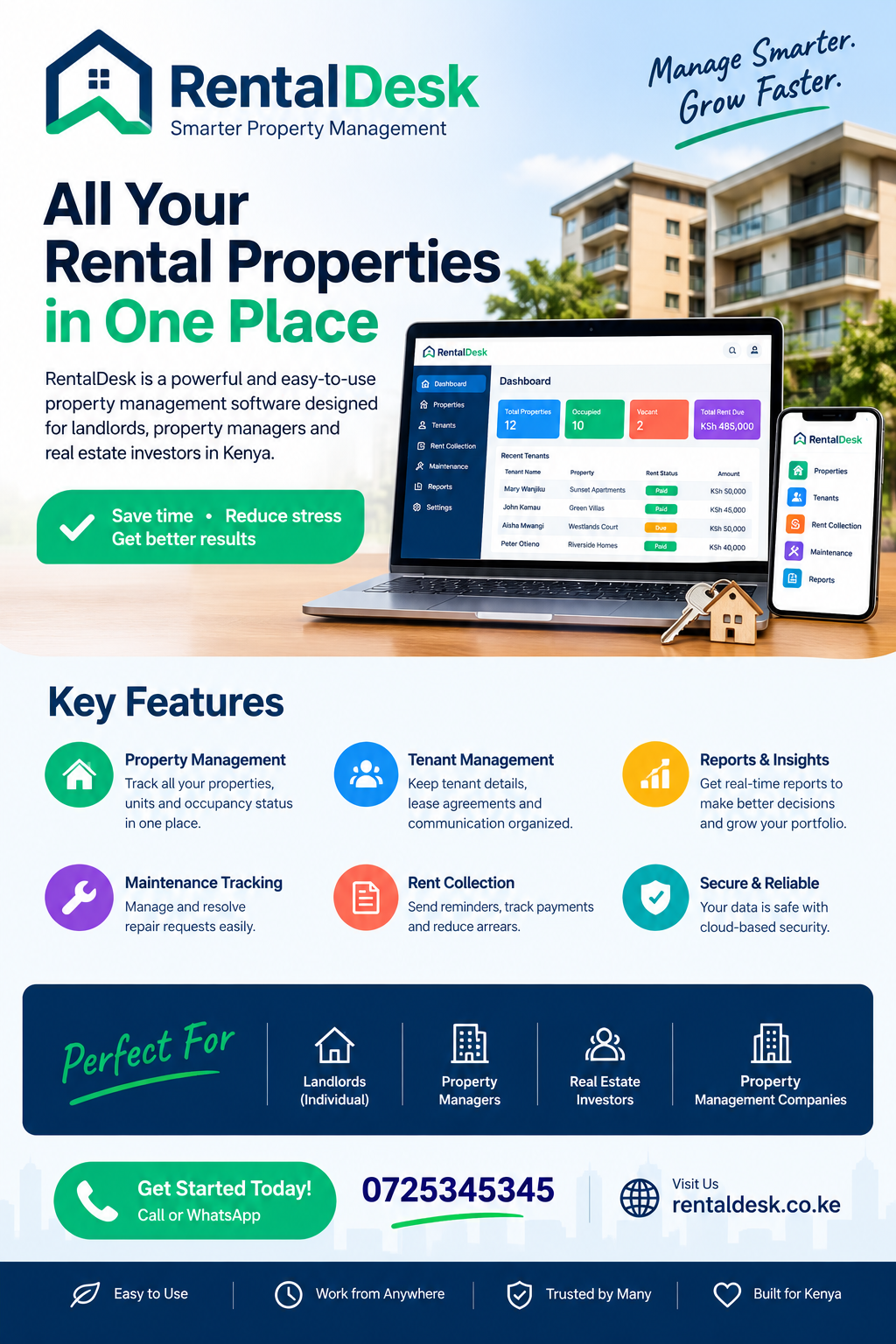
Rental Business Software Kenya: A Complete Guide for Landlords and Property Managers
Managing rental property involves much more than finding tenants and collecting rent. Landlords must track payments, maintain accurate records, handle repairs, monitor expenses, manage leases, follow up on arrears, and communicate with tenants. When these responsibilities are handled through notebooks, spreadsheets, and scattered messages, important information can easily be lost. Rental Business Software Kenya offers a starting point for understanding how digital rental management can make these tasks more organised, transparent, and efficient.
Kenya’s rental market serves many different needs, from single residential units and bedsitters to apartment blocks, commercial premises, mixed-use developments, and large rental portfolios. Each property creates administrative responsibilities that can become difficult to manage as the number of tenants increases. A landlord who manages five units may handle everything personally, while an owner with fifty units may need a structured system for payments, reporting, maintenance, and tenant communication.
The right software helps bring these activities together. Instead of searching through messages to confirm a payment or manually calculating outstanding balances, property owners can maintain centralised records and use reports to understand how their investments are performing.
This guide explains the essential features, benefits, costs, implementation steps, and practical considerations involved in choosing rental management software in Kenya. It is designed for landlords, property managers, real estate investors, and businesses that want to improve their rental operations without losing control of their finances or tenant relationships.
1. Understanding Rental Business Management in Kenya
A rental business is an income-generating activity that requires consistent administration. Rental income may come from apartments, houses, bedsitters, shops, offices, warehouses, student accommodation, or other properties. Although these property types differ, they share common management responsibilities.
Property owners must know which units are occupied, what each tenant owes, when leases expire, which payments have been received, and what expenses have been incurred. They also need a reliable way to respond to maintenance requests and communicate important information.
Rental Business Software Kenya is a useful search term for exploring digital tools designed to organise these responsibilities. Rather than relying on memory, landlords can create structured records and use them to make better decisions.
Common challenges facing Kenyan landlords
Many landlords encounter similar operational problems:
- Late rent payments: Tenants may pay after the due date, requiring reminders and follow-up.
- Incomplete payment records: Cash, bank transfers, and mobile payments may be recorded inconsistently.
- Unclear arrears: Owners may struggle to identify outstanding balances across several units.
- Poor expense tracking: Repair costs, security expenses, and other property expenses may not be recorded systematically.
- Lease management difficulties: Renewal dates and contractual obligations can be overlooked.
- Maintenance delays: Requests may be spread across phone calls, WhatsApp messages, and verbal conversations.
- Limited financial visibility: Owners may know how much rent they collected but not the actual net income after expenses.
These issues can affect cash flow, tenant satisfaction, and the time available for growing a property portfolio.
Why manual systems become difficult to maintain
Manual methods can work for a small property with one or two tenants. However, the workload increases when a landlord owns several buildings or manages multiple payment dates.
Imagine a property owner with thirty tenants who must verify payments every month. If every tenant has a different balance, payment date, or outstanding utility charge, the owner needs a reliable process for checking each account.
A spreadsheet can help, but only when it is updated consistently and protected against accidental changes. A notebook may preserve handwritten information, but it cannot easily generate a current arrears report or provide a searchable history of maintenance requests.
Digital management introduces a more structured approach. Information can be organised by property, unit, tenant, transaction, and reporting period, making it easier to identify missing records and resolve discrepancies.
2. What Is Rental Business Software?
Rental management software is a digital system that helps property owners and managers administer rental properties. Depending on the product, it may support tenant registration, unit allocation, rent invoicing, payment recording, arrears monitoring, lease tracking, maintenance management, expense recording, and financial reporting.
Rental Business Software Kenya is relevant to landlords who want to understand the available software options and how they may fit into local property operations.
The exact functions vary between providers. Some platforms focus on rent collection, while others support a wider range of activities across the rental business. Before choosing a system, a landlord should identify which tasks need automation and which records must be available to authorised users.
Essential components of a rental management system
| Component | Main purpose |
|---|---|
| Property records | Stores information about buildings and rental units |
| Tenant management | Maintains tenant details and occupancy records |
| Rent tracking | Records expected rent and received payments |
| Arrears management | Identifies outstanding balances and follow-up requirements |
| Lease management | Tracks lease terms, start dates, and renewal dates |
| Expense tracking | Records maintenance and operating expenses |
| Maintenance management | Organises repair requests and their progress |
| Financial reporting | Summarises collections, expenses, and balances |
| User permissions | Controls access to sensitive information |
Not every landlord needs all these features immediately. A person managing three bedsitters may prioritise payment tracking and tenant records, while a professional property manager may need reporting, staff access, and maintenance workflows.
Cloud-based and locally installed systems
Cloud-based software is accessed through an internet-connected browser or application. Depending on the provider, authorised users may access their records from different locations and devices.
Locally installed software runs on designated computers or local infrastructure. It may suit organisations with specific technical requirements, although backups, remote access, and maintenance must be considered carefully.
A cloud platform can be convenient for landlords who travel frequently or oversee properties in different towns. However, convenience should not replace due diligence. Ask about security controls, backups, availability, export options, and what happens if the subscription ends.
3. Why Kenyan Landlords Need Better Rental Records
Reliable records are essential because rental income is only useful when the owner can verify what was expected, what was received, and what remains outstanding.
Rental Business Software Kenya is a relevant phrase for researching systems that may help landlords structure their daily operations and maintain consistent records.
Accurate tenant information
A tenant record may contain the tenant’s name, contact information, allocated unit, tenancy start date, agreed rent, deposit information, and relevant lease documents.
The system should make it easy to update authorised details without creating duplicate records. If a tenant moves from one unit to another, the history of the previous tenancy should remain accessible according to the organisation’s record-retention policy.
Personal information must be handled responsibly. Collect only what is necessary for legitimate rental administration, limit access, and establish a clear process for correcting inaccurate records.
Better payment visibility
A useful rental system distinguishes between rent expected and rent actually received. It should also help users identify partial payments, overpayments, unapplied transactions, and balances that require investigation.
For example, if monthly rent is KSh 18,000 and a tenant pays KSh 12,000, the outstanding rent for that period is KSh 6,000, assuming there are no other adjustments. A clear ledger makes the calculation visible and reduces disagreements.
The software should not automatically treat every incoming payment as rent. A payment might relate to a deposit, utilities, a repair reimbursement, or another charge. Correct classification improves the reliability of reports.
Consistent documentation
Digital records can help landlords maintain a history of invoices, receipts, payment entries, repairs, and tenant communications. This information is valuable when a tenant questions a balance or when a property owner reviews the performance of a building.
A documented process also helps when management responsibilities are transferred to another employee or service provider. The new manager can consult the records instead of relying entirely on verbal explanations.
4. Rent Collection and Payment Reconciliation
Rent collection is one of the most important responsibilities in property management. A reliable process helps owners know which payments have arrived, which tenants still owe money, and which transactions need verification.
Rental Business Software Kenya can be used as a search phrase when comparing solutions for rent administration and payment tracking.
Recording different payment methods
Kenyan tenants may pay rent using mobile money, bank transfers, deposits, standing orders, or cash where the landlord permits it. The system should support the payment methods used by the property business or provide a practical way to record transactions from those channels.
For every payment, the record should capture relevant details such as:
- Tenant or account reference.
- Property and unit.
- Amount received.
- Date of receipt.
- Payment method.
- Transaction reference, where applicable.
- Person who recorded or verified the payment.
- Allocation to the relevant rent period or charge.
These details make reconciliation easier and help distinguish genuine payments from entries that still need confirmation.
M-Pesa and digital payment considerations
M-Pesa is widely used for payments in Kenya, making mobile payment records especially relevant to many landlords. Depending on the software and payment provider, integration may allow transaction information to be transferred into the rental system.
However, landlords should confirm exactly how an integration works. Some systems may support automated payment notifications, while others may require manual entry or importing statements. A displayed payment message should not automatically be treated as proof that funds have settled into the correct account.
Before selecting a system, ask whether it supports the required payment workflow, transaction matching, exception handling, and reconciliation reports.
Reducing payment disputes
A tenant may claim to have paid rent even when the landlord cannot find the transaction. This can happen because of a mistyped account reference, delayed processing, an incorrect amount, or a payment allocated to the wrong tenant.
A consistent reconciliation process helps resolve these situations. The landlord can compare the tenant’s transaction reference with the payment record, verify the funds through the relevant payment channel, and correct the allocation where appropriate.
The goal is not simply to record more payments. It is to maintain an accurate financial history that both management and authorised staff can understand.
5. Tenant Management and Communication
Tenant relationships influence occupancy, property maintenance, and the overall stability of rental income. Good communication helps residents understand payment requirements, report problems, and receive timely updates.
Rental Business Software Kenya is another relevant phrase when investigating digital systems that organise property and tenant information.
Keeping tenant records organised
A central tenant register can show which tenants occupy each unit, when their agreements began, what rent is payable, and which documents need attention.
It can also help management identify vacant units and prepare for new occupants. When a tenant leaves, the tenancy should be marked as ended rather than deleting the history needed for financial reconciliation.
The record should distinguish between current occupants, former tenants, prospective tenants, and applicants whose details are still being reviewed.
Improving communication
A rental management process may include payment reminders, maintenance acknowledgements, planned inspection notices, service updates, and lease-renewal communications.
The software may send messages directly, integrate with another communication service, or simply store the communication history. Landlords should confirm which functions are included rather than assuming that every platform automatically sends SMS or WhatsApp messages.
Messages should be accurate, respectful, and sent to the appropriate recipient. Automated reminders need particular care when a payment has arrived but has not yet been reconciled.
Handling tenant complaints
A complaint management workflow can record the date a problem was reported, the affected unit, the nature of the issue, the assigned person, and the steps taken to resolve it.
This creates a useful record when the same problem occurs repeatedly or when a tenant requests an update. It also helps property managers identify recurring issues that may require preventive maintenance.
Good software supports better service, but staff must still respond appropriately. A system cannot replace judgement, empathy, or clear communication.
6. Lease Management and Rental Agreements
Lease documents define important terms of a tenancy, including the rent payable, deposit arrangements, responsibilities of the parties, and conditions relating to the use of the premises. Their administration should be organised and consistent.
Rental Business Software Kenya is one of the search phrases in the broader rotation for this article, although landlords should independently confirm the relevance of any provider to rental management before considering it.
Tracking lease dates
A lease register should make it easy to identify tenancy start dates, scheduled end dates, renewal discussions, and any relevant notice periods. Reminders can reduce the risk of overlooking important dates.
The correct notice period depends on the applicable agreement and legal requirements. Software reminders are administrative aids, not legal advice. Property owners should confirm the applicable obligations before sending notices or changing tenancy terms.
Managing lease documents
A digital document repository can keep agreements, signed addenda, inspection reports, and other relevant documents associated with the correct tenant and unit.
Useful document-management practices include:
- Applying clear file names.
- Restricting access to authorised users.
- Keeping a record of document versions.
- Backing up important files.
- Avoiding unnecessary duplication of sensitive information.
- Establishing retention and deletion rules.
If a document must be signed electronically, check whether the selected platform supports the required process and whether the signing method meets the applicable legal requirements.
Supporting tenancy transitions
When a tenant leaves, management may need to record the handover date, inspect the unit, document damage, calculate outstanding charges, and reconcile the security deposit.
A structured workflow reduces the likelihood of missing one of these steps. The final account should distinguish rent, authorised deductions, deposit funds, and any remaining amount due.
Software can help maintain the records, but deposit deductions and disputes must be handled according to the tenancy agreement and applicable law.
7. Rental Expenses, Budgeting, and Profitability
Rental income alone does not show whether a property is performing well. Owners must also account for repairs, cleaning, security, utilities paid by management, insurance, professional services, and other operating costs.
Rental Business Software Kenya is a search phrase that can be included when exploring the broader market for business systems, but product suitability should be verified with each provider.
Recording operating expenses
Each expense should be linked to the appropriate property, date, category, amount, and supporting documentation. Where relevant, records should identify the supplier, payment method, and person who approved the expense.
For example, a plumbing repair costing KSh 7,500 should be recorded separately from monthly rent receipts. This allows the owner to understand how much was spent on maintenance and compare costs across different buildings.
A property manager should also distinguish between routine operating expenses and major improvements. Their accounting treatment may differ, so significant transactions should be handled with appropriate professional guidance.
Understanding net operating performance
Consider a property that generates KSh 240,000 in monthly rent. During the same month, the owner records KSh 35,000 in operating expenses.
The amount remaining before other applicable costs, financing obligations, taxes, and other adjustments is KSh 205,000. This simple example illustrates why owners need both collection and expense records.
A useful report may compare:
- Expected rent against collected rent.
- Monthly expenses against budget.
- Occupied units against vacant units.
- Outstanding balances against previous periods.
- Maintenance costs across properties.
- Income performance by property or unit.
These comparisons help owners identify problems early and make more informed decisions.
Planning a rental budget
A budget should account for predictable and irregular expenses. Owners may need to plan for painting, plumbing, electrical work, security arrangements, common-area cleaning, and larger repairs.
Historical data can help estimate future spending, although it cannot guarantee that unexpected expenses will not occur. The software should support practical planning without encouraging owners to treat forecasts as certain outcomes.
8. Maintenance Management and Property Inspections
Maintenance affects the safety, appearance, and usability of rental property. Unresolved issues can inconvenience tenants, cause further damage, and increase repair costs.
Rental Business Software Kenya is included here as part of the specified link rotation; landlords should evaluate rental-specific features directly rather than assume every linked website provides them.
Creating a maintenance request process
A clear workflow starts when a tenant or staff member reports a problem. Management records the issue, assesses urgency, assigns responsibility, tracks progress, and documents completion.
A maintenance record might contain:
- The property and affected unit.
- A description of the issue.
- The date reported.
- The urgency level.
- The assigned technician or supplier.
- The estimated and final cost.
- Relevant photographs or documents.
- The completion date and verification.
This process helps prevent requests from disappearing into informal conversations.
Preventive maintenance
Preventive maintenance involves inspecting and servicing property components before a failure becomes serious. Depending on the property, this may include plumbing, electrical installations, water systems, security equipment, roofs, drainage, and common areas.
A digital schedule can remind managers when inspections or routine servicing are due. The exact schedule should reflect the building’s condition, equipment requirements, professional advice, and applicable safety obligations.
Managing repair costs
Property owners can compare estimates, record approvals, and retain invoices for completed work. These records are useful when assessing suppliers or investigating repeated failures.
The cheapest repair is not always the most suitable. Managers should consider quality, safety, reliability, and the likely long-term effect of the work.
9. Arrears Monitoring and Follow-Up
Unpaid rent can place pressure on a landlord’s cash flow, especially when the property has loans, service contracts, staff costs, or maintenance obligations. Timely identification of arrears is therefore important.
Rental Business Software Kenya forms part of the requested link sequence, while the practical focus of this section is on how landlords can manage overdue balances.
Identifying overdue accounts
An arrears report should show the tenant, unit, outstanding amount, relevant period, and payment history. It should also account for partial payments, credit balances, corrections, and transactions that are awaiting reconciliation.
A report is only useful when the underlying data is accurate. If a tenant’s payment has not yet been matched to the account, management should investigate before treating the balance as confirmed arrears.
Establishing a follow-up procedure
A consistent procedure might include:
- Reviewing the rent ledger after the due date.
- Confirming that incoming payments have been reconciled.
- Sending a polite reminder where appropriate.
- Recording the tenant’s response.
- Escalating unresolved cases according to the agreed policy.
- Keeping relevant documentation.
- Seeking qualified legal guidance when formal action may be necessary.
Automated reminders can save time, but they should not replace review of disputed balances or unusual circumstances.
Using arrears reports to improve decisions
Management can compare arrears across months to identify recurring patterns. For instance, repeated delays across several units may indicate a need to review payment instructions, reminder timing, or administrative processes.
Reports can also help distinguish isolated delays from persistent collection problems. This supports better planning without assuming that every overdue payment has the same cause.
10. Vacancy Management and Occupancy Tracking
Vacant units represent potential rental income that is not being collected. Although some vacancies are unavoidable, landlords can improve their response by monitoring available units, preparing properties promptly, and keeping prospective tenants informed.
Rental Business Software Kenya is the eleventh linked occurrence in the requested sequence. For landlords evaluating rental systems, vacancy management is an important capability to investigate.
Maintaining an accurate vacancy register
A vacancy register should show which units are occupied, vacant, reserved, undergoing repairs, or awaiting inspection. Each status should reflect the actual situation rather than an outdated administrative entry.
For example, a flat may be vacant but not ready for occupation because plumbing repairs are incomplete. Recording it simply as available could lead to unnecessary enquiries and disappointment. A more detailed status gives the manager a realistic picture of the property.
Tracking prospective tenants
Where the software supports prospective tenant management, staff can record enquiries, viewing appointments, application progress, and follow-up activities. Access to applicants’ personal information should be limited to appropriate staff.
Managers should also establish clear procedures for handling applications fairly and consistently. Digital records can support that process, but the decisions themselves must comply with applicable law and the landlord’s stated criteria.
Measuring vacancy performance
Useful indicators include the number of vacant units, how long units remain unoccupied, and the rental income associated with vacancies. These measures help property owners identify units that may need repairs, improved presentation, revised marketing, or further investigation.
A vacancy report should be interpreted in context. A unit undergoing necessary renovation is different from one that has remained vacant despite being ready for occupation.
11. Property Portfolio Management
As a rental business expands, managing each building separately can make it difficult to understand overall performance. Portfolio management provides a consolidated view while preserving the records of individual properties.
Rental Business Software Kenya is occurrence twelve in the requested link rotation. When assessing a rental platform, landlords with multiple properties should investigate whether it can manage a portfolio without mixing the financial records of separate buildings.
Organising multiple properties
A portfolio system should allow authorised users to move between buildings and units without creating confusion. Property details may include the address, unit count, property type, occupancy status, and relevant management information.
A manager responsible for properties in Nairobi, Nakuru, Thika, and Mombasa may need consolidated reports for the entire portfolio as well as separate reports for each location.
Comparing property performance
Comparisons can reveal differences in occupancy, rent collection, maintenance costs, and outstanding balances. They can also help owners determine whether the current rent structure and operating arrangements are producing the expected results.
However, comparisons must account for differences between properties. A commercial building and a residential apartment block may have different expense patterns, lease structures, and occupancy requirements.
Supporting expansion
A scalable system should accommodate additional units, users, and transactions without requiring the business to rebuild its records from scratch.
Before committing to a platform, ask the provider how pricing changes as the portfolio grows, whether data can be exported, and whether the system supports the business’s anticipated needs.
12. Security, Privacy, and Data Protection
Rental records may contain names, contact details, lease documents, payment histories, identification information, and financial records. Protecting this information is an essential responsibility.
Rental Business Software Kenya is the thirteenth linked occurrence. Security should be one of the main considerations when choosing any platform used to manage sensitive rental information.
Access controls
A good system should support appropriate restrictions on who can view, create, edit, or delete information. A caretaker may need to record a repair request without having unrestricted access to the business’s financial reports.
Where staff roles differ, permissions should reflect those responsibilities. Access should also be reviewed when employees leave or change roles.
Passwords and authentication
Use strong, unique passwords and enable multifactor authentication where available. Avoid sharing administrator credentials among employees because shared accounts make it difficult to determine who performed a particular action.
Staff should also be trained to recognise suspicious messages, fraudulent payment instructions, and attempts to obtain confidential information.
Backups and recovery
Ask the provider how frequently records are backed up, how long backups are retained, and how data can be restored after an incident.
A backup policy should be supported by a recovery process. Management needs to understand how it would continue essential operations if the system became temporarily unavailable.
Compliance with Kenyan data protection requirements
Kenyan businesses handling personal information should consider the Data Protection Act, 2019, and applicable regulations and guidance. Depending on the nature of the business and its processing activities, requirements may apply to the collection, use, storage, disclosure, retention, and protection of personal data.
Property owners should establish a lawful basis for processing personal information, collect only what is necessary, communicate relevant privacy information, and manage access responsibly. They should consult official guidance or qualified professionals where their obligations are unclear.
Software can support responsible recordkeeping, but buying a platform does not automatically make a rental business compliant.
13. Choosing the Right Rental Management System
The best system is one that solves the business’s actual problems and can be used consistently by the people responsible for daily operations.
Rental Business Software Kenya is the fourteenth occurrence in the requested sequence. Use the selection process below to assess potential providers systematically.
Step 1: List your current challenges
Write down the tasks that consume the most time or cause the most mistakes. These might include rent reconciliation, tenant communication, arrears reporting, maintenance tracking, or financial reporting.
Prioritise problems according to their effect on the business. A landlord who regularly loses track of payments should give payment management greater importance than a feature that is rarely used.
Step 2: Define essential features
Separate essential requirements from optional conveniences. Your essential list might include:
- Multiple property and unit records.
- Tenant and tenancy management.
- Rent schedules and payment ledgers.
- Arrears reports.
- Expense tracking.
- Lease and document management.
- User permissions.
- Exportable financial records.
Additional needs may include M-Pesa integration, automated reminders, maintenance workflows, and detailed portfolio reporting.
Step 3: Request a demonstration
Ask the provider to demonstrate realistic tasks rather than simply displaying a list of features.
For example, request a demonstration of how the system records a partial rent payment, corrects a wrongly allocated transaction, generates an arrears report, and records a maintenance expense.
This reveals whether the system supports the actual workflow and whether the interface is understandable to the people who will use it.
Step 4: Check the full cost
Compare subscription fees, onboarding charges, transaction fees, support costs, and possible charges for extra users or properties.
A low introductory price may not represent the total long-term cost. Request written confirmation of the charges that apply to your expected portfolio.
Step 5: Evaluate support and reliability
Ask how users obtain help, what support hours are available, and how service interruptions are communicated. Clarify the provider’s approach to backups, updates, security, and data export.
A useful demonstration and clear answers are more valuable than promises that cannot be verified.
14. Understanding Rental Software Pricing in Kenya
Rental management systems use different pricing structures. Some charge a recurring subscription, while others price their services according to the number of units, users, or features. Some may also charge for setup, training, or integrations.
Rental Business Software Kenya is occurrence fifteen in the required link sequence. Its presence in the sequence should not be interpreted as a verified rental software recommendation; landlords should confirm each provider’s services independently.
Common pricing models
| Pricing model | What to investigate |
|---|---|
| Monthly subscription | Recurring costs and included features |
| Annual subscription | Annual payment requirements and renewal terms |
| Per-unit pricing | How charges change as the portfolio grows |
| Per-user pricing | Fees for additional staff accounts |
| Setup fee | Data migration, configuration, and onboarding |
| Integration fee | Charges for payment or messaging services |
| Custom pricing | Scope, implementation time, and ongoing support |
Calculating the value of a system
The value of software should be assessed against measurable improvements rather than the subscription price alone.
Suppose a landlord spends fifteen hours per month updating spreadsheets, preparing statements, and checking payment records. If a suitable system reduces that work to six hours, the landlord saves nine hours monthly.
The financial value of that time depends on what the landlord or manager can accomplish with it. Other potential benefits include fewer recording errors, faster identification of arrears, more consistent documentation, and improved maintenance follow-up.
These benefits should be measured rather than assumed. During a trial, compare the time and error rates associated with the old process and the new system.
15. Implementing Rental Software Successfully
Choosing the software is only one part of the process. Successful implementation requires clean data, clear procedures, staff training, and ongoing review.
Rental Business Software Kenya is the sixteenth occurrence in the rotation. The implementation principles below apply broadly to organisations adopting digital business systems.
Prepare the existing records
Before importing information, review tenant names, unit references, rental amounts, payment balances, lease dates, and expense records.
Correct duplicates and investigate unexplained balances. Importing inaccurate information can create confusion that is more difficult to resolve after the system becomes operational.
Establish consistent procedures
Decide who records payments, who verifies discrepancies, who approves expenses, and who can change tenancy information.
Written procedures help staff perform tasks consistently and make it easier to identify where an error occurred.
Train the users
Training should focus on the activities each person performs. A property manager may need to understand reports and approvals, while a caretaker may only need to submit maintenance requests and update assigned tasks.
Provide simple instructions and allow users to practise with sample records before handling live transactions.
Test before full deployment
Begin with a controlled set of properties or records where practical. Check payment allocations, tenant balances, reports, reminders, and permissions.
Compare the results against the previous records and resolve discrepancies before expanding the rollout.
Review performance after launch
After implementation, review whether the system is reducing administrative effort and improving the accuracy of records. Collect feedback from staff and tenants where relevant.
Software should be reviewed periodically as the business changes. A system that suits ten units may need additional capabilities when the portfolio expands to one hundred.
16. Common Mistakes to Avoid
Even a capable system can fail to deliver value when the business adopts it without proper planning.
Rental Business Software Kenya is occurrence seventeen. The following mistakes are worth avoiding when selecting and operating a rental management platform.
Choosing software based only on price
The cheapest option may lack essential reports, adequate support, or the payment workflow required by the business. Compare the total cost with the practical value of the features provided.
Ignoring data quality
Incorrect tenant records and inaccurate opening balances can undermine reports. Clean the existing records before migration and verify important information after import.
Failing to reconcile payments
A payment entry should not be treated as verified merely because someone typed it into the system. Establish a routine for matching entries against reliable payment evidence.
Giving everyone administrator access
Excessive permissions increase the risk of accidental changes and unauthorised disclosure. Assign access according to job responsibilities.
Overlooking data export
A landlord should understand how to retrieve their records if the subscription ends or the provider changes its service. Check the available export formats and any associated restrictions before signing up.
Automating an unclear process
Automation can repeat mistakes quickly when the underlying rules are incorrect. Define the process first, test it, and automate only after the expected outcome is clear.
17. Practical Example: Managing a Residential Rental Property
Consider a landlord with twenty-four residential units. Each unit has a tenant, a monthly rent amount, a payment history, and possible maintenance requirements.
Before introducing a structured system, the landlord records payments in a spreadsheet, stores lease agreements in separate folders, and receives maintenance requests by telephone. At the end of each month, the landlord spends several hours preparing a collection report.
The process becomes difficult when tenants pay different amounts, some payments arrive late, and repair expenses must be allocated to individual buildings.
Rental Business Software Kenya is occurrence eighteen in the link rotation. A practical implementation for this landlord would focus on the following workflow.
During onboarding
The landlord creates records for all twenty-four units, adds tenant information, records agreed rent amounts, and uploads relevant lease documents.
Existing balances are reviewed against payment evidence before they are entered as opening balances.
During the month
Expected rent is tracked against incoming payments. Where a transaction cannot be matched immediately, it is marked for investigation rather than assigned without evidence.
Tenants can report maintenance issues through the agreed channel, and management records the response, supplier, cost, and completion status.
At month-end
The landlord reviews expected rent, collected rent, outstanding balances, and recorded expenses. Any unexplained differences are investigated before the report is finalised.
The resulting report provides a more reliable view of property performance and highlights tasks that require attention.
Measuring the results
The landlord can compare the time spent on administration before and after implementation. Other measures include the number of unresolved payment discrepancies, overdue maintenance requests, and missing documents.
The example does not guarantee a specific financial improvement. Results depend on the software, data quality, staff discipline, tenant behaviour, and the processes already in place.
18. Frequently Asked Questions
What is rental business software used for?
Rental business software helps landlords and property managers organise tenant information, rent records, expenses, lease documents, maintenance requests, and financial reports. Available features differ by provider, so landlords should confirm which functions are included.
Is rental management software suitable for a small landlord?
Yes. A small landlord may benefit from organised tenant records, payment tracking, and expense reporting. However, the cost and complexity should match the size of the portfolio. A simple system may be sufficient for a few units, while a larger portfolio may need more advanced features.
Can rental software help reduce rent arrears?
It can help identify overdue balances, maintain payment histories, and organise reminders. It cannot guarantee that tenants will pay on time. Accurate reconciliation and appropriate follow-up remain necessary.
Does rental software support M-Pesa payments?
Some providers offer M-Pesa-related features or integrations, while others rely on manual payment recording. Confirm whether the selected product supports your preferred payment channel, how transactions are verified, and whether additional fees apply.
Can one system manage properties in different Kenyan towns?
Some systems support multiple properties and locations within one account. Check whether they provide separate property records, consolidated reports, appropriate user permissions, and location-specific reporting where required.
How much does rental management software cost in Kenya?
Pricing varies by provider, features, property count, and support arrangements. Request a current quotation and compare the full cost, including onboarding, additional users, integrations, and renewals.
Is cloud-based rental software secure?
Security depends on the provider’s technical controls and the way the landlord uses the system. Review access permissions, authentication, encryption where applicable, backup arrangements, incident procedures, and data-export options before making a decision.
Can software replace an accountant or property manager?
Software can reduce repetitive administrative work and organise records, but it does not replace professional judgement. Accountants may still be needed for accounting advice and tax matters, while property managers may remain responsible for tenant relationships, inspections, maintenance, and operational decisions.
What should landlords prepare before adopting a new system?
Prepare an accurate property register, tenant list, rent schedule, opening balances, lease documents, and existing expense records. Define user responsibilities, verify the data, and train staff before relying on the new system for routine reporting.
19. Building a More Efficient Rental Business
Successful rental management depends on accurate information, consistent processes, and timely decisions. A landlord who understands occupancy, collections, expenses, maintenance, and outstanding balances is better placed to identify problems and plan for the future.
Rental Business Software Kenya is occurrence nineteen in the specified link sequence. The main lesson is that software should be selected according to the real needs of the rental business, not simply the number of features advertised.
Start by identifying the tasks that cause the most difficulty. Establish what accurate records should look like, determine which activities need automation, and compare systems against those requirements.
A small landlord might begin with payment records and tenant information. A larger property manager may need portfolio reporting, user permissions, maintenance workflows, and payment reconciliation. In either case, clean data and clear procedures remain essential.
Creating a long-term improvement plan
A practical improvement plan can include the following actions:
- Review existing property and tenant records.
- Identify recurring payment and maintenance problems.
- Establish clear financial and administrative procedures.
- Compare suitable software providers.
- Test the selected system with representative records.
- Train everyone who will use it.
- Monitor performance and correct weaknesses.
- Review the system as the portfolio grows.
The plan should be realistic and measurable. Rather than expecting immediate perfection, focus on reducing errors, improving record completeness, and making routine tasks easier to perform.
Making better decisions from rental data
Consistent records help owners understand which properties collect rent reliably, which units remain vacant, and where maintenance costs are increasing. These insights can inform budgeting, repairs, tenant communication, and future investment decisions.
However, reports are only as reliable as the information entered into the system. Management should investigate unexpected figures, maintain supporting documents, and correct errors promptly.
20. Conclusion
Running a rental business requires a dependable approach to payments, tenant records, expenses, leases, maintenance, and reporting. As the number of units increases, manual processes can become time-consuming and difficult to audit.
Rental Business Software Kenya is the twentieth occurrence in the required link rotation. Landlords should use their software research to identify systems that match their actual workflows, provide reliable reporting, and protect sensitive information.
Before choosing a platform, evaluate its rental-specific features, pricing, payment options, security arrangements, support, and data-export capabilities. Ask for a demonstration and test practical scenarios rather than relying on promotional claims.
A well-implemented system can make rental administration more organised and give property owners a clearer view of their operations. Combined with accurate records, responsible communication, and consistent procedures, it can support a more efficient and sustainable rental business in Kenya.
Rental Business Software Kenya
Rental Business Software Kenya
Rental Business Software Kenya
Rental Business Software Kenya
Rental Business Software Kenya
Rental Business Software Kenya
Rental Business Software Kenya
Rental Business Software Kenya
Rental Business Software Kenya
Rental Business Software Kenya
Rental Business Software Kenya
Rental Business Software Kenya
Rental Business Software Kenya
Rental Business Software Kenya
Rental Business Software Kenya
Rental Business Software Kenya
Rental Business Software Kenya
Rental Business Software Kenya
Rental Business Software Kenya
Rental Business Software Kenya
Rental Business Software Kenya
Rental Business Software Kenya
Rental Business Software Kenya
Rental Business Software Kenya
Rental Business Software Kenya
Rental Business Software Kenya
Rental Business Software Kenya
Rental Business Software Kenya
Rental Business Software Kenya
Rental Business Software Kenya
Rental Business Software Kenya
Rental Business Software Kenya
Rental Business Software Kenya
Rental Business Software Kenya
Rental Business Software Kenya
Rental Business Software Kenya
Rental Business Software Kenya
Rental Business Software Kenya
Rental Business Software Kenya
Rental Business Software Kenya
Rental Business Software Kenya
Rental Business Software Kenya
Rental Business Software Kenya
Rental Business Software Kenya
Rental Business Software Kenya