
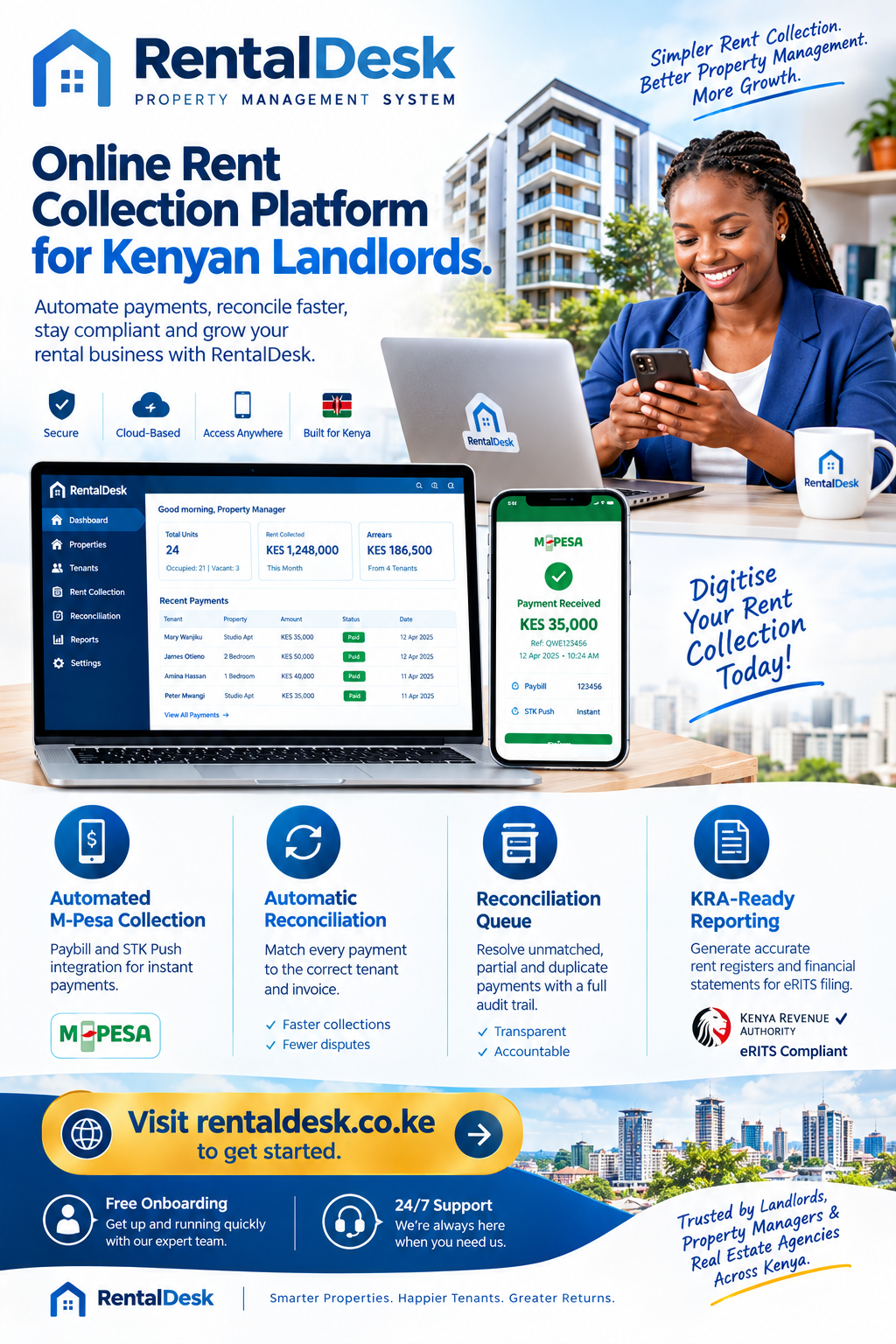
Online rent collection platform is the infrastructure that turns a tenant’s M-Pesa payment into a reconciled entry in your rent ledger without manual intervention. In Kenya, where over 90% of rent payments in urban areas flow through M-Pesa, the platform you choose determines whether rent collection is a fifteen-minute morning routine or a monthly administrative ordeal.
Most landlords still run the second version. A 2023-2024 Real Estate survey by the Kenya National Bureau of Statistics found that just 47.2 percent of real estate agents in Kenya use rent collection software, which means the majority are still matching digital payments with analogue methods. This guide explains what an online rent collection platform actually does, how the Kenyan payment rails work, and how RentalDesk connects collection to reconciliation, documentation, and compliance in one system.
What an Online Rent Collection Platform Actually Does
An online rent collection platform is not a payment link. It is the collection layer of a property management system, and it performs four distinct functions that must work together.
Initiation. The platform prompts the tenant to pay. This can happen through an invoice link, an SMS reminder, a tenant portal, or an STK Push prompt sent directly to the phone. The initiation channel determines how much friction the tenant experiences.
Capture. The platform receives the payment confirmation. For M-Pesa, this arrives as a C2B (Customer to Business) callback from Safaricom’s Daraja API, containing the amount, sender phone number, account reference, transaction ID, and timestamp. This happens in seconds, with no polling or manual checking required.
Matching. The platform compares the account reference against tenant and unit records. If the reference matches, the payment posts to the correct ledger. If it does not, the payment enters an exception queue. This is where most manual operations fail, because matching requires the payment details, the tenant record, and the invoice to be connected in one place.
Documentation. The ledger is updated, a receipt is generated, and the balance is recalculated. The payment stops being a transaction and becomes part of the property’s financial record.
An online rent collection platform that captures payments but does not reconcile them has solved half the problem. A platform that reconciles but does not document will still generate disputes. The complete solution connects all four functions.
The M-Pesa Rails: Paybill, STK Push, and Till
An online rent collection platform in Kenya is built on M-Pesa, and M-Pesa offers three collection products. Each tells a different story for reconciliation.
M-Pesa Paybill is the dominant rail for rent collection because it carries an account reference field. The tenant enters the Paybill number, then an account number—ideally their unit number—and the amount. When the payment completes, Safaricom fires a C2B callback containing that account reference. This is what enables automatic matching. Paybill is the correct foundation for any landlord who intends to automate reconciliation.
M-Pesa STK Push is the proactive version of M-Pesa. Instead of waiting for the tenant to open the M-Pesa menu, the platform sends a payment prompt directly to the tenant’s phone. The tenant enters their PIN and the payment completes. STK Push is particularly effective for reminders because the payment prompt is embedded in the reminder itself. The tenant does not need to remember the Paybill number or the account reference. They simply confirm the prompt.
M-Pesa Till Number is built for retail. The customer is not identified because in a till transaction it usually does not matter. For rent, a Till means the landlord must reconcile by phone number, by amount, or by asking the sender for a reference. Till Numbers have no account reference field, which makes automatic matching impossible. For any landlord serious about an online rent collection platform, Paybill is the appropriate choice.
The choice of rail is not merely technical. It determines whether the platform becomes an automated system or a digital version of the same manual process.
Why the Account Reference Is Everything
An online rent collection platform lives or dies by the account reference. When a tenant pays via Paybill, the reference is the only field that identifies who paid. A correct reference produces instant, automatic reconciliation. A wrong reference produces an exception that must be resolved manually.
Tenants do not always type their unit number correctly. “A3” might arrive as “a3”, “A 3”, “Unit A3”, or “apt3”. A production-grade platform normalises the reference before matching: trimming whitespace, converting to uppercase, removing special characters, and stripping prefixes like “UNIT” or “APT”. Without this normalisation layer, even well-intentioned tenants generate unmatched payments.
This is why standardising the reference format and communicating it in every lease and reminder is the single highest-leverage action a landlord can take before implementing any online rent collection platform. If tenants type “A12”, “a12”, “A 12”, “Apt 12” and “12A”, matching will fail. Standardise the format and communicate it repeatedly.
How Automated Reconciliation Works
An online rent collection platform becomes powerful when payments reconcile automatically. The mechanism is simpler than it sounds, but it depends on clean data and consistent references.
When a tenant pays via M-Pesa Paybill, Safaricom sends a C2B callback to the platform. The platform extracts the amount, phone number, account reference, and transaction ID. It looks up the account reference against tenant and unit records. If the reference matches, the payment posts to the correct invoice and the tenant’s balance updates in real time. A receipt is generated automatically. The dashboard reflects the change within seconds.
This happens without any manual intervention. The landlord does not need to check an M-Pesa message, open a spreadsheet, or ask the tenant for clarification. The platform has done the work.
RentalDesk implements this through Safaricom’s Daraja API with Instant Payment Notification (IPN) callbacks. When a tenant pays, the platform extracts the amount, phone number, account reference, and transaction ID, matches the account reference to the correct tenant and unit, credits the tenant account, generates a receipt, and updates the dashboard in real-time.
An online rent collection platform works best when the account reference is standardised and the platform includes fuzzy matching logic to handle variations. Without this, even a well-configured system will generate exceptions that consume staff time.
The Four Reconciliation Failures Every Platform Must Handle
An online rent collection platform will always generate exceptions. A payment will arrive with a wrong reference. A tenant will pay twice. A spouse will pay from their own phone. The quality of the platform is best judged by how it handles four predictable failure modes.
Missing or wrong reference. The payment arrives with no usable account number. The platform should surface it in a reconciliation queue rather than guessing. RentalDesk provides a clear dashboard of unmatched payments where authorised staff can match the payment correctly using the phone number, amount, and timing.
Partial payment. A tenant pays KSh 15,000 against a KSh 25,000 charge. The platform should post the partial amount against the open invoice and leave the balance open for follow-up. This is not just an accounting nicety. A tenant who has paid part of the rent should not be treated as fully unpaid.
Duplicate payment. The tenant paid twice, often because they did not receive a receipt the first time. A competent platform detects duplicates by transaction ID and flags them rather than auto-posting. RentalDesk detects duplicates and routes them for review, preventing overpayments from distorting the ledger.
Third-party payment. A spouse, parent, or employer pays on behalf of the tenant. The phone number does not match the tenant record. The platform should allow authorised staff to assign the payment to the correct tenant with a full audit trail recording who resolved the exception and when.
An online rent collection platform that handles the straightforward payments but loses the exceptions in a manual queue is not a complete solution. The exception process must be as structured as the routine process.
Bank Integration Beyond M-Pesa
An online rent collection platform should not treat M-Pesa as the only rail. Commercial tenants, corporate leases, and diaspora landlords often pay by bank transfer. A complete platform integrates directly with bank APIs to capture deposits and match them to invoices without relying on SMS messages or manual statement downloads.
RentalDesk integrates directly with APIs from top Kenyan banks including Equity, KCB, Co-operative Bank, Stanbic, and Standard Chartered. When tenants pay rent via bank transfer, the system captures the deposit and reconciles it against invoices. Every transaction is timestamped and preserved in an immutable ledger for audit readiness.
An online rent collection platform therefore extends beyond mobile money to include the full payment landscape. A landlord who collects via M-Pesa and bank transfer needs a system that handles both in the same ledger, without fragmenting reconciliation across two processes.
The Reconciliation Queue: Where Good Platforms Prove Themselves
An online rent collection platform will always generate exceptions. The question is not whether exceptions occur. It is how the platform handles them.
A well-designed reconciliation queue shows the payment details—amount, phone number, transaction ID, timestamp—alongside a list of possible matches. Authorised staff can assign the payment to the correct tenant in one action. The platform records who resolved the exception and when. This audit trail is what allows a landlord to defend the ledger if a dispute arises months later.
RentalDesk provides this reconciliation queue as a core feature. Unmatched, unclear, or duplicate payments are reviewed in the queue, and the resolution is logged. Every step is recorded in real time inside the dashboard. The platform also handles partial payments by posting them against the open invoice and leaving the balance open for follow-up.
Reminders, Receipts, and the Tenant Experience
An online rent collection platform is not only about the landlord’s convenience. It is about the tenant experience. The best platforms make payment effortless and confirmation immediate.
RentalDesk sends SMS or email reminders before and after rent due dates. The reminder ladder typically runs from a friendly heads-up several days before the due date, to a neutral reminder on the day, to progressively firmer messages after the due date. Automated reminders have been shown to improve on-time payment rates significantly, because most late payments are not deliberate defaults. They are forgotten payments, misaligned paydays, or simple omissions.
The receipt is equally important. RentalDesk issues digital receipts automatically once payment is verified, sent via SMS, WhatsApp, or email. The receipt includes the transaction ID, payment date and time, amount paid, and outstanding balance. This eliminates the “I paid” versus “I didn’t receive it” disputes that consume disproportionate time in manual operations.
An online rent collection platform improves the tenant relationship because it removes ambiguity. The tenant knows what they owe, knows when it is due, receives a prompt when payment is required, and receives confirmation when payment is made. The landlord knows who has paid, who has not, and what remains outstanding. Both parties are working from the same verified record.
Reporting and Compliance
An online rent collection platform produces data as a by-product of normal operations. That data is valuable for two purposes: managing the property and complying with KRA.
RentalDesk generates rent collection reports, income versus expense reports, arrears ageing reports, occupancy reports, and audit-ready financial statements. These reports are drawn from the same verified records used for daily operations, which means the numbers are consistent and defensible.
For KRA compliance, the Monthly Rental Income (MRI) tax applies to residential rental income between KES 288,000 and KES 15 million annually, at 7.5% of gross income. The tax is due by the 20th of the month following the month in which rent was received. The Kenya Revenue Authority’s Electronic Rental Income Tax System (eRITS) is designed to integrate with property management platforms, and accurate online rent collection records make filing straightforward.
An online rent collection platform therefore supports compliance as a by-product. A landlord with clean digital records can populate their MRI return accurately and avoid penalties associated with inaccurate or late filings.
Setting Up an Online Rent Collection Platform
Implementing an online rent collection platform follows a structured path.
Step 1: Confirm your Paybill. If you already have an M-Pesa Paybill, the platform can connect to it. If you do not, the platform guides you through the application process. A Paybill is essential for automatic reconciliation because it carries the account reference field.
Step 2: Standardise the account reference. Decide on a format that identifies both the property and the unit. For multi-property portfolios, use a prefix: “KIL-A12” for Kilimani building A unit 12. Communicate this format in every lease and every reminder.
Step 3: Connect the platform. RentalDesk connects your Paybill via Safaricom’s Daraja API. Payments made via M-Pesa reflect automatically, and the system matches each payment to the correct tenant or account.
Step 4: Configure reminders and receipts. Set up the reminder ladder and receipt delivery preferences. Automatic receipts should be issued for every verified payment.
Step 5: Run a pilot. Load a small property and process live payments. Reconcile a full month end to end and count the manual interventions. That number predicts your monthly workload.
Step 6: Train your team. Ensure everyone who touches payments understands the reconciliation queue and the exception process.
Step 7: Go live. Once the pilot validates the workflow, roll out to the full portfolio.
Common Mistakes When Adopting an Online Rent Collection Platform
An online rent collection platform journey has predictable failure modes.
Using a Till instead of a Paybill. A Till has no account reference field, which makes automatic matching impossible. If automation is the goal, Paybill is the foundation.
Letting tenants use inconsistent references. If tenants type “A12”, “a12”, “A 12”, “Apt 12” and “12A”, matching will fail. Standardise the format and communicate it repeatedly.
Treating the M-Pesa SMS as the ledger. A message proves money moved. The ledger explains why it moved and what remains due. The ledger is the authoritative record.
Reconciling at month-end instead of daily. A payment with a wrong reference sits unresolved for three weeks, and the tenant becomes anxious. Daily reconciliation resolves exceptions while they are fresh.
Allowing uncontrolled edits. If anyone can alter a balance, accountability is weak. Role permissions and audit trails help management identify who posted or adjusted a transaction.
How RentalDesk Delivers as an Online Rent Collection Platform
RentalDesk is built specifically for the Kenyan market, and rent collection is at the core of the platform.
M-Pesa Paybill and STK Push. RentalDesk captures every payment automatically, matches it to the correct tenant and unit, and updates the balance in real time.
Bank API integration. Deposits from Equity, KCB, Co-operative, Stanbic, and Standard Chartered are captured and reconciled.
Reconciliation queue. Unmatched, partial, and duplicate payments are flagged for review with a full audit trail.
Automatic receipts. Digital receipts are issued instantly via SMS, WhatsApp, or email.
Reminders and invoicing. The collection layer is connected to automated invoicing and the reminder ladder.
Reporting. Rent collection reports, arrears ageing, owner statements, and KRA-ready financial statements are generated from the same verified records.
Role-based access. Caretakers, managers, and accountants see only what they need to see.
Cloud access. RentalDesk is accessible from anywhere, which makes it suitable for diaspora landlords and multi-location portfolios.
The Financial Case for an Online Rent Collection Platform
An online rent collection platform pays for itself in three ways.
Time. A landlord managing 30 units who reconciles manually spends 4–6 hours per month on reconciliation alone. At 50 units, it becomes a half-day exercise that repeats monthly. A platform reduces that to minutes.
Arrears. Automated reminders and a frictionless payment path improve on-time payment rates. A property management company in Nairobi took over a distressed property with a rent collection rate of 55%. After implementing automated M-Pesa reconciliation and arrears workflows, the collection rate improved to 94% within four months.
Compliance. Accurate rent records are now a KRA requirement. A platform that reconciles every payment and produces clean reports makes eRITS filing straightforward and reduces the risk of penalties.
Real-World Impact of an Online Rent Collection Platform
An online rent collection platform has delivered measurable results for Kenyan landlords.
A Lavington landlord managing 25 residential units reduced arrears from 35% to 7% after implementing automated reminders and a structured collection platform. That translated to a KES 280,000 monthly reduction in outstanding rent and a KES 3.36 million annual improvement in cash flow.
A Mombasa agency reduced vacancy from 18% to 6% in six months, generating an extra KSh 3.2 million in annual revenue from the same buildings. Agencies that adopt integrated systems see a 20–30% lift in gross rental income within the first year.
These results come from treating the platform as an operating system, not a payment link. The platform captures the payment. The ledger explains it. The reports prove it.
How to Get Started with RentalDesk
Implementing an online rent collection platform is straightforward with RentalDesk .
Step 1: Sign up for RentalDesk. Visit RentalDesk and create your account. Choose a plan that matches your portfolio size. The Free Lite plan supports one property with up to five units; Starter covers up to 99 units; Estate Manager supports 100–999 units.
Step 2: Set up your properties. Add your properties, units, and tenants to the system. Include all relevant details—tenant contact information, lease agreements, rent amounts, and payment schedules.
Step 3: Configure M-Pesa collection. Set up M-Pesa Paybill or STK Push for rent collection. RentalDesk provides step-by-step guidance for this process.
Step 4: Activate automated reconciliation. Turn on payment matching, receipt generation, and the reconciliation queue.
Step 5: Establish your daily routine. Review new payments and clear the unmatched queue each morning. This takes minutes, not hours.
Step 6: Generate reports. Use RentalDesk reports for month-end close, owner reporting, and KRA filing.
Step 7: Train your team. Ensure everyone who touches payments understands the reconciliation workflow and the exception process.
The Future of Online Rent Collection in Kenya
An online rent collection platform is evolving rapidly in Kenya. M-PESA Ratiba, Safaricom’s standing order feature, allows tenants to set up automatic recurring payments directly from their M-PESA wallets. The M-Pesa Mini App now features rent payment services, and the Kenya Revenue Authority’s eRITS system is designed to integrate with property management platforms.
The direction is clear. An online rent collection platform in Kenya is moving from a collection channel to a complete operating system. The landlords who adopt it early will have lower arrears, faster reconciliation, better tenant relationships, and a compliance position that withstands scrutiny.
RentalDesk provides the structured platform that makes this possible—not just as a payment method, but as a fully reconciled, documented, and reportable financial system.