
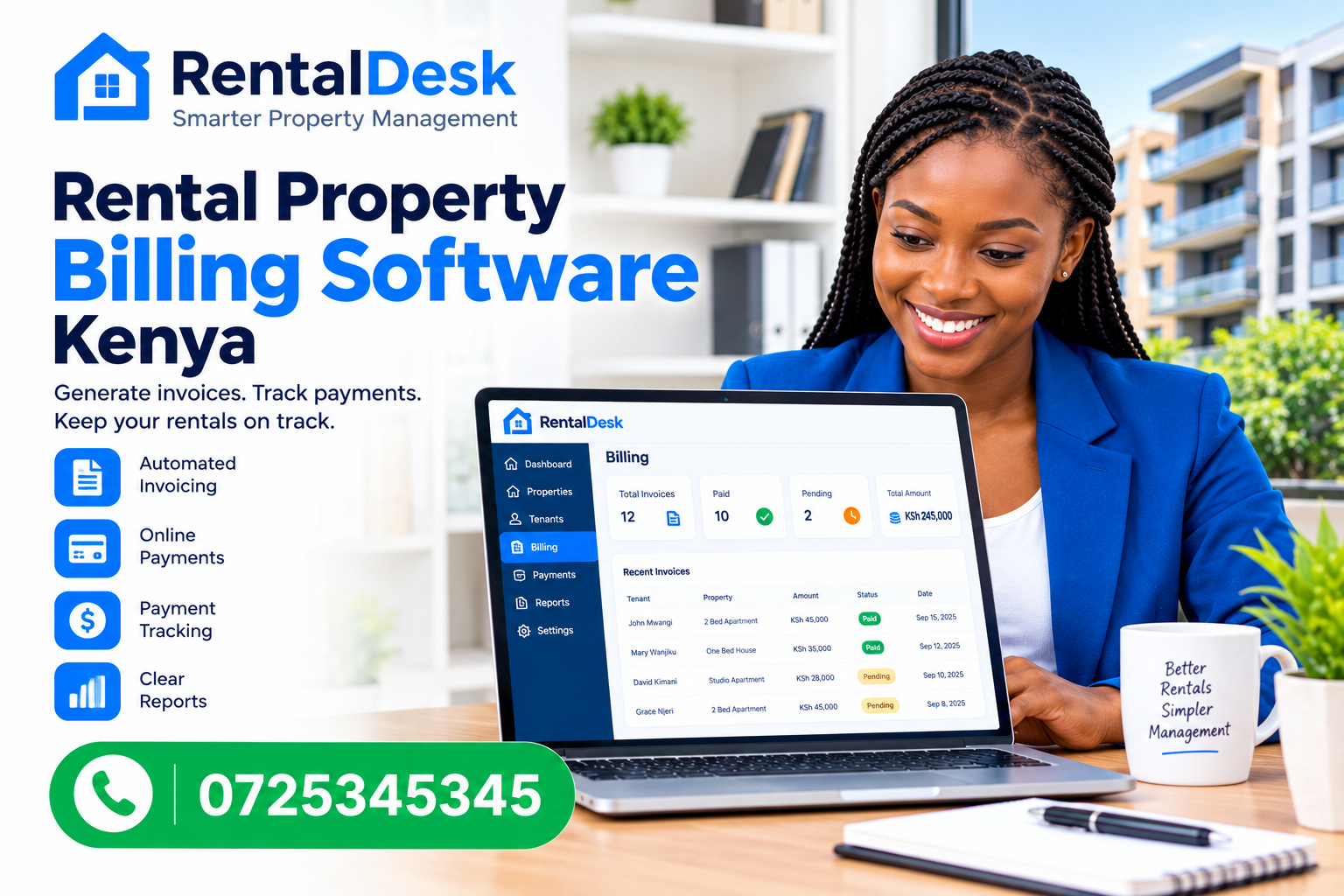
Rental Property Billing Software Kenya: A Practical Guide for Landlords and Property Managers
Managing rental properties involves much more than collecting rent at the end of every month. Landlords and property managers have to prepare tenant bills, track payments, issue receipts, follow up on arrears, manage different rental units, maintain accurate records and prepare financial reports. Rental Property Billing Software Kenya provides a structured way to manage these activities from one system. For Kenyan landlords, property managers, agencies and businesses managing several units, this type of software can reduce manual work and make rental billing easier to organize.
A property business may begin with a few tenants and simple spreadsheets. As the number of units increases, however, billing becomes more complicated. Different tenants may have different rent amounts, payment dates, utility charges, parking fees, service charges or other recurring charges. Tracking everything manually can make it difficult to know which tenants have paid, which invoices remain outstanding and how much income a property generated during a particular period.
This guide explains how rental property billing works, why billing accuracy matters, the features to look for in billing software, how automation can improve rent collection, and how landlords can choose a suitable solution for their operations. It also examines practical considerations for Kenyan property businesses, including M-Pesa payments, tenant statements, arrears management, reporting and record keeping.
What Is Rental Property Billing Software?
Rental Property Billing Software Kenya is a digital system designed to help landlords and property managers create, organize and monitor financial charges associated with rental properties. Instead of preparing every bill manually, users can configure properties, units, tenants, rental rates and recurring charges within a centralized system.
The software can then help generate bills based on the information stored in the system. Depending on the features available, it may also support invoices, receipts, payment records, tenant statements, outstanding balances and financial reports.
For a property manager, billing software is particularly useful because rental income usually involves recurring transactions. A tenant may owe monthly rent, parking charges, utility costs or other approved charges. Keeping these records separately in notebooks, spreadsheets, mobile messages and bank statements can create unnecessary administrative work.
Rental Property Billing Software Kenya brings these billing activities into one organized workflow. Property managers can maintain information about tenants and units while keeping billing records connected to the relevant property.
The objective is not simply to create an invoice. A good billing system should help answer important questions such as:
- Which tenants have been billed?
- Which tenants have paid?
- Which invoices are still outstanding?
- How much rent is overdue?
- Which properties generated the most income?
- What payments were received during a specific period?
- Which tenant account has an outstanding balance?
- How much revenue is expected from recurring rent?
These answers become increasingly important as a rental portfolio grows.
Why Rental Billing Matters to Kenyan Landlords
Rental Property Billing Software Kenya can be particularly useful for landlords and property managers handling multiple tenants. Rental income is often one of the most important financial activities in a property business, so inaccurate billing or incomplete records can affect cash-flow visibility.
Consider a property containing 40 rental units. If every tenant is billed manually each month, the property manager has to confirm the correct rent amount, prepare bills, record payments, issue receipts and identify outstanding balances. If some tenants pay through M-Pesa while others use bank transfers or other methods, reconciliation becomes another task.
A centralized system provides a clearer process.
The manager can maintain tenant information, configure rental charges and record payments against the appropriate accounts. When a tenant makes a payment, the transaction can be associated with the correct tenant and invoice, depending on the system’s available payment features.
Rental Property Billing Software Kenya can therefore support better financial organization without requiring a property manager to maintain several disconnected records.
The Problems Caused by Manual Rental Billing
Manual billing is not automatically wrong. A landlord with a very small number of units may manage the process successfully using simple tools. Problems often appear when the volume of transactions increases.
1. Repetitive data entry
Preparing the same information every month takes time. Rent amounts, tenant names, unit numbers and billing dates may need to be entered repeatedly.
Rental Property Billing Software Kenya can reduce repetitive work by keeping property and tenant information in a structured database.
2. Calculation errors
A small mistake in a rent amount or additional charge can result in an incorrect tenant bill. Correcting the error later may require additional communication and record updates.
3. Difficulty tracking arrears
When payment records are scattered across spreadsheets and messages, identifying overdue accounts can take longer. A billing system can provide a clearer view of outstanding balances.
4. Poor visibility across properties
A landlord managing several buildings may need to combine information from multiple spreadsheets to understand total rental income. Centralized reporting makes this process easier.
5. Delayed reporting
Property owners may need monthly or annual reports. Manually compiling these reports can consume valuable administrative time.
Rental Property Billing Software Kenya can help organize billing information so that reports can be produced from records already stored in the system.
Key Features to Look For
When evaluating Rental Property Billing Software Kenya, landlords should focus on features that solve actual billing and property management problems rather than choosing software based only on the number of features advertised.
Tenant billing
The core function should make it easy to generate charges for individual tenants. The system should allow users to associate a tenant with a specific property or rental unit.
Recurring rent charges
Recurring billing is one of the most useful features for rental businesses. Monthly rent charges can be generated according to configured rental terms instead of requiring the manager to recreate each charge manually.
Invoice management
A property manager should be able to create and monitor invoices. An invoice record can show the tenant, unit, billing period, amount due and payment status.
Payment tracking
Rental Property Billing Software Kenya should make it possible to record payments and connect them to the correct tenant account.
Receipts
Once payment has been recorded, tenants may require proof of payment. Digital receipts can provide a more organized record than handwritten receipts.
Tenant statements
Tenant statements provide a history of charges and payments. They can be useful when answering questions about outstanding balances or previous transactions.
Arrears tracking
The system should make overdue balances easy to identify. Arrears tracking can help managers prioritize follow-ups.
Property and unit records
Billing should be connected to the property structure. A system should allow managers to distinguish between properties, buildings, floors and individual units where appropriate.
Reporting
Reports can help owners understand rent collected, outstanding balances and other financial information.
Rental Property Billing Software Kenya becomes more useful when billing is connected to these wider property management activities.
Automating Monthly Rent Billing
Monthly billing is one area where automation can have an immediate operational impact.
Suppose a property manager has 80 units. At the beginning of each month, the manager needs to bill every occupied unit. Some tenants may have different rental rates. Others may have additional recurring charges.
With a manual process, the manager may prepare a spreadsheet, check the tenant list, calculate charges and send bills individually.
With Rental Property Billing Software Kenya, recurring billing information can be organized within the system. Once the relevant rent and tenant details have been configured, the manager can use the software’s billing workflow to produce the necessary charges.
Automation does not eliminate the need for oversight. Managers should still review billing records, confirm changes in rental agreements and investigate unusual transactions. The benefit is that routine work can be standardized.
Managing Different Rental Charges
Not every tenant account is identical.
A commercial tenant may have a different billing arrangement from a residential tenant. One apartment may include parking while another tenant pays separately for a parking space. Some properties may have utility-related charges or other approved costs.
Rental Property Billing Software Kenya can help organize different charges when the software supports configurable billing items.
For example, a tenant account could contain:
| Charge | Example |
|---|---|
| Monthly rent | KSh 35,000 |
| Parking | KSh 3,000 |
| Utility charge | Based on usage |
| Other approved charge | Based on agreement |
| Total | Calculated by the system |
The exact charges depend on the tenancy agreement and property arrangement. Software should support the way a business actually bills tenants rather than forcing every tenant into one billing structure.
M-Pesa and Digital Payment Tracking
Payment collection is an important part of rental management in Kenya. M-Pesa is widely used for business and personal transactions, making payment tracking a practical consideration for rental businesses.
Rental Property Billing Software Kenya can be valuable when payment records are integrated into a wider billing workflow.
A well-organized process should allow a property manager to connect incoming payments to the correct tenant account. This is important because receiving money is only one part of the process. The manager also needs to know what the payment was for and whether the tenant’s balance has been cleared.
For example, if a tenant pays KSh 30,000 toward a KSh 35,000 rent bill, the account should show the remaining balance of KSh 5,000. If the tenant later pays the remaining amount, the payment history should reflect the updated status.
This type of visibility makes reconciliation easier.
Rent Receipts and Proof of Payment
Tenants often want confirmation after making a rental payment. Paper receipts can become difficult to organize, particularly when a property manager handles many tenants.
Rental Property Billing Software Kenya can support digital receipt management where this feature is available.
A receipt should contain useful information such as:
- Tenant name
- Property or unit
- Amount paid
- Payment date
- Payment reference
- Relevant invoice or account information
- Remaining balance where applicable
Digital records can also make it easier for the property manager to retrieve historical payment information when a tenant asks about an earlier transaction.
Tenant Statements and Account History
A tenant statement is more detailed than a simple receipt. It provides a chronological record of charges and payments.
Rental Property Billing Software Kenya can help property managers maintain tenant account histories in a structured format.
For example, a statement might show:
| Date | Description | Charge | Payment | Balance |
|---|---|---|---|---|
| 1 Sept | September rent | KSh 30,000 | — | KSh 30,000 |
| 3 Sept | Payment received | — | KSh 20,000 | KSh 10,000 |
| 15 Sept | Payment received | — | KSh 10,000 | KSh 0 |
This type of record is useful when tenants want to understand their account or when managers need to investigate discrepancies.
Arrears Management
Late rent payments can create cash-flow challenges for property owners. Identifying arrears quickly is therefore an important part of rental administration.
Rental Property Billing Software Kenya can help managers identify unpaid balances when the system includes arrears reporting and account monitoring features.
A practical arrears process can include:
- Generate the tenant’s bill.
- Record incoming payments.
- Compare payments with amounts due.
- Identify accounts with outstanding balances.
- Review the age and value of the arrears.
- Contact the relevant tenant.
- Record follow-up actions where appropriate.
- Continue monitoring until the balance is resolved.
Software does not replace good tenant communication or the terms of a tenancy agreement. It simply provides better information for managing the process.
Property-Level Billing
A landlord may own several properties, each containing different numbers of units.
Rental Property Billing Software Kenya can help organize billing information by property when multi-property management is supported.
For example, an owner could have:
- Apartment Block A
- Apartment Block B
- Retail Centre C
- Office Building D
Each property may have different tenants, rental rates and billing requirements. Separating records helps the owner understand the financial performance of individual properties without mixing every transaction together.
This is particularly useful when owners want to compare expected rent against collected rent for each property.
Multi-Unit Property Management
Managing a single rental unit is relatively straightforward. Managing hundreds of units requires more structure.
Rental Property Billing Software Kenya can support a multi-unit workflow by connecting properties, units and tenants within one system.
A useful structure might look like:
Property → Building → Floor → Unit → Tenant → Billing Account
This hierarchy allows a property manager to locate information quickly.
For instance, instead of searching through a spreadsheet for “Unit 3B,” the manager can navigate to the relevant property and unit record and view its associated tenant and billing information.
Billing Reports for Property Owners
Property owners need more than individual tenant records. They also need summaries.
Rental Property Billing Software Kenya can be useful for generating or organizing reports when reporting capabilities are included.
Common rental reports may include:
- Rent billed
- Rent collected
- Outstanding rent
- Tenant balances
- Payment history
- Property income
- Unit occupancy information
- Monthly billing summaries
- Arrears reports
Reports can help owners make informed operational decisions because they provide a consolidated view of rental activity.
For example, an owner may discover that total billed rent increased while actual collections did not increase at the same rate. That information could prompt a review of arrears and payment follow-ups.
Improving Cash-Flow Visibility
Cash flow is a major consideration for property businesses.
Rental Property Billing Software Kenya can help managers distinguish between money that has been billed and money that has actually been collected.
This distinction matters.
If a property has 50 tenants and each owes KSh 20,000, the expected monthly billing may be KSh 1 million. That does not necessarily mean the property has collected KSh 1 million.
Some tenants may pay late. Others may pay partially. A few may have approved adjustments.
A billing system that separates invoices from payments can give managers a more accurate picture of outstanding income.
Reducing Administrative Work
Property management involves many repetitive tasks. Billing is one of them.
Rental Property Billing Software Kenya can reduce manual administration by centralizing information and automating routine workflows where supported.
Instead of maintaining separate records for:
- Tenant contacts
- Rent amounts
- Bills
- Receipts
- Payments
- Arrears
- Statements
- Reports
the property manager can use one platform to manage related information.
The time saved can then be redirected toward other property management responsibilities such as tenant communication, inspections, maintenance coordination and property marketing.
Improving Billing Accuracy
Accuracy is essential when dealing with money.
Rental Property Billing Software Kenya can help reduce avoidable errors by storing consistent tenant and property information.
Manual processes may lead to errors such as:
- Entering the wrong tenant name
- Using an outdated rent amount
- Forgetting a recurring charge
- Recording a payment against the wrong account
- Calculating an incorrect balance
- Losing a payment reference
Automated calculations and structured records can reduce these risks, although managers should still review important financial transactions.
Centralized Tenant Records
Tenant information is often spread across multiple sources when property management is handled manually.
Rental Property Billing Software Kenya can centralize relevant information, depending on the system’s features.
A tenant profile may include:
- Full name
- Contact details
- Property
- Unit
- Rental amount
- Lease information
- Billing history
- Payment history
- Outstanding balance
Having this information in one place can make customer service faster because managers do not have to search through multiple documents before answering routine questions.
Why Spreadsheets May Become Difficult to Manage
Spreadsheets remain useful for many businesses. They are flexible and familiar. The challenge arises when a property portfolio grows and the spreadsheet becomes the central system for every transaction.
Rental Property Billing Software Kenya provides a more specialized approach because the workflow is designed around property and rental management rather than general data entry.
A spreadsheet can show that a tenant owes KSh 25,000. A dedicated billing system can potentially connect that balance to the tenant, property, unit, invoice, payment history and reporting structure.
The difference becomes more significant as transaction volume increases.
Rental Billing for Residential Properties
Residential landlords have recurring rent collection requirements.
Rental Property Billing Software Kenya can support residential property billing by organizing tenants, units, recurring charges, invoices and payments.
A residential landlord can use a structured billing process to:
- Add the property.
- Add rental units.
- Register tenants.
- Configure rental rates.
- Generate recurring bills.
- Record payments.
- Monitor balances.
- Issue receipts.
- Review reports.
This workflow can make routine monthly administration more predictable.
Rental Billing for Commercial Properties
Commercial properties can have more complex billing structures.
Rental Property Billing Software Kenya may be useful for businesses managing shops, offices or other commercial rental spaces when the software supports the required billing arrangements.
Commercial tenants may have different lease terms, billing cycles or additional charges. A property manager therefore needs a system that can maintain accurate records for each tenant instead of assuming every account follows the same structure.
Handling Partial Payments
Partial payments are common in rental administration.
Rental Property Billing Software Kenya can help maintain clearer records when tenants pay less than the full amount due.
Suppose a tenant owes KSh 50,000 but pays KSh 30,000. The system should make it clear that:
- Amount billed: KSh 50,000
- Amount paid: KSh 30,000
- Outstanding amount: KSh 20,000
The remaining balance should not disappear simply because a payment has been recorded.
Clear partial-payment records can also reduce disputes because both parties can review the transaction history.
Handling Multiple Payment Methods
Tenants may use different payment channels depending on the property manager’s accepted options.
Rental Property Billing Software Kenya can help organize payments across supported payment methods.
These may include:
- M-Pesa
- Bank transfers
- Cash
- Other approved digital payment methods
The important factor is accurate recording. Every payment should be associated with the correct tenant and account.
Billing Notifications and Tenant Communication
Good billing is not only about creating invoices. Tenants need timely information about what they owe and whether their payments have been received.
Rental Property Billing Software Kenya can complement tenant communication when notification features are available.
Useful notifications may include:
- New rent bill
- Payment confirmation
- Outstanding balance
- Payment reminder
- Receipt availability
- Statement availability
Communication should remain clear and professional. Automated reminders can support consistency while property managers retain control over tenant relationships.
Security and Access Control
Rental billing systems contain financial and personal information, so access management matters.
Rental Property Billing Software Kenya should be evaluated not only for its billing capabilities but also for how users access and manage information.
Property businesses should consider:
- User accounts
- Password protection
- Role-based access where available
- Data backup
- Audit information
- Secure payment handling
- Controlled access to financial reports
Not every employee needs access to every financial record. Assigning appropriate permissions can help reduce unnecessary exposure of sensitive information.
Choosing the Right Rental Billing System
When comparing Rental Property Billing Software Kenya, property managers should first identify their actual requirements.
Ask questions such as:
How many properties do you manage?
A landlord with one building may have different needs from an agency managing hundreds of units.
How many tenants do you handle?
The number of tenants affects the volume of bills, payments, receipts and reports.
Which payment methods do your tenants use?
If M-Pesa is central to your collection process, payment integration or reconciliation capabilities may be important.
Do you need automated recurring billing?
If rent is billed monthly, recurring billing can save considerable administrative effort.
Do you need tenant statements?
If tenants frequently request account histories, statement functionality can be valuable.
Do you need arrears reports?
For larger portfolios, identifying overdue accounts quickly can be essential.
Do you manage more than one property?
If so, look for multi-property functionality.
Questions to Ask Before Buying Software
Before adopting Rental Property Billing Software Kenya, request a demonstration if possible and test the workflows that matter most to your business.
Consider asking:
- Can the system manage multiple properties?
- Can it manage individual rental units?
- Can tenants have separate accounts?
- Can recurring rent bills be generated?
- Can partial payments be recorded?
- Can receipts be issued?
- Can tenant statements be generated?
- Can arrears be monitored?
- Can payment information be reconciled?
- What reports are available?
- Can different users have different permissions?
- Is tenant data backed up?
- Can the system scale as the portfolio grows?
- What support is available when users experience problems?
These questions help ensure that the software solves the actual challenges faced by the property business.
Common Mistakes to Avoid
Buying software alone does not guarantee better rental management.
Rental Property Billing Software Kenya works best when the underlying property information is accurate and the business has clear billing procedures.
Avoid these common mistakes:
Entering incomplete tenant information
Missing contact details or incorrect unit information can make billing and communication difficult.
Failing to update rental rates
If the agreed rent changes but the software is not updated, future bills may be incorrect.
Ignoring payment reconciliation
Recording a payment without confirming the correct tenant account can create inaccurate balances.
Giving everyone full access
User permissions should match each person’s responsibilities.
Failing to review reports
Reports are useful only when managers actually review them and act on relevant findings.
Keeping outdated manual records
Once a business adopts a digital system, maintaining multiple competing records can create confusion. Establish a clear source of truth.
A Practical Monthly Billing Workflow
A consistent monthly process can make rental administration easier.
Rental Property Billing Software Kenya can support a workflow such as the following:
Step 1: Review tenant records
Confirm active tenants, vacant units and recent changes.
Step 2: Confirm rental charges
Check that rent amounts and recurring charges are accurate.
Step 3: Generate bills
Create monthly charges for applicable tenants.
Step 4: Send or publish bills
Make the billing information available to tenants through the available communication channels.
Step 5: Record payments
Post incoming payments against the appropriate tenant accounts.
Step 6: Review outstanding balances
Identify tenants who have paid partially or not at all.
Step 7: Follow up
Send appropriate reminders and maintain records of relevant communication.
Step 8: Reconcile
Compare recorded payments with the relevant payment sources.
Step 9: Generate reports
Review monthly billing, collections and arrears.
Step 10: Archive records
Maintain organized historical information for future reference.
How Rental Billing Supports Better Decision-Making
Property management decisions depend on reliable information.
Rental Property Billing Software Kenya can provide data that helps property owners understand rental activity.
For example, a manager may use reports to identify:
- Units with repeated late payments
- Properties with high outstanding balances
- Monthly collection trends
- Changes in rental income
- Vacant units
- Tenant account balances
The software does not make business decisions for the owner. Instead, it organizes information so the owner or manager can review the situation and decide what action is appropriate.
Supporting Growth in a Rental Business
A property business can become difficult to manage when its administrative processes do not grow with the portfolio.
Rental Property Billing Software Kenya can provide a more structured foundation for businesses adding properties and tenants.
For example, a landlord may start with 10 units and eventually acquire several buildings. The billing process that worked for 10 tenants may become inefficient for 100 tenants.
A scalable system can help the business maintain organized records as transaction volume increases.
Rental Billing and Professional Property Management
Professional property management involves accountability.
Rental Property Billing Software Kenya can support professional practices by creating consistent records for bills, payments and tenant accounts.
When a tenant asks, “How much do I owe?” the manager should be able to provide a clear answer.
When an owner asks, “How much rent was collected this month?” the manager should be able to produce a report.
When a tenant disputes a payment, the manager should be able to review the account history.
Good records make these interactions easier.
What Makes a Good Rental Billing System?
There is no single system that is perfect for every landlord.
Rental Property Billing Software Kenya should be evaluated based on the user’s property portfolio, workflow, budget, reporting requirements and tenant payment methods.
A practical system should be:
- Easy to use
- Organized
- Reliable
- Scalable
- Accessible to authorized users
- Suitable for the business’s billing model
- Capable of producing useful reports
- Supportive of accurate payment records
The most advanced system is not necessarily the most suitable if it is difficult for staff to use.
The Role of RentalDesk in Property Billing
Property managers looking for Rental Property Billing Software Kenya can consider solutions designed specifically around rental administration.
RentalDesk focuses on property management workflows, making it relevant to landlords and property managers who want to centralize rental operations.
A property business can benefit from having billing information connected with other important records rather than treating invoicing as an isolated task.
The exact features, integrations and pricing available should always be confirmed directly with the software provider before making a purchasing decision.
How to Implement Billing Software Successfully
Adopting Rental Property Billing Software Kenya requires more than creating an account. The business should prepare its information before moving into the system.
Step 1: Organize property information
Prepare a list of properties, buildings and units.
Step 2: Organize tenant information
Confirm tenant names, contacts, units and relevant tenancy details.
Step 3: Confirm rental rates
Review current rent amounts and approved recurring charges.
Step 4: Establish opening balances
If moving from another system, determine what each tenant owes or has paid.
Step 5: Configure billing
Set up recurring charges and other relevant billing items.
Step 6: Train users
Staff should understand how to create bills, record payments and generate reports.
Step 7: Test the workflow
Before relying entirely on the system, test typical billing scenarios, including partial payments and outstanding balances.
Step 8: Establish review procedures
Decide who checks billing records, payment entries and monthly reports.
Measuring the Benefits of Digital Billing
After implementing Rental Property Billing Software Kenya, property managers can review whether the system is improving their workflow.
Useful operational measures may include:
- Time spent preparing monthly bills
- Number of billing errors
- Time required to identify arrears
- Time needed to prepare reports
- Speed of responding to tenant account queries
- Accuracy of payment records
The goal is not simply to have software. The goal is to improve the underlying rental administration process.
Rental Billing and Tenant Experience
Tenants interact with property managers frequently around financial matters.
Rental Property Billing Software Kenya can support a more organized tenant experience by making billing information easier to retrieve.
Clear bills help tenants understand what they are expected to pay. Accurate receipts provide confirmation after payment. Statements provide transaction history. Timely reminders reduce uncertainty around outstanding balances.
These basic administrative improvements can make rental relationships easier to manage.
Rental Property Billing Software for Growing Portfolios
As the number of properties increases, the cost of manual administration can also increase.
Rental Property Billing Software Kenya provides a structured approach for landlords and property managers who need to manage growing billing volumes.
A growing portfolio can involve:
- More tenants
- More invoices
- More payment transactions
- More properties
- More tenant questions
- More reports
- More reconciliation work
A centralized billing system can help keep these activities organized.
Why Data Accuracy Still Matters
Even with Rental Property Billing Software Kenya, data quality remains important.
Software processes the information provided to it. If a property manager enters the wrong rent amount, incorrect tenant information or an incorrect opening balance, the system may produce records based on that incorrect information.
For this reason, businesses should establish a process for reviewing:
- Tenant records
- Rental rates
- Unit assignments
- Payment entries
- Opening balances
- Recurring charges
Automation and human oversight should work together.
Frequently Asked Questions
1. What is Rental Property Billing Software Kenya used for?
Rental Property Billing Software Kenya is used to organize rental billing activities such as creating rent charges, managing invoices, tracking payments, monitoring balances, issuing receipts and preparing reports. The exact features depend on the software provider.
2. Can rental billing software manage multiple properties?
Yes, systems designed for professional property management may support multiple properties and rental units. Before choosing a system, confirm how many properties and units it can manage and whether the structure matches your portfolio.
3. Can landlords track rent arrears using billing software?
Rental Property Billing Software Kenya can support arrears tracking when the system provides outstanding-balance and arrears reporting features. Managers can use these records to identify unpaid or partially paid tenant accounts.
4. Can M-Pesa payments be tracked?
Some rental management systems support M-Pesa-related payment workflows or integrations. Property managers should confirm the specific M-Pesa features available, including whether transactions can be automatically matched to tenant accounts.
5. Can tenants receive rent receipts?
Many rental billing systems support receipt generation. Rental Property Billing Software Kenya can be useful when a property manager needs an organized way to document tenant payments.
6. Can rental software generate tenant statements?
Yes, tenant statements are a common requirement in rental management systems. A statement can show charges, payments and outstanding balances over a selected period, depending on the system.
7. Is rental billing software suitable for small landlords?
It can be. A small landlord should consider whether the software saves enough administrative time and provides useful features for the size of the portfolio. A simple property with only a few tenants may have different requirements from a large rental agency.
8. Can the software manage partial rent payments?
Systems that support payment allocation can record partial payments and show the remaining tenant balance. This capability should be confirmed during a software demonstration.
9. What should property managers consider when choosing billing software?
Rental Property Billing Software Kenya should be assessed based on billing functionality, tenant management, payment tracking, reporting, ease of use, security, scalability, integrations, customer support and overall suitability for the property business.
10. How does billing software help property managers?
It can centralize rental information, automate recurring billing, organize payment records, identify outstanding balances and simplify reporting. The exact benefits depend on how the software is configured and used.
Final Thoughts
Rental billing becomes more demanding as a property portfolio grows. Manual processes can work for a small number of units, but landlords managing many tenants need reliable systems for creating bills, recording payments, tracking arrears and producing reports.
Rental Property Billing Software Kenya gives property managers a structured way to organize these activities while reducing dependence on scattered spreadsheets, notebooks and disconnected records.
The right system should fit the property’s actual billing process. Before choosing software, landlords should consider the number of properties they manage, the number of tenants, payment methods, recurring billing requirements, reporting needs, user access and future growth.
For Kenyan landlords and property managers, Rental Property Billing Software Kenya can be part of a broader digital property management strategy that brings billing, tenant information, payments and reporting into a more organized workflow.
When evaluating solutions, focus on practical usability rather than simply choosing the system with the longest feature list. A system that staff can understand, maintain and use consistently is more useful than a complicated platform that does not match the business’s day-to-day processes.
Ultimately, Rental Property Billing Software Kenya is most valuable when it helps a property business maintain accurate records, understand its rental income, identify outstanding balances and serve tenants efficiently. For landlords and property managers seeking to improve rental administration, digital billing provides a practical foundation for more organized property operations.