
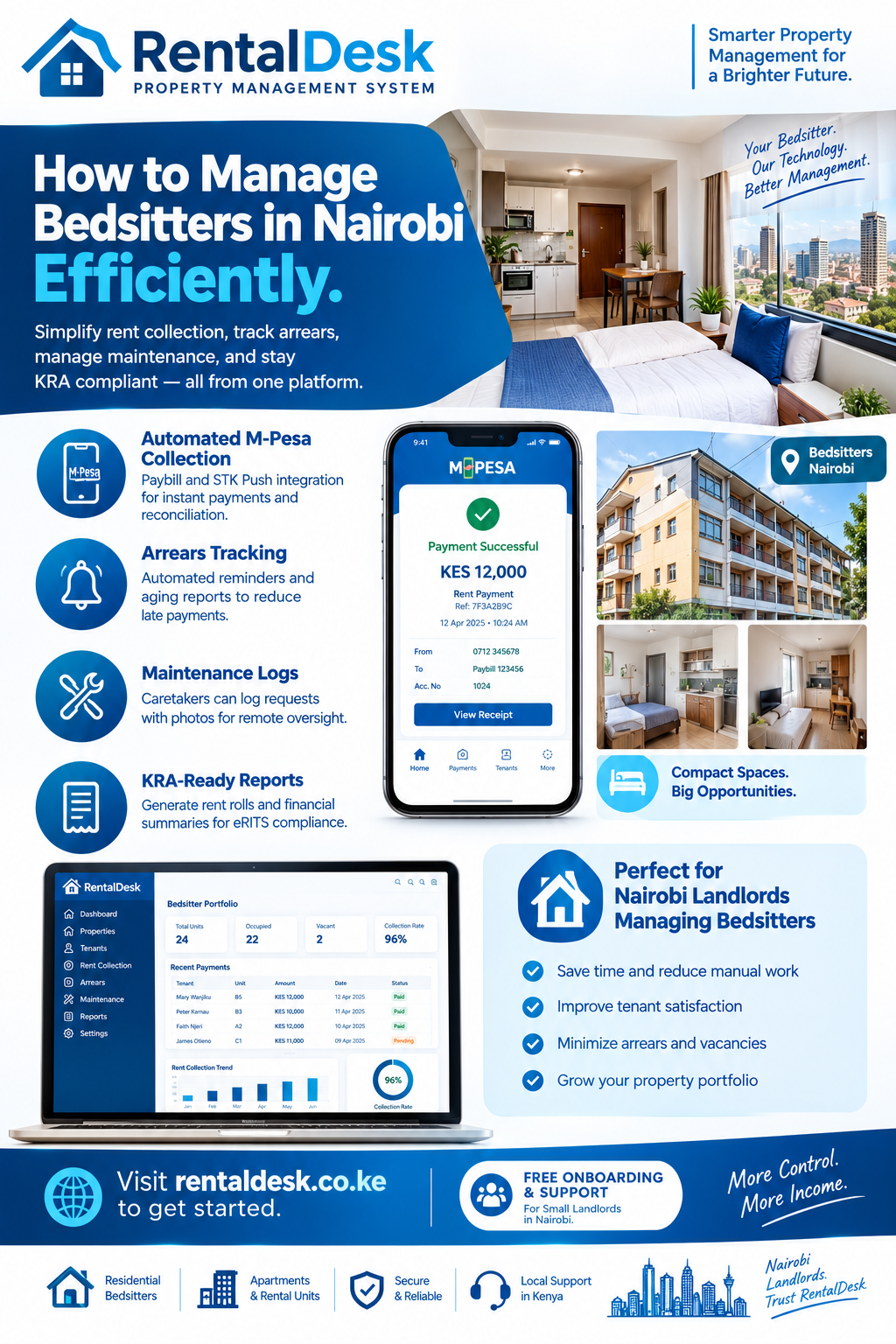
How to manage bedsitters in Nairobi efficiently is the operational question that determines whether a landlord builds a profitable rental business or a stressful side hustle. Bedsitters are the backbone of Nairobi’s rental market. They are the most affordable form of housing that offers privacy and self-contained facilities, attracting students, young professionals, and informal workers. Typical monthly rents range from KSh 5,000 in areas like Zimmerman to KSh 18,000 in more central or well-finished units.
However, managing these units comes with unique challenges. Margins are tight, tenant turnover is high, and a single missed month from two tenants can push cash flow negative. Relying on handwritten rent books, manual M-Pesa reconciliation, and phone calls is not just inefficient; it actively costs you money in time, errors, and late discoveries of arrears.
Understanding how to manage bedsitters in Nairobi efficiently requires a shift from reactive firefighting to a structured, automated operating model. This guide breaks down the essential systems, from tenant screening to M-Pesa reconciliation, that every bedsitter landlord must implement.
Understanding the Nairobi Bedsitter Market
Before implementing management systems, you must understand the market dynamics that dictate how you operate. The demand for bedsitters in Nairobi is driven by high urbanization, low incomes, and the high cost of land.
Areas like Pipeline, Umoja, Githurai, Kayole, Zimmerman, and Roysambu are characterized by dense, high-turnover rentals. In these areas, tenants are highly price-sensitive. A survey in Pipeline Estate revealed that residents tolerate substandard conditions because the estate offers an unbeatable combination of affordability and access to economic lifelines.
This means your management strategy must prioritize affordability, quick maintenance turnarounds, and reliable utilities. A landlord who tries to implement luxury-level management costs on a KSh 7,000 unit will quickly find themselves operating at a loss. The goal is to minimize vacancy periods, keep operating costs low, and ensure rent is collected consistently.
Tenant Screening and Lease Agreements
The foundation of efficient management is selecting the right tenants. High tenant turnover is a major risk in the bedsitter market, so screening must be thorough but efficient.
While a bedsitter landlord may not have the resources of a large commercial agency, basic screening is non-negotiable. Every prospective tenant should provide a National ID or Passport. For employed tenants, requesting three months of payslips or an employment letter helps verify financial capacity.
In 2026, Nairobi landlords are increasingly demanding payslips, tax records, and employment letters as court rulings against unlawful evictions force stricter screening before leases are signed.
A written tenancy agreement is essential. It must clearly state the rent amount, due date, deposit terms, and notice period. The agreement should also specify what is included (like water) and what is not. Critically, every payment must be accompanied by a receipt or an M-Pesa record. Without a lease, you have no legal basis to enforce terms or manage the property effectively.
How to Manage Bedsitters in Nairobi Efficiently with M-Pesa Automation
The most significant operational hurdle in how to manage bedsitters in Nairobi efficiently is rent collection and reconciliation. With over 90% of rent payments in urban Kenya flowing through M-Pesa, manual tracking is impossible at scale.
The Problem with Manual M-Pesa Reconciliation
When you manage ten or twenty bedsitters, you receive a flurry of M-Pesa messages at the end of the month. Some tenants pay on time, some pay late, some pay partially, and others use the wrong account reference. Manually matching these transactions to a spreadsheet takes hours and is prone to error.
The STK Push Solution
A modern approach to how to manage bedsitters in Nairobi efficiently relies on technology that automates the payment loop. M-Pesa STK Push rent collection is the method where your platform sends a payment prompt directly to the tenant’s phone. The tenant simply enters their M-Pesa PIN to confirm the payment.
This eliminates the need for the tenant to remember the Paybill number or the account reference. It also means the payment lands with the amount and unit reference built into the transaction, making automatic reconciliation possible. Whether you collect from six bedsitters in Rongai or sixty in Umoja, the automated loop handles the volume without complaint.
Automated Invoicing and Receipts
A property management system sends each tenant an invoice on the 1st of every month via SMS and records payment the moment funds hit your Paybill or Till number. Digital receipts are generated and sent instantly, eliminating the “nimetuma lakini sijapata receipt” disputes.
Arrears Management and Automated Reminders
Chasing arrears is a drain on time and energy. Efficient bedsitter management relies on systematic follow-up rather than emotional phone calls.
The Escalation Ladder
The system should flag unpaid units on day 5, day 10, and day 20, and send automated SMS reminders to the tenant. For a 20-unit bedsitter block, this saves approximately 3 to 4 hours of manual follow-up calls every single month.
The reminder ladder should escalate predictably. A friendly heads-up before the due date. A neutral reminder on the day. A firmer message after. A formal notice at a defined threshold. This consistency is a core component of how to manage bedsitters in Nairobi efficiently. Most arrears are recovered at the first polite reminder, because most late payments are not deliberate defaults.
Handling Partial Payments
Tenants often pay in instalments. A system that marks the invoice as paid loses the balance. A system that leaves the invoice unpaid misrepresents the payment. The right approach is to post the partial amount against the open invoice and leave the balance visible for follow-up. This ensures accurate accounting and avoids alienating a tenant who has made a good-faith effort.
Maintenance and Utility Management
Bedsitters have specific maintenance needs. Because space is compact, issues like plumbing, electrical faults, and ventilation require prompt attention.
Maintenance Tracking
Tenants should be able to submit maintenance requests through a tenant portal or via SMS. The caretaker or landlord can then assign the request to a vendor, track the progress, and record completion with photos.
This structured approach prevents small issues from becoming expensive capital expenses. For instance, a leaking tap reported and fixed immediately costs far less than a damaged wall caused by a persistent leak.
A good system allows your caretaker to log maintenance issues with timestamps and photos, giving you visibility whether you are in Nairobi CBD or in the diaspora. This accountability is vital for how to manage bedsitters in Nairobi efficiently.
Water and Utility Sub-Billing
Water costs are a major pain point for bedsitter landlords in Nairobi. Shared water costs can eat into your profits if not managed. Some property management systems include a water billing module that lets you record sub-meter readings per unit and auto-generate water charges on top of rent. This ensures you recover the costs accurately without disputes.
Occupancy and Vacancy Tracking
In the bedsitter market, vacancy is the enemy. Because rents are lower, a vacant unit has a proportionally larger impact on your net income.
You must track your occupancy rate meticulously. This means knowing which units are occupied, which are vacant, and when leases are due to expire. A system that alerts you to upcoming move-outs gives you time to advertise the unit and secure a new tenant before the current one leaves.
Adopting a property management system allows you to see vacancy rates and property performance across your portfolio. This data-driven approach helps you decide where to invest in improvements and where to adjust rents to maintain occupancy.
KRA Compliance and Financial Records
The Kenya Revenue Authority has intensified its oversight of rental income. The Monthly Rental Income (MRI) tax regime requires landlords to file returns and pay tax by the 20th of every month.
Managing this manually is a recipe for penalties. A property management system generates Month-end Rent Rolls, Aged Receivables, and Cash Flow summaries in one click. These reports are what your accountant or KRA agent needs for your MRI tax filings, which are now mandated to run through the eRITS portal as of 2026.
A clean financial record also protects you in the event of a dispute at the Rent Restriction Tribunal. It provides the audit trail required to prove tenancy terms and payment history.
Leveraging Technology to Manage Bedsitters Efficiently
The fragmented nature of bedsitter management makes it a prime candidate for digital transformation. Relying on a caretaker with a notebook creates an information bottleneck. If the caretaker is sick or leaves, the property loses its operational memory.
Cloud-based software like RentalDesk acts as the operational backbone. It turns a stressful, reactive side hustle into a predictable rental business. By automating rent collection, invoicing, and reporting, it allows you to focus on strategic decisions rather than administrative chores.
The software gives you real-time visibility. You can see exactly who has paid, who owes, and what maintenance issues are outstanding. This is the digital equivalent of having a live rent desk—an always-on point of contact where every payment and dispute is handled the moment it arises.
Tenant and Lease Records
Every tenant should have a digital profile containing their national ID, move-in date, lease terms, deposit paid, and payment history. This is the audit trail you need if a dispute reaches the tribunal.
Role-Based Access for Caretakers
Your caretaker should have a separate login with limited permissions. They should be able to record collections and log maintenance requests, but they should not be able to delete receipts or reallocate payments. A good system enforces this separation of duties, providing accountability and protecting your revenue.
Common Mistakes Landlords Make When Managing Bedsitters
The journey to mastering how to manage bedsitters in Nairobi efficiently is littered with predictable mistakes.
Using a Till instead of a Paybill. A Till number does not have an account reference field, making automatic matching impossible. You must use a Paybill to enable the tenant to enter their unit number as a reference.
Not standardizing the account reference. If tenants use different formats for their unit numbers (e.g., “A12”, “a12”, “Unit 12”), the system cannot match the payments. Standardize the format and communicate it clearly.
Reconciling at month-end instead of daily. A payment with a wrong reference sits unresolved for weeks, and the tenant becomes anxious. Daily reconciliation resolves exceptions while they are fresh.
Ignoring partial payments. Treating a partial payment as full settlement or as full non-payment creates disputes. The system must handle partial payments correctly by carrying forward the balance.
Failing to enforce a written lease. Without a written agreement, you have no legal recourse if a tenant refuses to pay or refuses to vacate. A written tenancy agreement and a signed house inspection report are essential.
Not accepting digital payments. In 2026, tenants expect to pay via M-Pesa. Refusing digital payments limits your tenant pool and increases the risk of cash theft or loss.
How to Get Started with Efficient Bedsitter Management
Implementing a structured management system is the most effective way to scale your bedsitter business.
Step 1: Choose a property management system. Select a platform designed for the Kenyan market, like RentalDesk, that supports M-Pesa Paybill and STK Push integration.
Step 2: Set up your properties and units. Register each bedsitter as a separate unit with its unique code and rent amount.
Step 3: Configure M-Pesa collection. Get a Paybill number and connect it to the system. Standardize the account reference format for your tenants.
Step 4: Migrate your tenant data. Clean up your existing records—ensure names, phone numbers, and balances are accurate—before entering them into the system.
Step 5: Train your caretaker. Show them how to use the mobile app to record payments and log maintenance requests.
Step 6: Go live. Start generating automated invoices and reminders. Review the reconciliation dashboard daily.
By following this structured approach, you can transition from manual chaos to automated control. This is the practical answer to how to manage bedsitters in Nairobi efficiently.
The rental market in Nairobi is competitive, but with the right systems, bedsitters can provide a stable and profitable income stream. Technology is not just a luxury; it is the operational backbone that turns a stressful side hustle into a predictable rental business.
- How to manage bedsitters in Nairobi efficiently
- How to manage bedsitters in Nairobi efficiently
- How to manage bedsitters in Nairobi efficiently
- How to manage bedsitters in Nairobi efficiently
- How to manage bedsitters in Nairobi efficiently
- How to manage bedsitters in Nairobi efficiently
- How to manage bedsitters in Nairobi efficiently
- How to manage bedsitters in Nairobi efficiently
- How to manage bedsitters in Nairobi efficiently
- How to manage bedsitters in Nairobi efficiently
- How to manage bedsitters in Nairobi efficiently
- How to manage bedsitters in Nairobi efficiently
- How to manage bedsitters in Nairobi efficiently