
Automated M-Pesa Rent Collection: The Smarter Way to Manage Rental Payments in Kenya
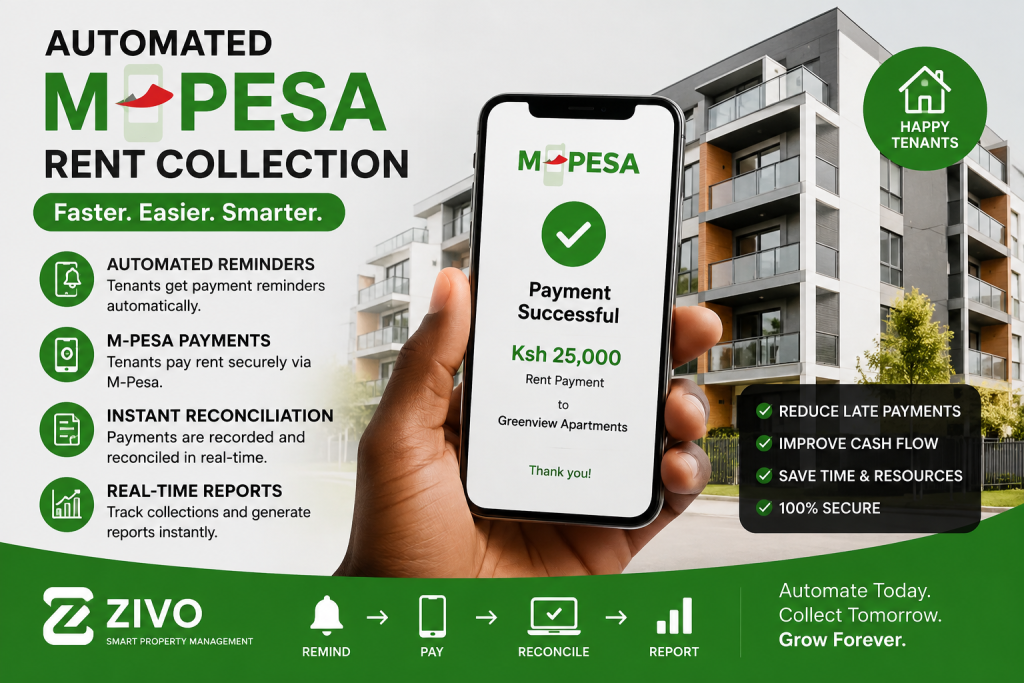
Managing rental properties in Kenya can be challenging, especially when landlords and property managers have dozens, hundreds, or even thousands of tenants. Rent must be collected on time, payments must be recorded correctly, tenants need receipts, arrears must be followed up, and property owners need accurate reports.
For many years, landlords have relied on manual processes to manage these activities. They check M-Pesa messages, update spreadsheets, write receipts, send reminders, and calculate outstanding balances. While this may work for a small property, the process becomes increasingly difficult as the number of tenants grows.
This is where automated M-Pesa rent collection can make a major difference.
By connecting rental management with digital payment technology, landlords and property managers can simplify how rent is collected, recorded, reconciled, and monitored. Instead of manually checking every transaction, a properly configured system can help match payments to tenants and update rental records automatically.
For property owners looking to improve efficiency, reduce rent arrears, save administrative time, and provide tenants with a convenient payment experience, digital rent collection is becoming an important part of modern property management.
What Is Automated M-Pesa Rent Collection?
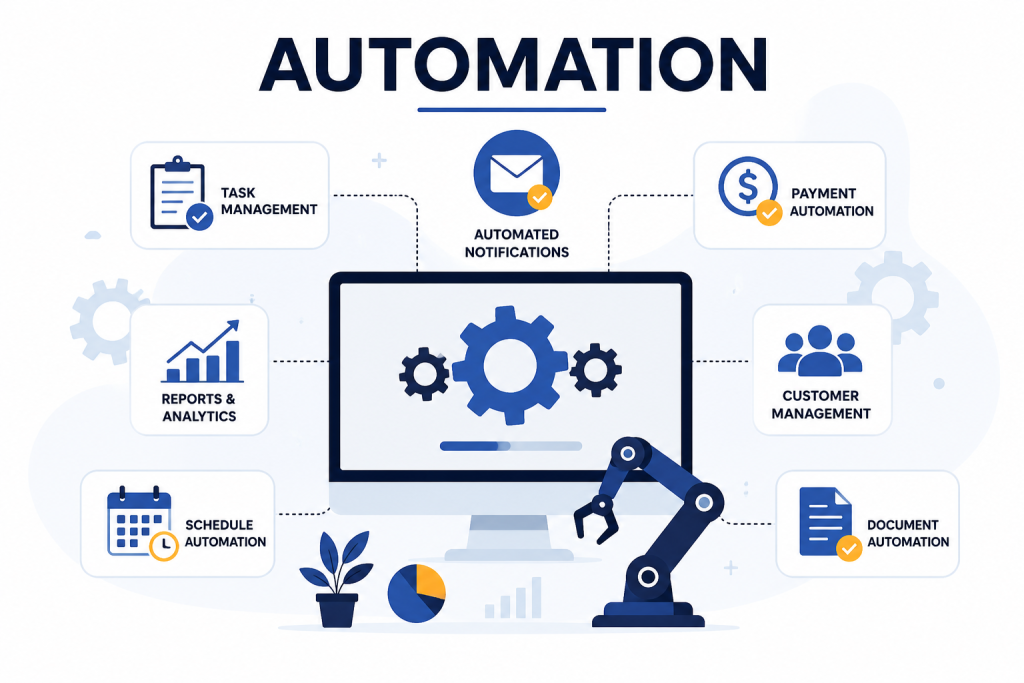
Automated M-Pesa rent collection is a digital process that enables landlords and property managers to collect rental payments through M-Pesa while reducing the need for manual payment recording and reconciliation.
M-Pesa is widely used for digital payments in Kenya, making it a natural payment channel for residential and commercial rental businesses.
With a suitable rental management platform, a landlord can provide tenants with a structured payment process. When a tenant makes a payment, the transaction can be connected to the relevant rental account.
The system can then help update the tenant’s payment record, calculate the remaining balance, generate reports, and support communication with the tenant.
Instead of spending hours checking individual messages and manually updating spreadsheets, property managers can have a centralized view of rental collections.
Why M-Pesa Is Important for Rent Collection in Kenya
Kenya has a strong digital payments ecosystem, and M-Pesa has become an important part of everyday financial transactions.
Tenants use mobile money for shopping, sending money, paying bills, and making business payments. Rent is therefore another payment that can be handled conveniently through mobile technology.
For landlords, accepting M-Pesa can make rent payment easier for tenants.
However, accepting M-Pesa is only one part of the process.
The bigger challenge is managing the transactions after they have been made.
A landlord may receive hundreds of M-Pesa transactions every month. Each payment needs to be associated with the correct tenant and rental unit.
This is where automated M-Pesa rent collection becomes valuable.
How Automated M-Pesa Rent Collection Works
The process can vary depending on the technology provider and payment integration, but the general workflow is straightforward.
Step 1: Register Properties
The property manager adds buildings, properties, blocks, floors, and rental units to the system.
Step 2: Register Tenants
Each tenant is assigned to a specific rental unit.
The system can store information such as the tenant’s name, phone number, monthly rent, lease information, and payment history.
Step 3: Configure Rent
The expected monthly rent is entered for each tenant or unit.
Step 4: Tenant Makes Payment
The tenant pays rent through the designated M-Pesa payment channel.
Step 5: Transaction Is Received
The payment information is received through the supported integration.
Step 6: Payment Is Matched
The system helps associate the transaction with the appropriate tenant account.
Step 7: Balance Is Updated
The tenant’s account reflects the payment and remaining balance.
Step 8: Receipt and Notification
Depending on the system configuration, a receipt or confirmation can be generated and sent to the tenant.
Step 9: Reporting
The payment becomes part of the landlord’s collection and financial reports.
This workflow reduces the amount of manual work required from property managers.
Key Benefits of Automated M-Pesa Rent Collection
The biggest advantage of automated M-Pesa rent collection is that it connects payment collection with rental record management.
Instead of treating payments and tenant records as separate activities, the two can work together.
1. Saves Time
Property managers spend less time checking messages and updating spreadsheets.
This allows them to focus on other important activities such as tenant support, property inspections, maintenance, marketing, and business growth.
2. Improves Payment Visibility
Landlords can see which tenants have paid and which tenants still have outstanding balances.
This is particularly useful when managing multiple properties.
3. Reduces Manual Errors
Automating repetitive data entry can reduce the risk of mistakes.
A payment record can be associated with a tenant account rather than being manually copied from one document to another.
4. Makes Arrears Easier to Monitor
Outstanding balances can be displayed in a centralized dashboard.
Property managers can identify overdue accounts and follow up faster.
5. Improves Tenant Convenience
Tenants can make payments through a familiar digital channel without having to visit an office.
6. Provides Better Records
Every transaction can form part of a structured payment history.
This makes it easier to investigate disputes and review tenant accounts.
7. Supports Better Reporting
Property owners can generate reports showing collections, outstanding rent, tenant balances, and property performance.
Automated M-Pesa Rent Collection for Landlords
Individual landlords can benefit from digital rent management even when they have a relatively small portfolio.
Consider a landlord who owns 20 apartments.
Every month, the landlord has to determine which tenants have paid, which tenants have not paid, and how much money is outstanding.
If the landlord relies entirely on M-Pesa messages and a notebook, keeping accurate records can become difficult.
With automated M-Pesa rent collection, the landlord can have a centralized system for monitoring payment activity.
This can be especially useful for landlords who live far away from their properties or have another full-time business.
Instead of calling a caretaker every few days for updates, the landlord can access reports and payment information digitally.
Automated M-Pesa Rent Collection for Property Managers
Professional property managers often handle significantly larger portfolios.
They may manage several apartment buildings for different property owners.
For these businesses, manual payment tracking can create a large administrative burden.
A centralized digital system can help property managers organize tenants, properties, payments, arrears, receipts, and reports in one place.
Managers can also provide property owners with clearer financial information.
For example, an owner can receive a monthly report showing:
- Total rent expected
- Total rent collected
- Outstanding rent
- Number of tenants who paid
- Number of tenants with arrears
- Collection percentage
- Property-by-property performance
This improves transparency between property managers and property owners.
Automated M-Pesa Rent Collection and Rent Arrears
Rent arrears can significantly affect the profitability of a rental business.
A tenant who misses one payment may eventually accumulate several months of unpaid rent if the issue is not addressed.
The earlier an outstanding balance is identified, the easier it may be to follow up.
A digital platform can help property managers identify overdue accounts.
For example, a dashboard may categorize tenants according to payment status:
Paid: Rent fully settled.
Partially Paid: Tenant has paid some of the required amount.
Due: Rent is expected but has not yet been received.
Overdue: Payment deadline has passed.
In Arrears: Tenant has an outstanding balance accumulated over time.
This visibility allows managers to prioritize follow-up activities.
Automated Rent Reminders
A common reason tenants pay late is simply that they forget.
Property managers can reduce this problem by sending reminders before rent is due.
Depending on the software, reminders can be sent through SMS, WhatsApp, email, or other communication channels.
A typical reminder might inform a tenant that rent is approaching its due date.
If the payment becomes overdue, another notification can be sent.
This creates a structured collection process instead of relying entirely on manual phone calls.
Digital Receipts for Tenants
Receipts are important because they provide evidence that a payment has been made.
Paper receipts can be lost or damaged.
Digital receipts provide a convenient alternative.
When a tenant pays rent, the system can generate a payment confirmation containing relevant information such as:
- Tenant name
- Property
- Unit
- Amount paid
- Payment date
- Payment reference
- Remaining balance
This improves transparency and can reduce payment-related disputes.
Service Description: Automated M-Pesa Rent Collection Solution
A professional automated M-Pesa rent collection service should go beyond simply accepting payments.
The goal should be to create a complete rental payment workflow.
Tenant Registration
The service should help landlords register tenants and assign them to rental units.
Property Management
Multiple properties and units should be managed from one platform.
M-Pesa Payment Integration
The system should support the relevant M-Pesa payment workflow and securely process transaction information.
Automatic Payment Recording
Transactions should be recorded against the appropriate rental accounts where supported by the integration.
Rent Balance Tracking
The system should calculate the amount paid and remaining balance.
Arrears Monitoring
Property managers should be able to identify tenants with outstanding balances.
Automated Notifications
Payment reminders and confirmations can reduce manual communication.
Digital Receipts
Tenants can receive confirmation of payments.
Collection Reports
Property owners can review rental income and payment performance.
Dashboard
A centralized dashboard provides a quick overview of the rental portfolio.
Together, these services can create a more efficient rent collection process.
Case Study 1: A 50-Unit Apartment Building
Consider a hypothetical apartment building with 50 occupied units.
Before adopting a digital system, the property manager checks M-Pesa messages every morning and manually updates an Excel spreadsheet.
At the end of the month, the manager spends several hours comparing the spreadsheet with payment messages.
Some tenants have partial payments, while others have outstanding balances.
The manager also needs to send individual reminders.
After implementing automated M-Pesa rent collection, the property manager moves payment monitoring into a centralized platform.
Tenant accounts are organized by unit.
Payments are reflected in the rental records.
Outstanding balances can be identified more easily.
Instead of spending several hours searching through messages, the manager can focus on tenants who actually require follow-up.
The result is a more organized collection process and better visibility into the property’s financial position.
Case Study 2: A Property Management Agency
Imagine a property management company handling 600 rental units across several buildings.
Previously, different employees maintained different spreadsheets.
This created challenges when property owners requested reports.
The company implemented a centralized digital rental management solution.
The team could now organize properties, tenants, payment information, and arrears in one system.
Managers could generate reports without combining multiple spreadsheets.
The company also introduced automated reminders.
As a result, staff had more time to focus on tenant support and property management rather than repetitive payment administration.
This example demonstrates how technology can become more valuable as a property portfolio grows.
Case Study 3: A Landlord Living Abroad
Consider a Kenyan landlord living outside the country while owning several rental properties locally.
Previously, the landlord depended on a caretaker to provide updates about rental payments.
Payment information was often shared through WhatsApp messages.
The landlord had limited visibility into collections.
With automated M-Pesa rent collection, the landlord can use digital reports to monitor rental activity remotely.
The property manager or caretaker can continue handling local operations while the owner has better access to payment information.
This creates greater transparency and accountability.
Testimonials
“It saves us hours every month.”
“Before using a digital rent collection system, we spent a lot of time checking M-Pesa messages and updating spreadsheets. Having the payment information organized in one place has made our work much easier.”
— Property Manager, Nairobi
“Following up on arrears is easier.”
“The biggest improvement for us is visibility. We can quickly identify tenants who have outstanding balances and follow up instead of discovering arrears much later.”
— Residential Property Owner, Kenya
“Our tenants get better service.”
“Digital payment confirmations and organized records have improved the experience for our tenants. They can make payments conveniently and get confirmation without waiting for us to prepare paperwork.”
— Property Management Agency, Kenya
Note: These testimonials are illustrative examples for marketing content and should be replaced with verified customer testimonials before publication.
The purpose of automated M-Pesa rent collection is therefore not to replace property managers. It is to give them better tools.
Improving Cash Flow Management
Rental businesses depend on predictable cash flow.
Landlords have expenses that must be paid regardless of whether tenants have paid their rent.
These may include:
- Maintenance
- Security
- Utilities
- Staff salaries
- Property loans
- Insurance
- Repairs
- Taxes
- Management expenses
When rent collection is delayed, these obligations can become difficult to manage.
A digital system gives landlords better visibility into expected and actual rental income.
This allows them to identify potential cash-flow problems earlier.
Better Financial Reporting
A good rental payment platform should provide more than a list of transactions.
It should help convert payment data into useful information.
Reports can show:
- Daily collections
- Weekly collections
- Monthly collections
- Outstanding rent
- Arrears by tenant
- Arrears by property
- Payment history
- Expected rental income
- Collection performance
These reports help property owners understand how their businesses are performing.
Security and Accountability
Rental payment information is sensitive.
Landlords should choose systems that provide appropriate security controls.
User permissions can ensure that employees only access information relevant to their responsibilities.
For example, a caretaker may need to view tenant information, while an accountant may require access to financial reports.
Property owners should also consider data backups and secure authentication.
A reliable automated M-Pesa rent collection system should be designed with security and accountability in mind.
Choosing the Right Rent Collection Software
Before choosing a platform, landlords should consider several factors.
Ease of Use
The system should be simple enough for property managers and staff to use.
Scalability
It should support portfolio growth.
Payment Integration
Confirm that the platform supports the relevant M-Pesa payment functionality.
Reporting
Look for detailed and easy-to-understand financial reports.
Arrears Management
The system should make overdue balances easy to identify.
Notifications
Automated reminders can improve communication.
Tenant Management
Tenant records should be connected to properties and units.
Customer Support
Reliable support can make implementation easier.
Common Mistakes When Digitizing Rent Collection
Technology can improve rent management, but implementation still needs to be handled carefully.
Incorrect Tenant Information
Make sure tenant names, phone numbers, units, and rent amounts are entered correctly.
Poor Payment References
A clear payment identification process can make transaction matching easier.
Ignoring Historical Arrears
Existing outstanding balances should be entered accurately.
Failing to Train Staff
Employees should understand how to use the platform.
Not Reviewing Reports
The purpose of collecting data is to use it.
Property managers should review reports regularly and act on outstanding balances.
The Future of automated M-Pesa rent collection
The future of rental management will involve increasing levels of automation.
Property management platforms are becoming more connected.
Payment systems, tenant communication, accounting, reporting, and property management can increasingly operate as part of one digital ecosystem.
Artificial intelligence may also support future rental management processes by identifying payment patterns and helping property managers predict potential arrears.
Automated communication may become more personalized.
Financial dashboards may provide real-time insights into rental performance.
For landlords, this means less administrative work and better decision-making.
Frequently Asked Questions
What is automated M-Pesa rent collection?
It is a digital rent management process that connects M-Pesa payments with rental records, helping landlords and property managers reduce manual payment tracking and reconciliation.
Can landlords track tenant arrears in automated M-Pesa rent collection?
Yes. A suitable rental management platform can help identify outstanding balances and overdue accounts.
Is automated M-Pesa rent collection suitable for apartments?
Yes. It can be particularly useful for apartment buildings with many tenants and frequent rental transactions.
Can property managers manage multiple buildings on automated M-Pesa rent collection?
Many modern rental management systems support multiple properties, buildings, and rental units.
Can tenants receive payment confirmations on automated M-Pesa rent collection?
Depending on the system, tenants can receive digital payment confirmations or receipts after their transactions are processed.
Does automated M-Pesa rent collection eliminate all manual work?
No system eliminates every administrative task. However, automation can significantly reduce repetitive payment recording, reconciliation, reporting, and reminder activities.
Can landlords monitor rent remotely on automated M-Pesa rent collection?
Cloud-based systems can allow authorized landlords to access rental information remotely through supported devices.
Is aautomated M-Pesa rent collection secure?
Security depends on the software provider, payment architecture, user access controls, and implementation. Landlords should evaluate the provider’s security practices before adopting a platform.
Why Choose a Professional automated M-Pesa rent collection?
Building and maintaining an effective rent collection process requires more than accepting payments.
A professional solution combines payment processing with tenant management, payment tracking, reporting, arrears monitoring, and communication.
This gives landlords a complete view of their rental business.
Instead of using separate tools for payment messages, spreadsheets, receipts, reminders, and reports, property managers can centralize their operations.
That can improve productivity and make it easier to scale.
How to Get Started
Moving from manual rent collection to a digital platform can be done gradually.
Start by listing all properties and units.
Next, organize tenant information and verify monthly rent amounts.
Review existing arrears and payment records.
Then configure the appropriate payment process and train your property management team.
Once the system is active, monitor payments regularly and use the available reports to identify opportunities for improvement.
The most important thing is consistency.
Every tenant should have an accurate account, every payment should be properly recorded, and outstanding balances should be followed up promptly.
Automated M-Pesa rent collection provides a smarter approach.
Ready to Modernize Your Rent Collection?
If you are still relying on spreadsheets, notebooks, M-Pesa messages, and manual follow-ups to manage rental payments, it may be time to upgrade your process.
With a professional automated M-Pesa rent collection solution, you can centralize tenant payments, monitor arrears, simplify reconciliation, automate reminders, generate reports, and gain better control over your rental business.
Start managing your rental payments smarter today.
Visit RentalDesk to explore a modern rental management solution designed to help landlords and property managers simplify rent collection, track payments, control arrears, and manage their properties more efficiently.
Take control of your rent collection. Reduce manual work. Improve payment visibility. Grow your rental business.