
Utility billing system for rentals in Kenya is where the relationship between a landlord and a tenant most often turns sour over the smallest sums. The rent is agreed and known. Water is not — it arrives as a figure on a slip under the door, calculated from a reading the tenant never saw, at a rate nobody explained, sometimes estimated because the caretaker did not open the meter cupboard that month, and occasionally doubled because a leak in a pipe the tenant cannot reach ran for three weeks. The tenant disputes it.
The caretaker says the meter says what it says. The landlord, who paid a bulk bill to the utility or a tanker that month and is trying to recover it across twelve units, discovers that the sub-meter readings add up to less than the bulk figure, or more, and has no idea which is wrong. A properly implemented utility billing system for rentals in Kenya does not eliminate disputes entirely, but it removes the grounds for most of them. When a tenant can see the reading, the rate, and the arithmetic, argument largely stops.
What Utility Billing Software Actually Does
At its simplest, utility billing system for rentals in Kenya refers to software designed to help property owners and managers calculate and collect charges associated with utilities and shared services. These charges can include water consumption, electricity consumption, garbage collection, security services, internet, cleaning, common-area electricity, shared water bills, service charges, and other recurring property expenses.
The exact billing model depends on the property. Some landlords use individual meters, while others divide a shared bill between several units. Some charges are fixed every month, while others depend on consumption. A good utility billing system for rentals in Kenya brings these calculations into a consistent workflow. Instead of calculating everything separately and then manually transferring figures into tenant invoices, the manager can maintain utility records alongside property, unit, tenant and payment information.
For Kenyan landlords, utility billing software becomes part of a broader rental management process rather than being treated as an isolated accounting tool. A well-designed workflow creates a central record for the property, units, tenants, meters, readings, charges, and payment history.
Why Utility Billing Has Become a Major Task
Utility billing is often underestimated because the amounts involved may be smaller than monthly rent. The administrative workload, however, can still be significant. Imagine a building with 80 units. Each unit has a water meter. At the end of the billing period, someone needs to collect 80 readings, determine consumption, apply the correct rate, prepare bills, communicate balances and follow up on unpaid amounts. Now add electricity, garbage collection and other shared services. A process that looked simple at 10 units can become a major administrative responsibility at 80 or 200 units.
Using utility billing system for rentals in Kenya helps create a repeatable process where the property manager knows what was measured, what was charged, what was invoiced and what has been paid. The biggest benefit is not simply faster calculations. It is better control over the entire billing trail.
The Sub-Metering Foundation
Submetering is the most practical solution for fair electricity and water billing in Kenyan rental properties, especially when Kenya Power remains the main utility provider. Kenya Power’s meter installed at the property acts as the mother meter. This is the primary meter that measures the total electricity consumption for the entire property whether it is an apartment block, commercial building, student hostel, or mixed-use development. Kenya Power bills the property owner based on the total units consumed as recorded on this mother meter.
Submetering involves installing individual meters for each tenant or unit within the property. These submeters are connected downstream from the Kenya Power mother meter. Each submeter measures the exact electricity consumption of a specific tenant, ensuring accurate usage tracking and transparent billing.
For water, sub-meters are similarly common. The landlord receives a bulk bill from the county water company and recovers the cost from tenants based on each unit’s actual consumption. A utility billing system for rentals in Kenya reconciles the sub-meter readings against the bulk bill, flagging discrepancies before they become disputes.
Common Manual Problems That Software Solves
Manual utility management often creates the same problems repeatedly. Meter readings are written down but not entered into a central record. A tenant’s reading is assigned to the wrong unit. A billing calculation is copied incorrectly. Shared utility costs are divided inconsistently. A payment is recorded against the wrong account.
Manual meter-reading errors are particularly costly. A single wrong digit can produce an incorrect bill. If the mistake is not identified immediately, the tenant may dispute the charge after receiving the invoice. When a property uses sub-metering, the manager needs to compare the current reading with the previous reading and calculate consumption. A reliable utility billing system for rentals in Kenya automates this calculation and maintains the supporting records.
The biggest benefit of automation is not simply faster calculations. It is better control over the entire billing trail. The property manager knows what was measured, what was charged, what was invoiced and what has been paid.
The Reading Review Process
A utility reading review helps Kenyan property teams catch incomplete or inconsistent records before preparing tenant bills. The aim is to connect each reading to the correct unit, period and approved charging method.
Match each reading to the right unit. Record a consistent property and unit identifier alongside the meter reference where applicable. Confirm that the person collecting readings knows which meter belongs to which unit. Similar labels or handwritten shortcuts can create mistakes that are difficult to explain later.
Make the review period consistent. Check the opening and closing dates before comparing usage. Different reading intervals can produce different totals even when the daily pattern is similar. If a reading is missing, flag the gap and assign a follow-up action. Follow the applicable agreement and approved billing policy for any estimation or adjustment; do not silently invent a figure to complete the spreadsheet.
Investigate exceptions before issuing bills. Look for entries that are missing, repeated, linked to the wrong unit or inconsistent with the record. An exception is a reason to investigate, not proof of misuse. Ask for a recheck or supporting information before deciding how to proceed.
Confirm the approved charging method. Separate the measured usage from the calculation used to produce the bill. The reviewer should be able to identify the relevant rate, effective period and any authorised adjustments.
Keep the evidence with the billing record. After review, retain the source readings, review decision and explanation of any correction. Record who approved the final result. Avoid maintaining a corrected invoice while leaving the supporting worksheet with an unexplained older figure.
Any utility billing system for rentals in Kenya that skips these checks will generate invoices that the property team cannot defend when a tenant asks a question.
Water Billing: The Dispute Hotspot
Water generates disputes in a way that rent does not. The amount varies monthly, so the tenant cannot budget for it. The basis is a reading the tenant usually did not witness. The rate is frequently unstated. Estimates replace readings without the tenant knowing. Leaks and faults produce bills that bear no relation to use. Communal meters produce apportionments the tenant cannot check. The landlord’s own cost is opaque to the tenant. The sums are small enough that the landlord does not invest in getting them right and large enough that the tenant resents them.
Every one of these is addressed by evidence and transparency. Water can be billed on evidenced readings, at a stated tariff, reconciled to what the landlord actually paid, and presented to the tenant in a statement they can check. A utility billing system for rentals in Kenya that shows the tenant the reading, the rate and the arithmetic removes most of the grounds for dispute.
Sub-meters are common in Kenyan rental properties. Their installation and reading discipline matter enormously. If the sub-meter readings add up to less than the bulk figure, the landlord is absorbing the difference. If they add up to more, tenants are being overcharged. A reconciliation process within the utility billing system for rentals in Kenya flags both scenarios before bills are issued.
Electricity Sub-Metering
Electricity sub-metering works alongside Kenya Power’s mother meter. Prepaid sub-metering is increasingly popular because tenants purchase tokens and load them directly into their meter. They only consume what they pay for. This eliminates arrears and reduces landlord involvement in bill collection.
Postpaid sub-metering records consumption and bills at the end of the billing cycle. Prepaid systems are often preferred for rental properties because they remove the risk of unpaid electricity balances accumulating.
Properly installed submetering does not result in double billing. Kenya Power bills the property owner once based on the mother meter. The owner then recovers the cost fairly from tenants based on each unit’s actual consumption recorded by the submeters.
Integrating M-Pesa Into Utility Billing
Kenya runs on M-Pesa, and utility billing should too. Tenants expect to pay service charges and utility bills through mobile money. A utility billing system for rentals in Kenya must integrate directly with M-Pesa Paybill so that payments are captured and matched automatically.
RentalDesk connects to Safaricom’s Daraja API with Instant Payment Notification callbacks. When a tenant pays a utility bill via Paybill, the system extracts the amount, phone number, account reference, and transaction ID, matches the reference to the correct unit and tenant, credits the account, generates a receipt, and updates the dashboard in real time. No more manual confirmation messages. No more screenshots pasted into a WhatsApp group.
The system should support STK Push as well. Tenants receive a payment prompt directly on their phone when they click “Pay Utility Bill” on their invoice. They enter their PIN and the payment completes. This convenience improves collection rates because it removes the friction between intention and payment.
Utility Bills and the Rent Invoice
In many Kenyan rental properties, utility charges are billed alongside rent in a single invoice. The tenant sees one amount due, itemised to show rent, water, garbage, security, and any other charges. A utility billing system for rentals in Kenya should support this consolidated billing model.
When a tenant pays, the payment is applied to the oldest outstanding charge first. If the tenant has a water balance outstanding from last month, the payment clears that before applying to the current month’s rent. The tenant statement shows the complete position, not just the rent balance.
This integration matters because it prevents the fragmentation that occurs when rent is tracked in one system and utilities in another. A single ledger that handles both is a single source of truth. A utility billing system for rentals in Kenya that cannot consolidate utility and rent charges creates more work, not less.
Shared Bills and Apportionment
Not every property has sub-meters. Some properties have a single water meter or a single electricity meter serving common areas, and the cost must be apportioned across units. The method of apportionment must be documented and applied consistently.
Common methods include equal division across units, division by unit size or number of bedrooms, and division by number of occupants. The chosen method should be stated in the tenancy agreement and applied uniformly. A utility billing system for rentals in Kenya should support the configured apportionment method and calculate each unit’s share automatically.
The Rent Restriction Act gives the Tribunal power to apportion charges where premises are occupied by tenants who enjoy services in common, such as water, light, conservancy, sweeper or watchman. For controlled tenancies, the Tribunal can fix the amount of water, light, conservancy, sweeper, watchman, or other service charge in addition to the standard rent. This means apportionment must be fair and evidence-based, not arbitrary.
The Legal Limits on Disconnection
A utility billing system for rentals in Kenya must operate within the legal framework that governs disconnection. A landlord who is owed rent or utility charges cannot simply turn the water off. Courts and tribunals have consistently held that disconnecting water or electricity is unlawful and can expose the landlord to damages.
In one Tribunal case, the landlord was ordered to allow the tenant quiet possession of the premises and not to interfere with water and electricity supply. Self-help measures such as dismantling doors, disconnecting water and electricity, or forcibly evicting tenants are usually unlawful and can even be counterproductive, especially where the tenant takes legal action.
A well-designed utility billing system for rentals in Kenya supports lawful recovery. It generates demand notices, tracks arrears, and documents the escalation sequence. It does not facilitate unlawful disconnection.
Utility Deposits and Move-Out Reconciliation
Many Kenyan landlords collect a utility deposit in addition to the rent deposit. The utility deposit covers outstanding water or electricity charges at the end of the tenancy. The deposit should be recorded separately and applied against the final utility bill.
At move-out, the landlord records the closing meter reading and calculates the final utility charge. If the deposit exceeds the charge, the balance is refunded. If the charge exceeds the deposit, the landlord pursues the tenant for the difference. A utility billing system for rentals in Kenya generates an itemised settlement statement showing the deposit received, the final charges applied, and the balance refundable or owed.
This documentation matters because utility deposit disputes are common. A landlord who provides a clear statement supported by readings and tariff evidence has a defensible position.
Reports Every Property Manager Should Review
A utility billing system should generate reports that support operational decisions. The rent and utility collection summary shows total charges billed, total collected, and outstanding balances. The arrears aging report categorises balances by age. The meter reading exception report flags missing or inconsistent readings. The utility consumption trend report shows usage patterns per unit and highlights anomalies that may indicate leaks or meter faults. The bulk reconciliation report compares total sub-meter consumption against the bulk bill from the utility provider.
These reports serve different decisions. The exception report prioritises follow-up. The consumption trend report informs maintenance planning. The reconciliation report protects the landlord from absorbing losses that should be recovered.
How RentalDesk Delivers Utility Billing for Rentals
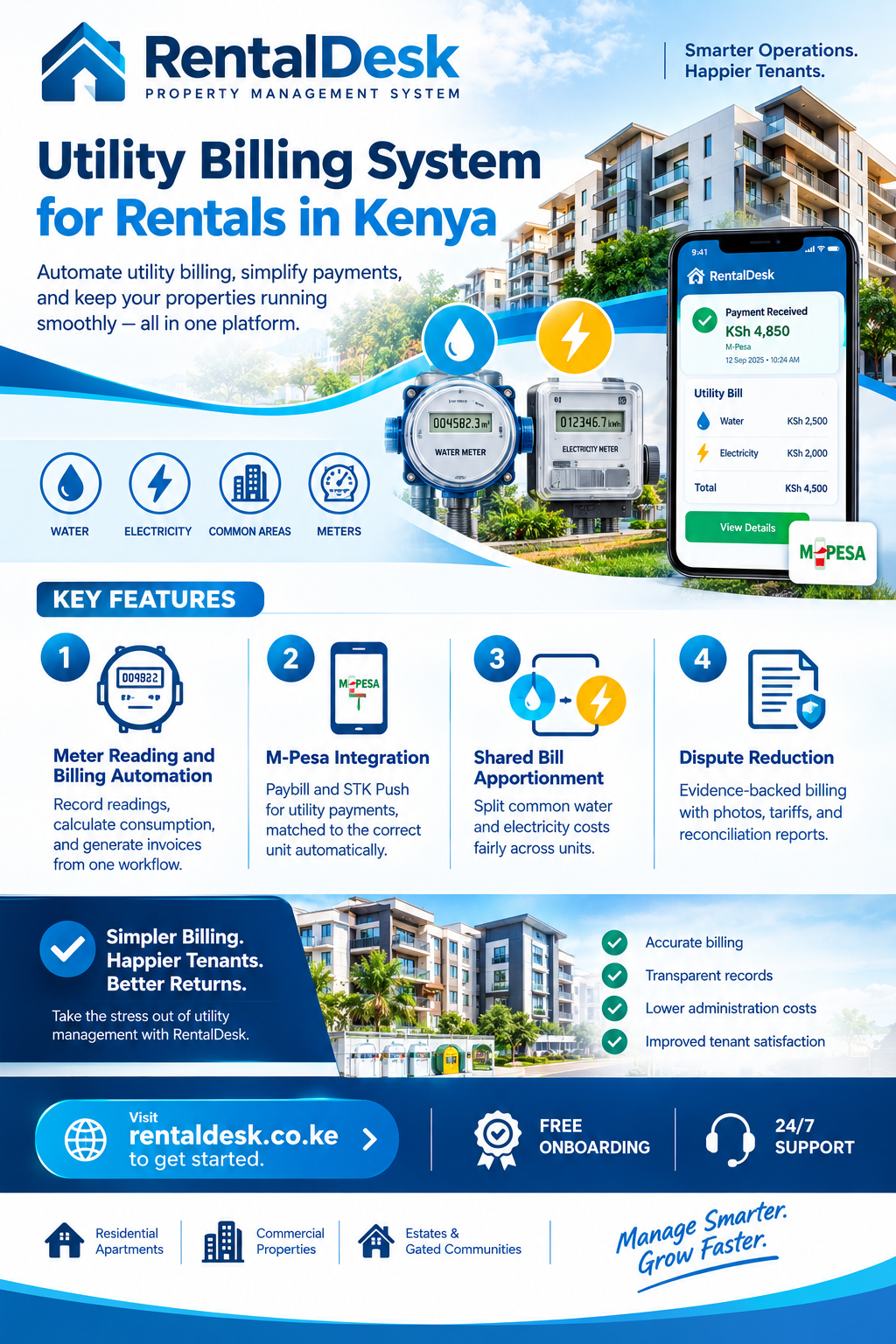
RentalDesk is built specifically for the Kenyan market, and utility billing sits at the centre of the platform. The utility module supports utility accounts, meter readings, imports, templates, invoice generation, utility payments and reconciliation.
Utility accounts and meter readings. The platform maintains a record of each meter, its associated unit, and its readings. Readings can be entered manually or imported, with photo evidence attached.
Template-based invoice generation. Utility invoices are generated from templates that reflect the applicable tariff and charge structure.
M-Pesa integration. Utility payments via Paybill and STK Push are captured and matched to the correct unit automatically.
Shared bill support. The platform supports splitting shared bills where a property uses common water or electricity accounts.
Utility balances. Outstanding utility balances are tracked alongside rent, so the tenant statement shows the complete position.
Reconciliation. Utility payments are reconciled against invoices, with exceptions flagged for review.
Reporting. Rent and utility collection summaries, arrears reports, and consumption trends are generated from verified records.
Role-based access. Caretakers can enter readings without seeing financial data. Managers can generate invoices. Finance can reconcile payments.
How to Get Started
Implementing a utility billing system for rentals in Kenya is straightforward with RentalDesk .
Step 1: Sign up. Visit RentalDesk and create your account. Choose a plan that matches your portfolio size.
Step 2: Set up properties, units, and meters. Add the property structure and record each meter against the correct unit.
Step 3: Configure tariffs and charges. Enter the applicable water and electricity rates, fixed charges, and apportionment methods.
Step 4: Configure M-Pesa collection. Connect your Paybill so that utility payments reconcile automatically.
Step 5: Run a pilot billing cycle. Process one full period for a single property and confirm that readings, calculations, and invoices are correct.
Step 6: Go live. Roll out to the full portfolio and review the exception report each billing cycle.
The Future of Utility Billing in Kenya
The utility billing landscape in Kenya is moving toward greater automation. Smart meters with IoT connectivity are becoming more common, allowing readings to be captured automatically without manual entry. Prepaid metering for both water and electricity reduces arrears and eliminates bill collection friction. M-Pesa integration continues to mature, with STK Push making payment effortless.
Regulatory oversight is also tightening. The Energy and Petroleum Regulatory Authority sets standards for metering and billing. The Water Services Regulatory Board approves tariffs for water service providers. Landlords and property managers who operate within these frameworks and maintain accurate records will be better positioned to avoid disputes and demonstrate compliance.
RentalDesk provides the structured platform that makes a utility billing system for rentals in Kenya work — not as an isolated calculator, but as a connected workflow that links meters, readings, tariffs, invoices, payments, and reports in one verified ledger.
- Utility billing system for rentals in Kenya
- Utility billing system for rentals in Kenya
- Utility billing system for rentals in Kenya
- Utility billing system for rentals in Kenya
- Utility billing system for rentals in Kenya
- Utility billing system for rentals in Kenya
- Utility billing system for rentals in Kenya
- Utility billing system for rentals in Kenya
- Utility billing system for rentals in Kenya
- Utility billing system for rentals in Kenya