
A landlord statement month-end checklist in Kenya should help an owner understand what happened during the reporting period. The statement needs to distinguish rent collected, amounts still outstanding and recorded deductions. When those figures are difficult to trace, even a short report can create a long exchange of questions.
RentalDesk’s owner statement tools bring owner-linked collections, expenses and payout context into the reporting workflow. Use a consistent review before sharing a statement so the summary agrees with the records behind it.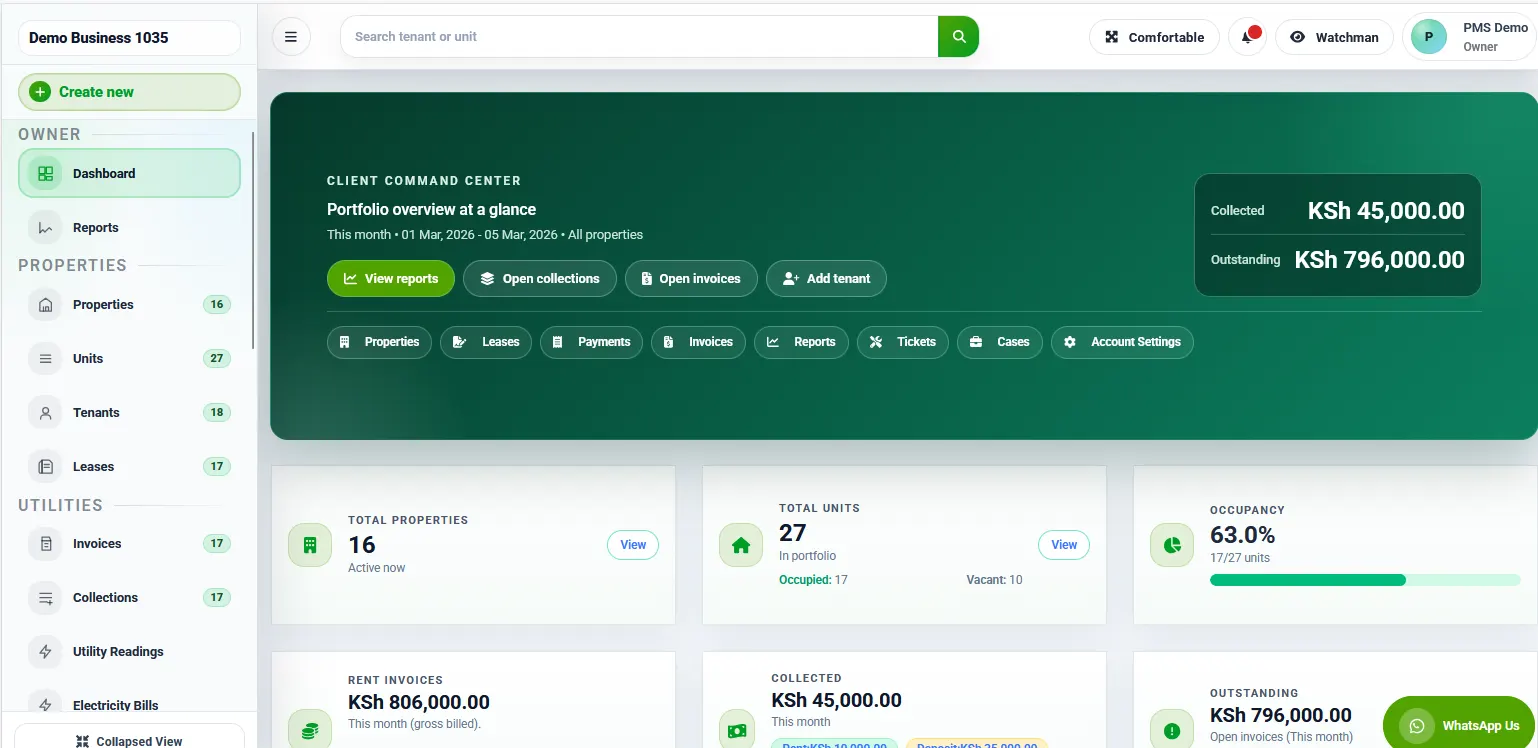
Define the reporting period
Make the start and end dates obvious. Decide how payments received after your reporting cutoff will be handled and apply that approach consistently. A clear period helps readers understand why a recent payment may appear in the next statement.
Check that the properties in the report belong to the intended owner. Where an agency manages several portfolios, property naming and owner links deserve the same attention as the totals.
Review collections before summarising them
Check for duplicate records, unclear references and payments still waiting to be allocated. Use bank and M-Pesa reconciliation to review exceptions before treating the collection figure as complete.
Keep rent billed separate from rent received. An invoice records a charge, while a collection records payment. The owner should be able to understand both without assuming every billed amount reached the account.
Explain deductions with supporting records
For each expense or fee, keep a description and the supporting reference used by your agency. Use a consistent naming style so the same kind of work does not appear under several unrelated labels.
If a contractor was discovered through JAAT’s business and service directory, retain the contractor’s actual invoice and work details. A marketplace listing provides discovery context; it is not the supporting record for the deduction itself.
Check the payout explanation
Review how collections, deductions and any recorded opening amounts contribute to the reported balance. Where advances or previous adjustments apply, make their treatment understandable. Ask a second team member to trace a sample statement back to its source records.
When a figure cannot yet be explained, keep it on a review list and resolve it before presenting the report as final. Avoid making an unexplained adjustment simply to force two totals to match.
Make owner questions easier to answer
Keep the reviewed statement version and its reporting period together. Assign a contact for follow-up questions and record corrections if they become necessary. A repeatable month-end process should make the next month’s review easier to follow.
What should an owner be able to see?
At minimum, the report should clearly identify the property, period, collections and explained deductions relevant to the agreed reporting arrangement. Discuss the required detail with the owner rather than assuming one summary format suits every portfolio.
1. Start the landlord statement month-end checklist with scope
List the owner, properties and dates covered by the report. Check that the report includes the intended buildings and excludes other owners’ records. Where a property has recently entered or left your management, confirm which part of the period belongs in the statement.
The landlord statement month-end checklist should make the reporting cutoff explicit. A payment received after that point may belong in a later statement depending on the agreed reporting method. Keep the treatment consistent and explain it clearly so a reader does not mistake timing for a missing payment.
2. Trace collections to confirmed payment records
Review the transactions included in the collection figure. Check the property and tenant allocation, identify possible duplicates and investigate references that remain unclear. Keep a record of unresolved items and avoid presenting an uncertain amount as a completed collection.
Use the landlord statement month-end checklist to sample both ordinary and unusual transactions. An ordinary payment tests the standard routine; a partial payment or correction tests whether the explanation remains understandable when the case is less straightforward. A colleague should be able to follow the same evidence.
3. Keep invoices separate from money received
Billing and collection figures describe different events. An invoice may remain unpaid at the cutoff, while a payment received this month may relate to an earlier charge. Label these measures clearly and avoid combining them into a single unexplained total.
A landlord statement month-end checklist helps reviewers ask the right question about each number. Does this line show an amount charged, a confirmed receipt or an outstanding balance? State the purpose of the figure before comparing it with another report that may use a different period or basis.
4. Support every deduction with a useful explanation
For each deduction, check the description, date, supporting reference and treatment under the agreed management arrangement. Where approval is required by your process, confirm that the relevant record is available. Avoid vague labels such as “other” when a concise description would explain the item.
The landlord statement month-end checklist should also identify items that belong to another period or property. A valid supplier invoice can still appear in the wrong place. Trace the work to the relevant building and check whether it has already been included elsewhere before accepting the deduction.
5. Explain the movement in the reported balance
Use an illustrative example to test the logic. Suppose a reporting worksheet starts with KSh 10,000 brought forward, adds KSh 100,000 of confirmed collections and records KSh 15,000 of supported deductions. Before other entries, that worksheet gives KSh 95,000. The example is a simple arithmetic check, not a prescribed accounting format.
If KSh 80,000 is then recorded as paid to the owner, the remaining amount in that example is KSh 15,000. Every component needs a traceable source. The landlord statement month-end checklist should ask the reviewer to explain each movement rather than accept the final amount because it appears plausible.
Your actual reporting arrangement may contain other entries. Label them and confirm their treatment with the person responsible for the accounts. Do not insert a balancing adjustment simply to force agreement between reports that may be measuring different things.
6. Review the statement from the owner’s perspective
Read the draft without relying on private background knowledge. Can you identify the property and period quickly? Do the labels explain the figures? Can you tell which amounts remain unresolved? If the answer depends on asking the preparer, improve the explanation before sharing the statement.
Assign this part of the landlord statement month-end checklist to a second reviewer where practical. Ask them to choose one collection and one deduction and trace both to their source records. This small exercise can reveal missing references more effectively than scanning only the totals.
7. Record the approved version and follow-up route
Keep the final reviewed statement together with its reporting period and the relevant supporting references. Identify the person who will answer owner questions. If a correction becomes necessary, record the reason and make it clear which version should now be used.
Closing the landlord statement month-end checklist should leave the next reviewer with an understandable record. Note any outstanding question, its responsible person and the expected next update. A statement marked final should not quietly contain an amount the team is still trying to explain.
Practical exceptions for a landlord statement month-end checklist
A payment arrives after the reporting cutoff
First check the actual receipt date and the period used by the report. Follow the reporting method agreed with the owner and describe the timing clearly. If the owner asks about the payment, point to the relevant record and explain where it appears, instead of making an unsupported change to a completed statement.
A supplier charge has incomplete details
Ask for the missing reference or work description before treating the line as fully supported. Confirm the property and the nature of the work. The landlord statement month-end checklist should retain the open question until the responsible person has reviewed the required evidence.
A correction is found after sharing
Trace the reason for the correction, review the affected figures and prepare a clearly identified replacement through your normal process. Explain what changed without including unrelated tenant information. Keep enough history for the next reporting cycle to start from the corrected position.
One owner has several properties
Review each property before combining the totals. A correct portfolio amount can hide a misallocation between buildings. Use consistent identifiers and make it possible to trace the owner-level summary back to property-level records. This is especially useful when the owner asks about one building’s performance.
Build a repeatable review calendar
Work backwards from the agreed statement date. Allow time to review payment exceptions, gather missing supporting records and complete a second check. Avoid leaving every clarification to the final day, when staff may be tempted to accept unexplained figures simply to finish the report.
A landlord statement month-end checklist can be divided among the team as long as responsibility remains clear. Name the person preparing the report, the person reviewing it and the contact handling questions. Record completion of each stage in the working process you already use.
Review the items that regularly delay reporting. If the same kind of missing reference appears each month, fix the collection or documentation process earlier in the cycle. The checklist should help improve the source records, rather than become a repeated exercise in searching for the same missing details.
Questions about the landlord statement month-end checklist
Should rent billed and rent collected always match?
No. Their relationship depends on the timing and status of the underlying accounts. Some charges may remain unpaid and some receipts may relate to earlier periods. Review the records and explain the difference rather than assuming that unlike totals indicate an error.
Does every owner need the same detail?
Agree on the reporting needs and use a consistent format for that arrangement. An owner overseeing several buildings may need a summary plus property detail, while another may focus on one property. The landlord statement month-end checklist should still test clarity, evidence and an understandable balance movement.
How much supporting information should accompany the report?
Provide the information needed for the agreed purpose through the normal authorised channel. Keep source records available for follow-up without copying unnecessary tenant details into every summary. Clear references often make questions easier to answer than a large, unorganised bundle of documents.
What if a figure cannot be explained by the deadline?
Escalate the question to the responsible reviewer and communicate the limitation clearly. Decide through your normal process whether the report needs more time or should identify an unresolved item. The landlord statement month-end checklist should not encourage an invented adjustment merely to meet a date.
Connect owner reporting to the daily records
Month-end work becomes easier to follow when the daily payment and follow-up records are maintained consistently. Clear references and timely investigation reduce the number of questions left for the reporting deadline. Staff should understand how their routine notes support the final explanation.
Read the daily rent arrears review guide and the software setup guide alongside this landlord statement month-end checklist. Together they connect starting records, daily checks and the owner-facing report.
During a RentalDesk demonstration, ask to trace a sample collection through the tenant record and into the reporting workflow. Include a supported deduction and an unresolved item in the discussion. Confirm the current features and plan that fit your agency before deciding how to organise the process.
Review the landlord statement month-end checklist after each cycle
Keep a brief record of the questions owners ask after receiving their statements. Group questions by cause: an unclear label, a missing reference, a timing difference or an item requiring further review. This gives the team evidence about what to improve before the next reporting date.
Update the landlord statement month-end checklist when a recurring question reveals a gap. For example, if owners repeatedly ask why billed amounts differ from receipts, add a check that both figures are labelled and explained. If a deduction is difficult to trace, improve the supporting reference at the point where the expense is recorded.
Use the landlord statement month-end checklist to test one corrected report with a colleague. Ask whether the revised explanation answers the original question without relying on private background knowledge. Keep changes practical and focused on the reader’s needs.
A short review after each cycle helps the process remain useful as the portfolio changes. Record the agreed improvement and its responsible person, then check the result during the following month’s preparation.
Improve your owner reporting workflow
Explore RentalDesk and request a sample statement walkthrough. Call 0725345345 or WhatsApp RentalDesk with your portfolio size and current reporting challenges.
Landlord statement month-end checklist for a new reviewer
A landlord statement month-end checklist should be understandable to a reviewer who did not prepare the report. Identify the reporting period, property or owner grouping, supporting records and unresolved items. The reviewer should be able to trace a sample figure without asking the preparer to reconstruct the entire month from memory.
Start with the agreed source of the figures and confirm that the report covers the intended period. A correct transaction included in the wrong month can still make the statement misleading. Record any timing question for review rather than moving an item merely to make the totals look expected.
Use the landlord statement month-end checklist to trace an exception
Choose an item that required investigation, such as an unmatched payment or an authorised correction. Follow the record from the original question to the approved outcome. Check that the statement reflects that outcome and that the explanation remains available to the staff who answer owner queries.
The landlord statement month-end checklist should distinguish evidence from approval. A receipt may support an expense, but the team must still follow its process for determining whether the charge belongs in the report. Keep the relevant decision clear instead of treating an uploaded document as automatic authorisation.
Check the explanation before distribution
Read any accompanying note from the owner’s perspective. Does it explain material unresolved items in plain language? The landlord statement month-end checklist should help the team avoid unexplained abbreviations and unsupported claims that every account is final when some items remain under review.
Share the statement only through the approved process and with the appropriate recipient. Do not attach a portfolio worksheet containing unrelated owners’ or tenants’ information. A focused report and a clear explanation are more useful than sending every supporting file indiscriminately.
Close the landlord statement month-end checklist
Record who completed the review and which items still need follow-up. Give each open question a responsible person and review date. The next reporting cycle should begin with those items visible, rather than relying on someone to remember a conversation after the statement was sent.
Use the landlord statement month-end checklist to improve the process where the same issue recurs. If source records repeatedly arrive late or use unclear unit labels, address that cause with the responsible team. Better preparation can reduce repeated investigation without weakening the review.
Finally, keep the approved report and its supporting reference in the agreed location. Staff should be able to identify the version actually sent to the owner. Clearly separate later corrections from the original issue so that any follow-up explanation matches the record.