 Managing rental properties in Kenya is becoming more demanding. As landlords and property managers handle more apartments, houses, commercial spaces and tenants, traditional methods such as notebooks, Excel spreadsheets, WhatsApp messages and manual M-Pesa reconciliation can quickly become difficult to control.
This is where property management software in Kenya can make a major difference.
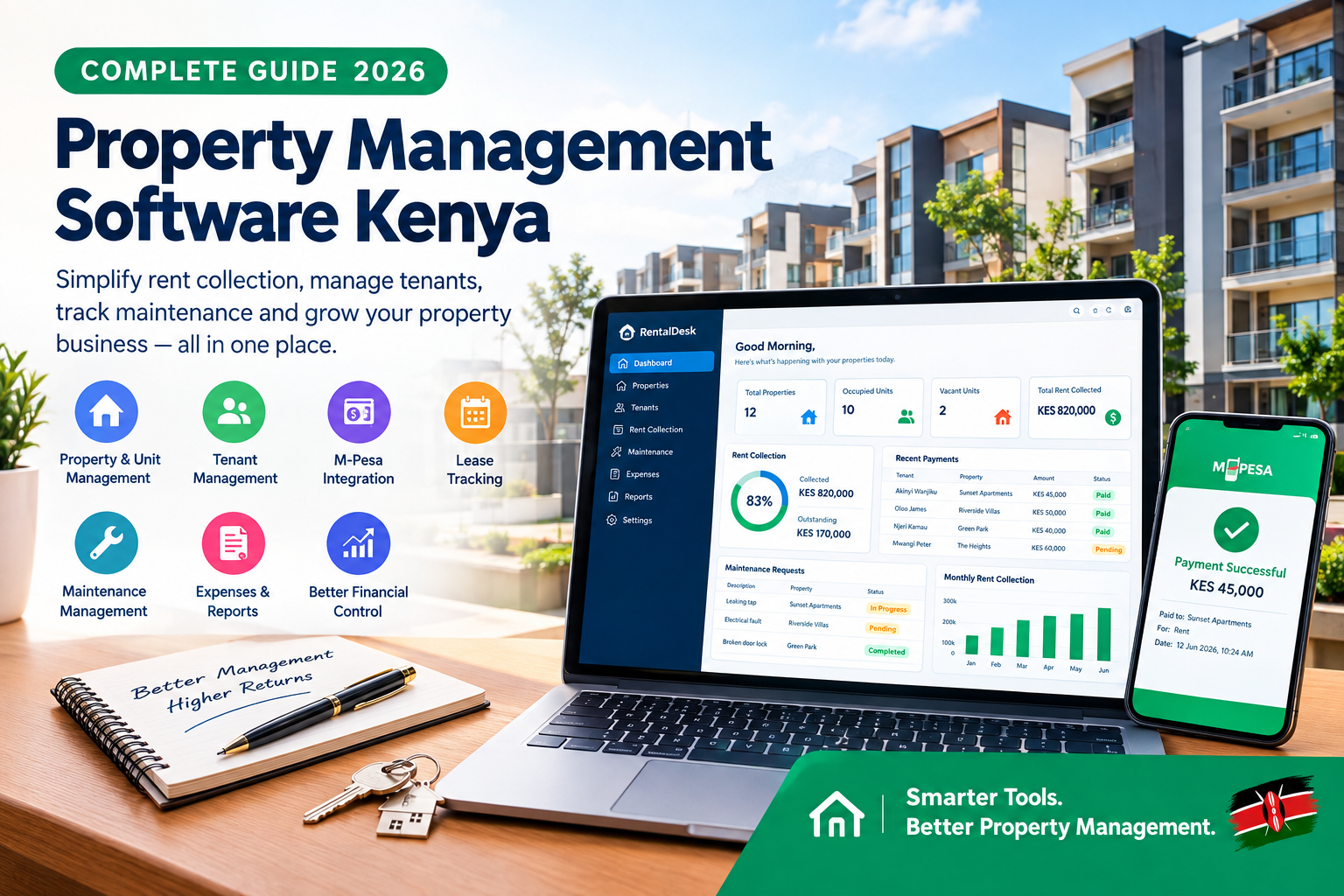
A modern property management system brings property records, tenants, rent collection, leases, maintenance, expenses and reports into one centralized platform. Instead of managing different parts of your rental business separately, you can monitor your entire portfolio from one dashboard.
In this complete 2026 guide, we explain what property management software Kenya users need, the most important features to look for, the benefits for landlords and property managers, and how to choose the right system for your rental business.
What Is Property Management Software?
Property management software is a digital system designed to help landlords, property managers, real estate companies and property owners manage rental properties more efficiently.
Instead of relying on multiple spreadsheets and physical files, a property management system allows you to organize important information in one place.
Depending on the system, you can manage:
- Properties and rental units
- Tenants
- Rent payments
- Rent arrears
- M-Pesa transactions
- Lease agreements
- Deposits
- Maintenance requests
- Expenses
- Vacant units
- Invoices and receipts
- Property reports
- Staff and caretaker activities
- Tenant communication
For Kenyan property owners, the most useful systems are designed around local rental workflows, including mobile money payments and automated rent tracking.
Why Property Management Software Is Important in Kenya
The number of rental units managed by individual landlords, property managers and real estate companies continues to increase. With more properties comes more administrative work.
A landlord managing 5 units may be able to use a spreadsheet. Managing 50, 100 or 500 units is a completely different challenge.
Common problems include:
1. Late Rent Payments
Following up with every tenant manually can consume a significant amount of time.
A property management system can help property managers identify outstanding balances and send rent reminders without relying entirely on manual follow-ups.
2. Difficult M-Pesa Reconciliation
M-Pesa is an important part of rent collection in Kenya. However, receiving payment notifications is not the same as maintaining an accurate rental ledger.
A good system should help connect payments with the correct tenant, property and rental account.
3. Lost Tenant Records
Tenant information stored in notebooks, different spreadsheets and phone contacts can become difficult to manage.
Property management software creates centralized tenant profiles where important information can be organized and accessed when required.
4. Poor Maintenance Tracking
Maintenance requests can easily get lost in WhatsApp conversations or phone calls.
A property management system can allow managers to record maintenance issues, assign tasks, monitor progress and keep a history of completed work.
5. Lack of Financial Visibility
Without accurate reports, it can be difficult to know how much rent has been collected, how much remains outstanding and how much has been spent on property maintenance.
A centralized system provides better visibility into property performance.
Key Features of Property Management Software Kenya Landlords Should Look For
Not every property management system offers the same capabilities. Before choosing software, consider whether it includes the features that matter most to your rental business.
1. Property and Unit Management
The system should allow you to create and organize your properties and individual units.
For example, you may manage:
- Apartment buildings
- Bedsitters
- Residential houses
- Commercial shops
- Offices
- Student accommodation
- Gated estates
- Mixed-use properties
You should be able to see which units are occupied, vacant or under maintenance.
2. Tenant Management
A tenant management system keeps tenant information organized.
Depending on the software, you can record:
- Tenant name
- Contact details
- Property and unit
- Rent amount
- Deposit
- Lease information
- Payment history
- Outstanding balances
- Important documents
This reduces the need to search through paper files or different spreadsheets.
3. Automated Rent Collection
Rent collection is one of the most important functions of property management software.
A good system can help you:
- Generate rent invoices
- Track payments
- Identify overdue accounts
- Monitor arrears
- Send reminders
- Generate receipts
- Maintain tenant payment histories
The goal is to make the rent cycle easier to monitor from billing to payment confirmation.
4. M-Pesa Integration
For Kenyan landlords, M-Pesa functionality should be one of the first features to investigate.
A suitable property management system should make it easier to connect mobile money payments with tenant accounts and rental records.
This can reduce manual reconciliation and improve payment visibility.
5. Rent Arrears Tracking
Knowing exactly who owes rent is critical for property managers.
Instead of checking multiple spreadsheets or M-Pesa messages, a centralized dashboard can show:
- Paid rent
- Part payments
- Outstanding balances
- Overdue rent
- Previous balances
- Payment history
This allows property managers to prioritize follow-ups.
6. Lease Management
Lease management helps landlords keep track of important tenancy dates.
A system can be used to monitor:
- Lease start dates
- Lease expiry dates
- Rent review dates
- Deposits
- Tenant agreements
- Renewal dates
Automated notifications can also help reduce the risk of missing important deadlines.
7. Maintenance Management
Property maintenance directly affects tenant satisfaction and property value.
A good property management system should allow tenants or staff to report issues and allow managers to track the work.
A typical workflow may include:
Maintenance request → Assignment → Work in progress → Completion → Cost recording
This creates a clearer history of property repairs.
8. Expense Tracking
Property owners need to understand not only their rental income but also their operating expenses.
Property management software can help record expenses such as:
- Repairs
- Plumbing
- Electrical work
- Cleaning
- Security
- Property supplies
- Maintenance materials
- Service providers
This makes it easier to understand the actual performance of a property.
9. Reports and Dashboards
A dashboard gives landlords and property managers a quick overview of their portfolio.
Useful reports can include:
- Rent collection reports
- Arrears reports
- Occupancy reports
- Tenant statements
- Income reports
- Expense reports
- Maintenance reports
- Property performance reports
The right reports can help property owners make decisions using current information instead of outdated spreadsheets.
Benefits of Property Management Software in Kenya
Saves Time
Automating repetitive tasks reduces the amount of time spent on manual data entry, rent follow-ups and reporting.
Reduces Human Errors
Manual records can contain duplicate entries, incorrect balances and missing information. Centralizing records can help reduce these problems.
Improves Rent Collection
Automated reminders, payment tracking and clearer tenant balances can make rent collection easier to manage.
Improves Tenant Communication
Tenants can receive clearer information about payments, balances, notices and maintenance requests.
Makes Property Management More Professional
A centralized system gives landlords and property managers a more organized way to operate their rental businesses.
Provides Better Financial Control
Property owners can monitor income, expenses, arrears and property performance from one system.
Supports Portfolio Growth
A good property management system should continue to work as your number of properties and tenants increases.
Property Management Software vs Excel Spreadsheets
Excel is useful for basic record keeping, but it has limitations when managing a growing rental portfolio.
| Feature | Excel Spreadsheet | Property Management Software |
|---|---|---|
| Tenant records | Manual | Centralized |
| Rent tracking | Manual | Automated/centralized |
| M-Pesa workflows | Usually manual | Can be integrated |
| Rent reminders | Manual | Can be automated |
| Maintenance | Separate tracking | Built-in workflow |
| Reports | Manual preparation | Automated reports |
| Lease tracking | Manual | Centralized |
| Portfolio dashboard | Limited | Available |
| Multi-user access | Possible but limited | Designed for teams |
| Scalability | Becomes difficult | Designed for growing portfolios |
The question is not whether Excel can manage rental information. It can.
The question is whether it can efficiently manage a growing property portfolio without creating additional administrative work.
Who Needs Property Management Software in Kenya?
Property management software can be useful for different types of rental businesses.
Individual Landlords
If you own several rental units, software can help you track rent, tenants, expenses and maintenance without relying on multiple spreadsheets.
Property Managers
Professional property managers can use software to manage multiple properties and provide owners with clearer reports.
Real Estate Agencies
Agencies managing rental properties for clients can centralize tenant, property and financial information.
Apartment Managers
Apartment managers can monitor occupancy, rent collection, tenant issues and maintenance from one platform.
Commercial Property Owners
Commercial landlords can use property management software to manage offices, shops and other commercial units.
Student Housing Managers
Student accommodation often involves large numbers of tenants and frequent tenant changes. Centralized records can make administration easier.
How to Choose the Best Property Management Software in Kenya
Choosing the right system requires more than comparing feature lists.
Consider the following factors.
1. Does It Support Kenyan Payment Methods?
If your tenants primarily pay through M-Pesa, make sure the system supports the payment workflow you actually use.
2. Is It Easy to Use?
A complicated system can create more problems than it solves.
Look for a platform that landlords, accountants, property managers, caretakers and other staff can understand quickly.
3. Can It Manage Multiple Properties?
If you expect your portfolio to grow, choose software that can manage multiple buildings, units and tenants.
4. Does It Provide Accurate Reports?
Reports should make it easier to understand rent collection, arrears, expenses and property performance.
5. Can Tenants Interact With the System?
Tenant-facing features can make communication and payment management easier.
6. Is the System Cloud-Based?
Cloud-based property management software allows authorized users to access information from different locations using an internet-connected device.
7. Is Customer Support Available?
When dealing with rent collection and financial records, reliable support is important.
8. Is the Pricing Suitable for Your Portfolio?
Compare the software cost with the amount of administrative work it can save and the improvements it can make to your rental operations.
How Property Management Software Works
A typical rental management workflow can look like this:
Step 1: Add Your Property
Create the property and add buildings, floors and units.
Step 2: Add Tenants
Enter tenant information and assign each tenant to the correct unit.
Step 3: Set Rental Details
Record rent amounts, deposits, billing dates and other relevant charges.
Step 4: Generate Rent Charges
The system records the amount expected from each tenant.
Step 5: Receive and Record Payments
Payments are recorded against the relevant tenant account.
Step 6: Monitor Arrears
The dashboard shows outstanding balances that require follow-up.
Step 7: Manage Maintenance
Record tenant maintenance requests, assign tasks and monitor completion.
Step 8: Generate Reports
Generate reports covering rent, tenants, expenses, arrears and property performance.
This creates a more structured rental management process than keeping information in separate notebooks, spreadsheets and messaging applications.
Why M-Pesa Matters in Kenyan Property Management
One of the biggest differences between property management in Kenya and some international markets is the importance of mobile money.
Many rental businesses receive payments through M-Pesa. Therefore, property management software designed for Kenya should consider the entire payment journey.
A strong workflow should connect:
Tenant → Rent Invoice → Payment → Tenant Account → Receipt → Property Report
This reduces the need to manually transfer information between different systems.
Current Kenyan property-management platforms increasingly highlight M-Pesa collection and reconciliation as core features, demonstrating how important this workflow has become.
Property Management Software and KRA Records
Financial record keeping is another important consideration for Kenyan landlords and property managers.
When evaluating software, ask how the platform handles invoices, receipts, income records, expenses and tax-related reporting.
If your business has specific tax or eTIMS requirements, confirm directly with the software provider and your tax professional that the system supports your particular compliance needs.
How Much Does Property Management Software Cost in Kenya?
The cost of property management software varies depending on the provider, number of units, features and pricing model.
Some systems charge according to:
- Number of properties
- Number of units
- Number of tenants
- Number of users
- Monthly subscription
- Annual subscription
- Transaction volume
Instead of choosing software based only on the cheapest price, compare the total value.
For example, consider how much time your team spends on:
- Rent follow-ups
- Payment reconciliation
- Preparing reports
- Tracking maintenance
- Updating spreadsheets
- Answering tenant balance questions
A system that reduces these tasks can provide value beyond its monthly subscription cost.
Common Mistakes to Avoid When Choosing Property Management Software
Choosing Based Only on Price
The cheapest system may not have the features your portfolio requires.
Ignoring M-Pesa Workflows
A system may look impressive but still create additional work if it does not fit your payment process.
Choosing Complicated Software
If staff and tenants cannot use the platform easily, adoption becomes difficult.
Failing to Check Reports
Always test the reports before committing to a system.
Not Considering Future Growth
Choose software that can accommodate your expected portfolio growth.
Keeping Data in Too Many Places
The purpose of property management software is to centralize information. Avoid systems that require you to continue maintaining multiple disconnected records.
Property Management Software Kenya: What Should You Prioritize in 2026?
In 2026, property owners should focus on software that solves real operational problems rather than simply choosing a platform with the longest feature list.
Prioritize:
- Reliable rent tracking
- M-Pesa payment workflows
- Tenant management
- Automated rent reminders
- Arrears tracking
- Lease management
- Maintenance management
- Expense tracking
- Financial reporting
- Mobile and cloud accessibility
- User permissions
- Data security
- Reliable customer support
The best system is ultimately the one that fits your property’s workflow.
Frequently Asked Questions About Property Management Software Kenya
What is the best property management software in Kenya?
The best property management software depends on your property type, number of units, budget and required features. Compare systems based on rent collection, M-Pesa workflows, tenant management, maintenance, reporting, ease of use and scalability.
Is property management software suitable for small landlords?
Yes. Small landlords can use property management software to organize tenants, rent payments, maintenance and financial records before their portfolio becomes difficult to manage manually.
Can property management software collect rent through M-Pesa?
Some property management platforms support M-Pesa-based rent collection and payment reconciliation. Always confirm the exact M-Pesa integration offered by the provider.
Can property management software track rent arrears?
Yes. Many systems provide tenant ledgers and arrears reports that show outstanding balances and payment history.
Can property management software manage multiple properties?
Yes. Multi-property management is one of the main advantages of using dedicated property management software instead of separate spreadsheets.
Can tenants use property management software?
Some platforms provide tenant portals or tenant-facing features that allow tenants to view balances, make payments, report maintenance issues and access relevant information.
Is property management software better than Excel?
For a growing rental portfolio, dedicated property management software can provide automation, centralized records, payment tracking, maintenance workflows and reporting that are difficult to maintain manually in Excel.
What should I look for in property management software in Kenya?
Start with the features that directly affect your daily operations: rent collection, M-Pesa support, tenant management, arrears tracking, lease management, maintenance, expenses, reports and ease of use.
Managing rental properties manually can become increasingly difficult as the number of units and tenants grows.
Property management software Kenya landlords and property managers use can bring rent collection, tenant records, maintenance, leases, expenses and reporting into one organized system.
The right platform should not simply store information. It should help you answer important questions quickly:
Who has paid rent? Who has an outstanding balance? Which units are vacant? Which leases are expiring? What maintenance issues are pending? How much income has the property generated?
For landlords and property managers looking to modernize their rental operations in 2026, investing in the right property management system in Kenya can provide better organization, visibility and control.
If you are currently managing properties through spreadsheets, notebooks, M-Pesa messages and WhatsApp, this is a good time to evaluate whether a dedicated property management system can simplify your daily operations.