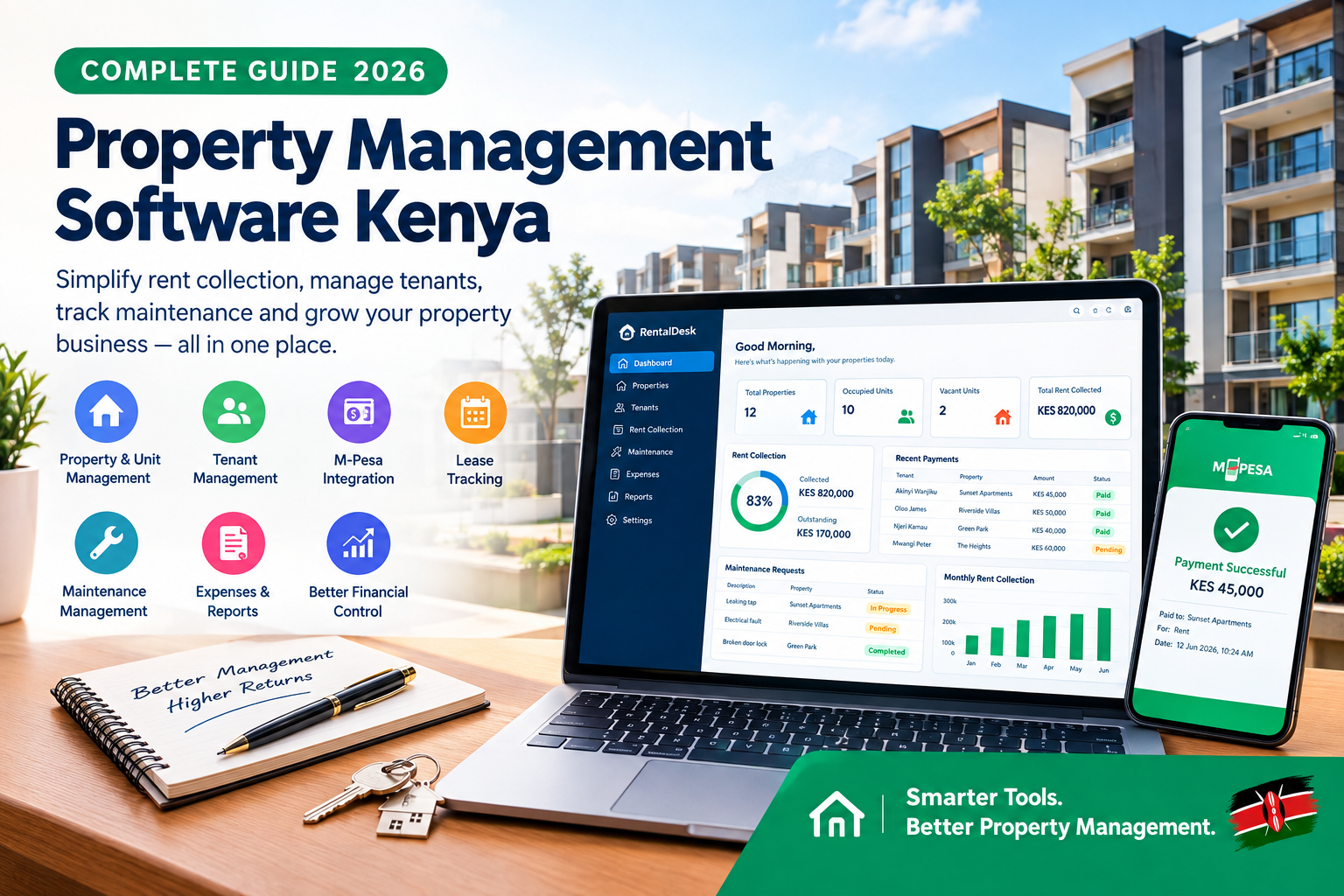
 Managing an apartment building involves much more than collecting rent. Landlords and property managers have to keep track of tenants, rental units, payments, arrears, leases, maintenance, vacancies, expenses, service charges and financial reports.
When these activities are managed using notebooks, spreadsheets, paper receipts, WhatsApp messages and separate payment records, it can become difficult to maintain accurate information as the number of apartments grows.
This is where Apartment Management Software Kenya becomes valuable.
Modern apartment management software helps landlords, property managers, estate managers and real estate companies centralize their rental operations in one system. Instead of managing every task manually, property teams can use technology to organize tenants, units, rent collection, maintenance and financial information.
In this complete 2026 guide, we explain what apartment management software is, its key features, benefits, how it works and what to consider when choosing an apartment management system in Kenya.
What Is Apartment Management Software?
Apartment management software is a digital platform designed to help property owners and managers operate apartment buildings more efficiently.
The software brings important property management activities into one centralized platform.
Depending on the system, apartment managers can use it to manage:
- Apartment buildings
- Rental units
- Tenants
- Rent payments
- Rent invoices
- Arrears
- Lease agreements
- Deposits
- Maintenance requests
- Vacant units
- Service charges
- Utility billing
- Property expenses
- Tenant communication
- Financial reports
Instead of maintaining separate records for each activity, an apartment management system gives managers a central place to monitor the property.
Why Apartment Management Software Kenya Is Important
Apartment buildings can contain dozens or hundreds of rental units. As the number of units increases, managing everything manually becomes more complicated.
A property manager may need to answer questions such as:
- Which tenants have paid rent?
- Who has outstanding rent?
- Which apartments are vacant?
- Which leases are expiring?
- Which maintenance requests are pending?
- How much rent was collected this month?
- How much is still outstanding?
- How much was spent on repairs?
- Which tenants have outstanding service charges?
Finding these answers manually can take considerable time.
With Apartment Management Software Kenya, this information can be organized in one system, giving landlords and managers better visibility over their properties.
Key Features of Apartment Management Software
The best apartment management system should provide features that solve the everyday challenges faced by landlords and property managers.
1. Apartment and Unit Management
Apartment management starts with knowing exactly what units you have and their current status.
A good system should allow you to organize:
- Apartment blocks
- Floors
- Unit numbers
- Unit types
- Rental prices
- Occupancy status
- Vacant units
- Occupied units
- Units under maintenance
This makes it easier to see the overall status of an apartment building.
For example, a manager with 100 units should be able to see how many are occupied, vacant or unavailable without checking several spreadsheets.
2. Tenant Management
Tenant records are one of the most important parts of apartment management.
A tenant management module can help store:
- Tenant names
- Phone numbers
- Email addresses
- Assigned apartment
- Rent amount
- Deposit
- Lease details
- Payment history
- Outstanding balances
- Move-in information
- Move-out information
Centralized tenant records reduce the risk of losing important information.
3. Automated Rent Collection
Rent collection is one of the biggest responsibilities of an apartment manager.
Apartment management software can help automate the rent cycle from billing to payment tracking.
The system can help managers:
- Generate rent invoices
- Record payments
- Track payment dates
- Identify overdue accounts
- Monitor partial payments
- Send payment reminders
- Generate receipts
- Produce tenant statements
This makes rent management more organized and reduces dependence on manual records.
4. M-Pesa Rent Management
M-Pesa is an important part of rental payment management in Kenya.
For this reason, landlords searching for apartment management software Kenya should pay particular attention to how a platform handles M-Pesa payments.
A suitable system can help connect payments with tenant accounts and make it easier to reconcile rent received against the correct apartment.
A typical workflow can look like:
Tenant → Rent Invoice → M-Pesa Payment → Payment Confirmation → Tenant Ledger → Receipt
This creates a more structured rent collection process.
5. Rent Arrears Tracking
Late and unpaid rent can affect the cash flow of an apartment building.
An apartment management system can help identify tenants with outstanding balances.
Managers can monitor:
- Current rent due
- Previous balances
- Partial payments
- Overdue rent
- Outstanding service charges
- Payment history
Instead of manually calculating balances, managers can use the system to identify accounts that require attention.
6. Lease Management
Managing lease agreements becomes increasingly difficult when there are many tenants.
Apartment management software can help organize:
- Lease start dates
- Lease expiry dates
- Renewal dates
- Deposit information
- Rent amounts
- Tenant agreements
- Important documents
Lease tracking can help managers avoid missing important tenancy dates.
7. Maintenance Management
Maintenance is a major part of running an apartment building.
Common issues include:
- Plumbing problems
- Electrical faults
- Broken doors
- Water problems
- Drainage issues
- Damaged fixtures
- General repairs
Instead of relying entirely on phone calls and WhatsApp messages, a property manager can record maintenance requests inside the apartment management system.
A typical process is:
Tenant reports issue → Manager records request → Technician assigned → Repair completed → Cost recorded
This creates a maintenance history for the property.
8. Vacancy Management
Vacant apartments represent potential lost rental income.
An apartment management system can help managers identify vacant units quickly.
You can track:
- Vacant units
- Occupied units
- Units awaiting tenants
- Units under maintenance
- Available rental prices
- Previous tenants
This makes it easier to understand occupancy across the apartment building.
9. Expense Management
Rent income is only one side of apartment management.
Property owners also need to monitor expenses such as:
- Repairs
- Cleaning
- Security
- Plumbing
- Electrical work
- Landscaping
- Maintenance materials
- Service providers
- Property administration
Recording expenses in the same system as rental income makes financial reporting easier.
10. Financial Reporting
Property owners need accurate information to understand how their apartment investments are performing.
Apartment management software can provide reports such as:
- Rent collection reports
- Arrears reports
- Tenant statements
- Income reports
- Expense reports
- Occupancy reports
- Maintenance reports
- Payment reports
Instead of spending hours preparing reports manually, managers can generate information from centralized property records.
Benefits of Apartment Management Software in Kenya
Saves Time
Automation reduces repetitive administrative work.
Managers can spend less time updating spreadsheets, calculating balances and searching through payment messages.
Improves Rent Collection
Clear payment records and automated reminders can make it easier to monitor rent collection and follow up on outstanding accounts.
Reduces Errors
Manual data entry can result in incorrect balances, duplicate records and missing information. Centralized software can reduce these risks.
Improves Tenant Service
Tenants benefit when payment records, statements and maintenance requests can be handled more efficiently.
Improves Financial Visibility
Landlords can see rental income, expenses and outstanding balances in a more organized way.
Makes Apartment Management More Professional
Digital records, automated receipts and structured reporting can create a more professional management process.
Supports Portfolio Growth
A system that supports multiple properties and units allows property managers to expand without having to completely change their management process.
Apartment Management Software vs Excel
Excel spreadsheets can be useful for small rental operations. However, they can become difficult to manage as the number of tenants and units increases.
| Feature | Excel | Apartment Management Software |
|---|---|---|
| Tenant records | Manual | Centralized |
| Rent tracking | Manual | Automated/centralized |
| Arrears tracking | Manual | Dedicated tracking |
| M-Pesa workflow | Usually manual | Can be integrated |
| Maintenance | Separate records | Built-in workflow |
| Lease tracking | Manual | Centralized |
| Reports | Often manual | Automated |
| Multiple properties | Possible but complex | Designed for it |
| Tenant communication | Separate tools | Can be integrated |
| Dashboard | Limited | Usually available |
Excel is not necessarily bad. The problem is that a growing apartment business needs more than a spreadsheet can conveniently provide.
Who Should Use Apartment Management Software?
Apartment Landlords
Landlords with multiple rental units can use software to keep tenant and payment records organized.
Property Managers
Professional property managers can manage several apartment buildings from one centralized platform.
Real Estate Companies
Real estate companies managing rental properties for multiple owners can use apartment management software to organize their portfolios.
Estate Managers
Estate managers can use software to coordinate tenants, payments, maintenance and property reports.
Apartment Management Companies
Companies responsible for day-to-day apartment operations can use centralized software to improve accountability and reporting.
How Apartment Management Software Works
A typical apartment management workflow can be divided into several stages.
Step 1: Add Your Apartment Building
Create the property and enter the relevant apartment blocks, floors and units.
Step 2: Add Tenants
Create tenant profiles and assign each tenant to the correct apartment.
Step 3: Configure Rent
Set the rent amount, billing cycle, deposits and other applicable charges.
Step 4: Generate Rent Charges
The system records the amount expected from each tenant.
Step 5: Record Payments
Payments are matched with the appropriate tenant and apartment account.
Step 6: Monitor Arrears
The system identifies outstanding balances for follow-up.
Step 7: Manage Maintenance
Record maintenance requests, assign work and monitor completion.
Step 8: Generate Reports
Managers can generate reports covering rent, arrears, tenants, expenses and occupancy.
This creates a structured management cycle from tenant onboarding to monthly reporting.
What Makes a Good Apartment Management System in Kenya?
Not every software platform is designed for the same market.
When choosing Apartment Management Software Kenya, consider whether the platform fits the way your apartment business operates.
M-Pesa Support
Since mobile money is widely used for rental payments in Kenya, check whether the platform supports your preferred M-Pesa workflow.
Easy Rent Tracking
The system should make it easy to see what has been billed, paid and remains outstanding.
Multiple Unit Management
Choose software that can handle your current number of units and your expected future growth.
Tenant Statements
Tenants and managers should be able to access clear payment histories and balances.
Maintenance Tracking
The platform should allow you to record and follow maintenance requests.
Financial Reports
Reports should help you understand the financial performance of your apartment properties.
Cloud Access
Cloud-based software can allow authorized users to access property information from different locations.
User Permissions
If you have caretakers, accountants, property managers or other staff, look for user-access controls that allow you to determine what each person can access.
Data Security
Tenant and financial information should be protected through appropriate security controls, backups and access management.
How Much Does Apartment Management Software Cost in Kenya?
The cost of apartment management software depends on several factors.
Pricing may be based on:
- Number of units
- Number of properties
- Number of tenants
- Number of users
- Features
- Monthly subscription
- Annual subscription
- Custom integrations
Instead of choosing software based only on price, compare the overall value.
Consider how much time your team currently spends on:
- Rent collection
- Payment reconciliation
- Tenant follow-ups
- Preparing reports
- Maintenance tracking
- Updating spreadsheets
- Calculating arrears
Software that reduces these tasks may provide significant operational value.
Common Apartment Management Problems Software Can Solve
Problem 1: Too Many Spreadsheets
A centralized system reduces the need for multiple spreadsheets.
Problem 2: Difficult Rent Reconciliation
Digital payment records can make it easier to connect payments with tenant accounts.
Problem 3: Unclear Arrears
A rent ledger provides clearer information about outstanding balances.
Problem 4: Lost Maintenance Requests
Maintenance tickets keep repair requests organized.
Problem 5: Missing Tenant Information
Centralized profiles make tenant information easier to retrieve.
Problem 6: Slow Reporting
Automated reports reduce the need to prepare every report manually.
Problem 7: Poor Vacancy Visibility
A unit management dashboard can show occupied and vacant apartments.
Apartment Management Software and Tenant Experience
Good apartment management is not only about collecting rent.
Tenant experience also matters.
Tenants expect property managers to:
- Confirm payments
- Provide accurate statements
- Respond to maintenance requests
- Communicate important notices
- Resolve issues efficiently
- Keep accurate records
Apartment management software can help create a more organized communication process.
When tenants can receive clear payment information and their maintenance requests are properly recorded, misunderstandings can be reduced.
Apartment Management Software for Growing Property Portfolios
A landlord may start with a few apartments and gradually acquire more properties.
At first, manual management may appear manageable.
But growth introduces additional complexity:
10 units → 50 units → 100 units → 500+ units
At each stage, the number of tenant records, payments, maintenance requests and financial transactions increases.
This is why scalability should be considered when selecting an apartment management system Kenya landlords can use for long-term growth.
The software should make it easier to add:
- New properties
- New apartment blocks
- New units
- New tenants
- New staff users
without creating a completely separate management process.
Questions to Ask Before Buying Apartment Management Software
Before choosing a platform, ask:
- Can it manage multiple apartment buildings?
- Can it manage hundreds of rental units?
- Does it support M-Pesa payment workflows?
- Can it track rent arrears?
- Can it generate tenant statements?
- Can it manage leases?
- Can it track maintenance requests?
- Can it record expenses?
- Can it generate financial reports?
- Can different staff members have different access levels?
- Is the system accessible from mobile devices?
- What customer support is provided?
- How is property and tenant data protected?
- Can the system grow with the business?
These questions can help you avoid choosing software that looks good but does not solve your actual property management challenges.
Why Kenyan Apartment Managers Are Moving Toward Digital Systems
Traditional apartment management often involves several disconnected tools.
A landlord may receive a payment notification on a phone, record it in a spreadsheet, communicate with the tenant through WhatsApp and keep a physical receipt.
When the number of tenants grows, this process becomes difficult to maintain.
Modern property management systems are designed to bring these activities into a more centralized workflow. Kenyan platforms commonly emphasize features such as M-Pesa payments, tenant management, arrears, maintenance and reporting because these are important parts of local rental operations.
Frequently Asked Questions
What is apartment management software in Kenya?
Apartment management software is a digital system that helps landlords and property managers manage apartment units, tenants, rent, payments, arrears, maintenance, expenses and reports from a centralized platform.
What is the best apartment management software in Kenya?
The best system depends on the size of your apartment portfolio, budget and required features. Compare platforms based on rent collection, M-Pesa support, tenant management, maintenance, reporting, security and scalability.
Can apartment management software manage M-Pesa rent payments?
Some apartment management platforms support M-Pesa payment workflows and reconciliation. Always confirm the exact integration and payment process provided by the software vendor.
Can I manage multiple apartment buildings using one system?
Yes. Many modern apartment management systems are designed to support multiple properties, buildings, units and tenants from one account.
Can apartment software track rent arrears?
Yes. Rent and tenant management modules can track outstanding balances, payment history and overdue accounts.
Can apartment management software manage maintenance?
Yes. Depending on the platform, managers can record maintenance requests, assign tasks, monitor progress and keep maintenance histories.
Is apartment management software suitable for small landlords?
Yes. Small landlords can use software to organize rental records from the beginning and have a system that can grow as their property portfolio expands.
Is apartment management software better than Excel?
For larger apartment portfolios, dedicated software can provide automation, tenant management, payment tracking, maintenance workflows and reporting that are more difficult to manage using spreadsheets alone.
Managing an apartment building requires accurate information, consistent rent collection and efficient communication.
As the number of tenants and rental units increases, manual processes can become increasingly difficult to control.
Apartment Management Software Kenya gives landlords, property managers and real estate companies a way to centralize their rental operations.
From tenant management and rent collection to M-Pesa payments, arrears, maintenance, vacancies, expenses and financial reports, the right apartment management system can help turn a complicated rental operation into a more organized business.
When choosing software, focus on the features that solve your actual problems. Look for reliable rent tracking, tenant management, M-Pesa support, maintenance management, financial reporting, security, ease of use and scalability.
The goal is not simply to digitize your records.
The goal is to manage apartments more efficiently, reduce administrative work, improve visibility and create a better experience for both property managers and tenants.
Related Topics to Build Your SEO Authority
For stronger topical coverage around Apartment Management Software Kenya, consider publishing supporting articles such as:
- Apartment Management System Kenya
- Best Property Management Software Kenya
- Rental Management Software Kenya
- Rent Collection Software Kenya
- M-Pesa Rent Collection Software Kenya
- Tenant Management System Kenya
- Estate Management Software Kenya
- Landlord Management Software Kenya
- Property Management System Kenya
- How to Manage Apartment Rent in Kenya
- How to Track Rental Arrears in Kenya
- Apartment Maintenance Management Software
- Rental Property Accounting Software Kenya
- Service Charge Management Software Kenya