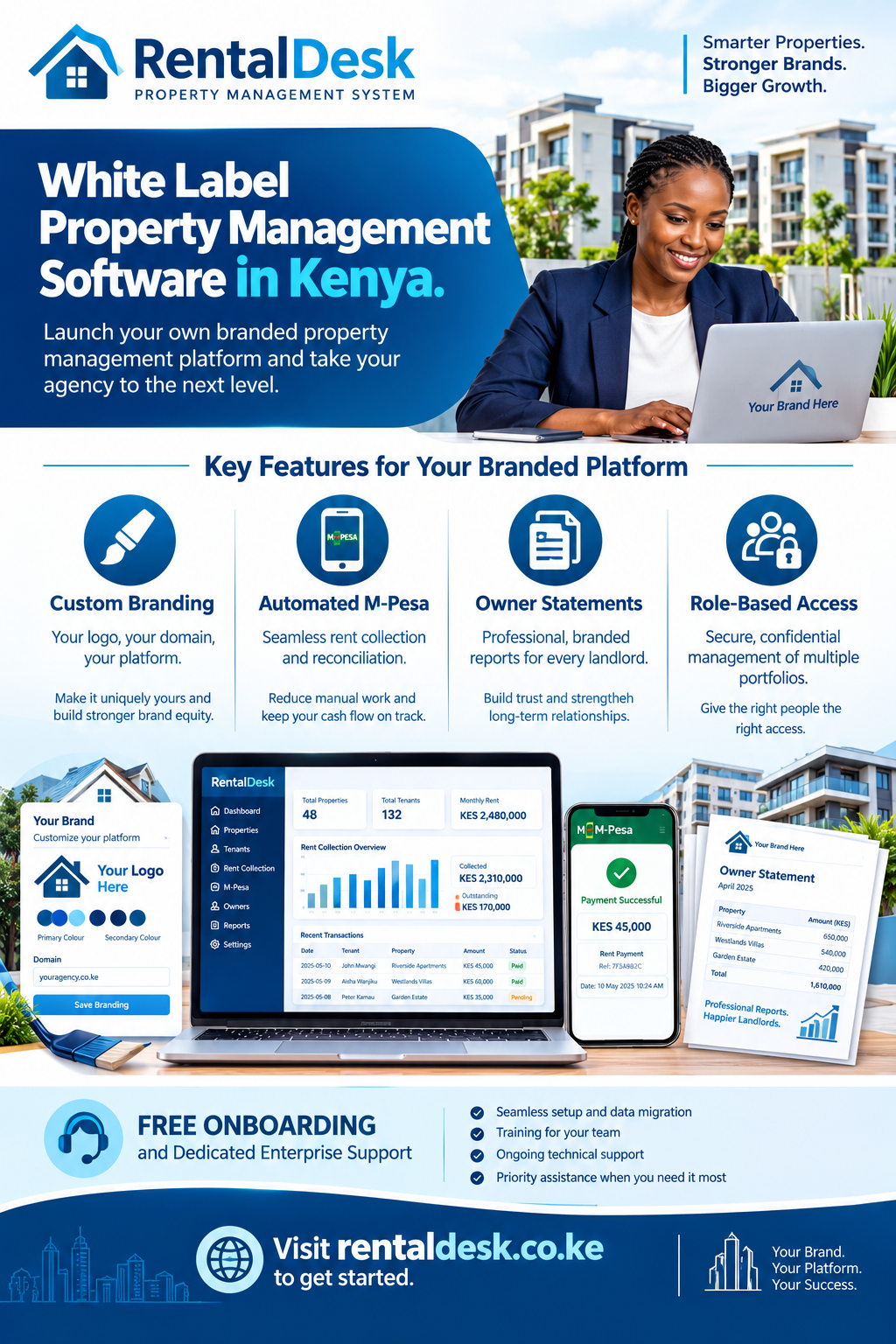
White label property management software in Kenya is the strategic tool that allows property management agencies to offer a powerful, fully branded digital platform to their clients without building the technology from scratch. As the Kenyan rental market becomes increasingly digitised, landlords expect real-time visibility, automated M-Pesa reconciliation, and digital receipts.
Agencies that rely on spreadsheets or generic software are struggling to keep pace. White label software solves this by giving the agency a customised platform that carries their logo, their domain, and their brand identity. RentalDesk provides a robust foundation for this model, enabling agencies to scale their operations and deliver premium service.
Why Agencies Need White Label Property Management Software in Kenya
The demand for white label property management software in Kenya is driven by the need for agencies to differentiate themselves. When an agency uses a standard, off-the-shelf tool, the landlord sees the software vendor’s brand, not the agency’s.
This dilutes the agency’s brand equity. A white label solution puts the agency front and centre. The landlord logs into a portal branded with the agency’s name. This builds trust and reinforces the agency’s professional image.
Furthermore, white label software allows agencies to create new revenue streams. They can bundle the software access into their management fee or offer it as a standalone SaaS product to smaller landlords. This transforms the agency from a service provider into a technology-enabled partner.
What Does White Label Actually Mean in Property Management?
In the context of white label property management software in Kenya, white labeling means customising the software to look and feel like the agency’s own proprietary technology. This goes beyond just swapping a logo.
It involves mapping a custom domain (such as portal.youragency.co.ke) to the platform. It means customising the login screens, the email notifications, and the PDF reports. When a tenant or landlord receives a statement, it carries the agency’s branding.
The underlying engine remains the same, handling the complex M-Pesa API integrations, accounting ledgers, and database management. But the user experience is entirely owned by the agency.
Key Features of White Label Property Management Software in Kenya
When evaluating white label property management software in Kenya, agencies should look for a platform that combines deep local integration with robust branding capabilities.
1. Custom Branding and Domain Mapping
The software must allow the agency to upload its logo and set its brand colours. It should support CNAME mapping so the portal operates on the agency’s domain. This creates a seamless, professional experience for the client.
2. M-Pesa Rent Collection and Reconciliation
The foundation of any successful rental operation in Kenya is M-Pesa. The white label platform must integrate directly with Safaricom’s Daraja API.
It should support STK Push and Paybill transactions. When a tenant pays, the system should automatically match the payment to the correct invoice. This eliminates manual data entry and ensures the agency’s ledgers are always accurate.
3. Multi-Owner and Multi-Property Hierarchy
An agency manages properties for multiple landlords. The software must maintain strict boundaries between these portfolios.
The white label platform should provide a consolidated dashboard for the agency, while giving each landlord a restricted view of their own properties. This ensures client confidentiality and simplifies reporting.
4. Automated Invoicing and Receipts
The system should generate invoices automatically based on the lease terms. When a payment is received, a digital receipt should be issued instantly.
These documents should carry the agency’s branding. This level of automation reduces the administrative burden on the agency and improves the tenant experience.
5. Owner Statements and Trust Accounting
Agencies must provide landlords with transparent financial statements. The software should generate monthly owner statements showing rent collected, expenses incurred, and the net remittance.
For agencies operating client accounts, the software should support trust accounting, ensuring that client funds are tracked separately from agency operating funds.
6. Role-Based Access and Client Confidentiality
The platform must allow the agency to assign different levels of access to its staff. Property managers, accountants, and caretakers should each see only what they need to see.
This prevents data leaks and ensures accountability. Every action within the system should be logged with a timestamp and user identification.
7. Maintenance Tracking and Vendor Management
Tenants should be able to submit maintenance requests through the branded portal. The agency can then assign these requests to vendors and track the progress.
This creates a complete audit trail of the repair process, which is essential for owner reporting.
8. KRA Compliance and eRITS Reporting
The Kenya Revenue Authority requires landlords to maintain accurate records for tax purposes. The software must generate rent registers, collection summaries, and financial reports suitable for eRITS filing.
The Financial Case for White Label Property Management Software in Kenya
Investing in white label property management software in Kenya is a strategic decision that impacts the agency’s bottom line in three ways.
First, it reduces administrative costs. By automating rent collection, reconciliation, and reporting, the agency can manage more units with the same number of staff.
Second, it increases client retention. Landlords are less likely to leave an agency that provides a superior, branded digital experience. The transparency and real-time data build trust.
Third, it opens up new revenue opportunities. The agency can charge a premium for the software platform or monetise the data insights.
How RentalDesk Supports White Label Operations
RentalDesk is built specifically for the Kenyan market and provides an excellent foundation for agencies looking to offer white label solutions.
While RentalDesk offers standard plans for growing agencies, its Enterprise tier supports white labeling for portfolios exceeding 1,000 units. The platform combines M-Pesa automation, multi-owner reporting, and role-based access into one secure system.
M-Pesa Integration: The Non-Negotiable Foundation of White Label Property Management Software in Kenya
Any white label property management software in Kenya that does not deeply integrate with M-Pesa is not fit for purpose. Over 90% of rent payments in urban Kenya flow through mobile money.
RentalDesk connects directly to Safaricom’s Daraja API with Instant Payment Notification callbacks. When a tenant pays via the branded portal, the system extracts the amount, phone number, and account reference.
It matches the payment to the correct tenant and unit. It credits the account, generates a branded receipt, and updates the dashboard in real time. This real-time flow of funds is essential for maintaining accurate agency ledgers.
Reconciliation Depth and Partial Payments
A white label platform must handle the realities of Kenyan tenant behaviour. Tenants often pay in instalments or use the wrong account reference.
The system must post partial payments against the open invoice and leave the balance visible. It must route third-party payments to a reconciliation queue with a full audit trail.
RentalDesk manages these exceptions flawlessly, ensuring the agency’s finance team can resolve discrepancies quickly.
Implementing White Label Property Management Software in Kenya
Rolling out white label property management software in Kenya requires a structured approach. It is as much an operational shift as it is a technical one.
Step 1: Define the Branding
Decide on the domain name, logo, and colour palette. Ensure the branding aligns with the agency’s overall marketing strategy.
Step 2: Migrate the Data
Clean the existing tenant and property data before migrating. Ensure all opening balances are verified and agreed upon by the landlords.
Step 3: Configure Roles and Permissions
Map out the agency’s team structure. Configure the system so that staff members have the appropriate level of access.
Step 4: Run a Pilot
Onboard a small group of landlords and tenants first. This allows the agency to test the branded experience and iron out any configuration issues.
Step 5: Go Live and Train Users
Once the pilot is successful, roll out the platform to the full portfolio. Provide training for both the agency staff and the landlords.
Common Mistakes Agencies Make When Choosing White Label Property Management Software in Kenya
The journey to adopting white label property management software in Kenya is littered with predictable pitfalls.
Choosing a platform with poor M-Pesa integration. If the system cannot automatically reconcile payments, the agency will drown in manual data entry.
Underestimating the migration effort. Moving data from multiple spreadsheets into a unified system is complex. It requires careful planning and validation.
Ignoring client confidentiality. If the access controls are not strict, a landlord might see another client’s data. This is a major breach of trust and a data protection risk.
Failing to train the team. A powerful software platform is useless if the staff does not know how to use it. Comprehensive training is essential.
Pricing: What White Label Property Management Software in Kenya Actually Costs
Pricing for white label property management software in Kenya varies based on the scale of the operation and the level of customisation required.
Typically, standard agency plans range from KSh 4,500 to KSh 12,000 per month. White label features, including custom domains and full branding removal, are usually reserved for the Enterprise tier.
This tier often starts at around KSh 30,000 per month for multi-branch operations. The cost is justified by the brand equity built and the operational efficiencies gained.
How to Choose the Best White Label Property Management Software in Kenya
When selecting a white label property management software in Kenya, agencies must look beyond the feature list.
Scalability: Can the platform handle the agency’s growth over the next five years?
Support: Is there a local support team that can resolve issues quickly?
Customisation: How much of the branding can be changed?
Security: Does the platform comply with the Data Protection Act, 2019?
A thorough evaluation will reveal which platform is truly capable of supporting a white label model.
White Label Property Management Software in Kenya and KRA Compliance
Compliance is a critical aspect of white label property management software in Kenya. The Kenya Revenue Authority is tightening its oversight of rental income.
The platform must generate rent registers and financial reports that support eRITS filing. It should automatically calculate the 7.5% Monthly Rental Income tax and provide the necessary documentation.
By using a compliant platform, agencies can protect their landlord clients from penalties and assessments.
The Future of White Label Property Management Software in Kenya
The future of white label property management software in Kenya is bright. As the real estate market matures, landlords will demand more transparency and better digital tools.
Agencies that offer a branded, automated platform will have a significant competitive advantage. They will attract better tenants, retain landlords longer, and operate more profitably.
How to Get Started with White Label Property Management Software in Kenya
Implementing white label property management software in Kenya is a straightforward process when you partner with the right vendor.
Step 1: Sign up. Contact the provider to discuss your agency’s requirements and volume.
Step 2: Set up your properties. Input your property portfolio and configure the hierarchies.
Step 3: Configure M-Pesa collection. Connect your Paybill to the system.
Step 4: Run a pilot. Test the system with a small group of landlords.
Step 5: Go live. Launch the branded platform to your full client base.
Evaluating White Label Property Management Software in Kenya for Your Agency
The decision to invest in white label property management software in Kenya should be based on a clear return on investment.
Calculate the time saved on reconciliation and reporting. Calculate the increased revenue from better tenant retention. Compare these gains to the cost of the software.
For most established agencies, the return on investment is substantial. The software pays for itself through increased efficiency and higher client satisfaction.
Why RentalDesk is the Preferred White Label Property Management Software in Kenya
RentalDesk is uniquely positioned to support Kenyan agencies with their white label needs.
The platform was built with the Kenyan market in mind. It understands the nuances of M-Pesa, the requirements of KRA, and the operational realities of managing multiple landlords.
With its robust feature set and scalable architecture, RentalDesk provides the perfect foundation for an agency looking to launch its own branded property management platform.
Succeeding with White Label Property Management Software in Kenya
Success with white label property management software in Kenya requires a commitment to digital transformation.
Agencies must be willing to change their processes. They must embrace automation and data-driven decision-making.
When done right, white label software transforms an agency from a traditional service provider into a modern, tech-enabled business.
The Long-Term View of White Label Property Management Software in Kenya
Looking ahead, white label property management software in Kenya will become the standard operating model for ambitious agencies.
The days of manual rent collection are numbered. The future belongs to agencies that provide a seamless, branded digital experience for their landlords and tenants.