
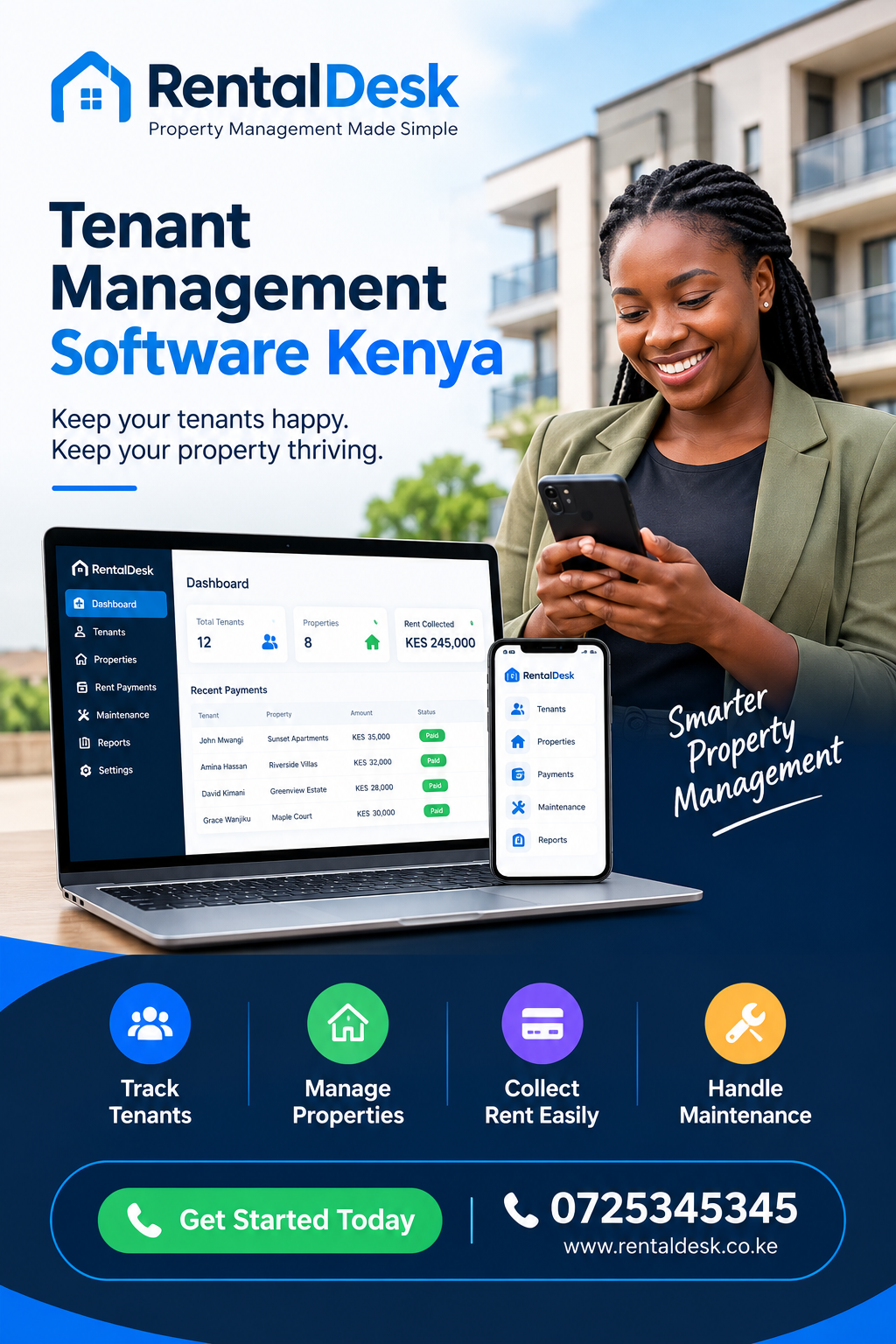
Managing tenants becomes considerably more difficult when property records are spread across notebooks, spreadsheets, WhatsApp conversations, M-Pesa messages and separate payment records. Tenant Management Software Kenya brings these activities into a structured system where landlords, agents and property managers can organize tenant information, monitor rent, manage leases, follow up arrears and maintain clearer records. This guide explains how tenant management software works, the features worth looking for, how it supports Kenyan rental businesses, and what to consider before choosing a system.
What Is Tenant Management Software?
Tenant Management Software Kenya refers to digital software designed to help landlords and property professionals manage information and daily activities related to tenants. Instead of maintaining separate records for every occupant, a centralized system connects tenants with properties, units, leases, rent charges, payments, balances, communication and maintenance activities.
A tenant management system is useful for both small and large rental portfolios. A landlord with ten apartments may need a simple way to see who has paid rent, while a property management company handling hundreds of units may need detailed permissions, automated billing, reporting and audit trails.
The main objective is simple: make tenant information easier to organize and act on.
A good system can help answer questions such as:
- Which tenant occupies a particular unit?
- When does the tenant’s lease expire?
- How much rent is expected?
- How much has already been paid?
- Which tenants have outstanding balances?
- Which maintenance requests are still unresolved?
- What payments were received during a particular period?
- Which units are vacant?
- Which tenants need a reminder?
- What records should be available to the property owner or accountant?
Tenant Management Software Kenya can therefore become the central record for tenant-related operations rather than another isolated tool.
Why Tenant Management Matters for Kenyan Rental Businesses
Kenya has a large rental market covering apartments, bedsitters, commercial properties, student accommodation, gated communities and mixed-use developments. Property owners may also manage units remotely while agents, caretakers and accountants handle activities on the ground.
This creates an operational challenge.
A landlord might receive rent through M-Pesa, receive maintenance requests through WhatsApp, keep tenant details in a spreadsheet and store lease documents in email. Each method works independently, but combining them manually creates room for errors.
Tenant Management Software Kenya provides a way to bring these activities together.
For Kenyan landlords, payment tracking is especially important. M-Pesa has become a familiar payment channel, so rental operations often need a reliable way to connect payment information with the correct tenant, unit and billing period. Modern rental platforms commonly emphasize M-Pesa workflows alongside bank payments and other collection methods.
The benefit is not simply convenience. Better records can make it easier to identify unpaid rent, investigate disputed payments, prepare reports and maintain a consistent relationship with tenants.
Who Needs Tenant Management Software?
Tenant Management Software Kenya can be useful to several types of property professionals.
Individual landlords
A landlord with a few units may initially feel that a notebook or spreadsheet is sufficient. As the number of tenants increases, however, recurring tasks become harder to remember.
The landlord needs to track:
- Tenant names and contacts
- Unit numbers
- Monthly rent
- Deposits
- Lease dates
- Payment history
- Outstanding balances
- Maintenance requests
- Notices
- Documents
A centralized system reduces the amount of information that has to be remembered manually.
Property managers
Tenant Management Software Kenya becomes increasingly useful when several properties are managed for different owners.
Property managers may need to separate information by building, owner or portfolio while still maintaining a single operational dashboard. They also need reporting that can be shared with property owners.
Real estate agencies
Agencies responsible for rental administration can use software to coordinate agents, property administrators and tenants.
Permissions are particularly important here. Staff should generally receive access appropriate to their responsibilities rather than sharing one unrestricted account.
Apartment and estate managers
Large residential developments may have many tenants, recurring service charges, maintenance issues and multiple payment records. Manual administration can become time-consuming.
A structured platform gives the management team one place to monitor tenant-related activities.
Key Features to Look For
Not every rental application provides the same capabilities. Before choosing Tenant Management Software Kenya, property owners should identify the functions they actually need.
1. Centralized tenant records
The foundation of tenant management is a reliable tenant profile.
A useful record may include:
- Full name
- Phone number
- Email address
- Identification details
- Property
- Unit
- Lease dates
- Rent amount
- Deposit information
- Emergency contact
- Documents
- Payment history
The goal is to eliminate duplicate records and make information available when needed.
2. Property and unit management
Tenant records are more useful when they are connected to specific properties and units.
Tenant Management Software Kenya should allow administrators to create properties, buildings and units and then assign tenants to the relevant spaces.
For example:
| Property | Unit | Tenant | Monthly Rent | Status |
|---|---|---|---|---|
| Green View Apartments | A01 | Tenant A | KSh 18,000 | Occupied |
| Green View Apartments | A02 | Tenant B | KSh 20,000 | Occupied |
| Green View Apartments | B04 | Tenant C | KSh 22,000 | Arrears |
| Green View Apartments | C03 | — | KSh 25,000 | Vacant |
This structure makes it easier to understand occupancy and rental income at a glance.
3. Lease management
Tenant Management Software Kenya should make lease information easy to retrieve.
Important lease information includes:
- Start date
- End date
- Rent amount
- Deposit
- Renewal terms
- Notice requirements
- Special conditions
- Attached documents
Lease expiry reminders can also help managers avoid relying on calendars or memory.
4. Rent tracking
Rent collection is one of the most important recurring activities in property management.
The system should show the amount billed, amount received, balance and payment status for each tenant.
A dashboard might categorize tenants as:
- Paid
- Partially paid
- Pending
- Overdue
- Vacant
Tenant Management Software Kenya becomes particularly useful when this information is updated consistently rather than reconstructed from individual payment messages.
M-Pesa and Rent Collection
For many Kenyan landlords, rent collection cannot be separated from mobile payments.
Tenant Management Software Kenya should therefore support workflows that make it easier to record and reconcile M-Pesa payments.
A strong rent collection process should answer three questions:
- Who made the payment?
- Which invoice or rent period does it cover?
- What balance remains after the payment?
Modern Kenyan rental platforms increasingly provide M-Pesa-related payment functionality, including automated or assisted reconciliation and tenant payment workflows.
The exact payment capabilities differ between platforms, so landlords should confirm whether a product supports their preferred Paybill, Till, bank or payment integration before implementation.
Why payment reconciliation matters
Imagine managing 80 tenants and receiving dozens of payments around the beginning of the month.
Checking each transaction manually can create several problems:
- A payment may be assigned to the wrong tenant.
- A tenant may pay part of the rent.
- A payment reference may be difficult to identify.
- A balance may not be updated immediately.
- A tenant may claim to have paid when the record has not been reconciled.
Tenant Management Software Kenya can reduce this administrative burden by maintaining structured payment records.
Tenant Statements and Balances
A tenant statement provides a running view of charges and payments.
For example:
| Date | Description | Charge | Payment | Balance |
|---|---|---|---|---|
| 1 Sept | September Rent | KSh 20,000 | — | KSh 20,000 |
| 3 Sept | Rent Payment | — | KSh 15,000 | KSh 5,000 |
| 12 Sept | Balance Payment | — | KSh 5,000 | KSh 0 |
Tenant Management Software Kenya makes this kind of record easier to maintain than a collection of handwritten entries.
A tenant statement can also help resolve disputes.
If a tenant asks, “How much do I owe?”, the manager can review the transaction history instead of reconstructing it from several sources.
Automated Rent Reminders
Late rent follow-up can consume a significant amount of time.
Tenant Management Software Kenya can support automated or scheduled reminders, depending on the platform.
For example, a property manager may establish a communication process where:
- A rent notification is sent before the due date.
- A payment confirmation is issued after payment.
- A reminder is sent when a balance becomes overdue.
- A follow-up is triggered after a defined period.
Automation does not remove the need for human communication. Instead, it handles predictable administrative messages so the property team can concentrate on exceptions.
Maintenance and Tenant Requests
Tenant management goes beyond collecting rent.
Tenants also report:
- Leaking taps
- Electrical faults
- Plumbing problems
- Broken doors
- Water issues
- Security concerns
- Appliance problems
- Common-area issues
Tenant Management Software Kenya can connect maintenance requests to individual tenant and unit records.
A basic maintenance workflow could look like this:
Tenant reports issue → Request is logged → Manager assigns task → Technician responds → Work is completed → Request is closed.
This is better than relying entirely on WhatsApp messages because important requests can otherwise disappear into a busy conversation.
Maintenance Records Improve Accountability
Tenant Management Software Kenya can provide a history of maintenance activity.
A manager may want to know:
- When was the issue reported?
- Who reported it?
- What was the problem?
- Who was assigned?
- How much did the repair cost?
- When was the work completed?
- Was the tenant notified?
These records can be useful when evaluating recurring problems.
For example, if the same plumbing issue occurs repeatedly in one building, the property owner may discover that repeated small repairs are less practical than a larger corrective project.
Tenant Communication
Communication is another important part of tenant management.
Tenant Management Software Kenya can help organize notices and tenant communication when the platform supports messaging functionality.
Common communications include:
- Rent reminders
- Maintenance updates
- Planned water interruptions
- Inspection notices
- Lease renewal messages
- Policy updates
- General building notices
The advantage of structured communication is traceability.
Instead of asking staff members what happened during a previous conversation, management can review the relevant communication history.
Tenant Documents
Paper records can become difficult to manage when a portfolio grows.
Tenant Management Software Kenya can help organize digital documents associated with tenants and leases.
Possible documents include:
- Lease agreements
- Identification documents
- Application forms
- Payment records
- Notices
- Inspection reports
- Correspondence
- Deposit records
Document management should be combined with appropriate access controls. Sensitive tenant information should only be available to people who require it for legitimate business purposes.
Arrears Management
Rent arrears require consistent follow-up.
Tenant Management Software Kenya can help property managers identify outstanding balances and prioritize follow-up.
A useful arrears report might show:
| Tenant | Unit | Amount Due | Days Outstanding | Action |
|---|---|---|---|---|
| Tenant A | A01 | KSh 5,000 | 4 | Reminder |
| Tenant B | B03 | KSh 20,000 | 15 | Follow-up |
| Tenant C | C05 | KSh 35,000 | 31 | Escalation |
This allows management to focus attention where it is needed.
The software should not replace professional judgment or the legal procedures applicable to tenancy matters. Instead, it provides better records for making administrative decisions.
Reporting for Landlords and Property Managers
Tenant Management Software Kenya becomes more valuable when it turns operational data into useful reports.
Reports may cover:
- Rent collected
- Outstanding rent
- Occupancy
- Vacancies
- Tenant balances
- Payment history
- Property income
- Maintenance costs
- Expenses
- Lease expiries
A property owner managing several buildings can use reports to compare performance without manually combining multiple spreadsheets.
Why reporting matters
Suppose a landlord owns three apartment blocks.
A monthly report could show:
| Metric | Block A | Block B | Block C |
|---|---|---|---|
| Units | 40 | 60 | 30 |
| Occupied | 38 | 54 | 29 |
| Rent billed | KSh 760,000 | KSh 1.08M | KSh 580,000 |
| Collected | KSh 735,000 | KSh 1.01M | KSh 565,000 |
| Outstanding | KSh 25,000 | KSh 70,000 | KSh 15,000 |
Tenant Management Software Kenya can make this type of portfolio visibility easier when the platform provides appropriate reporting capabilities.
Multi-Property Management
Managing one property is different from managing ten.
Tenant Management Software Kenya should make it possible to separate buildings and units while still providing a consolidated view.
This is important for professional property managers because different properties may have:
- Different rent amounts
- Different tenants
- Different owners
- Different maintenance providers
- Different expenses
- Different occupancy rates
A multi-property structure prevents information from becoming mixed together.
Role-Based Access
A property management company may have administrators, accountants, leasing staff, caretakers and property owners.
Tenant Management Software Kenya can support role-based workflows where available.
For example:
| Role | Potential Access |
|---|---|
| Administrator | Full operational access |
| Accountant | Payments and financial reports |
| Caretaker | Tenant and maintenance tasks |
| Leasing officer | Applications and lease information |
| Property owner | Reports and portfolio overview |
The exact permission structure varies by product, but the principle is important: users should receive access appropriate to their responsibilities.
Mobile Access for Property Teams
Property work does not always happen from a desk.
Tenant Management Software Kenya should ideally work well on mobile devices if staff need to update information while visiting properties.
A caretaker may need to:
- Confirm a tenant’s payment status
- Record a meter reading
- Check a maintenance request
- Update occupancy
- Contact a tenant
- Review a unit
Mobile access can reduce the delay between an activity happening and the system being updated.
How Tenant Management Software Reduces Manual Work
Consider a landlord managing 50 units manually.
Every month, they may need to:
- Review tenant records.
- Check rent payments.
- Identify unpaid tenants.
- Calculate balances.
- Send reminders.
- Issue receipts.
- Track maintenance requests.
- Update spreadsheets.
- Prepare owner reports.
- Follow up on unresolved issues.
Tenant Management Software Kenya can consolidate many of these recurring activities.
The goal is not to automate every decision. The goal is to remove unnecessary administrative repetition.
What a Typical Monthly Workflow Looks Like
A structured rental operation may follow this sequence.
Before the due date
Tenant Management Software Kenya can be used to review upcoming charges and tenant accounts.
The property manager checks:
- Active leases
- Rent amounts
- Upcoming invoices
- Outstanding balances
- Vacant units
On rent collection days
Payments are monitored and matched against tenant accounts.
Managers can identify:
- Fully paid accounts
- Partial payments
- Unpaid accounts
- Unidentified payments
After the due date
Tenant Management Software Kenya can help identify arrears and organize follow-up.
Instead of sending the same message manually to every tenant, managers can focus on accounts that actually require attention.
At month-end
The property team can review:
- Total rent billed
- Total rent collected
- Outstanding balances
- Expenses
- Maintenance
- Vacancies
- Property-level performance
This creates a repeatable operating rhythm.
Choosing the Right Tenant Management Platform
Choosing Tenant Management Software Kenya should begin with your actual workflow rather than a long list of features.
Ask these questions.
How many units do you manage?
A landlord with ten units may have different requirements from an agency managing 1,000.
Check whether the platform can accommodate your current portfolio and expected growth.
How do tenants pay?
Confirm whether the platform supports the payment methods you actually use.
If M-Pesa is central to your collection process, ask how payment matching, reconciliation and receipts work.
Does it support multiple properties?
If you have more than one building, make sure the platform can separate portfolios clearly.
Can staff have different permissions?
This matters when multiple people access the system.
Does it provide useful reports?
Avoid choosing software simply because it has a dashboard. Ask whether the reports answer questions you regularly need to answer.
Is data export available?
You should understand how your information can be exported or retrieved if your business needs change.
Common Mistakes When Choosing Rental Software
Tenant Management Software Kenya should solve operational problems rather than create new ones.
Several mistakes are common.
Choosing based only on price
The cheapest software may not provide the functionality your operation requires.
Instead of comparing subscription prices alone, consider the administrative time saved and the reliability of the records.
Buying too many features
The opposite problem also exists.
A small landlord may not need a complicated enterprise system. Extra features can make adoption harder.
Ignoring payment workflows
If rent collection is the core activity, payment reconciliation should be evaluated carefully.
Failing to test usability
A system can have many features and still be frustrating to use.
Ask staff to perform common tasks during a demonstration:
- Add a tenant
- Create a unit
- Record payment
- Check an arrears balance
- Generate a report
- Log maintenance
Not planning data migration
If you already use spreadsheets, decide how existing tenant information will be transferred.
Poor data migration can cause duplicate or incomplete records.
How to Move From Spreadsheets to Software
Moving from spreadsheets to Tenant Management Software Kenya does not need to happen all at once.
Step 1: Clean your data
Remove duplicate tenant records and correct inconsistent names, phone numbers and unit numbers.
Step 2: Organize properties
Create a consistent property and unit structure.
Step 3: Verify balances
Before importing payment information, reconcile outstanding balances.
Step 4: Import tenant information
Transfer the essential records first.
Step 5: Test payment workflows
Make sure the system records payments correctly.
Step 6: Train staff
Show employees how to perform their daily tasks.
Step 7: Run parallel checks
For the first reporting period, compare the software records with your previous process.
Step 8: Retire unnecessary spreadsheets
Once the new process has been verified, reduce duplicate data entry.
Data Security and Tenant Information
Tenant records may contain sensitive personal and financial information.
Tenant Management Software Kenya should therefore be assessed not only for features but also for security practices.
Ask providers about:
- User authentication
- Password management
- Access controls
- Data backups
- Audit logs
- Encryption
- Data retention
- Account recovery
- Administrative permissions
Property managers should also establish internal rules for who can access tenant information.
Security is not only a software issue. Staff behavior matters as well.
Avoid sharing passwords between employees. Review access when employees leave. Give temporary users only the permissions they require.
Tenant Experience Matters Too
Tenant management software should not be viewed only from the landlord’s perspective.
Tenant Management Software Kenya can improve the tenant experience when it provides useful self-service functionality.
A tenant may want to:
- View their balance
- See payment history
- Receive a receipt
- Pay rent
- Report maintenance
- Read notices
- Access relevant documents
A clear self-service experience can reduce unnecessary calls and messages.
It can also give tenants greater visibility into their own accounts.
Supporting Better Communication Between Tenants and Managers
Poor communication often creates avoidable disputes.
For example, a tenant may report a leaking pipe through WhatsApp. The manager reads the message but forgets to assign the repair.
Tenant Management Software Kenya can create a structured request that remains visible until it is resolved.
That changes the workflow from:
Message → memory → action
to:
Request → assignment → progress → completion → record
The difference may seem small, but it becomes significant across hundreds of maintenance requests.
Tenant Onboarding
The beginning of a tenancy is another opportunity to use software effectively.
Tenant Management Software Kenya can support a structured onboarding process.
A possible checklist includes:
- Create tenant profile.
- Assign property and unit.
- Enter agreed rent.
- Record deposit.
- Upload lease.
- Confirm contact information.
- Configure billing.
- Provide payment instructions.
- Confirm move-in date.
- Record opening balance.
A consistent onboarding process reduces missing information later.
Lease Renewals and Vacancies
Tenant management should also cover what happens when a lease ends.
Tenant Management Software Kenya can help managers monitor upcoming lease expirations.
A renewal workflow might include:
- Identify leases expiring within 90 days.
- Contact the tenant.
- Review rent terms.
- Confirm renewal decision.
- Update the lease.
- Record the new dates.
- Update billing if rent changes.
When a tenant leaves, the system should also help record the move-out date, final balance, inspection and vacancy.
Using Software to Manage Growth
A major reason landlords adopt Tenant Management Software Kenya is that manual administration becomes harder as portfolios grow.
A process that works for five tenants may not work for 100.
For example, checking five M-Pesa messages manually is manageable. Checking hundreds of transactions every month is different.
Growth therefore requires systems that can handle:
- More tenants
- More properties
- More transactions
- More staff
- More maintenance requests
- More reporting requirements
The software should grow with the operating model rather than forcing the business to redesign its processes every few months.
What Should a Property Manager Measure?
Tenant Management Software Kenya can provide data that helps managers monitor operational performance.
Useful metrics may include:
Occupancy rate
How many units are occupied compared with the total number of available units?
Collection rate
How much of the rent billed has been collected during a given period?
Arrears
How much remains unpaid?
Vacancy duration
How long do units remain empty?
Maintenance turnaround
How long does it take to resolve maintenance requests?
Lease expiry pipeline
How many leases are approaching renewal?
These measurements can help property managers identify operational bottlenecks.
Tenant Management for Different Property Types
Different rental properties have different requirements.
Apartments
Tenant Management Software Kenya can manage standard monthly rent, tenant records, maintenance and payment tracking.
Student housing
Student accommodation may require room-level assignments, guarantor information, academic-year billing or higher tenant turnover.
Commercial properties
Commercial rentals may involve different lease terms, deposits, service charges, invoices and renewal arrangements.
Mixed-use buildings
A mixed-use property may contain shops, offices and residential units. The software should allow different unit types and billing structures.
Gated estates
Estate management may involve tenants, owners, service charges, maintenance and common-area expenses.
The right platform should accommodate the property’s actual structure rather than assuming every rental business operates the same way.
Cost Considerations
Pricing for Tenant Management Software Kenya varies depending on the provider and the number of units or features required.
Some platforms charge per unit. Others use monthly packages, transaction-based pricing or customized plans.
Before comparing prices, identify the full cost.
Consider:
- Subscription
- Setup
- Data migration
- Training
- Payment processing
- SMS charges
- Additional users
- Integrations
- Support
- Reporting features
For example, a low monthly subscription may not be the lowest total cost if critical features require separate charges.
RentalDesk currently presents Kenya-shilling pricing plans, including a free tier for up to five units and paid plans for larger portfolios.
Questions to Ask a Software Provider
Before adopting Tenant Management Software Kenya, ask the provider specific questions.
- How are tenant records stored?
- Can I manage multiple properties?
- Can I assign tenants to specific units?
- How are M-Pesa payments recorded or reconciled?
- Can tenants view their statements?
- Can staff have different permissions?
- Can I export my data?
- How are backups handled?
- What happens if an employee leaves?
- Is customer support available locally?
- Can the system work on mobile devices?
- How are maintenance requests tracked?
- Can I generate property reports?
- Can the platform handle partial payments?
- What happens when a tenant moves out?
The answers should be specific enough for you to understand how the software would fit into your current workflow.
Why Local Context Matters
A generic international property platform may offer many features but still require workarounds for Kenyan operations.
Tenant Management Software Kenya should reflect common local workflows such as KSh-based billing and M-Pesa payments.
Several Kenyan-focused rental platforms currently emphasize local payment methods, mobile access, tenant records and property-specific workflows.
Local context can also matter for customer support, implementation, terminology and the practical needs of Kenyan landlords.
Practical Example: Managing a 30-Unit Apartment Building
Consider a landlord with 30 apartments in Nairobi.
Without structured software, the landlord may keep:
- Tenant details in a spreadsheet
- Rent payments in M-Pesa messages
- Maintenance requests in WhatsApp
- Lease documents in email
- Expenses in a notebook
- Monthly reports in another spreadsheet
Tenant Management Software Kenya can bring these processes into a centralized workflow.
The landlord could begin the month by reviewing all active tenants and invoices.
During rent collection, payments can be recorded against the relevant tenant accounts.
At the end of the due period, the manager can identify outstanding balances.
Maintenance requests can be assigned and monitored separately.
At month-end, the landlord can review income, arrears, expenses and occupancy.
The real advantage is not a flashy dashboard. It is the reduction of disconnected administrative tasks.
Practical Example: A Property Management Company
Now consider an agency managing 500 units across several buildings.
The agency may have:
- Property managers
- Accountants
- Caretakers
- Leasing officers
- External technicians
- Property owners
Tenant Management Software Kenya can provide a shared operational environment when the system supports appropriate permissions.
A caretaker may only need access to tenant and maintenance information for assigned properties.
An accountant may need payment and financial reports.
A property owner may need access to portfolio performance.
An administrator may oversee the entire system.
This separation helps reduce unnecessary access while allowing everyone to work from consistent information.
Common Challenges When Implementing Rental Software
Software can improve operations, but implementation still requires planning.
Staff resistance
Employees who are comfortable with spreadsheets may initially prefer familiar tools.
Training and clear procedures can help.
Poor data quality
If old tenant records contain errors, moving them into new software does not automatically fix them.
Inconsistent processes
Different staff members may record payments or tenant information differently.
Standard operating procedures help create consistency.
Too much automation
Automation should be used carefully. Some tenant situations require human review.
Lack of follow-through
A system only works when staff actually update it.
Management should define who is responsible for each task.
How to Get the Most Value From Your System
Tenant Management Software Kenya becomes more useful when it is treated as part of the business process rather than simply an application.
Start with the activities that consume the most time.
For many landlords, these may include:
- Rent reconciliation
- Arrears follow-up
- Tenant communication
- Maintenance tracking
- Reporting
Automate or simplify these first.
Then expand into other workflows.
It is also useful to review the system regularly. Ask:
- Are tenant records complete?
- Are payments being updated promptly?
- Are maintenance tickets closed?
- Are reports accurate?
- Are staff using the correct process?
- Are tenants receiving useful communication?
Continuous review prevents the platform from becoming another source of outdated information.
Frequently Asked Questions
What is tenant management software?
Tenant Management Software Kenya is software designed to organize tenant records, leases, rent payments, balances, maintenance requests, communication and other rental administration tasks in a centralized system.
Is tenant management software useful for small landlords?
Yes. Small landlords can benefit from organized tenant records and payment tracking even when they manage only a few units. The main consideration is choosing a system that matches the size and complexity of the portfolio.
Can tenant management software track M-Pesa rent payments?
Many Kenyan-focused platforms support M-Pesa-related rental workflows, although the exact integration differs between providers. Some support automated matching, payment requests or reconciliation, while others may require manual recording.
Can tenants access their own information?
Some platforms provide tenant portals where occupants can view balances, invoices, payment history, notices or maintenance requests. Check the provider’s exact functionality before purchasing.
Does tenant management software replace accounting software?
Not necessarily. Some rental platforms include financial reporting or accounting functions, while others integrate with external accounting systems. The right setup depends on the complexity of the property business.
Can I manage several properties using one system?
Yes, multi-property support is a common feature of rental management platforms. However, confirm how properties, owners, units and staff permissions are separated.
Is cloud-based software better than spreadsheets?
The answer depends on the business. A spreadsheet may work for a very small portfolio, while cloud software can become more practical as transaction volume, tenant numbers and reporting requirements increase.
How should I choose software for a Kenyan rental business?
Start by identifying your most important workflows. Check tenant records, rent collection, M-Pesa support, arrears, maintenance, reporting, permissions, mobile access, security, support and pricing.
What information should I keep for each tenant?
Useful information may include contact details, unit assignment, lease dates, rent amount, deposit, payment history, relevant documents and communication records. Only collect and retain information that is appropriate for the legitimate operation of the tenancy.
Final Thoughts
Effective tenant management is fundamentally about keeping accurate information, following consistent processes and making it easy to see what needs attention.
Tenant Management Software Kenya can bring tenant records, units, rent, payments, maintenance, communication and reporting into one structured environment. For Kenyan landlords and property managers, this can be particularly valuable when portfolios become large enough for manual administration to create delays and errors.
The most important step is not choosing the platform with the longest feature list. It is choosing a system that fits the way your rental business actually operates.
Start by mapping your current process.
Where are tenant records stored? How are M-Pesa payments reconciled? How are arrears identified? How are maintenance requests tracked? How are lease expiries monitored? How are monthly reports prepared?
Once those questions are clear, Tenant Management Software Kenya becomes easier to evaluate because you can compare software against real operational requirements rather than marketing claims.
For a growing landlord, a structured system can provide better visibility over tenants and payments. For a professional property manager, it can create consistency across multiple properties and teams. For tenants, it can make payments, communication and service requests easier to follow.
The practical objective is straightforward: maintain reliable tenant records, collect rent efficiently, respond to issues promptly and keep the property business organized.
Tenant Management Software Kenya is ultimately most valuable when it helps turn those objectives into repeatable daily workflows.