
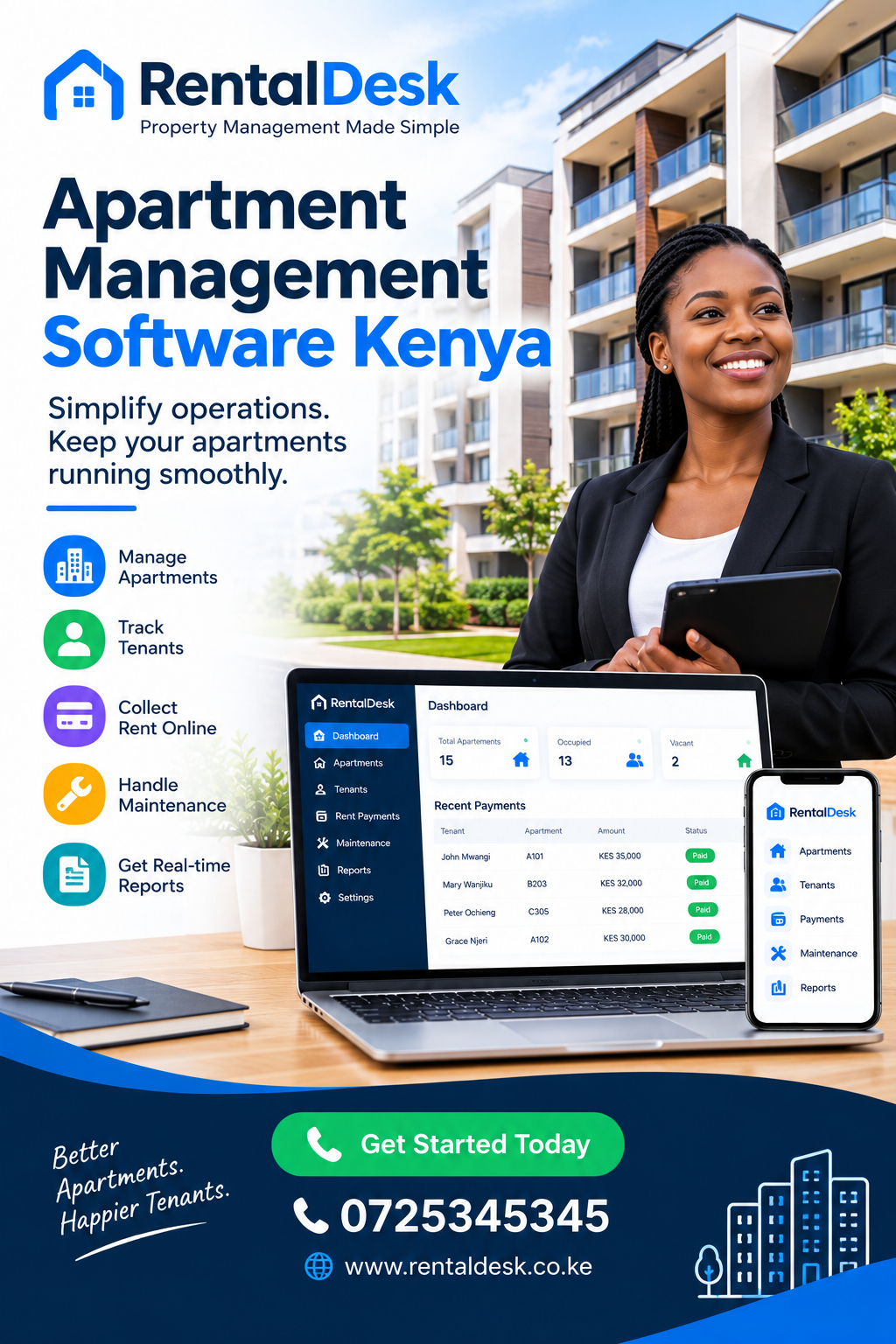
Apartment Management Software Kenya: A Complete Guide for Landlords and Property Managers
Managing an apartment building involves far more than collecting monthly rent. Landlords and property managers have to keep track of tenants, vacant units, leases, payments, arrears, maintenance requests, expenses, communication and property records. Apartment Management Software Kenya provides a centralized way to organize these activities and gives property managers a clearer view of what is happening across their buildings. This guide explains what apartment management software does, the features Kenyan property managers should look for, how it can simplify rent collection and maintenance, and how to choose a system that fits a growing rental portfolio.
What Is Apartment Management Software?
Apartment Management Software Kenya is a digital system designed to help landlords, property managers and apartment administrators manage the day-to-day operations of residential buildings.
Instead of maintaining separate spreadsheets for tenants, handwritten rent records, WhatsApp conversations for maintenance and different files for leases, an apartment management platform brings relevant information together.
Depending on the software, a property manager may be able to manage:
- Apartment buildings
- Individual units
- Tenant profiles
- Lease agreements
- Rent charges
- Payments
- Arrears
- Receipts
- Maintenance requests
- Property expenses
- Vacancies
- Tenant communication
- Reports
- Documents
The exact features vary from one provider to another, but the underlying purpose is the same: create an organized system for managing apartments and the people who occupy them.
For a landlord managing a handful of units, this can reduce repetitive administration. For a professional property management company handling hundreds of apartments, it can provide a structured operating environment for multiple employees and properties.
Why Apartment Management Has Become More Complex
An apartment building may look straightforward from the outside. Internally, however, dozens or hundreds of individual transactions can occur every month.
Consider a 100-unit apartment block.
The management team may need to track 100 tenant accounts, monthly rent for each unit, deposits, partial payments, arrears, repairs, utility charges, vacant units, lease dates and tenant communication.
Apartment Management Software Kenya becomes useful because these activities are connected.
A payment belongs to a tenant. The tenant occupies a unit. The unit belongs to a building. The building belongs to a property portfolio. A maintenance request may relate to the same tenant and unit. A lease determines the agreed rental terms.
When these relationships are maintained in separate records, administrators have to connect the information manually.
That is where errors and delays can occur.
Who Can Use Apartment Management Software?
Apartment Management Software Kenya can support several types of property businesses.
Individual landlords
A landlord with several apartments may initially manage everything through a spreadsheet or notebook.
That approach can work for a small portfolio, but recurring administration increases as more tenants are added.
A landlord may eventually need to track:
- Tenant contact details
- Unit numbers
- Rent amounts
- Deposits
- Payment dates
- Outstanding balances
- Lease expiry dates
- Maintenance
- Receipts
A centralized platform can make these records easier to retrieve.
Property management companies
Apartment Management Software Kenya can be especially useful for professional property managers who operate buildings on behalf of property owners.
A management company may need to separate information by property while allowing authorized staff to access the information needed for their roles.
The system can also make owner reporting easier by providing consolidated information about rent collection, vacancies, expenses and maintenance.
Apartment caretakers
Caretakers are often the people dealing with tenants directly.
They may receive reports about plumbing, electricity, security, water interruptions or other problems.
With a structured system, those requests can be logged and followed through to completion.
Real estate agencies
Agencies managing rental properties for multiple clients may also benefit from centralized property and tenant records.
Managing Apartments and Units
One of the first things a property management system should handle is the structure of the building.
Apartment Management Software Kenya can help administrators organize properties into buildings and units.
For example:
| Building | Floor | Unit | Status | Monthly Rent |
|---|---|---|---|---|
| Riverside Apartments | Ground | G01 | Occupied | KSh 18,000 |
| Riverside Apartments | 1 | A01 | Occupied | KSh 20,000 |
| Riverside Apartments | 1 | A02 | Vacant | KSh 20,000 |
| Riverside Apartments | 2 | B01 | Occupied | KSh 22,000 |
| Riverside Apartments | 2 | B02 | Maintenance | KSh 22,000 |
This structure gives the property manager a quick understanding of the building.
Instead of searching through different spreadsheets, the administrator can see which apartments are occupied, vacant or undergoing maintenance.
Tenant Records
A reliable tenant database is central to apartment administration.
Apartment Management Software Kenya can maintain tenant profiles that connect occupants with their respective units.
A tenant profile may contain:
- Full name
- Phone number
- Email address
- Unit
- Lease information
- Rent amount
- Deposit
- Payment history
- Outstanding balance
- Relevant documents
- Maintenance requests
Keeping this information together helps reduce duplicate data entry.
It also makes it easier for authorized staff to answer routine questions.
For example, if a tenant calls about their rent balance, the property manager should not have to search through multiple files before responding.
Rent Collection and Payment Tracking
Rent collection is one of the most important functions of apartment management.
Apartment Management Software Kenya can help property managers monitor expected rent against actual payments.
A typical rent dashboard might show:
- Total rent billed
- Total rent collected
- Partially paid accounts
- Unpaid accounts
- Arrears
- Collection percentage
- Outstanding balances
This is particularly useful in Kenya, where mobile money is widely used for rental payments.
The important issue is not merely receiving money. It is correctly associating each payment with the correct tenant and billing period.
M-Pesa and Apartment Rent
M-Pesa is an important part of many Kenyan rental operations.
Apartment Management Software Kenya can be valuable when the system supports M-Pesa-related rental payment workflows.
Depending on the platform, these workflows may include payment requests, transaction recording, reconciliation, receipts or automated updates.
Kenyan rental platforms commonly promote M-Pesa integrations and payment reconciliation because landlords need to connect mobile transactions to individual tenant accounts. (ezrent.co.ke)
When evaluating a system, property managers should ask exactly how the integration works rather than assuming every product handles M-Pesa in the same way.
Questions to ask include:
- Can tenants pay directly through the platform?
- Does the system support Paybill or Till workflows?
- Are transactions matched automatically?
- How are partial payments handled?
- Are receipts generated?
- Can administrators correct wrongly allocated payments?
- Can payment reports be exported?
Why Payment Reconciliation Matters
Imagine an apartment building with 150 tenants.
During the first week of the month, many tenants make payments within a short period.
Apartment Management Software Kenya can help turn those transactions into structured tenant account records.
Without reconciliation, management may encounter problems such as:
- Unidentified payments
- Duplicate entries
- Incorrect tenant balances
- Delayed receipts
- Difficulty investigating disputes
A good payment process should make it clear which tenant paid, how much was paid, when the payment was received and what balance remains.
Tenant Statements
Tenant statements are another valuable feature.
Apartment Management Software Kenya can maintain a transaction history for individual tenants.
A statement might look like this:
| Date | Description | Charge | Payment | Balance |
|---|---|---|---|---|
| 1 September | September Rent | KSh 25,000 | — | KSh 25,000 |
| 4 September | Rent Payment | — | KSh 20,000 | KSh 5,000 |
| 10 September | Balance Payment | — | KSh 5,000 | KSh 0 |
This makes it easier for both management and tenants to understand the account.
If there is a disagreement about a balance, the transaction history provides a starting point for investigation.
Managing Rent Arrears
Late rent is an important operational concern for apartment managers.
Apartment Management Software Kenya can help identify accounts with outstanding balances.
Instead of reviewing every tenant individually, a property manager can use an arrears report to focus on accounts requiring attention.
An arrears report could include:
| Tenant | Unit | Balance | Days Outstanding |
|---|---|---|---|
| Tenant A | A12 | KSh 4,000 | 5 |
| Tenant B | B08 | KSh 15,000 | 12 |
| Tenant C | C21 | KSh 30,000 | 30 |
This does not replace communication or the legal procedures applicable to tenancy matters. It simply makes the administrative record easier to monitor.
Automated Rent Reminders
Manually reminding every tenant about rent can become repetitive.
Apartment Management Software Kenya may support automated reminders depending on the provider and plan.
A typical workflow could involve:
- Reminder before the due date
- Payment confirmation after payment
- Outstanding balance notification
- Follow-up for overdue accounts
Automation is most useful for predictable events.
The property manager can then spend more time dealing with individual cases that require human attention.
Lease Management
An apartment management system should also help administrators keep track of lease information.
Apartment Management Software Kenya can connect lease records to specific tenants and units.
Important details may include:
- Lease start date
- Lease end date
- Monthly rent
- Deposit
- Renewal terms
- Notice period
- Special conditions
- Attached documents
Lease information is easier to manage when it is connected directly to the tenant and property record.
Lease Renewal Tracking
Lease expiry dates should not depend entirely on someone’s memory.
Apartment Management Software Kenya can help property managers identify leases approaching their expiry dates where reminder functionality is available.
A renewal process might look like:
- Identify leases expiring within a defined period.
- Contact affected tenants.
- Review the rental terms.
- Discuss renewal requirements.
- Record the decision.
- Update the lease information.
- Adjust billing where applicable.
A structured process gives managers more time to handle renewals before deadlines become urgent.
Vacancy Management
Empty apartments do not generate rental income, so vacancy tracking is important.
Apartment Management Software Kenya can provide visibility into vacant units and their status.
A manager may want to know:
- Which units are vacant?
- When did each unit become vacant?
- Is the unit ready for occupation?
- Is maintenance required?
- Has it been advertised?
- Is a viewing scheduled?
- Has a new tenant been approved?
A vacancy dashboard can turn this information into an actionable list.
Apartment Maintenance Management
Maintenance is one of the most common areas where apartment managers rely heavily on informal communication.
Tenants may report problems through calls, SMS, WhatsApp or in person.
Apartment Management Software Kenya can provide a structured alternative by creating maintenance requests that can be assigned and monitored.
A maintenance workflow could be:
Tenant reports issue → Request is recorded → Manager assigns technician → Work begins → Work is completed → Request is closed.
This creates a record that can be reviewed later.
Common Apartment Maintenance Requests
Apartment managers may receive requests involving:
- Plumbing
- Electrical faults
- Water supply
- Broken locks
- Doors
- Windows
- Lighting
- Drainage
- Appliances
- Common areas
The importance of each issue varies, so a system should ideally allow administrators to record priority and status.
Tracking Maintenance Costs
Apartment Management Software Kenya can also help property managers understand how much is being spent on repairs when expense tracking is available.
A maintenance record could include:
- Date reported
- Unit
- Problem
- Technician
- Materials
- Labour
- Total cost
- Completion date
Over time, these records may reveal recurring problems.
For example, if the same plumbing issue occurs repeatedly in a particular block, the property owner may want to investigate the underlying cause rather than continuing to approve individual repairs.
Tenant Communication
Communication is another important part of apartment administration.
Apartment Management Software Kenya can support structured tenant communication where the platform provides messaging functionality.
Property managers commonly need to communicate about:
- Rent
- Maintenance
- Water interruptions
- Electricity work
- Security notices
- Inspections
- Lease matters
- Building announcements
A communication history can be helpful because it provides context when staff members change or when an issue needs to be reviewed.
Tenant Portals
Some apartment management platforms offer tenant-facing portals.
Apartment Management Software Kenya may allow tenants to access information such as balances, invoices, payment history or maintenance requests depending on the system.
A tenant portal can reduce routine questions because tenants can access certain information themselves.
For example, instead of calling the office to ask for a statement, the tenant can retrieve it from the portal if that functionality is provided.
Digital Document Management
Apartment buildings generate many documents.
These may include:
- Lease agreements
- Tenant applications
- Identification documents
- Inspection forms
- Notices
- Receipts
- Maintenance records
- Correspondence
Apartment Management Software Kenya can make document organization easier when digital document storage is included.
However, managers should consider access controls and privacy requirements when storing personal information.
Only authorized people should have access to sensitive tenant documents.
Apartment Inspections
Property inspections help managers understand the physical condition of units.
Apartment Management Software Kenya can support inspection records where the platform provides inspection functionality.
A simple inspection process might record:
- Unit number
- Inspection date
- Condition
- Issues identified
- Photos or documents
- Recommended action
- Responsible person
- Completion status
These records can become particularly useful during tenant move-in and move-out processes.
Move-In Management
Tenant onboarding should be consistent.
Apartment Management Software Kenya can help property managers establish a checklist for new occupants.
A move-in process might include:
- Confirm tenant details.
- Assign apartment.
- Record rent.
- Record deposit.
- Upload lease.
- Confirm payment method.
- Provide building information.
- Record meter readings where applicable.
- Complete inspection.
- Confirm occupancy.
A standardized process reduces the risk of missing important information.
Move-Out Management
When a tenant leaves, management needs to update several records.
Apartment Management Software Kenya can help administrators record the move-out date, final account status and apartment condition.
The process may include:
- Final rent calculation
- Utility reconciliation
- Inspection
- Deposit review
- Key return
- Document updates
- Vacancy creation
- Maintenance assessment
Once the apartment is ready, the unit can be marked as available for a new tenant.
Managing Service Charges
Some apartment buildings have service charges in addition to rent.
These may cover shared services such as:
- Security
- Cleaning
- Landscaping
- Common-area lighting
- Waste management
- Shared facilities
Apartment Management Software Kenya can be useful when the system supports additional charges and billing structures.
Property managers should verify whether the software can distinguish rent from service charges and other recurring fees.
This is important because different charges may have different billing rules.
Expense Management
Apartment management is not only about income.
Property owners also need visibility into expenses.
Apartment Management Software Kenya can help organize expense information when financial management features are included.
Typical apartment expenses may include:
- Repairs
- Security
- Cleaning
- Landscaping
- Staff costs
- Utilities
- Insurance
- Professional services
- Equipment
- Property improvements
Tracking these expenses against properties can provide a clearer picture of operational performance.
Property Reports
Good reporting helps transform raw transactions into useful information.
Apartment Management Software Kenya may provide reports covering different aspects of a rental portfolio.
Useful reports include:
- Rent collection
- Arrears
- Occupancy
- Vacancies
- Tenant balances
- Expenses
- Maintenance
- Lease expiries
- Property income
For example:
| Metric | January | February | March |
|---|---|---|---|
| Rent Billed | KSh 2.0M | KSh 2.0M | KSh 2.0M |
| Rent Collected | KSh 1.91M | KSh 1.95M | KSh 1.94M |
| Outstanding | KSh 90K | KSh 50K | KSh 60K |
| Vacant Units | 5 | 4 | 6 |
The purpose of reporting is to make management information easier to understand.
Managing Multiple Apartment Buildings
A property manager may eventually manage several buildings.
Apartment Management Software Kenya can provide a centralized structure for multiple properties where the platform supports portfolio management.
For example, an agency could manage:
- Riverside Apartments
- Green Heights
- Westlands Court
- Kilimani Residences
Each building can have its own units, tenants, charges, payments and maintenance records.
The management company can still use portfolio-level reporting to understand the overall business.
Role-Based Access
Not every employee needs access to every record.
Apartment Management Software Kenya can support role-based permissions where available.
For example:
| Role | Possible Responsibilities |
|---|---|
| Administrator | Manage property records |
| Accountant | Payments and financial reports |
| Caretaker | Tenant and maintenance tasks |
| Leasing Officer | Applications and leases |
| Property Owner | Reports and portfolio information |
The exact roles depend on the business and software.
Role-based access can reduce unnecessary exposure of sensitive information.
Mobile Property Management
Apartment managers frequently work away from their desks.
Apartment Management Software Kenya can be particularly useful when it provides mobile-friendly access.
A caretaker visiting a building may need to check:
- A tenant’s account
- A maintenance request
- Unit status
- Contact information
- Outstanding work
Mobile access reduces the need to return to an office before updating records.
Benefits of Apartment Management Software
There are several practical reasons property managers adopt digital systems.
Apartment Management Software Kenya can provide:
Better organization
Tenant and property information can be maintained in one place.
Faster rent monitoring
Managers can identify paid and unpaid accounts without manually checking every record.
Better maintenance follow-up
Requests can be assigned and monitored.
Easier reporting
Monthly reports can be generated from recorded transactions.
Reduced duplication
Staff can work from the same underlying records.
Better tenant service
Tenants can receive faster answers when information is readily available.
Easier portfolio growth
A structured system can make it easier to add buildings and units.
How Software Can Reduce Administrative Work
Imagine a manager handling 200 apartments manually.
At the beginning of every month, they may need to:
- Calculate expected rent.
- Review payments.
- Identify unpaid accounts.
- Send reminders.
- Issue receipts.
- Update balances.
- Handle maintenance.
- Prepare reports.
Apartment Management Software Kenya can consolidate many of these recurring activities.
The objective is not to eliminate the property manager’s role.
Human judgment remains important.
The objective is to remove unnecessary repetitive administration so the manager can focus on tenant relationships, property condition and business decisions.
Choosing the Right Software
Before purchasing Apartment Management Software Kenya, property owners should define their requirements.
Start with the portfolio.
How many apartments do you currently manage?
How many do you expect to manage in the next two or three years?
A system suitable for 20 units may not provide the same value for 500 units.
Next, consider payment workflows.
If most tenants pay through M-Pesa, understand how the software handles those payments.
Then evaluate tenant communication, maintenance, reporting and user permissions.
Features to Prioritize
A practical checklist includes:
- Property management
- Unit management
- Tenant records
- Lease management
- Rent billing
- Payment tracking
- M-Pesa support
- Arrears management
- Tenant statements
- Receipts
- Maintenance
- Expense tracking
- Reporting
- Document storage
- User permissions
- Mobile access
- Data export
- Customer support
Not every business needs every feature.
The right combination depends on the property portfolio.
Questions to Ask Before Buying
Ask the provider:
- How many units can the system support?
- Can I manage multiple properties?
- Can I track individual tenant balances?
- How does M-Pesa integration work?
- Can tenants access statements?
- Can I record partial payments?
- How are arrears reported?
- Can maintenance requests be assigned?
- Can staff have different permissions?
- Can I export my records?
- How are backups handled?
- Is the system mobile-friendly?
- What customer support is available?
- Are there additional charges for SMS or payment services?
- How is existing data imported?
These questions can reveal differences between competing products.
Moving From Excel to Property Management Software
Many landlords begin with spreadsheets.
Excel is useful for organizing data, but it becomes harder to manage when several people need to update the same records or when the portfolio becomes large.
Apartment Management Software Kenya can provide a more structured environment.
A migration process should begin with data cleanup.
Remove:
- Duplicate tenants
- Old tenants
- Incorrect phone numbers
- Incorrect unit numbers
- Duplicate payments
- Unclear balances
Then organize the data by property, building, unit and tenant.
Verify balances before importing them.
Once the migration is complete, test the system using several real scenarios.
Staff Training
Technology only works when people use it correctly.
Apartment Management Software Kenya should be introduced with clear staff procedures.
Training should cover the activities employees perform most often.
For example:
Caretaker training
- Add maintenance request
- Update request status
- Find tenant contact
- Record inspection
Accountant training
- Review payment
- Reconcile transaction
- Generate report
- Review arrears
Administrator training
- Add property
- Add unit
- Add tenant
- Manage users
- Review reports
Training should be practical rather than limited to a general product demonstration.
Data Security
Tenant information should be handled carefully.
Apartment Management Software Kenya should be evaluated for security controls as well as convenience.
Ask providers about:
- Authentication
- User permissions
- Backups
- Data encryption
- Audit records
- Account recovery
- Data retention
- Data export
Property managers should also establish internal policies.
Employees should not share passwords. Former employees should have their access removed. Sensitive tenant documents should not be downloaded or shared unnecessarily.
Tenant Privacy
Apartment records can contain personal information.
Managers should collect information for legitimate business purposes and handle it responsibly.
Access should be limited to people who require the information.
A property management system can help with access controls, but the organization remains responsible for how staff use tenant information.
What Does Apartment Management Software Cost?
The price of Apartment Management Software Kenya depends on the provider, number of units, features and pricing model.
Some providers charge based on the number of units. Others offer fixed monthly plans or customized packages.
Possible costs include:
- Subscription
- Setup
- Data migration
- Additional users
- SMS
- Payment processing
- Integrations
- Support
Do not compare subscription prices without checking what is included.
A cheaper plan may have limits on units, users or features.
A more expensive plan may provide capabilities that a small landlord does not actually need.
Calculating the Value of Software
The value of apartment software is not limited to its monthly subscription.
Consider the time currently spent on administration.
For example, suppose a property manager spends several hours every month reconciling rent payments and preparing reports.
If software significantly reduces that workload, the saved administrative time has business value.
There may also be value from:
- Faster arrears follow-up
- Fewer data-entry mistakes
- Better reporting
- Faster maintenance response
- Easier tenant communication
The right calculation is therefore broader than the subscription price.
Common Mistakes When Choosing Software
Some landlords focus too heavily on the number of features.
Apartment Management Software Kenya should instead be evaluated against actual workflows.
Mistake 1: Choosing based only on price
A low price does not necessarily mean the software is suitable.
Mistake 2: Ignoring payment reconciliation
Rent collection is central to most apartment businesses.
Mistake 3: Buying unnecessary complexity
Small landlords may not need enterprise-level functionality.
Mistake 4: Failing to test the system
Ask the provider for a demonstration.
Test common tasks rather than simply watching a presentation.
Mistake 5: Ignoring data migration
If your existing records are poorly organized, migration should be planned carefully.
A Practical Implementation Plan
A simple implementation can be divided into stages.
Stage 1: Document your current process
Write down how you currently handle:
- Tenants
- Rent
- Payments
- Arrears
- Maintenance
- Leases
- Reporting
Stage 2: Identify problems
Determine which activities consume the most time.
Stage 3: Configure the software
Set up properties, units, users and billing structures.
Stage 4: Import data
Move verified tenant and property information into the system.
Stage 5: Test
Test payment, tenant, maintenance and reporting workflows.
Stage 6: Train
Train staff according to their responsibilities.
Stage 7: Monitor
Review the first few reporting cycles carefully.
Example: Managing a 50-Unit Apartment Building
Consider a landlord with 50 apartments in Nairobi.
Before implementing software, tenant information is maintained in Excel, payments are checked from M-Pesa messages and maintenance is handled through WhatsApp.
The landlord spends several hours each month preparing a rent report.
Apartment Management Software Kenya can centralize these workflows.
The landlord can create the building and all 50 units.
Each tenant can then be assigned to the appropriate apartment.
Rent charges can be configured according to the relevant agreements.
Payments can be recorded and reconciled.
Outstanding balances can be identified.
Maintenance requests can be tracked.
At the end of the month, management can review rent collection, arrears, occupancy and expenses.
The system becomes a central operational record instead of relying on several disconnected tools.
Example: Managing 300 Apartments
Now consider a professional property management company with 300 apartments across six buildings.
The company may have:
- Three property managers
- Two accountants
- Six caretakers
- Leasing staff
- External contractors
Apartment Management Software Kenya can provide a common platform for these teams if it supports the necessary roles and permissions.
The accountant can concentrate on payment records.
Caretakers can manage maintenance and tenant requests.
Property managers can oversee buildings.
Management can review portfolio reports.
Property owners can receive appropriate reports.
This creates a more consistent process across the portfolio.
Measuring Apartment Performance
Property managers need meaningful metrics.
Apartment Management Software Kenya can help organize the information required to monitor these metrics.
Occupancy
What percentage of units are occupied?
Collection
How much of the billed rent has been collected?
Arrears
How much remains outstanding?
Vacancy duration
How long are apartments staying empty?
Maintenance response
How quickly are tenant issues being addressed?
Maintenance cost
How much is being spent on repairs?
Lease renewals
How many leases are approaching expiry?
Tracking these indicators gives management a clearer operational picture.
Kenyan Considerations
A system intended for Kenyan apartment managers should reflect local business practices.
Apartment Management Software Kenya should ideally accommodate common local requirements such as KSh-based rent, mobile payments and the needs of Kenyan landlords and tenants.
M-Pesa is particularly important to evaluate because mobile payments are widely used in Kenya.
Kenyan property managers should also consider whether customer support understands local rental workflows and whether the software is practical for the staff who will actually use it.
Future-Proofing Your Apartment Business
A landlord’s needs can change.
A property owner with 30 apartments today may have 150 in several years.
Apartment Management Software Kenya should therefore be evaluated not only against today’s requirements but also reasonable future growth.
Consider whether the platform can accommodate:
- More properties
- More units
- More staff
- More tenants
- More transactions
- More reports
- More payment activity
The objective is to avoid replacing the system every time the business expands.
How Tenants Benefit
The benefits of apartment software are not limited to landlords.
Apartment Management Software Kenya can improve tenant service by making routine information easier to access.
Tenants may benefit from:
- Faster payment confirmation
- Clearer statements
- Easier maintenance reporting
- Better communication
- Access to relevant documents
- More transparent balances
When tenants can see accurate information, routine misunderstandings may be easier to resolve.
Building a More Organized Apartment Operation
A well-run apartment operation depends on consistency.
Tenant records need to be accurate.
Payments need to be reconciled.
Maintenance requests need follow-up.
Lease dates need monitoring.
Reports need to be generated regularly.
The system should support these routines rather than complicate them.
Apartment Management Software Kenya is most useful when the technology matches the actual working habits of the property team.
Frequently Asked Questions
What is apartment management software?
Apartment Management Software Kenya is software designed to help landlords and property managers manage apartment buildings, units, tenants, rent, payments, maintenance, leases, vacancies and reports.
Can apartment software manage multiple buildings?
Yes. Many property management platforms support multiple properties and units. However, the exact number of properties and available portfolio-management features depend on the provider.
Can it track M-Pesa rent payments?
Many Kenyan rental platforms support M-Pesa-related payment workflows. The exact level of integration differs, so property managers should confirm whether transactions are automatically reconciled, manually recorded or handled through another process.
Can tenants see their rent balances?
Some systems provide tenant portals or self-service features where tenants can view balances, statements, invoices or payment histories. This depends on the platform.
Can apartment software manage maintenance?
Yes, where maintenance functionality is provided. Managers may be able to record requests, assign tasks, track progress and close completed jobs.
Is apartment management software suitable for a small landlord?
Yes. A small landlord can use software to organize tenant records and payment information. However, the platform should match the size and complexity of the portfolio.
Can software track rental arrears?
Yes. Rent management systems commonly provide outstanding-balance or arrears information. Managers should verify how the platform handles partial payments and adjustments.
Can I move my Excel records into apartment management software?
Many systems support some form of data import or migration. Before moving data, clean duplicate records and verify tenant balances.
How much does apartment management software cost in Kenya?
Pricing varies by provider, number of units, features and payment model. Some providers offer different plans based on portfolio size, while others provide customized pricing.
What should I look for when choosing apartment management software?
Focus on the features that directly affect your operation: tenant records, unit management, rent collection, M-Pesa workflows, arrears, maintenance, lease management, reporting, security, permissions, mobile access and customer support.
Conclusion
Running an apartment building requires accurate information and consistent follow-up. When tenant details, rent payments, maintenance requests, leases and reports are scattered across different systems, administrative work can become unnecessarily difficult.
Apartment Management Software Kenya gives landlords and property managers a structured way to bring these activities together.
The most important consideration is not how many features a platform advertises. It is whether those features solve the problems your property team encounters every day.
Before selecting a system, review your current processes. Identify where rent reconciliation takes too long, where tenant records become difficult to find, where maintenance requests get lost and where monthly reporting requires excessive manual work.
Then evaluate software against those specific challenges.
A suitable platform can help organize apartment units, maintain tenant records, monitor rent, identify arrears, manage maintenance, track leases and produce useful reports. It can also make it easier for growing property businesses to maintain consistent processes across multiple buildings.
For Kenyan landlords and property managers, payment workflows deserve particular attention. M-Pesa support, reconciliation and tenant statements should be assessed carefully because rent collection is at the heart of apartment administration.
Apartment Management Software Kenya should ultimately make property management simpler, more organized and easier to monitor.
The best starting point is to define what your team needs today, identify where your current process breaks down, and then choose software capable of supporting the portfolio as it grows.
A well-implemented apartment management system is not simply another piece of technology. It becomes part of the daily operating structure of the rental business, helping property managers spend less time searching for information and more time managing tenants, buildings and the overall property portfolio.