
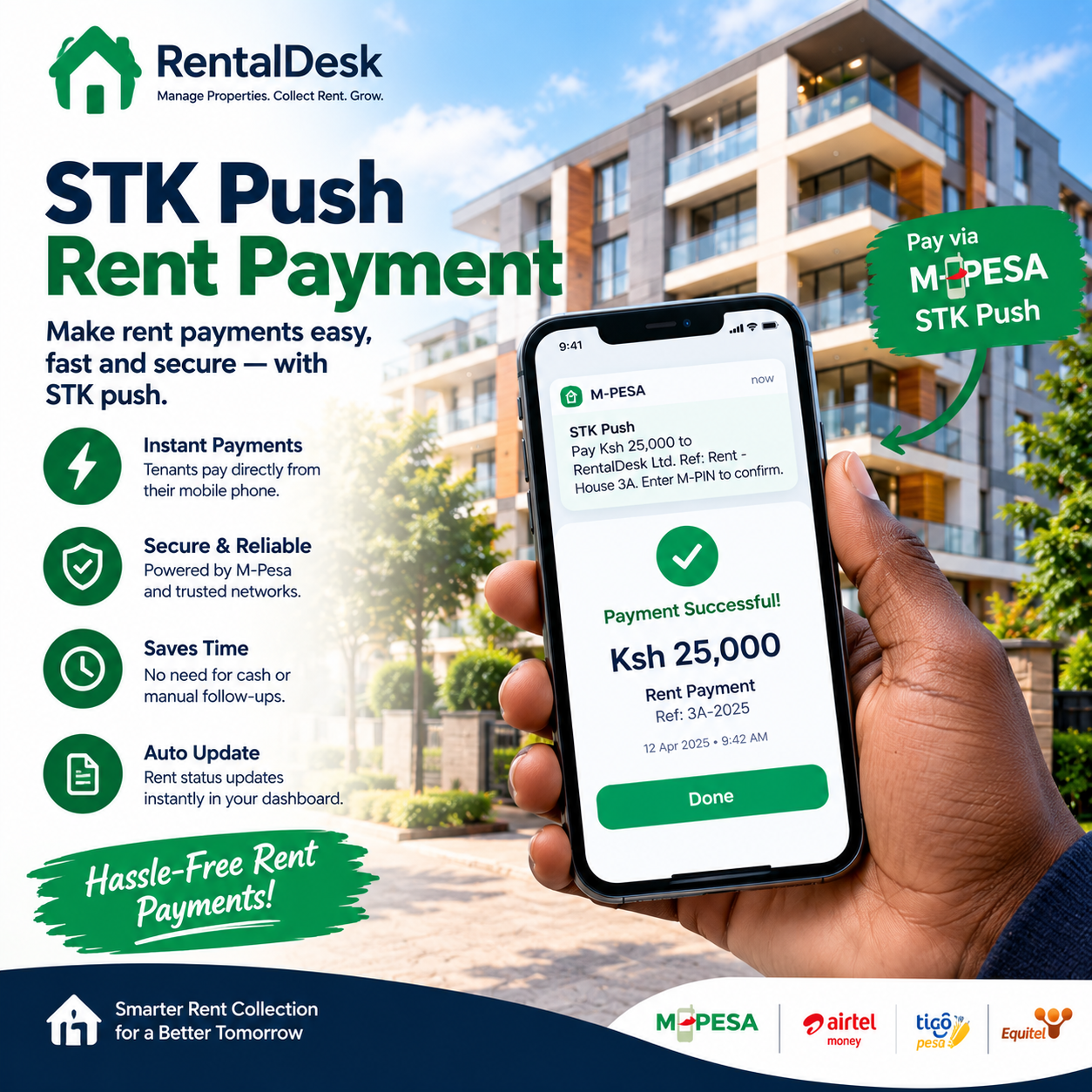
STK push rent payment is the quiet revolution reshaping how rent moves between tenants and landlords across Kenya — one prompt, one PIN, and the money has landed.
There are no typed Paybill numbers to fumble, no amounts to calculate on a behalf of memory, and no forwarded screenshots offered as proof.
Just a single tap that turns a rent bill into a banked payment within seconds of the request being sent.
For decades, collecting rent meant waiting, hoping, and reconciling by guesswork at the end of every month.
Tenants forgot, digits went wrong, and landlords discovered shortfalls weeks after the damage was already done.
STK push rent payment closes that gap by bringing the payment to the tenant, instead of asking the tenant to go and find it.
This guide walks you through everything the technology offers in 2026 and how to make it yours.
We cover how a payment actually flows, how it compares with Paybill and cash, what it costs, and how to roll it out across your portfolio.
We also cover scaling, the diaspora angle, the mistakes to avoid, and the questions landlords ask most.
By the end, you will be able to offer STK push rent payment to your tenants with total confidence.
Whether you collect from three bedsitters in Rongai or three hundred apartments across Nairobi, the principle is identical.
The shorter the distance between seeing the bill and paying it, the faster the money arrives.
That compression of distance is the entire promise of STK push rent payment.
And nothing else in the Kenyan rental toolkit compresses distance quite so completely.
Billing, paying, confirming, and recording collapse into one motion, which is why STK push rent payment is becoming the default across the market.
The landlords who adopt it early are already reporting faster collections, cleaner books, and calmer months.
What STK Push Actually Is
STK stands for SIM Toolkit — the small menu built into every SIM card — and the push feature lets a registered business send a payment prompt directly to a customer’s phone.
You have already used it if you have ever checked out on a Kenyan shopping app: the M-Pesa popup appears, shows the amount and the merchant, and asks for your PIN.
STK push rent payment applies that same familiar checkout experience to rent, with the landlord’s details carried invisibly inside the prompt.
The tenant does exactly one thing — confirm — and every other decision has already been made correctly.
The amount is right because the system set it.
The account is right because the business number belongs to you.
That removal of every manual step is what makes STK push rent payment fundamentally different from every payment method that came before it.
It is equally worth knowing what the tenant never does.
They never copy an account number, never type an amount, and never send money to a number someone read out over the phone.
The prompt carries everything, which is why STK push rent payment leaves virtually no room for the errors that plague manual payments.
Because the feature runs on the SIM toolkit itself, it works on ordinary feature phones just as well as on smartphones.
That reach across every device in the market is one of the quiet superpowers of STK push rent payment in a country of mixed handsets.
And because only registered businesses can trigger prompts, every genuine request arrives through verified channels rather than anonymous messages.
That verification layer is what separates STK push rent payment from every scam message that ever asked a tenant to “send money to this number.”
The technology has been proven at national scale for years.
It powers checkout on e-commerce platforms, bill payments for utilities, and ticketing for travel companies serving millions of customers.
Rent is simply the newest — and arguably the most natural — home for it.
How the Money Flows: Step by Step
Understanding the flow makes the technology feel simple rather than mysterious.
Here is the complete journey of one month’s rent under STK push rent payment, from demand to deposit.
First, the demand is created — an invoice or reminder generated by your platform, carrying the exact amount due for that unit.
Second, the request travels through the official mobile money business system, tagged with your receiving account and the tenant’s number.
Third, the tenant’s phone lights up with the amount, your business name, and a request for the M-Pesa PIN.
Fourth, the tenant enters the PIN, and STK push rent payment completes instantly — money moves from their wallet to your account in one motion.
Fifth, both of you receive confirmation messages within seconds, each one generated independently by the system.
Those twin confirmations are the audit trail that makes STK push rent payment so effortless to reconcile.
Neither party depends on the other for proof, because the system speaks to both of you directly.
At no point does the money rest in anyone else’s hands — not a caretaker, not an agent, not a middleman.
Direct, instant, and documented: those three words describe every STK push rent payment from start to finish.
If the tenant’s balance is too low, the prompt simply fails and can be retried once funds arrive, with the attempt recorded either way.
Nothing is lost, nothing is charged, and your records stay truthful about what did and did not happen.
That graceful handling of failure is an underrated strength of STK push rent payment in the real world.
Setup happens once, and after that the flow repeats itself every month without effort.
Load your units and tenants once, and the entire cycle — demand, prompt, payment, confirmation — becomes infrastructure you never think about again.
Why 2026 Is the Breakout Year
Three forces have converged to make this the year one-tap rent goes mainstream across Kenya.
Each one removes an old barrier that kept landlords waiting.
Together, they move STK push rent payment from novelty to necessity.
First, official business payment integrations are no longer reserved for corporations with technology departments.
Modern property platforms have done the heavy lifting, which places STK push rent payment within reach of any landlord holding a smartphone.
What once required contracts and developers is now a subscription feature.
Second, tenants have fully internalized one-tap payments through online shopping and everyday bill settlement.
The behavior required for STK push rent payment is already muscle memory for an entire generation.
There is nothing new to teach, which removes the last adoption friction entirely.
Third, competition among landlords for good tenants has professionalized the market.
Owners offering frictionless STK push rent payment are visibly out-collecting those still waiting for bank slips and cash chits.
Tenants notice, choose, and stay — and the market is pricing that difference in.
There is also a fourth, quieter force: the record-keeping expectations of the wider economy.
Banks, lenders, and tax authorities increasingly want clean, digital income histories from property owners.
A portfolio running on STK push rent payment produces exactly that record as a byproduct of simply getting paid.
Adopting early still carries an advantage — but the window is closing fast.
The Honest Comparison: STK Push vs. Paybill vs. Cash
The clearest way to appreciate this technology is to measure it against what it replaces.
Manual Paybill payment asks the tenant to open M-Pesa, choose the right menu, enter the business number, key the account name, type the amount, and confirm.
Six steps means six chances for a single wrong digit to send rent to a stranger.
STK push rent payment carries the account and the amount inside the prompt, leaving the tenant nothing to get wrong.
Recovery from a wrong manual payment can take days of calls and goodwill, while a failed prompt simply waits to be retried.
Cash is the other incumbent, and its weaknesses are older still.
Cash leaves no record, invites under-the-table arrangements, and turns every reconciliation into an argument.
Every STK push rent payment, by contrast, documents itself completely without anyone lifting a pen.
The comparison even extends to proof of payment.
Under manual methods, the landlord depends on the tenant’s forwarded screenshot — a file that can be edited, faked, or simply never sent.
With STK push rent payment, both parties receive their own confirmations directly from the system, ending the screenshot era entirely.
Wrong-number payments, the classic disaster of manual methods, become structurally impossible when nothing needs typing.
That single elimination is worth the switch for most landlords, and it is the arithmetic behind the rapid rise of STK push rent payment.
There is also a speed dimension the table rarely shows.
A cash payment waits for a handover, a Paybill waits for the tenant to get around to it, but a prompt arrives at the exact moment the tenant is most able to act.
Timing is a payment feature, and STK push rent payment is the only method that controls it.
By speed, by accuracy, by records, and by safety, one-tap wins every measure that matters.
The Complete Loop: Invoice to Payment to Receipt
A prompt is most powerful when it sits inside a complete system.
The modern flow runs invoice, payment, receipt — with STK push rent payment as the hinge between demand and settlement.
The platform generates the invoice on schedule and delivers it with a pay button attached.
The tenant taps, confirms, and pays without switching apps or asking for numbers.
Within minutes, the receipt lands in the same thread, and your records update themselves.
That tight loop is the engine of STK push rent payment efficiency — and the reason rent arrives hours after billing instead of weeks.
The loop also protects both sides.
Dated invoices and instant receipts together form evidence of what was billed and what was paid, ending arrears disputes before they begin.
Documentation of that quality is the legal spine of STK push rent payment practice.
For tenants who fall behind, the same thread becomes your payment-plan record, with agreed installments triggering their own prompts on their own dates.
A system where the demand, the settlement, and the proof live in one place is the complete expression of STK push rent payment.
And because everything reconciles automatically, the month-end exercise that once consumed your evenings shrinks to a glance.
Owners describe the change as watching rent “close itself” — a phrase that would have sounded like fantasy five years ago.
Real Benefits for Landlords
The first benefit is speed of collection.
Portfolios using one-tap consistently report most rent arriving within hours of the invoice going out.
That velocity transforms the monthly rhythm of any STK push rent payment operation.
The second benefit is the disappearance of wrong-number payments, because there is nothing left to mistype.
The money goes where the system sends it, every single time, with no exceptions to investigate.
The third benefit is reconciliation that does itself.
Every completed prompt matches to the right tenant automatically, so month-end balancing shrinks from evenings to minutes.
Landlords who once spent the first week of the month matching messages now spend it on other things entirely.
The fourth benefit is structural: money flows directly to your account, never through intermediaries.
That single fact removes the root condition behind the most painful landlord disputes, and it is why STK push rent payment has become the backbone of absentee portfolios especially.
The fifth benefit is an audit trail that strengthens your position in any disagreement.
A complete, dated history of every request and confirmation is evidence no memory can match.
That record strength is the quiet insurance built into every STK push rent payment you receive.
The sixth benefit is professional reputation.
A prompt bearing your property’s name on a tenant’s screen signals an operation worth respecting.
Landlords known for frictionless STK push rent payment attract better tenants and keep them longer.
The seventh benefit is delegation without risk.
When tenants pay directly through prompts, you can grow your portfolio without growing your exposure to the people who work in it.
Growth and safety stop being a trade-off, which is the deepest structural gift of STK push rent payment.
Why Tenants Prefer It Even More
Tenants are the quiet winners of this shift.
Paying rent stops being a project and becomes a notification.
There are no Paybill numbers to store, no amounts to calculate, and no anxiety about whether money reached the right place.
Every STK push rent payment generates proof of payment in the tenant’s own messages — protection that matters enormously at deposit refund time.
A tenant with a complete history of confirmations can settle any dispute in one screen, not one argument.
That leverage is why savvy renters now ask about payment methods before signing.
Convenience extends to timing too.
A tenant paid on the 28th can clear rent the moment the prompt arrives, instead of waiting for a payday ritual.
Surveys of renters consistently rank one-tap payment among the most appreciated landlord practices.
Tenants actively choose properties offering STK push rent payment, and they stay longer where paying is effortless.
Retention like that is worth more than any discount, and it compounds month after month for landlords who make STK push rent payment their standard.
There is also a dignity dimension that landlords underestimate.
Chasing rent by phone or at the gate is awkward for both sides, and tenants feel that awkwardness as much as owners do.
A prompt replaces the chase with a tap, preserving the relationship on both ends — the human dividend of STK push rent payment done right.
Use Cases Across the Rental Calendar
The flexibility of the technology shows in how many rental moments it serves.
Monthly rent is the classic case, with the invoice triggering its own prompt on delivery.
Reminders are the second case — an overdue follow-up carrying its own tap-to-pay, turning a nag into a fifteen-second resolution through STK push rent payment.
Deposits and move-in payments form the third case, where the sums are large and the need for clean records is highest.
A deposit settled through STK push rent payment arrives with its own permanent receipt, protecting tenant and landlord from day one.
Water, garbage, and service charges ride the same rails, letting you settle every small monthly obligation without a single cash handover.
Even payment plans work beautifully, with each agreed installment triggering its own prompt on its own date.
That scheduling discipline keeps plans honest and records complete — the humane side of STK push rent payment.
Late fees, where agreements provide for them, can be calculated and attached to prompts automatically.
Rent reviews and annual escalations flow through the same system without anyone recalculating by hand.
For property managers, every client portfolio can run on the same rails simultaneously, with per-owner reporting generated automatically from the prompt history.
That consistency across buildings and owners is the professional dividend of standardized STK push rent payment adoption.
Scaling: From One Unit to a Hundred
The technology earns its keep differently at every portfolio size, and it is worth seeing the whole ladder.
For a landlord with one or two units, STK push rent payment is about professionalism and peace of mind from the very first tenancy.
Good habits formed early cost nothing and pay forever.
For a landlord with ten to thirty units, the payoff becomes visible arithmetic.
Manual methods at that scale break down into missed entries and disputed months, while STK push rent payment keeps every account matched automatically.
This is the size where most owners say they finally stopped losing sleep over collections.
For a landlord with fifty units or more, one-tap becomes infrastructure, full stop.
Reconciliation, receipts, and reporting at that volume are simply impossible by hand, and STK push rent payment carries the entire load without adding staff.
The landlord with a hundred units and the landlord with three use the same tap — only the totals differ.
That uniformity of process is what makes the technology genuinely scalable rather than merely convenient.
Growth stops requiring new systems and starts requiring only new rows.
Owners who adopt STK push rent payment early therefore inherit an advantage that compounds with every unit they add.
The Diaspora Landlord’s Best Friend
No group gains more from this shift than Kenyans earning at home while living abroad.
Distance has always punished landlords with information gaps — collections reported late, vacancies reported late, excuses arriving instead of figures.
STK push rent payment closes the gap because the payment record reaches the owner’s dashboard directly, wherever in the world they sit.
A tenant in Kitengela taps, and the owner in London sees the confirmation within the minute.
That immediacy removes the caretaker from the middle of the money entirely.
The classic diaspora loss — rent collected on the ground but never remitted — becomes structurally impossible when tenants pay through STK push rent payment straight into the owner’s account.
Time zones stop mattering too.
Prompts fire and payments settle around the clock, so an owner eight hours behind still watches rent land in real time.
For the diaspora owner, STK push rent payment is not a convenience but the difference between anxious ownership and confident ownership.
Combined with a tracking platform and a trusted caretaker for the physical side, it completes a system where distance costs almost nothing.
Thousands of owners abroad now run Kenyan portfolios with less friction than neighbors who live down the road.
That inversion is the quiet legacy of STK push rent payment reaching the diaspora market.
A Boon for Property Managers and Caretakers
Property managers juggle many owners, and payment errors damage hard-won client trust faster than anything else.
Standardized prompts keep every client’s collections accurate, matched, and documented simultaneously.
That reliability is what retains management clients on STK push rent payment arrangements for years.
Caretakers gain just as much.
When tenants pay directly through prompts, the caretaker stops being the messenger at the gate — and the suspected middleman in every shortfall.
Removing money from their hands entirely is the cleanest protection a field worker will ever receive.
Honest staff understand this immediately, and they become the loudest advocates of STK push rent payment on the ground.
The system also defends them in reverse.
A caretaker whose collections are logged and matched cannot be falsely accused when balances fluctuate for honest reasons.
Mutual protection, fairly framed, is what turns field teams into partners in STK push rent payment adoption rather than obstacles to it.
Features to Demand in 2026
If you adopt through a platform, evaluate the offering against a demanding checklist.
First, demand one-tap initiation from invoices and reminders, because a pay flow buried three menus deep defeats its own purpose.
Second, insist on automatic matching, where every completed payment lands on the correct tenant’s account without manual entry.
That hands-free accuracy is the baseline of serious STK push rent payment software.
Third, look for automatic receipts issued the moment payment completes, closing the loop without your involvement.
Fourth, check that dismissed prompts and insufficient balances are handled gracefully, with gentle re-prompts rather than lost tenants.
Fifth, demand a searchable history of every request, completion, and failure in your STK push rent payment records.
Sixth, confirm the platform exports that history in formats you control, because your records belong to you.
Data portability is the exit door you must always be able to walk through.
Seventh, ask how the platform handles tenants with multiple units or shared accounts, because real portfolios are messier than demos.
Finally, mind the basics: the system must work on affordable phones and weak networks.
Usability decides whether your STK push rent payment setup runs all year or dies by March.
Security: What Tenants Must Know
The technology is safe precisely because of what it removes.
The PIN is entered only into the official prompt on the tenant’s own phone, and money moves directly to your registered account.
No landlord, agent, or platform ever needs a tenant’s PIN — and any request for one is a scam, full stop.
Genuine prompts display the merchant name and the exact amount before the PIN step, so tenants verify every STK push rent payment before committing.
If a prompt ever names an amount you did not agree to, the correct response is to dismiss it and call your landlord, not to enter anything.
That one reflex defeats every impersonation trick in existence.
Teach your tenants the golden rule — never share your PIN with anyone, for any reason — and the entire channel becomes virtually fraud-proof.
That single habit, reinforced warmly at onboarding, protects every STK push rent payment your portfolio will ever process.
Security here is not a feature you buy but a habit you teach, and it costs one onboarding message.
What It Costs
The honest cost picture has two layers: the payment itself and the platform around it.
Standard mobile money transaction charges apply to STK push rent payment exactly as they do to any Paybill payment — the sender pays the usual fee, and rates evolve, so confirm current pricing before setting expectations.
On the platform side, many property apps bundle the capability into plans ranging from free tiers to a few thousand shillings monthly, depending on portfolio size.
Annual billing typically trims ten to twenty percent off the monthly rate for owners who commit.
Against one prevented late month or one avoided dispute, the economics of STK push rent payment are overwhelmingly favorable.
The honest framing is this: the payment costs what it always cost, and the automation around it costs less than the time it returns.
For most portfolios, the entire stack pays for itself within the first billing cycle it touches.
Few upgrades to a rental business offer a better ratio than STK push rent payment delivered through a solid platform.
Getting Started: Your First Two Weeks
Switching your portfolio takes one deliberate week, followed by one gentle month.
Week one is setup.
Choose a platform that offers STK push rent payment natively, load your units and tenants, and send yourself a test prompt first.
That single test — sending, confirming, and receiving on your own number — teaches you more than any demonstration ever will.
Week two is tenant onboarding.
Introduce the change with a short, warm message explaining that rent can now be paid in one tap, and include the PIN-safety line in the same message.
Tenants consistently welcome the upgrade when it arrives as a gift rather than a policy.
The first billing cycle is your observation month.
Watch how quickly prompts convert to payments, note any tenants who struggle, and follow up personally where needed.
By month two, STK push rent payment becomes the routine nobody thinks about — which is exactly what infrastructure should feel like.
Common Mistakes to Avoid
The most common mistake is treating the prompt as the whole system.
A tap-to-pay with no underlying records — no invoice, no balance, no history — is just a faster way to collect confusion.
Keep the technology anchored to proper records, and STK push rent payment becomes infrastructure rather than a gadget.
The second mistake is over-prompting.
Firing repeated requests at struggling tenants trains them to dismiss it, and a dismissed habit is hard to rebuild.
Let reminders escalate politely, keep every STK push rent payment courteous, and the tap stays trusted for years.
The third mistake is skipping the tenant explanation.
An unexplained prompt on a stranger’s phone looks exactly like the scams tenants have been warned about.
One onboarding message prevents that misread entirely.
The fourth mistake is neglecting records hygiene.
Outdated numbers and wrong rent amounts produce failed prompts and confused confirmations.
Five minutes of monthly housekeeping keeps every STK push rent payment accurate.
Real Scenarios from Real Portfolios
Picture a landlord with fourteen bedsitters in Rongai who replaced cash handovers with platform-generated prompts.
Invoices now go out on the twenty-fifth with pay buttons attached, and most rent lands within forty-eight hours.
His month-end reconciliation dropped from an evening at the table to ten minutes on his phone.
Picture a nurse in Atlanta with six apartments in Kilimani, once dependent on a caretaker’s monthly summary.
Payments now flow to her own account through STK push rent payment, and the caretaker’s job is keys and repairs rather than cash.
Her first clean quarter ended with her doubling the portfolio — growth the old arrangement could never have supported.
Picture a caretaker in Embakasi who spent years under suspicion he had done nothing to earn.
Once tenants paid directly through prompts, his collections were provable by definition, and the owner’s trust returned within a single month.
He now trains new caretakers on the system himself.
These stories repeat across the country because the mechanics are universal.
Direct payments, instant confirmations, and automatic records produce the same calm in every neighborhood.
Technology simply ended the guessing — and the guessing was the whole problem.
The Road Ahead: 2027 and Beyond
The trajectory points toward rent that pays itself.
Invoices will arrive, prompts will follow, and reconciliation will complete before you finish your morning tea.
Prediction is arriving just behind, with systems learning each tenant’s rhythm and timing prompts for maximum effect.
Within a few years, one-tap will look back at Paybill numbers the way Paybill looked back at cash.
The landlords adopting STK push rent payment today are building the muscle memory that the whole market will carry by 2027.
The message for today’s owner is simple.
The tool that ends collection friction is affordable, verified, and already sitting in every tenant’s pocket.
There has never been a better moment — in 2026 or beyond — to make STK push rent payment your standard.
Frequently Asked Questions
What is STK Push in simple terms?
It is a payment prompt sent to the tenant’s phone by a registered business, which the tenant confirms by entering their M-Pesa PIN.
If your tenant can shop online, they already know exactly how to complete STK push rent payment.
The entire learning curve is one tap.
Is it safe for tenants?
Yes — the PIN is entered only into the official prompt on the tenant’s own phone, and money moves directly to the landlord’s registered account.
Anyone asking for a PIN is a fraudster, not a payment, and every genuine STK push rent payment shows its amount and merchant before asking anything.
What happens if the tenant has insufficient funds?
The prompt fails gracefully and can be retried once funds are available, with the platform recording the attempt either way.
Nothing is lost and nothing is charged, and the arrears picture stays accurate for every STK push rent payment attempt made.
Does it work on basic phones without internet?
Yes — the technology lives in the SIM toolkit itself, so prompts reach ordinary feature phones just as easily as smartphones.
That universal reach is one of the most practical strengths of STK push rent payment across Kenya’s mixed devices.
How is it different from a Paybill number?
A Paybill requires the tenant to initiate and type everything manually, while a prompt carries the details inside itself so the tenant only confirms.
The difference is the six steps and six error chances removed from every single STK push rent payment.
Can I set it up without a platform?
Triggering prompts requires a registered business integration with the mobile money system, which is why most landlords access the capability through property platforms that have already completed the work.
That route also gets you the invoices, matching, and receipts that make STK push rent payment genuinely useful rather than merely fast.
Does it work for tenants living outside Nairobi?
Yes — prompts travel over the mobile network, not over geography, so a tenant in Lodwar confirms the same way as one in Kilimani.
Location has never mattered less to rent collection than it does with STK push rent payment.
Can it handle partial payments or payment plans?
Yes — agreed installments trigger their own prompts on their own dates, and platforms record each completed piece against the balance.
Structured plans stay honest because every installment announces itself through STK push rent payment.
What if a tenant dismisses the prompt by mistake?
The platform records the dismissal, and a polite re-prompt resolves it in seconds.
Mistakes cost nothing because nothing is lost until the PIN is entered and confirmed.
That forgiveness is built into the design of STK push rent payment.
Does it help at tax time?
It helps enormously, because every completed payment carries a timestamp and an amount that export cleanly for filings.
Clean income records are the byproduct of simply getting paid through STK push rent payment.
Where can I find verified tenants and landlord tools together?
Start with platforms that combine verified listings with landlord-friendly technology, such as rentaldesk.co.ke.
Pairing the right tenants with one-tap STK push rent payment takes you from chasing rent to simply confirming it — every month, in seconds.