
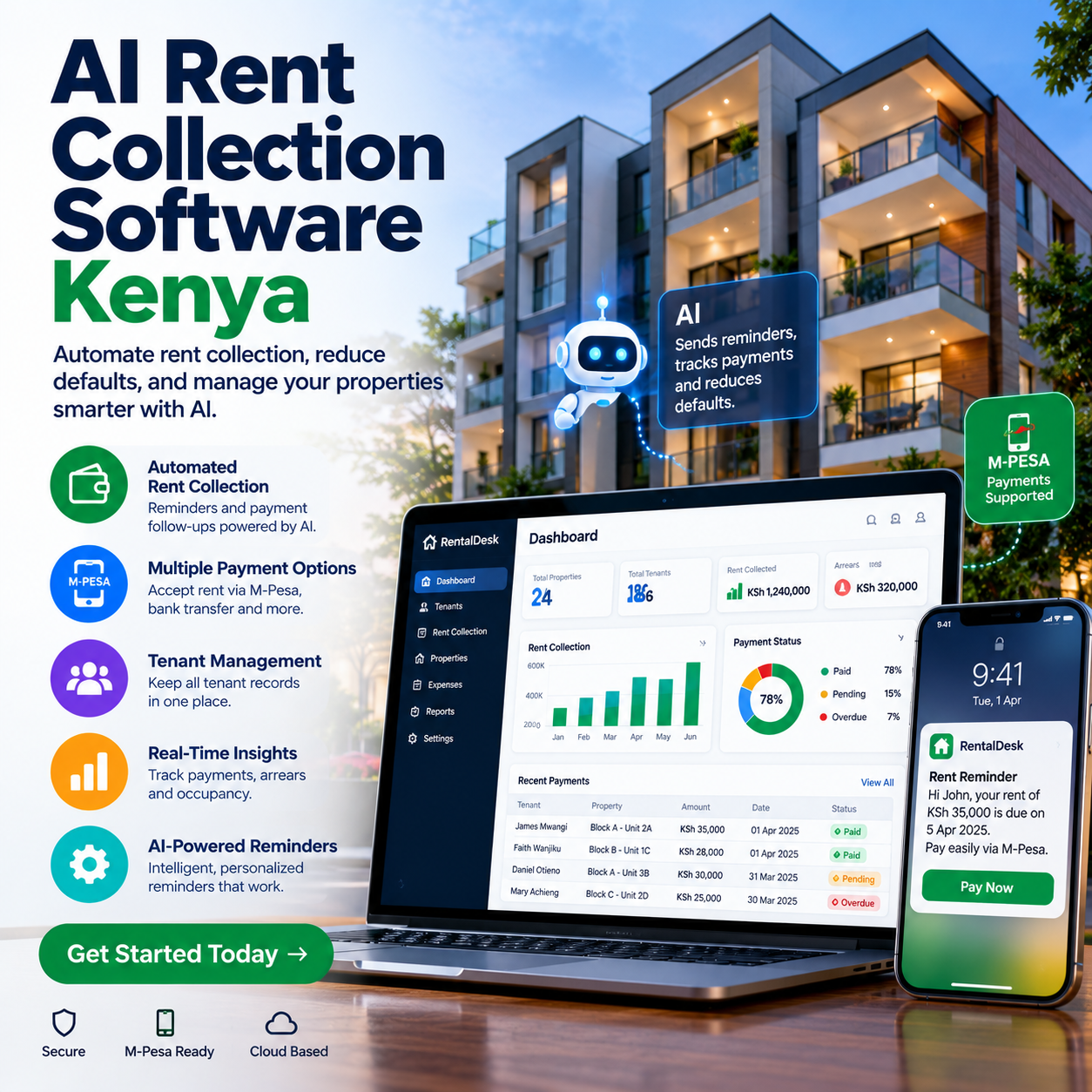
AI rent collection software is the newest chapter in Kenya’s property technology story — software that does not just record rent, but thinks about it.
Where ordinary tools tell you who paid, AI rent collection software predicts who will not pay, flags trouble before it starts, and handles the follow-up conversation for you.
The landlords adopting AI rent collection software are discovering something remarkable: most rental income problems are predictable, and predictable problems are preventable.
For years, rent management meant looking backward — counting what arrived, listing what did not, and chasing the difference.
AI rent collection software flips that timeline, studying payment patterns to warn you before a balance ever exists.
That shift from reaction to prevention is the biggest change in rental income management since M-Pesa itself.
This guide walks you through everything this new category offers and how to use it responsibly.
We cover what the intelligence actually does, which features matter, what it costs, where it falls short, and how to roll it out across your portfolio.
By the end, you will be able to evaluate any AI rent collection software like a seasoned professional — and know exactly what to demand.
Whether you collect from six bedsitters or six hundred apartments, the principles are identical.
Money that predicts itself is money that protects itself.
And nothing embodies that idea more completely than well-chosen AI rent collection software working quietly in the background of your portfolio.
What Is AI Rent Collection Software?
AI rent collection software is a platform that uses machine intelligence to manage the full journey of rent — from predicting payment to collecting it to reconciling it.
The “AI” is not a gimmick or a chatbot bolted onto a spreadsheet.
It is a set of pattern-recognition engines that learn your portfolio’s behavior and act on what they learn.
Think of the difference between a thermometer and a weather forecast.
A thermometer — ordinary rent tracking — tells you the temperature right now: paid, unpaid, overdue.
AI rent collection software is the forecast: it studies historical patterns, current signals, and tenant behavior to tell you what is coming next week.
Under the hood, the intelligence handles several distinct jobs.
It learns each tenant’s payment rhythm, spots anomalies that suggest fraud or vacancy, personalizes reminder timing, and answers routine questions automatically.
Together, these capabilities make AI rent collection software less like a ledger and more like a collection agent that never sleeps.
It helps to separate the real from the marketing.
Some products slap “AI” on any automated reminder; genuine AI rent collection software demonstrates learning — its predictions and actions improve as it observes your portfolio over time.
Ask any provider to show you a prediction, an anomaly catch, or a learned pattern from real data.
That demonstration is the dividing line between authentic AI rent collection software and a label.
Why 2026 Is the Breakout Year
Three forces are converging to make 2026 the year intelligent collection goes mainstream in Kenya.
Each one removes an old barrier.
Together, they move AI rent collection software from novelty to necessity.
First, the data is finally rich enough.
Years of digital rent payments through M-Pesa have created the payment histories that machine learning needs to find patterns.
The raw material for genuine AI rent collection software predictions simply did not exist five years ago.
Second, the technology has become affordable.
Capabilities that once required data science teams now ship inside platforms any landlord can subscribe to for the price of a family dinner out.
The cost barrier that kept AI rent collection software institutional has effectively collapsed.
Third, landlord expectations have matured.
After years of dashboards and reminders, owners are asking the obvious next question: if the software can see my arrears, why can’t it prevent them?
That question is exactly what AI rent collection software was built to answer.
The Core Intelligence: What the AI Actually Does
The capabilities inside AI rent collection software fall into six practical categories.
Understanding each one helps you separate substance from sales talk.
Use this section as your feature map.
Prediction is the headline capability.
By studying each tenant’s history — dates, amounts, delays, and responses — the system scores the likelihood of on-time payment before each due date.
That forward view is the foundational promise of AI rent collection software.
Smart reminders form the second capability.
Instead of identical messages on identical days, the system personalizes timing, channel, and tone to each tenant’s observed behavior.
A reminder that arrives when the tenant can actually act is worth ten sent at random — the everyday intelligence of AI rent collection software.
Anomaly detection is the third.
Sudden changes in payment patterns — a reliable tenant going quiet, amounts that shrink, payments from unexpected numbers — trigger early flags.
Anomalies are how AI rent collection software catches vacancies, job losses, and fraud in their first days instead of their third month.
Conversational automation is the fourth.
Chatbots on WhatsApp and SMS answer routine questions — balance, due date, payment confirmation — without a human in the loop.
That instant availability is the service face of AI rent collection software.
Intelligent reconciliation is the fifth.
Payments match themselves to tenants and invoices automatically, with the system learning from corrections to make fewer errors over time.
Self-improving bookkeeping is the quiet labor saving inside AI rent collection software.
Insight generation completes the set.
The platform surfaces patterns you would never compile yourself — which units underperform, which months dip, what your portfolio’s true collection rate is becoming.
That analytical layer is what elevates AI rent collection software from tool to advisor.
How It Works: The Intelligent Loop
The magic of AI rent collection software lies in a loop that senses, predicts, acts, and learns — every month, across every unit.
Here is how the cycle runs in a live portfolio.
Watch how each step feeds the next.
First, the system ingests your baseline: units, tenants, rent amounts, due dates, and every historical payment it can access.
Second, it builds a behavioral profile per tenant — their typical payment day, their preferred channel, their response to reminders.
Third, ahead of each due date, AI rent collection software issues its prediction: likely on-time, likely late, or at risk.
Fourth, action follows prediction automatically.
Low-risk tenants receive a standard courteous reminder, while at-risk tenants get earlier, warmer, better-timed outreach — the differentiated touch that defines AI rent collection software.
Fifth, payments reconcile themselves as they land, and the system watches for the anomalies that contradict its expectations.
Sixth — and this is the step that makes it AI — the outcomes feed back into the models.
Every prediction that proves right or wrong teaches the system, so the AI rent collection software serving your portfolio this December is measurably sharper than the one that started in January.
That learning loop is why early adopters describe the software “getting better at my properties” over time.
No manual system improves itself while you sleep.
That compounding advantage is the deepest economic argument for AI rent collection software.
Predictive Arrears: Stopping Problems Before They Exist
Arrears deserve their own deep look, because prediction changes that problem more than anything else.
Traditional tracking discovers arrears after the due date passes.
AI rent collection software identifies the likelihood of arrears days before the date arrives.
Consider what that window makes possible.
A tenant whose pattern suggests trouble can receive a friendly check-in before the due date — a conversation, not a confrontation.
Landlords using AI rent collection software report resolving most predicted late payments with a single early, human message.
The signals behind the predictions are practical, not mystical.
Payment dates drifting later each month, amounts edging downward, reminders going unanswered, and partial payments increasing are all classic precursors.
An owner watching AI rent collection software flags sees these stories assembling in real time.
Prediction also changes portfolio-level planning.
When the system forecasts that March collections will run light, you can plan commitments accordingly instead of being surprised.
Cash flow built on forecasts rather than hope is the quiet financial upgrade of AI rent collection software.
One honest boundary: predictions are probabilities, not certainties.
The system tells you where to look early; it does not replace your judgment about the human behind the number.
Landlords who treat AI rent collection software forecasts as a conversation starter — not a verdict — get the best of both minds.
Smart Reminders: The Right Message at the Right Moment
Reminders are where AI meets tenant psychology most directly.
The difference between a reminder that works and one that annoys is timing, tone, and channel — precisely the variables AI rent collection software learns to optimize.
Timing comes first.
If a tenant historically pays on the 3rd, a reminder on the 28th is noise, while a gentle nudge on the 2nd is a service.
Schedule intelligence like this is the visible face of AI rent collection software.
Channel follows the tenant’s habits.
Some respond to WhatsApp within minutes, others to SMS, others only after an app notification — and the system learns which is which per tenant.
Channel-matching is how AI rent collection software achieves response rates manual messaging never touches.
Tone adapts to the relationship stage.
A first-time slight delay warrants warmth; a chronic pattern warrants firmer, clearer language — escalated gradually and consistently.
That graduated diplomacy is the judgment embedded in well-built AI rent collection software.
The outcome is measurable.
Portfolios typically see late payments drop sharply within the first automated cycles, because the messages finally arrive when tenants can act.
Few changes to a rental business deliver visible returns as quickly as the reminder intelligence inside AI rent collection software.
Anomaly Detection: Your Early Fraud and Vacancy Alarm
Not every signal is about lateness — some are about impossibility, and those deserve special attention.
Anomaly detection watches for the payments and patterns that should not exist.
This protective layer is the least glamorous and most valuable part of AI rent collection software.
The classic catch is the phantom payment.
A caretaker forwards a convincing M-Pesa screenshot, but no matching transaction appears in the system’s records — a mismatch flagged within minutes, not months.
Intermediary fraud of exactly this kind is what AI rent collection software was born to expose.
Vacancy signals arrive the same way.
A unit whose payments stop, whose utility patterns flatten, and whose reminders go unanswered may be empty long before anyone reports it.
Early vacancy detection saves owners using AI rent collection software thousands in silent dead months.
Wrong-number and wrong-amount payments — honest tenant errors under the old manual regime — surface instantly and route to the right account.
Even internal anomalies get caught: a caretaker logging cash at 2 a.m., or the same repair claimed twice.
Patterns like these are invisible to memory and obvious to AI rent collection software.
The principle is simple and powerful.
Anything that breaks the learned pattern of your portfolio becomes visible immediately.
That continuous, tireless vigilance is what owners are really buying when they adopt AI rent collection software.
Conversational AI: The Assistant in Every Tenant’s Pocket
The newest layer is conversational — software that talks.
Tenants message a WhatsApp or SMS number and get instant, accurate answers: their balance, their due date, their last payment, their receipt.
That always-available assistant is the friendliest face of AI rent collection software.
The benefits run deeper than convenience.
Routine questions stop interrupting your day, because the assistant answers the “how much do I owe” messages at 11 p.m. without involving you.
For landlords of any size, that deflection alone reclaims hours every month — the most immediately felt gift of AI rent collection software.
Conversations also become data.
A tenant asking about a payment plan reveals distress early; a tenant confirming receipt happily confirms engagement.
That conversational intelligence feeds directly back into the predictions that make AI rent collection software sharper.
The best systems keep a human escape hatch.
When a conversation exceeds the assistant’s competence — a dispute, a hardship, a negotiation — it escalates to you with the full thread attached.
That human-in-the-loop design is the hallmark of mature AI rent collection software, and you should demand it.
AI vs. Traditional Rent Tracking: The Honest Comparison
Readers of our earlier guides often ask how this category differs from the rent tracking software we have covered before.
The distinction is timeline and initiative.
Traditional tracking records what happened; AI rent collection software anticipates what will happen and acts on it.
The comparison plays out across every daily task.
Traditional tools tell you a payment is missing on the 6th; intelligent platforms predicted the miss on the 1st and started the conversation then.
Traditional reminders fire on schedule; intelligent reminders fire on likelihood, personalized by AI rent collection software to each tenant’s rhythms.
Traditional reconciliation waits for your manual matching; intelligent matching resolves itself and learns from its rare errors.
Traditional reports summarize the past month; intelligent insights forecast the next one.
In fairness, traditional tools still suit small, stable, hands-on portfolios perfectly well.
An owner with five units who enjoys monthly spreadsheet rituals loses little by skipping AI rent collection software.
But for growing portfolios, absentee owners, and anyone tired of being surprised, the intelligence layer stops being optional — which is why the market is consolidating around it so quickly.
Many platforms now bundle both layers anyway.
The practical question is not whether to choose AI over tracking, but whether your AI rent collection software includes the full record-keeping foundation the intelligence needs to learn from.
Real Benefits for Landlords
The first benefit is arrears prevention rather than arrears recovery.
Every balance avoided is worth more than a balance chased — no awkwardness, no escalation, no vacancy risk.
That inversion of the collections problem is the defining value of AI rent collection software.
The second benefit is reclaimed time.
Reminders, receipting, reconciliation, and routine questions all run themselves, returning hours to your actual life every month.
Owners consistently describe AI rent collection software as “hiring an assistant who never asks for leave.”
The third benefit is earlier truth.
Vacancies, fraud, and tenant distress all surface in days instead of quarters, while they are still cheap to fix.
That compressed detection window may be the most financially significant feature of AI rent collection software.
The fourth benefit is compounding accuracy.
Unlike manual systems that stay static, the platform’s predictions and matches improve every month it runs.
Your AI rent collection software is the only part of your operation that gets better without being asked.
The fifth benefit is portfolio intelligence.
Which units underperform, which rents lag the market, which months historically dip — these insights were once the privilege of large institutions.
Today they come standard inside AI rent collection software for any owner who wants them.
Benefits for Property Managers and Caretakers
Property managers gain a force multiplier.
One person can now deliver prediction, personalized reminders, and instant answers across dozens of client portfolios.
That leverage is why professional firms are standardizing on AI rent collection software faster than any other segment.
Client reporting transforms too.
Forecasts, anomaly logs, and collection analytics give every owner client a clearer picture than any monthly verbal update ever could.
Transparency at that depth is what retains clients on AI rent collection software platforms for years.
Caretakers, handled well, become beneficiaries rather than suspects.
The system documents their collections, defends them against false accusations, and removes the money-handling burden from their job entirely.
Field staff who understand this framing often become the most enthusiastic advocates of AI rent collection software on the ground.
What AI Cannot Do: The Honest Limits
Every honest guide draws the line between what software does and what only humans can.
AI predicts likelihoods, but it cannot feel the difference between a tenant in genuine hardship and one testing your patience.
That judgment — and the mercy or firmness it requires — remains yours, and it matters.
AI sends perfect messages, but it cannot sit across a table from a struggling tenant and design a fair payment plan.
The systems that work best treat AI rent collection software as the preparation layer for human decisions, never the replacement for them.
AI also depends on data quality.
Wrong amounts, missing tenants, and stale records produce confident nonsense, so your setup discipline still determines your outcomes.
Clean inputs remain the landlord’s responsibility no matter how clever the AI rent collection software on top.
Finally, AI has no accountability.
When a decision truly matters — a termination, an escalation, a legal step — a human name must stand behind it.
Owners who keep that principle enjoy every benefit of AI rent collection software without any of the ethical exposure.
Must-Have Features to Demand in 2026
The category is young enough that quality varies widely, so evaluate against a demanding checklist.
The best AI rent collection software platforms share a clear set of capabilities.
Use this section as your scorecard.
First, demand genuine predictive scoring with visible history — show me predictions made, and how often they were right.
Transparency about accuracy is the single best test of authentic AI rent collection software.
Second, insist on M-Pesa-native reconciliation that learns, so matching improves instead of merely automating.
Third, expect personalized reminder intelligence — per-tenant timing, channel, and escalation — not one-size-fits-all blasts.
Differentiation by tenant is the visible signature of real AI rent collection software.
Fourth, look for anomaly alerts with explanations, telling you what broke the pattern and why it flagged.
Fifth, demand conversational support with human escalation, so the assistant knows its limits.
Sixth, check the foundation layer: invoices, receipts, statements, and exports must exist regardless of the intelligence on top
Finally, mind the practical basics — affordable phones, weak networks, and a short learning curve.
Usability still decides whether AI rent collection software becomes infrastructure or shelfware in your business.
Choosing the Right Platform
A structured selection process protects you in a fast-moving market.
Start with your realities: unit count, payment mix, team size, and how much of the follow-up you want automated.
The right AI rent collection software fits your operation, not the loudest advert.
Trial with real data, without exception.
Run one property through a full monthly cycle — a prediction, a reminder, a payment, a query — and watch how the system behaves.
One honest month of testing reveals more than any AI rent collection software demonstration ever will.
Interrogate the intelligence directly.
Ask how predictions are built, what accuracy the provider observes, and what happens when the model is wrong.
Providers of serious AI rent collection software answer these questions gladly; the rest reveal themselves by dodging.
Confirm the exit door as always.
Your data should export completely, because your records belong to you across every platform decision you will ever make.
Data portability is non-negotiable when adopting any AI rent collection software.
What It Costs in 2026
Pricing in this category remains friendlier than the technology suggests.
Competition among Kenyan providers has kept intelligence within reach of ordinary owners.
Against prevented arrears alone, AI rent collection software typically repays itself within the first month or two.
Typical pricing structures heading into 2026 look like this:
- Free tiers: basic tracking with limited intelligence, suitable for very small portfolios
- Per-unit plans: commonly KSh 30–100 per unit monthly, intelligence included
- Flat monthly plans: roughly KSh 1,000–5,000 depending on features and portfolio size
- Annual plans: usually 10–20 percent cheaper than monthly billing
Weigh the price against the full value stack: prevented arrears, reclaimed hours, earlier vacancy detection, and compounding accuracy.
Viewed that way, the true cost of good AI rent collection software approaches zero.
The real question is how long you can afford to run a portfolio on reaction alone.
Watch for hidden costs as you compare.
Some systems charge separately for reminders, conversational features, or advanced analytics, so read the tiers carefully.
Transparent pricing is a quality signal in the young AI rent collection software market worth preferring.
Getting Started the Right Way
Adoption succeeds or fails in the first two months, so begin deliberately.
Load one property completely and accurately, because every prediction the system ever makes learns from the data you give it first.
Clean setup is the foundation of intelligent AI rent collection software usage.
Let the system observe before you judge it.
Give the models one full billing cycle to learn your tenants before evaluating the predictions against reality.
Patience in month one is what makes the AI rent collection software of month six genuinely useful.
Introduce tenants to the new experience warmly.
A short message explaining faster receipts and easier payments — benefits they feel immediately — sets exactly the right tone for the intelligence to work.
Then review weekly at first, monthly once the rhythm settles.
Act on predictions, verify the anomalies, and note where the system earns your trust.
That feedback habit is how landlords extract full value from AI rent collection software year after year.
Common Mistakes to Avoid
The most common mistake is trusting predictions as verdicts.
A forecast is a conversation starter with a tenant, not a decision about one.
Landlords who pair AI rent collection software insight with human judgment get the best of both.
The second mistake is dirty data.
Wrong amounts and stale tenant records quietly poison every forecast and flag the system produces.
Verify your setup before trusting any AI rent collection software output.
The third mistake is over-automation of sensitive moments.
Hardship conversations, disputes, and terminations deserve a human voice even when the platform could technically handle them.
Discipline about what stays human is what keeps AI rent collection software an asset rather than a liability.
Privacy, Data, and Tenant Trust
Intelligence runs on data, and data carries responsibility.
Kenya’s Data Protection Act frames how tenant information should be collected, stored, and used, and reputable providers design for it.
Treat compliance as a minimum standard in any AI rent collection software you adopt.
Be transparent with tenants about what the system does.
A one-line explanation — records kept securely, reminders sent helpfully, data never sold — converts surveillance anxiety into service appreciation.
Trust is the multiplier on everything AI rent collection software tries to achieve.
Use predictions for payment behavior only.
Profiling tenants beyond their tenancy — their employment, their personal lives — crosses ethical and legal lines that no landlord benefit justifies.
Restraint keeps the intelligence welcome, and welcome intelligence works better.
The Road Ahead: 2027 and Beyond
The trajectory points toward portfolios that increasingly run themselves.
Payment, prediction, reminders, and reconciliation are converging into single flows where rent requests, confirmations, and receipts complete without human touchpoints.
The AI rent collection software of 2027 will feel less like a tool and more like a colleague.
Integration with vetting is coming next.
Payment history will flow into tenant screening, rewarding reliable renters with easier access across the market.
That data flywheel is the long-term promise of AI rent collection software ecosystems.
The message for today’s owner is simple.
The intelligence that was institutional five years ago is now affordable, local, and proven across thousands of Kenyan portfolios.
There has never been a better moment — in 2026 or beyond — to put AI rent collection software to work on your income.
Frequently Asked Questions
What does AI actually do in rent collection software?
It learns each tenant’s payment patterns, predicts likely late payments before due dates, personalizes reminders, detects anomalies like fraud or vacancy, and reconciles payments automatically.
Think of it as a collections analyst studying your portfolio continuously.
The learning loop is what distinguishes genuine AI rent collection software from ordinary automation.
Is my portfolio too small for AI to be useful?
Even five units benefit, because one prevented arrears quarter pays for the software for years.
Free and low-cost tiers make the entry decision easy at any size.
Habits built on AI rent collection software small scale beautifully as you grow.
How accurate are the predictions?
Accuracy improves with data volume and history, so early months are directional rather than perfect.
Ask any provider to show real accuracy figures from portfolios like yours before you commit.
Transparency on this point is the best single test of serious AI rent collection software.
Will tenants dislike automated messages?
Not when the messages are well-timed, courteous, and genuinely useful — which is precisely what the intelligence optimizes for.
Most late payments are honest forgetfulness, and tenants appreciate a clear nudge that arrives when they can act.
Hostility comes from bad timing, not from automation itself.
Does it work with M-Pesa?
Yes — M-Pesa reconciliation is the foundation the intelligence learns from, matching payments to tenants automatically.
Confirm the depth of integration during your trial, because claims vary widely between platforms.
Proper M-Pesa integration is the core plumbing of AI rent collection software.
Can it replace my caretaker or property manager?
It replaces tasks, not people — the messages, matching, and monitoring — while humans still handle viewings, repairs, and judgment calls.
Many owners find the combination of a trusted caretaker and intelligent software outperforms either alone.
Delegation changes; oversight remains yours in any AI rent collection software arrangement.
What happens when the AI gets it wrong?
You will see misses — a predicted on-time tenant who goes silent, or an at-risk flag on someone who pays early — so treat forecasts as priorities, not verdicts.
The system learns from every miss, which is exactly how it improves.
Humility about this is the mark of experienced AI rent collection software users.
Is my tenants’ data safe?
Reputable providers use encryption, backups, and access controls comparable to banking standards, and operate within Kenya’s data protection framework.
Confirm the provider’s practices, retention limits, and your export rights before committing.
Data stewardship is a baseline requirement of professional AI rent collection software — verify it, never assume it.
Where can I find verified tenants and landlord tools together?
Start with platforms that combine verified listings with landlord-friendly technology, such as rentaldesk.co.ke.
Pairing the right tenants with intelligent AI rent collection software takes you from chasing rent to preventing problems — month after month, automatically.