
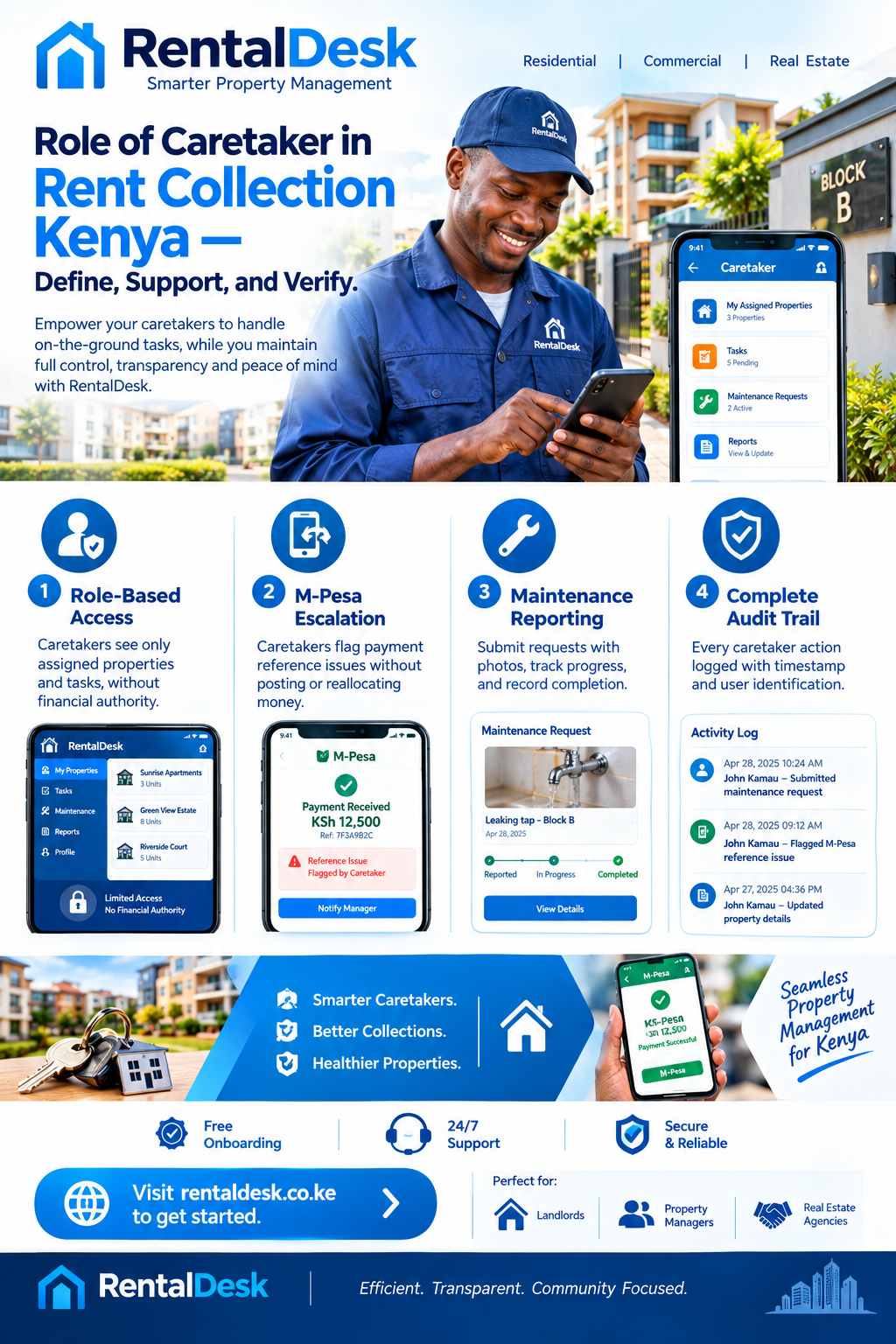
Role of caretaker in rent collection Kenya is the operational question that determines whether a rental property runs smoothly or quietly leaks money every month. In the Kenyan rental market, the caretaker is not a peripheral figure. They are often the first point of contact for tenants, the person who knows which unit is vacant, which tenant is struggling, and which pipe started leaking last night. For absentee landlords and busy property managers, the caretaker is the eyes and ears of the operation.
But when it comes to rent collection, the caretaker’s role is frequently misunderstood, inconsistently applied, and poorly documented. A properly defined role of caretaker in rent collection Kenya is not about giving the caretaker more power. It is about giving them a clear, limited, and accountable function that supports the collection process without exposing the property to financial risk.
Why the Caretaker’s Role in Rent Collection Matters in Kenya
The case for defining the role of caretaker in rent collection Kenya rests on the structural reality of Kenyan property management. The caretaker arrangement exists because it must: owners live in town, abroad, or across the city, while their properties sit in Ngara, Kitengela, Kakamega, or a plot on the edge of Eldoret. Distance is the defining condition, and the caretaker is the owner’s only presence on the ground. For absentee landlords, caretakers double as collectors, enforcing rent deadlines and sometimes holding money before transferring it to owners.
That arrangement works until records are needed. And records are always eventually needed. The deposit dispute, the repair bill questioned, the arrears balance argued, the vacancy nobody reported: every one of these conversations needs a record the informal arrangement never kept. When a tenant claims they paid rent from a relative’s phone, the caretaker forwards a screenshot to the manager. Finance cannot match it because the reference is incomplete. The tenant is still shown in arrears, and another reminder is sent. The problem is not lack of effort. It is an informal handoff with no assigned exception, status, or reliable link to the tenant account.
A well-defined role of caretaker in rent collection Kenya solves this by converting each field observation into a structured, reviewable event while keeping financial decisions with authorised staff. The caretaker records facts. The system and the manager make the decisions.
What the Caretaker Is Actually Responsible For
The role of caretaker in rent collection Kenya conversation must begin with the specific duties that define the position. In Kenyan rental management, the caretaker’s responsibilities typically include several core functions.
Rent and service charge collection follow-up. The caretaker is responsible for ensuring timely rent and service charge collection. This does not mean the caretaker decides who pays or how much. It means the caretaker follows up with tenants who have not paid, reminds them of the due date, and reports the status to the property manager.
Daily status reporting. The caretaker submits daily status reports to the property manager relating to security, repairs and maintenance, tenant welfare, and rent collection. These reports are the early warning system that allows the manager to act before small issues become expensive problems.
Tenant relationship management. The caretaker is the first point of contact for tenant concerns, complaints, and emergency issues. They log requests, respond to routine matters directly, and escalate serious issues to the property manager.
Property inspection. The caretaker conducts regular inspections of the building and compound, identifying maintenance issues such as leaks, cracked surfaces, faulty fittings, or safety hazards early.
Maintenance supervision. The caretaker supervises the work of cleaning, housekeeping, and building maintenance staff and contractors. They are on site when the plumber arrives, when the electrician inspects the wiring, and when the cleaner finishes the common areas.
Vacancy and letting support. The caretaker assists in the letting of space, shows vacant units to prospective tenants, and reports occupancy changes.
Cash handling under authorised processes. Where cash is unavoidable, the caretaker may collect money under an authorised process. But recording receipt of money is different from reconciling and approving the financial entry. The workflow should capture payer, amount, reason, and time, and the caretaker should never be the final authority on reconciliation.
Any landlord or agency seeking clarity on the role of caretaker in rent collection Kenya should understand that the caretaker’s function is operational, not financial. The caretaker collects information. The system collects money.
What the Caretaker Should Not Be Allowed to Do
The role of caretaker in rent collection Kenya conversation must include clear boundaries, because field access becomes risky when convenience overrides separation of duties.
Unless a carefully approved role requires it, caretakers should not change posted rent, approve refunds, edit owner banking information, delete receipts, reallocate M-Pesa transactions, change management fees, publish landlord statements, or view unrelated properties.
The reason is straightforward. A caretaker who can reallocate an M-Pesa transaction can hide a missing payment. A caretaker who can delete a receipt can erase the evidence of a cash collection. A caretaker who can view all properties in a portfolio can see data belonging to landlords who are not their employers. These are not hypothetical risks. They are the failure modes that emerge when access is granted for convenience rather than designed around responsibility.
RentalDesk enforces this separation through role-based access. Each user sees only what they are allowed to manage. This reduces mistakes and increases accountability across the team. The caretaker sees the information they need to do their job. The finance team sees the information they need to reconcile. Neither sees the other’s data.
The M-Pesa Reconciliation Challenge and the Caretaker
The role of caretaker in rent collection Kenya conversation cannot be separated from M-Pesa, because roughly the majority of tenant payments in urban Kenya arrive through mobile money. The old way involves someone screenshotting payments, pasting them in a folder, manually updating a sheet, then chasing the landlord on WhatsApp to confirm the figure. That process breaks down the moment a payment arrives with an incorrect reference or from a third-party phone number.
A caretaker may encounter a tenant who says rent was paid from a relative’s phone. The caretaker forwards a screenshot to the manager. Finance cannot match it because the reference is incomplete. The tenant is still shown in arrears, and another reminder is sent. This is not a failure of the caretaker. It is a failure of the system to provide a structured way to escalate the exception.
RentalDesk addresses this through its reconciliation queue. When a payment cannot be matched automatically, it enters a queue where authorised staff can resolve it with a full audit trail. The caretaker can flag the issue through the app without posting or reallocating money. The finance team resolves it. The tenant receives a receipt. The arrears figure remains accurate.
For any property manager evaluating the role of caretaker in rent collection Kenya, the critical requirement is that the caretaker can escalate a payment issue without being able to resolve it financially. The escalation is the caretaker’s job. The resolution is the finance team’s job.
Cash Handling: The Highest-Risk Area
The role of caretaker in rent collection Kenya conversation must address cash handling with particular care, because cash is where most caretaker-related financial losses occur.
Where cash is unavoidable, it should be receipted at the point of collection, recorded immediately, and banked on a defined schedule. A digital platform that lets a caretaker record a cash receipt on a phone at the door creates the record at the right moment. The tenant gets an SMS receipt immediately, and the cash is tracked until it is deposited.
But the caretaker should not be the final authority on whether the cash has been accounted for. The workflow should capture the payment, and a separate authorised user should reconcile it against the bank deposit. RentalDesk supports this separation. The caretaker can record the cash receipt. The manager or accountant can confirm the banking. The audit trail records both actions.
An agency or landlord researching the role of caretaker in rent collection Kenya should treat cash handling as the single most important control to define. A caretaker who collects cash without a receipting process is a caretaker who will eventually be accused of something, whether or not they did it. The system protects the honest caretaker as much as it protects the landlord.
Tenant Communication and the Caretaker
The role of caretaker in rent collection Kenya conversation must address tenant communication, because the caretaker is often the person the tenant sees and speaks to daily. A tenant who is struggling to pay rent may tell the caretaker before they tell the landlord. A tenant who has a maintenance issue will report it to the caretaker first.
This places the caretaker in a position of trust but also of risk. If the caretaker communicates a payment arrangement that the landlord has not approved, the landlord is bound by nothing and the tenant feels misled. If the caretaker fails to communicate a maintenance issue, the tenant feels ignored.
RentalDesk provides a structured way for the caretaker to record tenant communications. The caretaker can log the interaction, note what was discussed, and flag it for the manager’s attention. The record is timestamped and attached to the tenant’s account. When the manager reviews the account, they see the full history. When a dispute arises, the record settles the question.
This structured approach turns the caretaker from an informal intermediary into a documented communication channel. The caretaker’s observations become part of the property record rather than verbal information that disappears.
Role-Based Access: What the Caretaker Should See
The role of caretaker in rent collection Kenya conversation must define what the caretaker can see, because access should follow actual responsibilities.
A caretaker assigned to a building may need to view unit numbers, occupant names needed for service, current work orders, and a limited follow-up list. They may need to record readings, inspection evidence, key movements, maintenance findings, visitor or incident information, and tenant messages requiring escalation.
What the caretaker should be able to do includes viewing only assigned properties, blocks, and units. Seeing task summaries and due dates relevant to on-site work. Capturing water or electricity readings with meter identifiers and photographs. Opening maintenance reports with category, priority, description, and evidence. Updating permitted stages such as “visited,” “contractor arrived,” or “work appears complete.” Recording move-in or move-out checklist items, keys, and condition evidence where authorised. Submitting occupancy-change requests for manager verification. Escalating a tenant payment-reference issue without posting or reallocating money. And adding factual notes to assigned follow-up tasks.
What the caretaker should not see or do is equally important. They should not change posted rent, approve refunds, edit owner banking information, delete receipts, reallocate M-Pesa transactions, change management fees, publish landlord statements, or view unrelated properties.
RentalDesk allows landlords and agencies to assign permissions for caretakers, accountants, property managers, admin staff, landlords, inspectors, and vendors. Each user sees only what they are allowed to manage.
The Daily Workflow: How the Caretaker Supports Collection
The role of caretaker in rent collection Kenya conversation becomes concrete when we look at the daily workflow. A caretaker who supports rent collection effectively follows a structured routine.
Morning review. The caretaker opens the app and reviews the list of tenants who have not paid. The list is generated automatically from the ledger. Tenants with outstanding balances are highlighted. The caretaker knows exactly who to follow up with.
Follow-up. The caretaker contacts the tenants on the list. If the tenant has paid but the payment has not matched, the caretaker escalates the payment reference issue through the app. If the tenant has not paid, the caretaker records the conversation and the tenant’s response.
Maintenance reporting. The caretaker inspects the property, identifies issues, and submits maintenance reports with photos. The manager receives the report, assigns a vendor, and tracks completion.
Meter reading. The caretaker records water and electricity meter readings per unit. The readings are submitted with photos of the meters. The system calculates consumption and generates bills.
End-of-day report. The caretaker submits a daily status report covering security, maintenance, tenant welfare, and rent collection. The manager reviews the report and takes action where needed.
This structured workflow converts the caretaker’s daily activities into a documented record. The manager does not need to call the caretaker to ask what happened. The record answers the question.
How Technology Supports the Caretaker’s Role
The role of caretaker in rent collection Kenya conversation must address the technology that makes the role workable. A caretaker armed with a phone and a structured app is far more effective than a caretaker armed with a notebook and a WhatsApp account.
RentalDesk provides the caretaker with a mobile workspace designed for on-site work. The caretaker can view assigned properties, see tenant names and rent status, record maintenance requests with photos, capture meter readings, and escalate payment issues. Every action is logged with a timestamp and user identification.
The platform also connects the caretaker’s field observations to the central ledger. When the caretaker records a cash payment, the payment appears in the tenant’s account. When the caretaker submits a maintenance report, the report enters the same workflow used by the property manager. When the caretaker escalates a payment reference issue, the issue enters the reconciliation queue. Nothing is lost, and nothing is duplicated.
This connection between the field and the office is what makes the role of caretaker in rent collection Kenya sustainable at scale. An agency managing fifty caretakers across fifty buildings cannot rely on phone calls and WhatsApp messages. It needs a system where every caretaker’s observations flow into the same structured record.
Common Mistakes Landlords and Agencies Make
The role of caretaker in rent collection Kenya journey has predictable failure modes.
Giving the caretaker too much financial authority. A caretaker who can post payments, reallocate M-Pesa transactions, or delete receipts can hide missing money. The caretaker should record facts, not make financial decisions.
Giving the caretaker too little support. A caretaker who has no system for recording payments or escalating issues will fall back on WhatsApp and memory. The property loses its operational memory when the caretaker leaves or takes leave.
Failing to define the escalation path. A caretaker who does not know when to escalate an issue will either handle it badly or not handle it at all. The escalation path should be documented and understood.
Not verifying field information. A caretaker app that accepts everything without review creates a false sense of control. Managers should verify field information through reconciliations, review queues, and spot checks.
Treating the caretaker as a scapegoat. When a payment is missing, the caretaker is often the first person suspected. A system that logs every action protects the honest caretaker by showing exactly what they did and when.
How RentalDesk Supports the Caretaker’s Role
RentalDesk is built specifically for the Kenyan market and supports the caretaker’s role in rent collection without exposing the property to financial risk.
Role-based access. The caretaker sees only their assigned properties, tenant names needed for service, rent status, open repairs, and vacancies. They cannot see deposit balances, owner statements, or other properties.
Structured task management. Tasks are assigned with due dates and visible status. The caretaker knows what to do and when it is due. The manager knows what has been completed.
M-Pesa escalation. The caretaker can escalate a payment reference issue without posting or reallocating money. The finance team resolves the exception through the reconciliation queue.
Maintenance reporting. The caretaker can submit maintenance reports with photos and descriptions. The manager assigns vendors, approves quotes, and tracks completion.
Meter reading capture. The caretaker records water and electricity readings with meter identifiers and photographs. The system calculates consumption and generates bills.
Cash receipt recording. The caretaker records cash payments at the point of collection. The tenant receives an SMS receipt. The manager reconciles the banking.
Audit trail. Every action the caretaker takes is logged with a timestamp and user identification. The record protects both the caretaker and the landlord.
Handover support. When a caretaker leaves or takes leave, the system retains all records. The next caretaker can pick up without losing the operational history.
The Legal and Compliance Dimension
The role of caretaker in rent collection Kenya conversation must acknowledge the legal framework that governs the caretaker’s activities. The caretaker acts as an agent of the landlord or property manager. They do not have independent legal authority to enter contracts, waive rent, or approve expenses beyond their delegated limits.
Under the Data Protection Act, 2019, the caretaker is a data processor if they handle tenant data. They must handle it lawfully and only for the purpose for which it was collected. The caretaker should not share tenant data with unauthorised parties.
Under the Estate Agents Act, Cap 533, the caretaker is not an estate agent unless registered. They should not perform estate agency functions beyond their defined role.
RentalDesk supports compliance by enforcing role-based access and maintaining a complete audit trail. The caretaker’s activities are logged, and the data they can access is limited.
The Financial Impact of a Well-Defined Caretaker Role
The role of caretaker in rent collection Kenya conversation is ultimately about financial performance. A caretaker who follows up on late payments, escalates payment issues promptly, and reports maintenance issues early reduces arrears and preserves property value. A caretaker who is not supported by a system creates more problems than they solve.
RentalDesk connects the caretaker’s daily activities to the financial ledger. When the caretaker escalates a payment issue, the reconciliation queue resolves it faster. When the caretaker reports a maintenance issue, the repair is completed before it becomes a capital expense. When the caretaker records a cash payment, the tenant receives a receipt and the ledger is updated.
For any landlord or agency investing in the role of caretaker in rent collection Kenya, the return is measurable. Faster reconciliation, fewer disputes, better tenant relationships, and a property record that survives staff changes.
How to Get Started
Implementing a structured approach to the role of caretaker in rent collection Kenya is straightforward with RentalDesk .
Step 1: Sign up. Visit RentalDesk and create your account. Choose a plan that matches your portfolio size.
Step 2: Define caretaker roles and permissions. Decide what each caretaker can see and do. Configure role-based access accordingly.
Step 3: Configure M-Pesa collection. Connect your Paybill so that payments reconcile automatically and the caretaker can escalate exceptions.
Step 4: Configure maintenance workflows. Define how maintenance requests submitted by caretakers are routed to the right person.
Step 5: Train caretakers. Show them how to use the app for rent follow-up, maintenance reporting, meter readings, and cash receipt recording.
Step 6: Run a pilot. Roll out to one property before the full portfolio, and gather feedback from caretakers on usability.
Step 7: Go live. Roll out to the full portfolio and review the caretaker activity log regularly.
The Future of the Caretaker’s Role in Kenya
The role of caretaker in rent collection Kenya landscape is moving toward greater digitisation and accountability. Government tax infrastructure is integrating with property management platforms. M-Pesa remains the dominant collection rail. And the caretaker is increasingly supported by mobile apps that capture field observations in real time.
The landlords and agencies that adopt a structured approach to the caretaker’s role early will not simply have tidier records. They will have lower arrears, faster reconciliation, better tenant relationships, and a property operation that runs smoothly whether the caretaker is on duty or on leave.
RentalDesk provides the structured platform that makes the role of caretaker in rent collection Kenya work—not as an informal arrangement held together by phone calls and trust, but as a documented, limited, and accountable function that supports the entire collection process.
- Role of caretaker in rent collection Kenya
- Role of caretaker in rent collection Kenya
- Role of caretaker in rent collection Kenya
- Role of caretaker in rent collection Kenya
- Role of caretaker in rent collection Kenya
- Role of caretaker in rent collection Kenya
- Role of caretaker in rent collection Kenya
- Role of caretaker in rent collection Kenya
- Role of caretaker in rent collection Kenya
- Role of caretaker in rent collection Kenya
- Role of caretaker in rent collection Kenya
- Role of caretaker in rent collection Kenya