
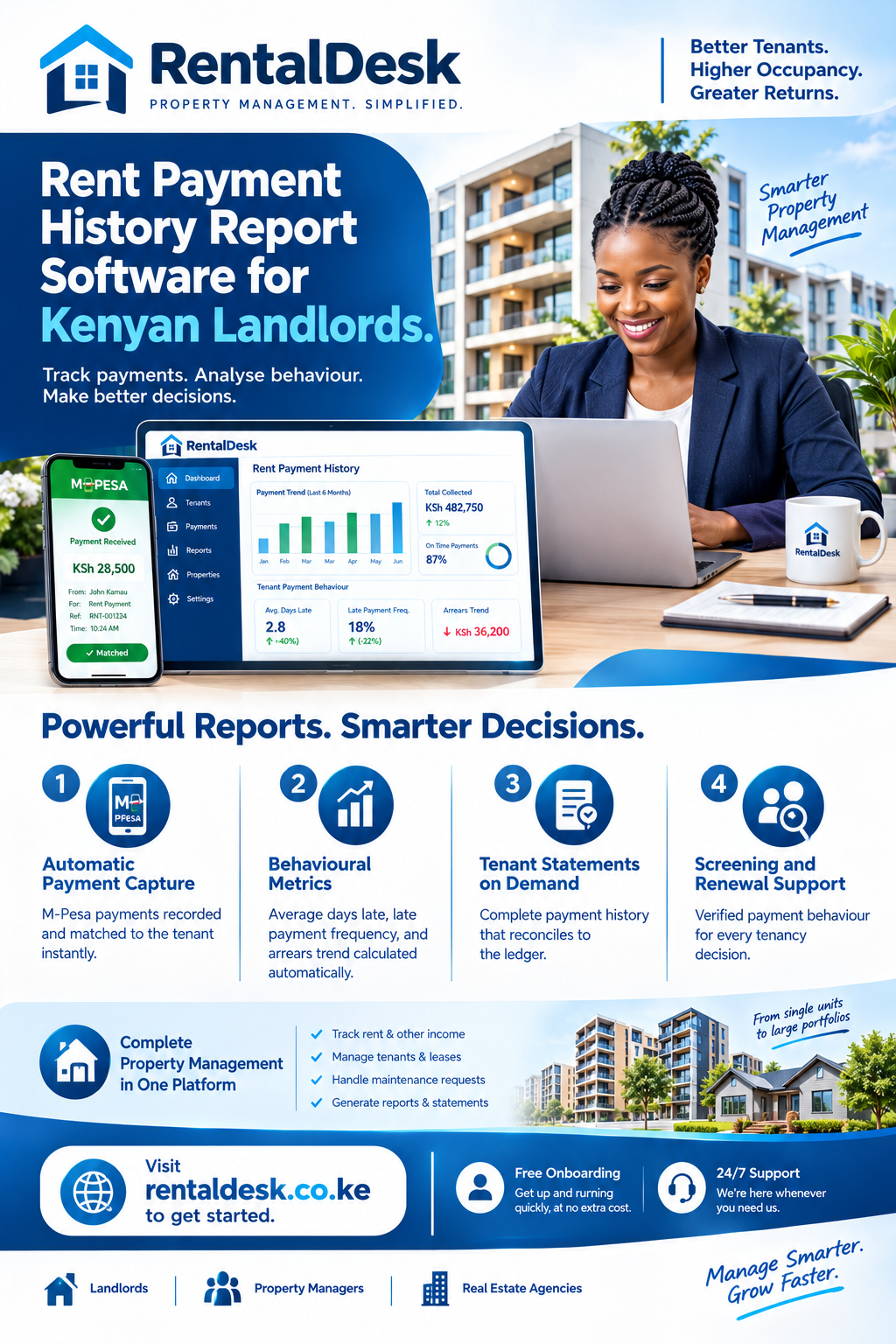
Rental Utility Billing Software Kenya: A Complete Guide to Managing Tenant Utility Charges
Managing rental properties involves much more than collecting rent at the end of every month. Landlords and property managers must also account for water consumption, electricity, garbage collection, shared lighting, security-related utilities and other services that tenants use. When these expenses are calculated manually, mistakes can lead to disputes, delayed payments and difficulties balancing property accounts. Rental Utility Billing Software Kenya offers a practical approach to organizing these responsibilities by helping property owners manage utility charges, maintain billing records and improve communication with tenants.
For landlords managing apartments, residential estates, bedsitters, commercial buildings and mixed-use properties, accurate utility billing is essential. Tenants want to understand what they are paying for, while property owners need reliable records showing the amounts charged, payments received and balances outstanding. A structured billing process makes it easier to meet both expectations.
The challenge becomes more complicated when a building has several tenants sharing common facilities or when water and electricity bills must be divided among multiple rental units. A handwritten notebook or basic spreadsheet may work for a small property, but it can become difficult to maintain as the number of tenants grows.
With Rental Utility Billing Software Kenya, property managers can explore a more organized way of handling utility charges alongside other rental administration activities. The goal is not simply to produce bills. It is to establish a dependable process for recording consumption, explaining charges, tracking payments and resolving billing questions.
This guide explains how rental utility billing works, why accurate calculations matter, which features landlords should consider, how utility expenses can be allocated fairly and how digital tools can support rental property operations in Kenya.
1. What Is Rental Utility Billing Software?
Rental utility billing software is a digital solution that helps landlords and property managers calculate, issue, record and monitor utility charges associated with rental properties. Depending on the system, it may support water billing, electricity charges, shared service expenses, meter readings, tenant statements and payment reconciliation.
Instead of calculating every tenant’s charges independently, property managers can use a consistent process for collecting consumption information, applying agreed billing rules and recording the resulting amounts.
For example, consider an apartment building in Nairobi with 24 occupied units. Each tenant receives a monthly water bill, while common-area electricity is shared according to an established arrangement. The manager must record readings, calculate individual charges, communicate amounts due and track payments.
Without a structured process, the manager may have to consult several notebooks, receipts and spreadsheets to answer a simple question about a tenant’s balance. A digital workflow can make these records easier to organize and retrieve.
When evaluating Rental Utility Billing Software Kenya, landlords should distinguish between basic invoicing tools and systems that support the wider utility billing process.
A basic invoicing tool may allow a manager to enter an amount and generate a bill. A more specialized solution may also help organize meter readings, maintain tenant-level records, apply billing rates and reconcile payments against outstanding invoices.
The appropriate option depends on the property’s size, utility arrangements and administrative requirements.
Utility billing versus ordinary rent billing
Rent billing and utility billing are related, but they are not identical.
Rent billing generally concerns the agreed rental amount for a particular unit and period. Utility billing concerns services consumed by tenants or expenses allocated to them under their tenancy arrangements.
A tenant might therefore receive:
-
A monthly rent invoice.
-
A water consumption bill.
-
An electricity charge.
-
A shared waste collection fee.
-
An applicable common-area service charge.
-
A statement showing previous unpaid amounts and recorded payments.
These items should be clearly identified rather than combined into an unexplained total.
Using Rental Utility Billing Software Kenya as a reference point for evaluating digital workflows, property managers should look for ways to keep charges transparent and maintain a clear distinction between rent, consumption-based expenses and other agreed fees.
Who needs utility billing software?
The solution can be useful for several types of property operators.
Apartment landlords: Owners of apartment blocks often need to calculate charges for multiple tenants every month.
Property management companies: Companies handling properties on behalf of owners may need consistent procedures across several buildings.
Residential estate managers: Estates may have shared lighting, water systems, waste services and other common expenses requiring documented allocation.
Commercial property managers: Offices, shops and business premises may have different utility arrangements, including individual meters or shared facilities.
Bedsitter and hostel operators: Properties with many small units can generate substantial administrative work when utility bills are prepared manually.
Mixed-use property owners: Buildings containing shops, offices and residential units may require different billing rules for different categories of occupants.
The more complex the property’s utility arrangements, the more valuable standardized billing procedures become.
2. Why Accurate Utility Billing Matters for Kenyan Landlords
Utility billing directly affects cash flow, tenant relationships and the reliability of property records. Errors that appear small on individual invoices can become significant when repeated across many units.
For example, an incorrect charge of KSh 150 applied to 40 units creates a total discrepancy of KSh 6,000 for one billing period. If the error is repeated over several months, correcting the accounts can become increasingly difficult.
A reliable process supported by Rental Utility Billing Software Kenya can help property managers identify these issues earlier and keep supporting records together.
Reducing calculation mistakes
Manual billing often involves copying meter readings, subtracting previous readings, multiplying consumption by an applicable rate and adding other charges.
Each step creates an opportunity for error.
A staff member may enter the wrong reading, apply an outdated rate or transfer a tenant’s charge to the wrong unit. These mistakes can affect the amount collected and create disagreements when tenants review their statements.
A well-configured digital system can standardize calculations and reduce repetitive data entry. Managers must still verify meter readings, tariff settings and allocation rules because incorrect source information can produce incorrect bills even when the arithmetic is automated.
Improving tenant confidence
Tenants are more likely to understand a bill when it shows how the amount was calculated.
A useful statement may include the billing period, previous meter reading, current reading, units consumed, rate applied, other authorized charges and total payable.
Where appropriate, it should also show previous balances, payments received and the remaining amount due.
With Rental Utility Billing Software Kenya, landlords can assess how digital records might support clearer communication and more consistent billing administration.
Transparency is particularly important when tenants suspect that a shared utility charge has been divided unfairly.
Supporting predictable cash flow
Utility expenses may need to be paid to suppliers even when some tenants have not settled their individual charges.
If billing is delayed, tenants receive their invoices late and the property owner may have difficulty recovering expenses promptly. Inaccurate records can also make it harder to identify unpaid balances.
A consistent billing calendar helps managers issue bills promptly, monitor due dates and follow up on outstanding amounts.
Making property records easier to review
Property owners need to know whether utility collections correspond with supplier expenses and recorded tenant charges.
If records are scattered across paper files, bank messages and spreadsheets, preparing an accurate monthly summary can take considerable time.
A centralized process makes it easier to review billing history, identify missing payments and investigate discrepancies.
3. Common Utility Billing Challenges in Rental Properties
Before selecting a system, landlords should identify the problems they need to solve. Different buildings have different utility arrangements, and a solution should reflect the actual situation rather than impose unnecessary complexity.
Manual meter reading and calculation
Where each unit has a separate meter, staff must record readings consistently and calculate consumption for the relevant period.
For example:
-
Previous reading: 145 cubic metres.
-
Current reading: 153 cubic metres.
-
Consumption: 8 cubic metres.
The manager must then apply the relevant rate and account for any additional charges or adjustments permitted by the property’s billing arrangement.
A simple subtraction error can affect the invoice. Missing readings may also require a documented estimate or a follow-up visit, depending on the applicable agreement and procedures.
A system evaluated as Rental Utility Billing Software Kenya should therefore be assessed for its ability to maintain meter records, preserve billing history and flag incomplete information where supported.
Dividing shared utility expenses
Not every rental unit has an individual meter. Some properties have a common water connection, shared electricity supply or central utility equipment.
In these situations, the manager needs a defensible allocation method.
Possible methods include:
-
Dividing a documented expense equally among eligible units.
-
Allocating charges according to agreed occupancy-based rules.
-
Using individual consumption readings where available.
-
Applying an agreed floor-area or other appropriate allocation method.
-
Separating identifiable common-area consumption from private consumption.
The correct method depends on the property’s configuration, tenancy agreements and applicable requirements. A landlord should not assume that every method is appropriate for every property.
Handling late and missing payments
A tenant may pay rent but forget to pay a separate water bill. Another may settle several charges in one transfer without identifying each invoice.
If payments are not recorded against the correct accounts, outstanding balances can become misleading.
The manager needs to distinguish between an invoice that remains unpaid, an invoice that has been partially paid and a payment that has been received but not yet allocated.
Dealing with tenant disputes
Utility disputes commonly arise when tenants cannot understand how a charge was calculated or believe that a meter reading is inaccurate.
Useful supporting evidence includes dated readings, supplier invoices, the agreed allocation formula and records of adjustments.
With Rental Utility Billing Software Kenya, property operators can explore workflows that keep this information organized and easier to retrieve when questions arise.
Managing several buildings
A landlord with one building may be able to manage utility records through a single spreadsheet. A company responsible for several properties faces a more demanding task.
Each building may have different meters, tariffs, billing dates and tenant arrangements.
A suitable system should make it possible to identify the property and unit associated with every charge. If the software supports multiple properties, managers should also investigate how it separates reports, users and records between locations.
4. Essential Features to Look for in Utility Billing Software
Not every rental management application includes dedicated utility billing capabilities. Landlords should compare the features available with the tasks their staff actually perform.
When reviewing Rental Utility Billing Software Kenya, start by identifying the minimum features required to calculate and explain utility charges accurately.
Meter reading management
The system should provide a practical way to record meter readings and associate each reading with the relevant property, unit, meter and date.
Ideally, users should be able to review previous readings and identify missing entries.
Useful capabilities may include:
-
Recording opening and closing readings.
-
Storing meter identification details.
-
Maintaining historical readings.
-
Calculating consumption differences.
-
Identifying unusual changes for manual review.
-
Recording corrections with an explanation.
Automatic alerts and anomaly detection should only be expected if the selected product explicitly supports them.
Flexible billing calculations
A property may charge tenants using fixed rates, consumption-based rates or documented allocation formulas.
The software should accommodate the billing methods actually used by the property.
Managers should confirm whether the system supports different rates for different utilities, effective dates for rate changes, partial billing periods and adjustments.
The system should also allow authorized staff to review calculations before invoices are finalized.
Tenant and unit records
Utility bills must be associated with the correct tenant and rental unit.
A good system should help managers maintain unit identifiers, occupancy information, tenant contact details and relevant billing records.
Where a tenant moves out or a new tenant takes possession, the property manager should be able to document the change and establish the correct responsibility for charges.
Invoice generation
Generating readable invoices is a core requirement.
Each invoice should identify the tenant, property, unit, billing period, charge descriptions, amounts due and payment instructions.
Where consumption-based billing applies, the invoice should ideally show the readings, consumption and calculation method.
A system assessed under Rental Utility Billing Software Kenya should be checked for the quality and clarity of its invoice output rather than judged solely by whether it can produce a document.
Payment tracking and reconciliation
A billing system should help managers record payments and compare them with invoices.
Depending on the product, this may include manual payment entry, imported transaction records or supported payment integrations.
Managers should confirm whether the system supports partial payments, overpayments, credit balances and the correction of incorrectly allocated transactions.
Reporting
Useful reports can include:
-
Total utility charges for a billing period.
-
Payments received.
-
Outstanding utility balances.
-
Consumption by unit.
-
Charges by building.
-
Adjustments and corrections.
-
Comparisons between supplier expenses and tenant recoveries.
Reports are most useful when managers can trace summary figures back to the underlying records.
5. How Utility Billing Works in Practice
A consistent billing cycle helps property managers avoid omissions and establish a clear routine for tenants.
The exact workflow will vary according to whether the property uses individual meters, shared meters or fixed service charges. However, a typical cycle follows several steps.
Step 1: Confirm the property and tenant records
Before calculating any bill, verify that every unit has the correct tenant information and utility arrangement.
Check whether the unit is occupied, which utilities apply and which billing method is authorized.
A vacant unit may still incur certain property-level expenses, but the manager should not automatically allocate every cost to another tenant without a valid basis.
Step 2: Collect the necessary readings and supplier bills
Record the relevant readings and obtain supplier invoices for shared expenses.
Readings should be associated with dates and meter identifiers. Supplier bills should be linked to the appropriate building and billing period.
Where a reading is unavailable, document the reason and follow the property’s approved procedure for resolving the gap.
Step 3: Calculate consumption and charges
For a consumption-based utility, calculate the difference between the current and previous readings.
Suppose a water meter records 34 cubic metres at the start of a period and 40 cubic metres at the end.
Consumption is:
40 − 34 = 6 cubic metres.
If the applicable rate is KSh 120 per cubic metre, the consumption charge is:
6 × KSh 120 = KSh 720.
This is a simplified illustration. Actual billing may include different tariffs, fixed charges, taxes or other applicable components.
Step 4: Apply shared charges appropriately
Suppose a building has a documented common-area electricity expense of KSh 6,000 for a month. If the tenancy arrangements permit equal allocation across 12 eligible units, each unit’s share would be KSh 500.
The calculation is:
KSh 6,000 ÷ 12 = KSh 500.
The manager should retain the supplier bill and document why those units are included in the allocation.
Step 5: Review invoices before issuing them
Check for missing readings, unexpected changes, duplicate charges and incorrectly assigned tenants.
A review is especially important when rates have changed or a tenant has moved in or out during the billing period.
A system used for Rental Utility Billing Software Kenya evaluation should be tested with realistic examples before being introduced across an entire property.
Step 6: Issue bills and record payments
Send invoices using the communication methods supported by the property.
Record payments against the correct invoices, investigate unidentified transactions and update balances when adjustments are approved.
Step 7: Reconcile the period
At the end of the cycle, compare the amounts billed, amounts collected and supplier expenses.
Investigate significant differences instead of carrying unexplained balances into the next month.
6. Understanding Water Billing in Rental Properties
Water billing deserves particular attention because consumption varies considerably between households, commercial tenants and different types of rental units.
In a building with individual water meters, the manager can calculate each unit’s consumption directly from its readings. Where the building has only a common meter, the manager must use an appropriate allocation method consistent with the property’s arrangements.
Individual water meters
Individual meters provide a clearer basis for determining consumption.
For each unit, the manager should maintain a previous reading, current reading, reading date and applicable rate.
Unexpected consumption increases should be investigated where practical. Possible explanations include leaking plumbing, a change in occupancy, incorrect readings or genuine changes in water use.
An unusual reading is a reason to investigate, not automatic proof that a tenant has misused water.
Shared water connections
Where a shared meter serves several tenants, the manager should clearly explain how the total expense is allocated.
If a property uses an agreed occupancy-based formula, records should show the relevant occupancy information and calculation.
Where a common water bill includes water used in shared facilities, managers should determine how that consumption is treated under the applicable arrangements.
Water billing example
Consider a property with four occupied units sharing an expense of KSh 4,800.
If the documented arrangement permits an equal split, the calculation is:
KSh 4,800 ÷ 4 = KSh 1,200 per unit.
If a different allocation method has been agreed, the amounts may differ.
The important principle is consistency. Tenants should be able to understand the calculation and the property manager should be able to reproduce it from the supporting records.
Using Rental Utility Billing Software Kenya as a guide when comparing billing workflows, landlords should prioritize systems that make the calculation method visible and maintain historical records.
7. Managing Electricity Charges Fairly
Electricity billing presents different challenges depending on whether tenants have separate meters, prepaid meters or access to a shared supply.
Some properties have individual utility accounts, while others pay a common electricity bill that includes corridor lighting, security lighting, pumps and other shared equipment.
Individual electricity meters
Where a tenant has a dedicated meter, the property manager should determine whether electricity billing is handled directly by the supplier or recovered through the landlord under the applicable arrangement.
If the landlord is responsible for calculating charges, the system should support the relevant readings, rates and documentation.
Managers should avoid duplicating charges already paid directly by tenants.
Shared electricity expenses
Common-area electricity may cover lighting, lifts, pumps, security equipment or other shared facilities.
The manager should distinguish between identifiable common expenses and consumption attributable to individual units.
Any recovery of these costs should follow the applicable agreement and requirements. Software can record the calculation, but it cannot make an otherwise inappropriate charge valid.
Managing rate changes
Electricity tariffs and supplier charges may change over time. The property manager should retain the relevant bills and ensure that calculations use the correct rates for the applicable period.
Historical invoices should not be silently recalculated using new rates.
A reliable billing process records when a rate changed, what rate applied to each period and whether any corrections were required.
8. Handling Shared Utility Bills and Service Charges
Not all charges associated with a rental building are measured by an individual meter.
A landlord may incur costs for garbage collection, common-area cleaning, shared pumps, communal lighting or other services. These costs require careful classification before they are allocated to tenants.
Separate consumption charges from shared expenses
Consumption charges are based on the amount of a utility used by a particular unit. Shared expenses are costs associated with facilities or services used by several occupants or the property generally.
Combining these categories without explanation can make invoices confusing.
A statement should identify each type of charge separately and show the basis for calculating it.
Establish documented allocation rules
Before allocating shared expenses, define:
-
Which expenses are eligible for allocation.
-
Which units participate in the allocation.
-
The method used to determine each unit’s share.
-
How vacant units are treated.
-
How changes in occupancy are handled.
-
How corrections are documented.
These rules should be consistent with the applicable tenancy agreements and legal requirements.
Avoid double charging
A common billing problem occurs when a cost is included in a fixed service charge and then added again as a separate expense.
For example, if an agreed monthly charge already covers a specified shared service, adding that same expense again without an appropriate basis may create a dispute.
The billing process should identify what each charge covers and distinguish recoverable expenses from costs borne by the owner.
9. Using Digital Billing to Improve Rent and Utility Collection
Utility billing is closely connected to the broader financial administration of a rental property. A tenant’s payment history may include rent, water, electricity and other charges, so the manager needs an accurate way to distinguish each component.
A system reviewed as Rental Utility Billing Software Kenya should be assessed for how well it connects billing records with payment tracking and tenant statements.
Keep separate balances for different charges
A single combined balance may conceal important details.
For instance, a tenant might have paid the full rent but still owe KSh 850 for water. If the records show only a combined amount, the manager may incorrectly assume that rent remains unpaid.
Separate charge categories make statements easier to interpret and help staff follow up on the correct outstanding amount.
Support different payment methods
Kenyan tenants may use M-Pesa, bank transfers, cash where accepted, or other approved payment channels.
The property’s procedure should identify which payment methods are accepted and how each transaction is verified.
Where the software supports payment integration, confirm which providers are supported, whether transactions are matched automatically and what fees or configuration requirements apply.
Do not assume that a product supports a particular M-Pesa integration merely because it advertises payment tracking.
Improve payment reconciliation
Reconciliation means comparing recorded payments with the invoices and accounts they are intended to settle.
A practical monthly process includes:
-
Reviewing payments received during the period.
-
Matching each payment to the correct tenant or account.
-
Identifying transactions without clear references.
-
Recording partial payments accurately.
-
Correcting duplicate or misallocated entries.
-
Confirming the remaining balances.
-
Retaining supporting records for future review.
Make follow-ups more informative
Instead of sending a vague message asking a tenant to pay, a manager can communicate the billing period, charge category, amount outstanding and payment reference.
Clear communication reduces unnecessary exchanges and gives the tenant enough information to investigate a disputed amount.
10. The Importance of Tenant Statements and Billing History
A tenant statement provides a chronological view of charges, payments, adjustments and balances.
This history becomes especially valuable when a tenant questions an old charge or when the management team changes.
A statement should ideally include:
-
Opening balance.
-
New utility invoices.
-
Other applicable charges.
-
Payments received.
-
Approved adjustments.
-
Closing balance.
-
Relevant dates and transaction references.
A manager should be able to explain how the closing balance was calculated.
For example, if a tenant starts the month with KSh 400 outstanding, receives a water bill of KSh 900 and pays KSh 1,000, the remaining balance is KSh 300, assuming there are no other transactions.
The calculation is:
KSh 400 + KSh 900 − KSh 1,000 = KSh 300.
This simple example illustrates why every transaction must be recorded correctly.
A system being considered for Rental Utility Billing Software Kenya should be evaluated for its ability to preserve this history and produce statements that non-technical users can understand.
11. Choosing the Right Utility Billing System for Your Property
The best solution is not necessarily the one with the longest feature list. It is the one that fits the property’s billing arrangements, budget, staff capacity and reporting needs.
Start with the property’s size and complexity
A landlord managing five units with individual meters may have very different requirements from a company managing 300 units across several buildings.
Consider:
-
Number of properties and units.
-
Number and type of utility meters.
-
Frequency of billing.
-
Number of staff involved.
-
Volume of payments.
-
Complexity of shared charges.
-
Reporting requirements.
-
Expected growth.
Evaluate ease of use
A complicated system may create more work if staff struggle to enter readings or generate invoices.
Ask for a demonstration using realistic property information. Test the tasks staff will perform most frequently rather than relying entirely on a sales presentation.
Confirm the actual feature set
Ask whether the software supports the specific billing rules used by the property.
Questions may include:
-
Can it record individual meter readings?
-
Can it calculate consumption automatically?
-
Can it handle shared charges?
-
Can it produce tenant-level statements?
-
Can it track partial payments?
-
Can it report outstanding balances?
-
Can it maintain historical rates?
-
Can it export data for accounting?
-
Can it separate multiple properties?
-
Can it restrict access by staff role?
The answers should be confirmed with the provider.
Consider support and training
A property management system is more useful when staff know how to operate it correctly.
Ask what onboarding, documentation and technical support are available. Establish who will configure billing rates, approve adjustments and resolve data-entry errors.
Review the total cost
Software costs may involve subscriptions, setup fees, user limits, transaction fees, support charges or additional modules.
Request a clear explanation of all applicable costs before committing.
A low initial price does not necessarily represent the lowest long-term cost if important features are charged separately.
12. Comparing Manual Billing, Spreadsheets and Dedicated Software
Property managers often move through several stages as their portfolios grow.
The following table summarizes the main considerations.
|
Area |
Manual records |
Spreadsheets |
Dedicated billing software |
|---|---|---|---|
|
Meter readings |
Written records |
Structured entry |
Depends on available features |
|
Calculations |
Manual |
Formula-based |
May be automated |
|
Invoice preparation |
Handwritten or separate documents |
Often semi-manual |
May be generated automatically |
|
Payment tracking |
Receipts and notebooks |
Manual updates |
May be integrated with billing |
|
Historical records |
Can be difficult to retrieve |
Searchable if maintained well |
Often organized by tenant and unit |
|
Multiple properties |
Increasingly difficult |
Requires careful file management |
May support centralized management |
|
Reporting |
Manual summaries |
Formula-based summaries |
Depends on reporting tools |
|
Access control |
Physical record control |
File permissions |
May include user roles |
|
Initial cost |
Often low |
Often low |
Varies by provider |
|
Consistency |
Depends on staff |
Depends on formulas and procedures |
Depends on configuration and controls |
A spreadsheet can remain suitable for a small property with simple billing arrangements. Dedicated software becomes more attractive when repetitive calculations, multiple properties or detailed reporting create substantial administrative work.
However, digitization alone does not guarantee accurate records. Staff still need clear procedures, proper training and regular reconciliation.
13. Calculating the Potential Return on Investment
Landlords should assess software costs against the time and administrative effort that the system may save.
Suppose a property manager spends 12 hours every month collecting readings, preparing invoices and reconciling utility payments. After introducing an appropriate system, the time required falls to seven hours.
The potential saving is five hours per month, or 60 hours over 12 months.
If the manager’s internal time is valued at KSh 500 per hour, the estimated value of the time saved is:
60 × KSh 500 = KSh 30,000 per year.
This is an illustrative calculation, not a guaranteed saving.
Actual results depend on the property’s size, the quality of existing records, staff efficiency and the software’s capabilities. The estimate also excludes setup, subscription, training and other costs.
A broader evaluation should consider several factors:
-
Staff time saved.
-
Reduction in billing corrections.
-
Fewer unresolved discrepancies.
-
Faster preparation of statements.
-
Better visibility into unpaid charges.
-
More reliable monthly reporting.
Property owners should avoid counting the same benefit twice. For example, time saved on reconciliation and time saved on payment follow-ups may overlap if both refer to the same administrative task.
14. Data Security and Privacy in Utility Billing
Utility billing records contain information about tenants, payments, occupancy and consumption. Property managers should treat these records as confidential business information.
When evaluating Rental Utility Billing Software Kenya, ask how the provider handles access control, data protection, backups and account recovery. The actual security features must be verified rather than assumed.
Restrict access appropriately
Not every staff member needs access to every record.
A staff member responsible for meter readings may not need permission to change billing rates or delete payment entries.
Where the system supports user roles, assign permissions according to job responsibilities.
Maintain backups
Property records should remain recoverable if a device fails, a file is corrupted or an account becomes inaccessible.
Ask whether backups are automatic, how frequently they occur and how recovery works.
For spreadsheets, maintain controlled backups and avoid relying on a single copy stored on one computer.
Preserve an audit trail
A useful audit trail identifies significant changes, including corrections to readings, invoices and payment records.
This helps managers determine what changed, when it changed and who made the change, where the system supports that information.
Follow applicable data protection requirements
Kenyan businesses should assess their responsibilities under the Data Protection Act, 2019, and other applicable requirements when processing tenant information.
This may involve appropriate security measures, transparency about personal data processing, access controls and careful management of information shared with third-party service providers.
Landlords should seek qualified advice when they are uncertain about their specific legal obligations.
15. Common Mistakes to Avoid When Implementing Utility Billing Software
Introducing software without improving the underlying process can reproduce existing problems in digital form.
Property managers should address these common mistakes before relying on automated billing.
Entering inaccurate opening readings
If the initial readings are incorrect, subsequent consumption calculations may also be incorrect.
Before migration, verify meter identifiers, opening readings, reading dates and the units of measurement.
Where a reading cannot be confirmed, record the uncertainty instead of silently entering a guessed value.
Using inconsistent billing dates
Different billing periods can cause confusion when readings are collected late or supplier bills cover different dates.
Establish a clear schedule and document exceptions.
If supplier billing periods differ from tenant billing periods, define how those differences will be handled.
Failing to document shared expenses
A manager should be able to explain why a tenant was charged a particular share of a common bill.
Retain supplier invoices and document the allocation formula.
Avoid changing the formula informally from month to month.
Ignoring tenant changes
Move-ins and move-outs can affect responsibility for utility charges.
Record the relevant dates, final readings where applicable and any agreed apportionment for partial periods.
Make sure invoices are associated with the correct tenant.
Treating every payment as rent
A payment may settle a water invoice, electricity bill, rent balance or several charges at once.
Record the intended allocation rather than applying all payments automatically to rent.
Where a payment reference is unclear, investigate it before making assumptions.
Automating without reviewing exceptions
Automated calculations can speed up billing, but unusual readings and missing data still need human attention.
Set up a review process for exceptional situations, including negative consumption, unexpectedly high usage, duplicate readings and unusual balances.
Failing to train staff
Staff should understand both the software and the property’s billing policies.
Training should cover data entry, rate changes, invoice approval, payment allocation, corrections and reporting.
16. A Practical Implementation Plan for Landlords
A structured implementation helps property managers introduce digital billing without disrupting existing operations.
Phase 1: Review current records
Gather existing tenant lists, unit details, meter identifiers, supplier bills, rates and outstanding utility balances.
Identify duplicate records, missing readings and unresolved disputes.
Do not transfer every old entry without checking whether it is accurate.
Phase 2: Define billing rules
Document how each utility is billed.
Specify whether charges are consumption-based, fixed or allocated across units. Record the applicable rates, billing dates and procedures for missing readings.
Where rules depend on tenancy agreements or legal requirements, confirm that the intended approach is appropriate before configuring it.
Phase 3: Configure the system
Create property and unit records, assign tenants, enter verified opening balances and configure the applicable billing methods.
Where the software allows it, establish staff roles and approval requirements.
Phase 4: Test representative examples
Test the system using several realistic scenarios.
Include an individually metered unit, a unit sharing common expenses, a tenant with a partial payment and a tenant who moves out during a billing period.
Compare the system’s calculations with independently checked examples.
Phase 5: Run a controlled billing cycle
For the first cycle, review the generated invoices carefully before sending them to tenants.
Compare the totals with the existing method and investigate discrepancies.
Communicate any changes to tenants clearly.
Phase 6: Review and improve
After the first month, assess how much time the process takes, whether bills are clearer and whether staff can reconcile payments more easily.
Correct configuration problems and update training where necessary.
17. Using Utility Billing Reports to Improve Property Decisions
Billing reports can reveal patterns that are difficult to identify from individual invoices.
For example, a manager may notice that one building consistently records higher water consumption than comparable buildings. This could justify checking for leaks, reviewing occupancy differences or verifying meter readings.
Reports can also identify properties where utility collections regularly fall behind supplier expenses.
Consumption reports
Consumption reports can help managers compare utility usage between units or periods.
Interpret the figures carefully. Differences may reflect household size, business activity, property design, weather, leaks or measurement problems.
Consumption alone does not establish that a tenant has acted improperly.
Outstanding balance reports
These reports show which invoices remain unpaid and how long they have been outstanding.
Managers can use the information to prioritize follow-ups and identify recurring billing issues.
A balance should be reviewed alongside payment records and any unresolved disputes before further action is taken.
Expense and recovery reports
Comparing supplier expenses with tenant charges can help property owners understand whether their billing arrangements recover the costs they are intended to cover.
Differences may result from vacant units, common-area usage, timing differences, unallocated charges or incorrect readings.
The purpose of the report is to identify and explain these differences, not to assume that every discrepancy represents a loss.
Budgeting and planning
Historical utility records can support budgeting for shared services, maintenance and building operations.
Reliable data may also help identify when equipment needs inspection or when a building’s utility expenses have changed substantially.
18. How Rental Utility Billing Software Fits Into Broader Property Management
Utility billing is one component of property administration. Landlords may also need to manage rent invoices, lease records, maintenance requests, tenant communication and financial reporting.
Keeping these processes coordinated can reduce duplicate data entry and improve visibility across the property.
When comparing Rental Utility Billing Software Kenya, property owners should determine whether they need a standalone billing tool or a broader rental management platform.
A standalone tool may be sufficient when utility calculations are the main challenge.
A wider platform may be more appropriate when managers also want to maintain tenant records, monitor rent collection, track maintenance and prepare consolidated reports.
Tenant records and occupancy
Accurate tenant records help ensure that invoices go to the right person and that charges are assigned to the correct unit.
When occupancy changes, utility billing records should reflect the relevant dates and any applicable final readings.
Maintenance management
High water consumption may indicate a possible leak, while unusual electricity use may justify inspecting equipment.
Where the system supports maintenance workflows, a manager may be able to link an identified issue to a maintenance request and track its resolution.
This connection should be confirmed with the provider.
Financial reporting
Utility charges and payments should be recorded consistently with the property’s accounting procedures.
Where a system integrates with accounting software, verify how transactions are transferred, how duplicate entries are prevented and how corrections are handled.
Owner reporting
Property owners often want summaries of rent collections, utility expenses and outstanding tenant balances.
A consolidated report can help them understand the financial position of a property without reviewing every invoice individually.
The quality of these reports depends on the completeness and accuracy of the underlying data.
19. Why Local Requirements Matter When Selecting Software
Rental properties in Kenya operate under different utility arrangements. Some buildings rely on individual supplier accounts, while others have shared water systems or common-area electricity.
Landlords may also collect payments through M-Pesa or bank transfers and maintain records in Kenyan shillings.
A useful system should fit these practical conditions.
Kenyan payment workflows
Confirm whether the software can record the payment methods used by your tenants.
If M-Pesa integration is important, ask whether the integration is direct, supported through a third party or limited to manually recording payments.
Check whether transaction references are stored and whether payments can be matched to the correct tenant account.
Local support and training
A provider that understands common property management workflows may be better positioned to help staff configure the system.
However, local availability should not replace technical evaluation. Confirm the actual support arrangements, response times and training options.
Compliance and documentation
Billing arrangements should be consistent with tenancy agreements, applicable utility requirements and relevant laws.
Software can help preserve records, but landlords remain responsible for ensuring that the amounts charged and the methods used are appropriate.
Scalability
Choose a system that can accommodate expected changes in the property portfolio.
A solution that works for ten units may need different reporting, user permissions or integration capabilities when used across several hundred units.
Evaluate those requirements before committing to a long-term arrangement.
20. Measuring Whether Your Billing Process Is Improving
After implementation, establish a few practical measures to evaluate the results.
These measures should reflect the property’s priorities rather than focusing only on how many invoices the system generates.
Useful indicators include:
-
Time required to prepare monthly utility bills.
-
Number of invoices requiring correction.
-
Number of missing or disputed readings.
-
Time taken to reconcile payments.
-
Total value of unidentified payments.
-
Number of unresolved billing queries.
-
Percentage of bills issued according to schedule.
-
Difference between documented utility expenses and corresponding tenant charges.
Record a baseline before changing the process. Compare subsequent periods using consistent definitions.
For example, if invoice preparation takes 15 staff hours each month before implementation, compare that with the time required after the process has stabilized.
A reduction may indicate that the new workflow is helping, although changes in occupancy, staffing and billing complexity should also be considered.
Do not judge the software solely by the first month. Staff may need time to learn the system, and initial data cleanup can temporarily increase the workload.
21. The Future of Digital Utility Billing for Rental Properties
Rental property administration increasingly benefits from organized digital records, clearer reporting and reduced dependence on manual calculations.
The value of these tools lies in making everyday operations more dependable.
Future improvements in property management technology may include better integrations with meters, automated payment matching, digital tenant statements and more detailed consumption analysis. The availability of these features varies by provider and should not be assumed without verification.
For landlords, the priority is to solve today’s operational problems while avoiding unnecessary complexity.
A small property may need nothing more than dependable meter records, transparent invoices and accurate payment tracking. A large property management company may require multi-property reporting, staff permissions and integration with other systems.
The right choice depends on actual requirements, available resources and the quality of the implementation.
22. Frequently Asked Questions About Rental Utility Billing Software
1. What is Rental Utility Billing Software Kenya used for?
Rental Utility Billing Software Kenya is a term used to describe digital tools for managing utility charges associated with rental properties in Kenya. Depending on the product, the software may help record meter readings, calculate consumption, prepare invoices, track payments and maintain tenant billing histories. Landlords should confirm the features available in their chosen system.
2. Can utility billing software calculate water bills automatically?
Some systems can calculate water charges from previous and current meter readings using configured rates. Others may require manual entry of consumption or charges. Before choosing a solution, confirm whether it supports the property’s meter types, billing rates and calculation methods. Staff should still verify readings and investigate unusual results.
3. Can landlords use software to divide shared utility bills?
Yes, where the software supports the required allocation methods. A property may divide a documented shared expense equally, by an agreed occupancy-based formula or through another appropriate method. The chosen allocation must be consistent with the relevant agreements and requirements. The system should make it possible to document how the amount assigned to each unit was calculated.
4. Does rental utility billing software support M-Pesa payments?
Support varies by provider. Some platforms may offer payment integrations, while others only allow staff to record payments manually. Ask the provider whether M-Pesa is directly integrated, which transaction details are captured, whether payments can be matched automatically and whether any additional charges apply. Do not assume that every property management platform includes the same integration.
5. Is utility billing software suitable for a landlord with a few rental units?
It can be useful for a small landlord, particularly when individual units have separate meters or billing records are becoming difficult to maintain. However, a simple spreadsheet may remain adequate for a property with few units and uncomplicated charges. Compare the software’s cost and learning requirements with the time and errors it could realistically help reduce.
6. How can utility billing software reduce tenant disputes?
Clear invoices, recorded readings, documented rates and accessible payment histories can help landlords explain how charges were calculated. When a tenant raises a concern, the manager can review the supporting records instead of relying on memory. Software cannot prevent every dispute, but transparent procedures and consistent documentation can make disagreements easier to investigate and resolve.
7. Can the software track unpaid water and electricity bills?
Many billing tools provide outstanding balance reports, but the exact capabilities depend on the product. Check whether the system distinguishes utility charges from rent, records partial payments and produces tenant-level statements. Accurate follow-up also requires staff to record payments promptly and investigate transactions that cannot immediately be matched to an invoice.
8. What should landlords check before buying utility billing software?
Review the system’s meter-reading features, billing calculations, invoice format, payment tracking, reports, data security, support arrangements and total cost. Test the system with realistic examples from the property. Confirm that it supports the actual billing methods used and can maintain reliable records when tenants move, rates change or invoices need correction.
9. Can utility billing software manage several rental properties?
Some systems support multiple properties, but their capabilities differ. Ask whether each building can have separate unit records, meter readings, rates, billing schedules and reports. If several employees use the platform, confirm whether access permissions can be assigned by role or property. Test consolidated reporting if the owner needs a portfolio-wide view.
10. How can a landlord get started with digital utility billing?
Start by reviewing tenant records, meter readings, supplier bills and existing balances. Document the rules used to calculate each charge, select software that supports those rules and test the configuration before issuing invoices. Train staff, verify the first billing cycle and establish a routine for reviewing payments, correcting errors and reconciling utility expenses.
23. Conclusion: Building a More Reliable Utility Billing Process
Utility billing is an important part of managing rental properties successfully. Incorrect calculations, unexplained shared expenses and poorly maintained payment records can consume staff time and weaken tenant confidence. These challenges become more difficult as a property portfolio grows.
A structured digital process can help landlords record meter readings, calculate charges consistently, issue clearer invoices and maintain more reliable tenant statements. It can also support payment reconciliation and help property owners identify discrepancies before they accumulate.
The starting point is to understand how utilities are supplied and billed in each building. Individual meters, shared connections, common-area expenses and different tenancy arrangements require appropriate procedures. Technology should support those procedures rather than replace the need for accurate readings, transparent calculations and sound management decisions.
When evaluating Rental Utility Billing Software Kenya, focus on the practical tasks that take the most time or produce the most errors. Verify the available features, test realistic billing scenarios and compare the full cost with the likely operational benefits.
For landlords managing multiple units, an organized billing process can make it easier to explain charges, monitor outstanding amounts and prepare monthly reports. For tenants, clear statements and documented calculations make utility payments easier to understand.
The most effective approach combines suitable software, consistent procedures, accurate records and responsive communication. With these elements in place, rental property owners can build a more transparent and dependable system for managing utility expenses while keeping their wider property operations organized.