
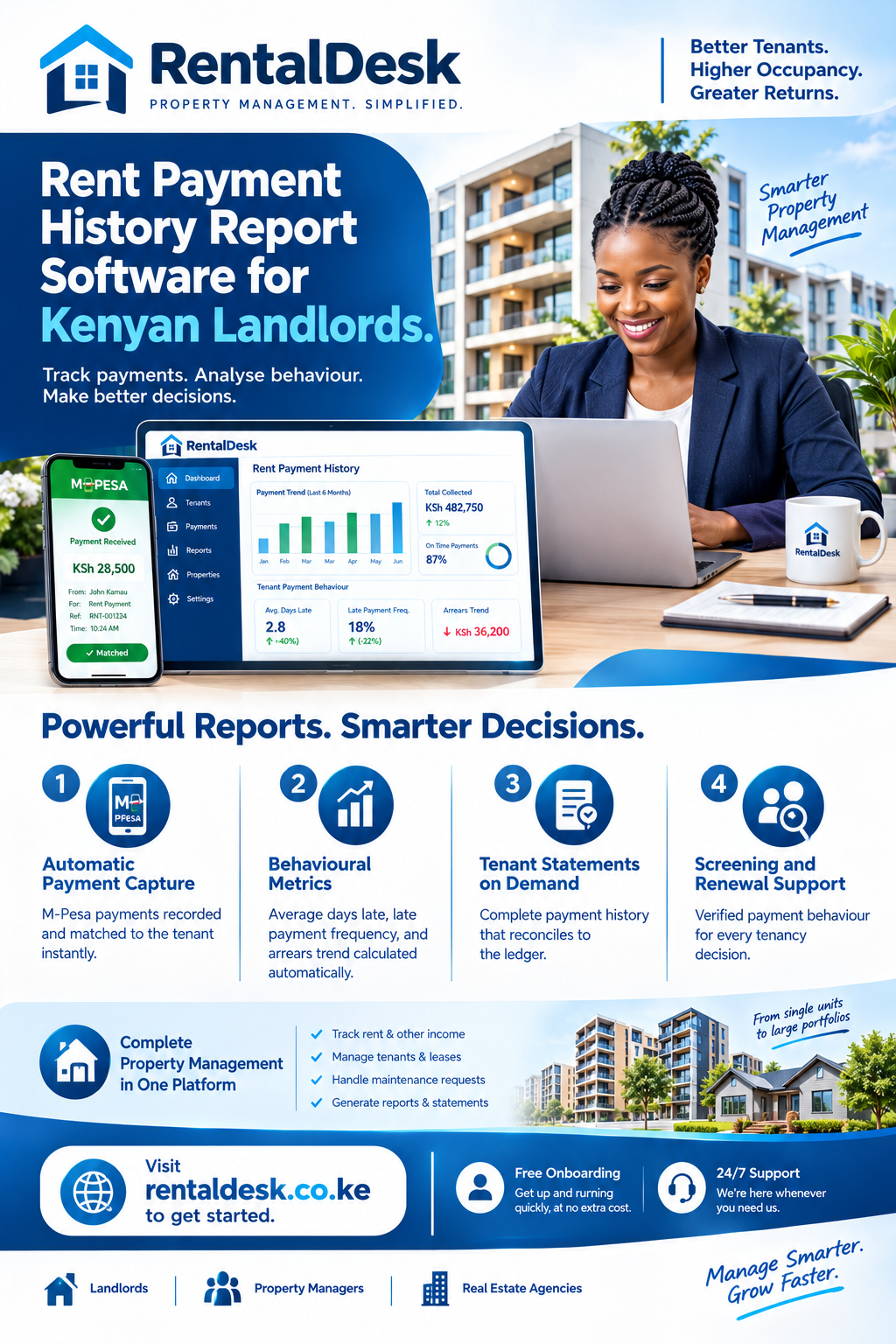
Rent payment history report software is the system that turns scattered M-Pesa confirmations into a structured behavioural record that supports every tenancy decision a landlord has to make. In Kenya, where over 90% of rent payments flow through M-Pesa, the raw data already exists. Every transaction leaves a trail — a transaction ID, a timestamp, an amount, and a phone number.
The problem is that most landlords never assemble that trail into anything usable, which means they make renewal decisions, screening decisions, and arrears decisions on impressions rather than records. Understanding rent payment history report software is therefore not about generating a statement. It is about building the evidence base that determines whether a tenancy is renewed, whether a deposit deduction survives scrutiny, and whether a landlord can demonstrate compliance to the Kenya Revenue Authority.
Why Rent Payment History Report Software Matters in Kenya
The case for rent payment history report software rests on a hard reality of the Kenyan rental market: tenant screening is weak, and the consequences of weak screening compound over time. Industry data on Kenyan rental portfolios consistently shows that a significant share of landlord losses comes from arrears the owner gave up on. A tenant who misses one month of rent often becomes a tenant who misses two, and by the time the problem is noticed, the deposit is gone and the tenant has moved out.
A structured rent payment history report software changes the sequence. Payment behaviour is recorded from the first month of the tenancy. Average days late, frequency of late payment, partial payment patterns, and arrears trends become visible rather than remembered. When the lease comes up for renewal, the landlord has evidence rather than an impression. When a new applicant claims a clean payment record at their previous property, the landlord has a mechanism to verify it. When a dispute arises about what was paid and when, the record settles the question.
The scale of the problem justifies the investment. A landlord managing thirty units who cannot identify which tenants consistently pay late is managing blind. A landlord who can see the payment behaviour of every tenant is managing with information. The rent payment history report software that generates that information is not a convenience. It is a risk management tool.
What Rent Payment History Report Software Should Actually Do
The market offers many tools that claim to track payments. Most of them record transactions and display a balance. A much smaller number assemble those transactions into a behavioural profile that supports decisions.
A genuine rent payment history report software does six things. It records every payment against the correct tenant, invoice, and period. It maintains a complete running balance so the history is always accurate. It calculates behavioural metrics such as average days late and frequency of late payment. It links payment behaviour to arrears aging. It produces a tenant statement that reconciles to the ledger. And it retains the full history beyond the current tenancy, so that past behaviour informs future screening.
Systems that do only the first are payment recorders. Systems that do all six are behavioural tracking systems. The difference shows up the first time a landlord needs to decide whether to renew a tenancy. Any landlord evaluating rent payment history report software should test that specific decision before committing.
The Components of a Complete Payment History Report
The rent payment history report software conversation must begin with what the history actually contains, because a partial history is a misleading history. A complete payment history report should include several core components.
Every Invoice Raised
The history begins with what was charged. Each invoice should record the amount, the due date, the billing period, and any additional charges such as service charge, water, garbage, or parking. Without the invoice record, the payment record has nothing to be measured against. RentalDesk generates recurring rent invoices automatically from the lease record, so every charge is documented from the first month of the tenancy.
Every Payment Received
The history records every payment, including the amount, the date received, the payment method, and the transaction reference. For M-Pesa payments, this data arrives automatically through Safaricom’s C2B callback. For cash payments, it must be recorded at the point of collection. Any landlord researching rent payment history report software should confirm that the platform captures both M-Pesa and bank payments automatically.
Every Allocation Decision
When a payment is received, it must be allocated to a specific invoice or invoices. A partial payment must be posted against the open invoice, with the balance remaining visible. The allocation decision is part of the history, because it determines the running balance. RentalDesk posts partial payments against the open invoice and leaves the balance open, so the allocation is recorded consistently rather than being decided manually each time.
The Running Balance
The running balance after each transaction is what makes the history useful. It shows not just what was paid but what remained outstanding at each point in time. This is the figure that answers the question “how far behind was this tenant, and when?” A rent payment history report software that does not maintain a running balance is a transaction log, not a payment history.
Behavioural Metrics
The metrics that turn a payment record into a decision-making tool are average days late, frequency of late payment, partial payment frequency, and arrears trend. A tenant with an average of two days late is a different proposition from a tenant with an average of twenty-two days late, even if both have never missed a month. RentalDesk calculates these metrics automatically from the ledger.
How Payment History Connects to Reconciliation
The rent payment history report software cannot function without reconciliation, because the history is only as accurate as the payment data behind it. When a tenant pays via M-Pesa Paybill, Safaricom fires a C2B callback containing the amount, phone number, account reference, and transaction ID. The system extracts the account reference, looks it up against tenant and unit records, and if the reference matches, posts the payment to the correct invoice. The running balance updates. The receipt generates. The history records the transaction.
RentalDesk implements this through Safaricom’s Daraja API with Instant Payment Notification callbacks. When a tenant pays, the platform extracts the amount, phone number, account reference, and transaction ID, matches the account reference to the correct tenant and unit, credits the tenant account, generates a receipt, and updates the dashboard in real-time.
A rent payment history report software built on manual reconciliation will produce a history that is incomplete and therefore misleading. Every unmatched payment is a gap in the record, and a gap in the record undermines every decision that depends on it.
Payment History and Tenant Screening
The rent payment history report software conversation must address screening, because payment history is the most predictive factor in tenant behaviour. Financial vetting is becoming standard practice among Kenyan landlords. Property managers are moving beyond basic identity checks. Depending on the estate and monthly rent bracket, applicants are now frequently asked to supply proof of employment, financial statements, tax identification, and professional and previous landlord references. The motivation is simple: default prevention.
RentalDesk retains the full payment history for every tenant, including past tenancies. When a tenant vacates and applies for another property within the same portfolio, the landlord has the record immediately. Payment behaviour is the most predictive factor in tenant behaviour, and a system that tracks it gives the landlord evidence rather than an impression.
Payment History and Data Protection
The rent payment history report software conversation must acknowledge the legal boundary on how payment history is used. Under Kenya’s Data Protection Act, 2019, tenant data — including names, phone numbers, National ID numbers, payment history, and arrears balances — is personal data. A landlord who is a data controller must process that data lawfully, fairly, and transparently. Publishing a list of tenants who owe rent, sharing payment histories in WhatsApp groups, or distributing them to other landlords constitutes unlawful processing of personal data.
RentalDesk processes customer and tenant data in alignment with the Kenya Data Protection Act, 2019. The platform uses encrypted transport via HTTPS, role-based access controls, permission boundaries, operational monitoring and audit logs, and backup and disaster recovery controls. Every action taken within the system is logged with a timestamp and user identification. A rent payment history report software without access controls is a data protection risk.
Payment History and KRA Compliance
The rent payment history report software question has acquired a compliance dimension that did not exist a few years ago. The Kenya Revenue Authority’s Monthly Rental Income regime requires landlords to file returns by the 20th of the month following rent receipt. The Electronic Rental Income Tax System (eRITS), launched in April 2025, is designed to integrate with existing rental property management systems.
KRA expects landlords to maintain records necessary for the determination and ascertainment of the tax. Among those records are rent registers, receipts, and lease documentation. A payment history report contributes to this record set by documenting what was charged and what was collected for each tenancy. RentalDesk generates rent collection reports, income versus expense reports, and audit-ready financial statements from the same verified records used for daily operations.
Payment History and Tribunal Proceedings
The rent payment history report software must produce documentation that is admissible in legal proceedings. When a matter reaches the Rent Tribunal, the landlord’s case depends on evidence. The evidence required includes a complete arrears statement showing every invoice raised, every payment received, and the running balance. A record of every communication with the tenant. The lease agreement and any amendments. And proof that the correct procedures were followed.
RentalDesk maintains all of these records. The arrears statement is generated from the same verified records used for daily operations. When the matter reaches the tribunal, the landlord has a complete file. A rent payment history report software that produces a clean tribunal export is worth its subscription the first time it is used.
Common Implementation Mistakes
The rent payment history report software journey has predictable failure modes. Migrating incomplete payment data means the behavioural metrics will be wrong. Failing to standardise the account reference means payments cannot be matched and the history will have gaps. Recording only payments and not invoices means the history cannot show whether a payment was on time or late. Skipping partial payments means the history will misrepresent every partially paying tenant. Leaving the ledger disconnected from reconciliation means the history will not reconcile. Sharing history without access controls is a data protection violation.
How RentalDesk Delivers Rent Payment History Report Software
RentalDesk is built specifically for the Kenyan market, and payment history tracking sits at the centre of the platform.
Automatic payment capture. M-Pesa payments are captured through the C2B callback and matched to the correct tenant and invoice automatically.
Complete running balance. The ledger maintains an accurate running balance for every tenant, updated in real time.
Behavioural metrics. Average days late, frequency of late payment, partial payment frequency, and arrears trend are calculated automatically.
Tenant statements. Complete payment history generated on demand, covering any date range, reconciling to the ledger.
Partial payment handling. Partial payments post against the open invoice and are recorded in the history as outstanding balances.
Digital receipts. Receipts are issued automatically once payment is verified, sent via SMS, WhatsApp, or email.
Arrears aging. Payment behaviour is linked to arrears aging, so the history supports recovery strategy.
Role-based access. Caretakers, managers, and accountants see only what they need to see, with every access logged.
KRA-ready reporting. Rent collection reports, income versus expense reports, and financial statements generated from the same records.
How to Get Started
Implementing rent payment history report software is straightforward with RentalDesk .
Step 1: Sign up. Visit RentalDesk and create your account. Choose a plan that matches your portfolio size.
Step 2: Record your lease terms. Enter rent amounts, due dates, billing frequencies, and late-fee terms for each tenancy.
Step 3: Import verified payment history. Load as much verified payment history as possible for existing tenants.
Step 4: Configure M-Pesa collection. Connect your Paybill to RentalDesk so that payments reconcile automatically and the history builds itself.
Step 5: Configure receipts and statements. Set receipt delivery preferences and confirm the statement format.
Step 6: Run a pilot cycle. Process one full billing period for a single property and reconcile the history against the underlying records.
Step 7: Go live. Roll out to the full portfolio once the pilot validates the history, and review the payment behaviour report at each renewal decision.
The Future of Rent Payment History in Kenya
The rent payment history report software landscape is moving in a clear direction. Government tax infrastructure is integrating with property management platforms. Standing order features allow tenants to authorise recurring payments directly from their mobile wallets, which will change the shape of payment behaviour data. And the gap between payment capture, history building, and decision-making is closing.
The landlords who adopt structured payment history tracking early will not simply have tidier records. They will make better tenancy decisions, recover arrears faster, resolve disputes more easily, and build a portfolio of tenants who pay on time because the record rewards them for doing so.
RentalDesk provides the structured platform that makes rent payment history report software work in Kenya — not as a payment recorder, but as a behavioural record that supports every tenancy decision a landlord has to make.