
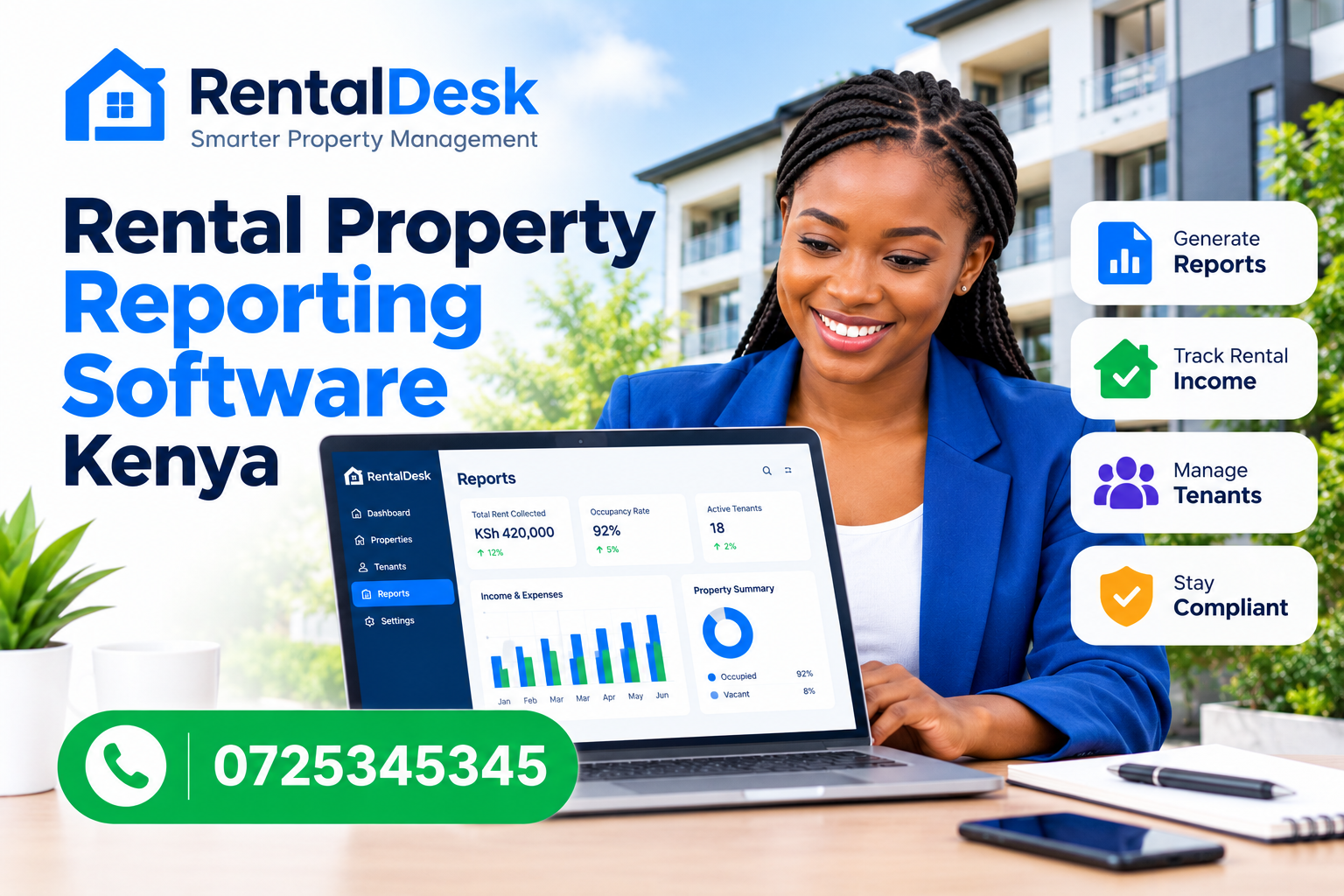
Rental property owners and managers need accurate information about income, expenses, occupancy, arrears, maintenance, and tenant activity. Rental Property Reporting Software Kenya gives Kenyan landlords and property managers a practical way to turn day-to-day records into clear reports that support better record keeping and routine decision-making. This guide explains what reporting software does, the reports it should produce, the benefits for rental businesses, and what to consider before adopting a system.
For a landlord with a few units, reporting can begin as a simple monthly exercise. For a growing portfolio, however, the number of transactions, tenants, properties, and payment records can make manual reporting difficult. Rental Property Reporting Software Kenya can centralize relevant information so a manager does not have to search through notebooks, spreadsheets, messages, receipts, and separate accounting records every time a report is needed.
The purpose is not to create reports for their own sake. Good reporting should answer practical questions: How much rent was billed? How much was collected? Which units have balances? What expenses were recorded? Which properties generated the most income? What maintenance costs are increasing? With Rental Property Reporting Software Kenya, these questions can be handled through organized records and repeatable reporting workflows.
What Is Rental Property Reporting Software?
Rental property reporting software is a digital system designed to collect, organize, and present information generated by rental operations. It can bring together property details, units, tenants, rent charges, payments, expenses, maintenance records, and other operational information. Rental Property Reporting Software Kenya is particularly useful when the same information needs to be reviewed repeatedly by landlords, property managers, finance staff, or owners.
Instead of preparing every report from scratch, a reporting system can use existing records to produce summaries based on selected properties, periods, tenants, or transaction categories. Rental Property Reporting Software Kenya can therefore support both routine reporting and deeper review of rental performance.
A useful reporting system should also make information easier to understand. Tables, summaries, filters, transaction lists, and period comparisons can help a user move from raw records to information that can be acted upon. Rental Property Reporting Software Kenya becomes more valuable when reports are connected to the underlying records rather than maintained as isolated documents.
Why Rental Businesses Need Better Reporting
Rental businesses depend on reliable records. A landlord may need to confirm whether rent was received, while a property manager may need to explain a balance to an owner. Rental Property Reporting Software Kenya can make those tasks more structured by keeping reporting information in one system.
Manual reporting also creates opportunities for duplicated entries, missed transactions, incorrect totals, and outdated spreadsheets. Rental Property Reporting Software Kenya can reduce some of these risks by using consistent records and predefined reporting processes. It does not remove the need for review, but it can make review more manageable.
For growing portfolios, visibility becomes even more important. Rental Property Reporting Software Kenya can help users compare units, properties, income categories, expenses, and outstanding balances without rebuilding the same spreadsheet each month.
Key Reports a Rental Property Manager Should Have
A reporting platform should cover the core areas of rental operations. Rental Property Reporting Software Kenya can be used to organize the information needed for reports such as rent collection summaries, tenant balances, income statements, expense reports, occupancy reports, and property-level performance summaries.
Rent Collection Reports
Rent collection reporting shows what was expected and what was actually received. Rental Property Reporting Software Kenya can help present billed rent, payments received, outstanding balances, payment dates, and other relevant transaction details in a structured format.
A manager can use a collection report during monthly reconciliation. If a unit has an outstanding amount, the report should make it easier to trace the balance back to the relevant charge and payment records. Rental Property Reporting Software Kenya supports this type of review by connecting reporting to rental transaction data.
Income and Expense Reports
Owners need to understand both revenue and costs. Rental Property Reporting Software Kenya can help organize rental income alongside expenses such as maintenance, utilities paid by the property, service-related costs, repairs, and other approved operational expenses.
An income and expense report can be prepared for a single property, a group of properties, or a selected reporting period. Rental Property Reporting Software Kenya becomes especially useful when an owner manages several buildings and wants a consistent reporting format across the portfolio.
Arrears Reports
Arrears reporting helps identify tenants with unpaid balances and shows how much remains outstanding. Rental Property Reporting Software Kenya can provide a structured view of overdue amounts, which can help property managers prioritize follow-up and keep payment records current.
A good arrears report should distinguish between current charges and older balances where the system supports that level of detail. Rental Property Reporting Software Kenya can make it easier to review these records without depending on memory or manually maintained lists.
Occupancy and Vacancy Reports
Vacancy affects rental income, so managers need visibility into occupied and vacant units. Rental Property Reporting Software Kenya can organize occupancy information by property, building, unit, or reporting period, depending on the system’s features.
Vacancy reporting can also support planning. If several units remain empty, a manager may investigate marketing activity, pricing, property condition, or tenant turnover. Rental Property Reporting Software Kenya can give the manager a consistent record from which to begin that review.
Property Expense Reports
Expense reporting helps property owners understand where money is being spent. Rental Property Reporting Software Kenya can categorize recorded expenses and present them in a way that supports property-level review.
For example, repeated repair costs may deserve closer attention, while one-off expenses may need to be separated from recurring operational costs. Rental Property Reporting Software Kenya can make those patterns easier to identify when the underlying transactions are entered consistently.
How Reporting Software Supports Landlords in Kenya
Kenyan landlords operate across different property types, from residential apartments and bedsitters to commercial spaces and mixed-use developments. Rental Property Reporting Software Kenya can provide a common reporting structure while still allowing records to be organized around individual properties and units.
Payment records may also involve channels commonly used in Kenya, including M-Pesa and bank payments. Rental Property Reporting Software Kenya can help managers organize payment information alongside tenant and unit records, provided the system supports the relevant payment workflows.
For a landlord in Nairobi managing several apartments, a monthly report might need to show expected rent, received payments, balances, expenses, and net figures for each property. Rental Property Reporting Software Kenya can make that information easier to compile and review.
A smaller landlord may need fewer reports, but the principle is the same. Rental Property Reporting Software Kenya can provide a repeatable method for keeping rental records organized as the portfolio grows.
Benefits of Using Rental Property Reporting Software
1. Saves Administrative Time
Preparing recurring reports manually can consume hours, especially when information is stored in several places. Rental Property Reporting Software Kenya can reduce repetitive data compilation by generating reports from records already entered into the system.
2. Improves Record Visibility
A centralized system makes it easier to see where information belongs. Rental Property Reporting Software Kenya can bring property, tenant, payment, and expense records into a reporting workflow that is easier to follow.
3. Supports Faster Follow-Up
Reports can highlight outstanding balances, overdue items, unusual expenses, and vacant units. Rental Property Reporting Software Kenya can help managers identify these items earlier so they can decide what action to take.
4. Makes Owner Reporting More Consistent
Property managers often need to send regular updates to property owners. Rental Property Reporting Software Kenya can support standardized reports that use the same categories and reporting periods each time.
5. Helps With Portfolio Reviews
When a portfolio contains multiple properties, comparing performance manually can be difficult. Rental Property Reporting Software Kenya can help users organize data by property, unit, income type, expense type, or period.
6. Reduces Dependence on Scattered Spreadsheets
Spreadsheets can be useful, but they become harder to maintain as the volume of records increases. Rental Property Reporting Software Kenya can provide a dedicated environment for rental records and reporting.
Features to Look for in Reporting Software
Property and Unit Reporting
The system should allow reports to be filtered by property and unit. Rental Property Reporting Software Kenya is more useful when a manager can move from a portfolio summary to the specific property or unit behind a figure.
Tenant Reporting
Tenant-related reporting can include balances, payment history, tenancy status, and other relevant records. Rental Property Reporting Software Kenya can help managers review tenant information without compiling separate lists.
Payment Tracking
Payment tracking is central to rental reporting. Rental Property Reporting Software Kenya should connect payment entries with the correct tenant, unit, property, amount, and date wherever the system supports these fields.
Expense Tracking
Expense categories should be clear enough to support meaningful reports. Rental Property Reporting Software Kenya can help managers see how costs are distributed across properties and periods.
Arrears and Outstanding Balances
A reporting system should make outstanding balances easy to identify and investigate. Rental Property Reporting Software Kenya can support this by presenting arrears information alongside relevant tenant and transaction records.
Customizable Reporting
Different landlords have different reporting requirements. Rental Property Reporting Software Kenya can be more practical when users can select date ranges, properties, categories, or other filters rather than relying on one fixed report.
Export and Sharing Options
Managers may need to share reports with property owners, accountants, or internal teams. Rental Property Reporting Software Kenya can add value when reports can be exported or presented in a usable format.
Access Control
Rental information can contain financial and tenant details. Rental Property Reporting Software Kenya should therefore be evaluated alongside user access controls, account permissions, authentication, backups, and other security practices offered by the provider.
Reporting Automation and Monthly Workflows
Automation is useful when it removes repetitive steps without hiding important details. Rental Property Reporting Software Kenya can support a monthly reporting workflow in which charges, payments, expenses, and tenant records are updated before reports are generated.
A simple monthly process might look like this:
- Confirm that tenant and unit records are current.
- Record or reconcile payments received.
- Review rent charges and outstanding balances.
- Enter and categorize property expenses.
- Check maintenance and other operational records.
- Generate income, expense, arrears, and occupancy reports.
- Review exceptions before sharing reports.
Using Rental Property Reporting Software Kenya within this workflow can help make reporting a routine process rather than an end-of-month scramble.
Using M-Pesa and Other Payment Records
Many Kenyan rental businesses receive payments through mobile money or bank channels. Reporting becomes useful when payment records can be connected to the tenant and rental obligation they relate to. Rental Property Reporting Software Kenya can support a structured view of these transactions when the platform provides suitable payment-recording or reconciliation features.
The important point is accuracy. A payment should be assigned to the correct tenant and unit, and any partial payment or outstanding amount should remain visible. Rental Property Reporting Software Kenya can help managers review the resulting balances in a consistent report.
Reporting for Different Property Types
Residential Rentals
Residential property managers may focus on rent collection, tenant balances, occupancy, repairs, and recurring expenses. Rental Property Reporting Software Kenya can help bring these areas into a single reporting process.
Commercial Properties
Commercial properties may involve different lease terms, billing structures, and expense arrangements. Rental Property Reporting Software Kenya can help managers produce reports based on the records and categories relevant to their commercial portfolio.
Mixed-Use Properties
Mixed-use developments can contain residential and commercial units. Rental Property Reporting Software Kenya can help separate or combine reports according to property, unit type, or reporting period.
Practical Example: A Nairobi Rental Portfolio
Consider a property manager overseeing several apartment blocks in Nairobi. Each building has multiple units, different tenants, monthly rent charges, payment records, and maintenance expenses. At the end of the month, the owner wants a clear summary rather than a collection of screenshots and spreadsheets. Rental Property Reporting Software Kenya can help organize the underlying records into a report covering rent billed, rent received, balances, expenses, and occupancy.
The manager can then review exceptions before sending the report. If one unit has an unusual balance or a property has higher maintenance spending, the report provides a starting point for investigation. Rental Property Reporting Software Kenya does not replace managerial judgment; it gives the manager organized information to work with.
How to Choose the Right Reporting System
Start With Your Reporting Needs
List the reports you actually use. Do you need rent collection reports, arrears reports, expense reports, owner statements, occupancy reports, or portfolio summaries? Rental Property Reporting Software Kenya should be assessed against those real requirements rather than a long feature list alone.
Check Ease of Use
A system can have many features and still be difficult to use. Rental Property Reporting Software Kenya should be understandable to the people entering transactions and reviewing reports every month.
Consider Scalability
Choose a system that can support your current portfolio and a reasonable level of growth. Rental Property Reporting Software Kenya can be more valuable when the same reporting process continues to work as additional units or properties are added.
Review Data Security and Backups
Ask how user access, backups, data protection, account recovery, and system availability are handled. Rental Property Reporting Software Kenya should be evaluated as both a reporting tool and a system that stores important business records.
Test the Actual Reports
Do not choose software based only on screenshots or a feature list. Request a demonstration or trial where possible and test the reports you use most. Rental Property Reporting Software Kenya should produce information that is clear, relevant, and easy to verify against source records.
Common Reporting Mistakes to Avoid
Entering Incomplete Information
Reports can only be as useful as the records behind them. If payments, expenses, or tenant details are missing, the resulting report may not reflect the actual position. Rental Property Reporting Software Kenya should be paired with disciplined data entry and regular review.
Mixing Personal and Property Expenses
Property records should distinguish rental business expenses from unrelated personal spending. Rental Property Reporting Software Kenya can help organize business expenses, but users still need clear internal rules about what should be recorded.
Ignoring Small Balances
Small unpaid balances can accumulate if they are repeatedly carried forward without review. Rental Property Reporting Software Kenya can make outstanding amounts easier to identify so that they can be checked and resolved where appropriate.
Producing Reports Without Reviewing Exceptions
Automation does not mean every report is automatically correct. Managers should investigate unusual figures, duplicate payments, unexpected expenses, or missing transactions. Rental Property Reporting Software Kenya is most useful when reporting is combined with sensible review procedures.
Cost Considerations for Kenyan Landlords
The right software cost depends on the portfolio size, features required, number of users, support arrangements, and billing model. Instead of choosing purely on price, landlords should consider the administrative work the system is expected to reduce. Rental Property Reporting Software Kenya should be evaluated against the practical value of accurate records, faster reporting, and easier portfolio oversight.
For a small portfolio, a simple system may be enough. A larger property management company may need broader tenant management, accounting, maintenance, payment, and reporting capabilities. Rental Property Reporting Software Kenya should match the complexity of the operation rather than forcing every landlord into the same setup.
How Reporting Improves Property Management Decisions
Reporting is most useful when it helps a manager move from information to a practical next step. A monthly statement might show that rent collections are below the amount billed, but the real value comes from being able to investigate the difference. The manager can examine tenant balances, payment dates, vacancies, and adjustments instead of relying on a general impression.
A similar approach applies to expenses. A property may appear profitable at first glance, yet repeated repairs, utility costs, or other operational expenses can affect the amount available after costs. Good reporting brings those figures into view so that owners can ask better questions about maintenance, budgeting, tenant turnover, and property operations.
The same principle applies to occupancy. A vacant unit represents more than an empty room; it can affect expected rental income and may require marketing, repairs, cleaning, or other preparation before a new tenant moves in. A report can show where vacancies exist and how they relate to the wider portfolio.
Managers should therefore avoid treating reports as documents that are prepared once and forgotten. A better approach is to use them during regular management meetings, monthly reviews, owner updates, and financial checks. This turns reporting into part of the operating process.
Owner Statements and Transparent Communication
Property owners often want straightforward answers about their investments. They may ask how much was collected during a particular month, what expenses were paid, which tenants have balances, or why a property’s net income changed. A consistent reporting format makes these conversations easier.
Owner statements should be understandable to someone who does not work inside the property management office every day. Instead of presenting unexplained figures, the report should make the period, property, income, expenses, balances, and other important categories clear. Where necessary, the manager can provide supporting transaction details.
Consistency matters as well. If the report layout changes every month, owners may spend more time trying to understand the format than reviewing the information. A repeatable structure makes month-to-month comparisons easier and helps identify unusual movements.
For property managers handling multiple owners, standardization can also reduce administrative effort. A common reporting workflow means the manager does not have to build a completely different spreadsheet for every property unless the owner’s requirements genuinely differ.
Data Accuracy: The Foundation of Good Reporting
No reporting system can compensate for poor source data. If a payment is recorded against the wrong tenant, an expense is assigned to the wrong property, or a rent charge is missing, the report can produce a misleading result even when the software itself is working correctly.
That is why data-entry procedures matter. Property managers should establish clear rules for recording payments, creating charges, categorizing expenses, updating tenant information, and correcting errors. Staff should also know who is responsible for reviewing records before reports are finalized.
Regular reconciliation is another important practice. Payment records should be compared with the relevant bank or mobile-money records where appropriate. Outstanding balances should be checked against tenant accounts, and unusual transactions should be investigated rather than ignored.
A useful reporting system should make it possible to trace figures back to their source records. When a manager sees an unexpected amount, they should be able to investigate the underlying transaction rather than accepting the number without explanation.
Reporting Across a Growing Portfolio
Growth changes reporting requirements. A landlord with five units may know most transactions personally. A portfolio with dozens or hundreds of units creates a different administrative environment. More tenants mean more payments, more potential balances, more maintenance activity, and more records to review.
As the portfolio expands, reports should help users move between levels of detail. An owner may begin with a portfolio summary, then review one property, then a building, then a unit or tenant account. This drill-down approach can save time when investigating an issue.
Growth also increases the importance of user roles. A property manager may need access to operational information, while an accountant may focus on financial records. Other staff may only need access to tenant or maintenance information. A system should allow the organization to control access according to responsibilities where such functionality is available.
The objective is not to create complicated reporting. It is to maintain visibility even as the amount of information grows.
Using Reports for Budgeting and Planning
Historical reports can also support future planning. If a property consistently records certain operating costs, the owner can use past information as one input when preparing a future budget. Rental income records can similarly help establish realistic expectations, while vacancy and arrears reports can highlight areas that deserve attention.
Budgeting should not rely on a single month’s result. Property income and expenses can vary, so managers should review several reporting periods when the data is available. This provides a broader picture and reduces the risk of making decisions based on an unusual month.
Maintenance reporting can be particularly useful for planning. Repeated repairs on the same equipment, building area, or unit may indicate that a larger intervention should be considered. The report does not make that decision for the owner, but it can provide evidence for the discussion.
A Simple Reporting Checklist for Every Month
Before finalizing a monthly rental report, a manager can work through a short checklist:
- Confirm the reporting period and properties included.
- Check that all active tenants and units are correctly recorded.
- Review rent charges and payment entries.
- Investigate outstanding balances and unusual adjustments.
- Confirm that property expenses have been categorized.
- Review vacant units and recent tenant changes.
- Check maintenance entries that affect property costs.
- Compare major figures with the previous reporting period.
- Investigate unexpected differences.
- Save or share the final report according to the organization’s process.
This checklist is deliberately simple. A consistent routine can be more useful than a complicated procedure that staff rarely follow.
Why Reporting Should Be Part of a Larger Property Management System
Reporting works best when it is connected to the other parts of property management. If tenant records, rent charges, payments, expenses, maintenance activities, and property details are maintained in separate places, managers may spend unnecessary time bringing them together.
A connected system can create a single workflow: a property is created, units are recorded, tenants are assigned, charges are raised, payments are entered, expenses are captured, and reports are generated from the same underlying records. This structure can reduce duplicate work and make it easier to trace information.
Reporting should therefore be considered when evaluating an entire property management solution, not only when searching for a standalone reporting feature. A system that produces attractive reports but requires extensive manual data entry may not solve the underlying administrative problem.
Final Selection Checklist
Before choosing a rental reporting solution, ask the following questions:
- Can it manage all the properties and units currently in the portfolio?
- Can it record tenant and payment information in a structured way?
- Can it produce rent collection and arrears reports?
- Can it track and report property expenses?
- Can users filter reports by property and date?
- Can the business export or share reports when necessary?
- Are user permissions available for different staff roles?
- Are backups and account security clearly addressed?
- Is the interface practical for everyday staff use?
- Does the pricing model make sense for the portfolio size?
- Can the provider offer training or customer support?
- Can the system continue to support the business as the portfolio grows?
These questions help keep the evaluation focused on actual operating needs rather than marketing language.
Getting Started With Better Rental Reporting
A landlord does not need to redesign every process at once. A practical first step is to identify the reports currently prepared manually and the information required to create them. Next, identify where that information is stored and which parts of the process consume the most time.
From there, the landlord or property manager can select a system, configure properties and units, enter tenant records, establish payment and expense categories, and test a reporting workflow. The first few reporting periods should be treated as an opportunity to find missing data, clarify categories, and improve procedures.
Once the process is stable, recurring reports can become part of the normal monthly routine. Managers can use them for owner communication, financial review, arrears follow-up, occupancy monitoring, and operational planning.
The most useful system is not necessarily the one with the longest feature list. It is the one that fits the organization’s workflow, keeps records organized, and produces information that people can understand and use.
Frequently Asked Questions
1. What does rental property reporting software do?
It organizes rental data and turns records such as rent charges, payments, expenses, occupancy, and tenant balances into usable reports. Rental Property Reporting Software Kenya can reduce the need to prepare recurring summaries manually.
2. Can reporting software help with rent arrears?
Yes. If the system records charges and payments, it can present outstanding balances and arrears reports. Rental Property Reporting Software Kenya can make it easier to identify accounts that require review or follow-up.
3. Can I use rental reporting software for several properties?
Many systems are designed to support multiple properties and units. The exact capacity depends on the provider, so confirm limits, user access, and reporting options before subscribing.
4. Can rental reports include expenses?
Yes. A suitable system can record categorized expenses and produce expense reports by property, category, or period, depending on its features.
5. Is M-Pesa support important for Kenyan rental businesses?
It can be useful when tenants commonly pay through mobile money. The key is to ensure that payment records can be accurately connected to the correct tenant, unit, and rental charge.
6. Can property owners receive reports from a property manager?
Yes. Managers can generate and share periodic reports where the software provides export, sharing, or owner-reporting functionality. The format should be agreed upon with the property owner.
7. Should a small landlord use reporting software?
It depends on the number of units, transaction volume, reporting needs, and willingness to manage records digitally. Even a small portfolio can benefit from consistent records, but the system should be proportionate to the landlord’s needs.
8. What should I check before buying rental reporting software?
Review the reports, ease of use, property and tenant management features, payment tracking, expense tracking, security controls, support, data export, scalability, and total cost.
Conclusion
Reliable reporting gives landlords and property managers a clearer view of how their rental operations are performing. The goal is to move from scattered records to organized information that can be reviewed regularly. A suitable system can help track rent, expenses, arrears, occupancy, and property-level performance while reducing repetitive administrative work.
For Kenyan rental businesses, the strongest starting point is a reporting process built around accurate transaction records, clear categories, consistent monthly reviews, and reports that answer real management questions. The software should support that process rather than make it more complicated.