
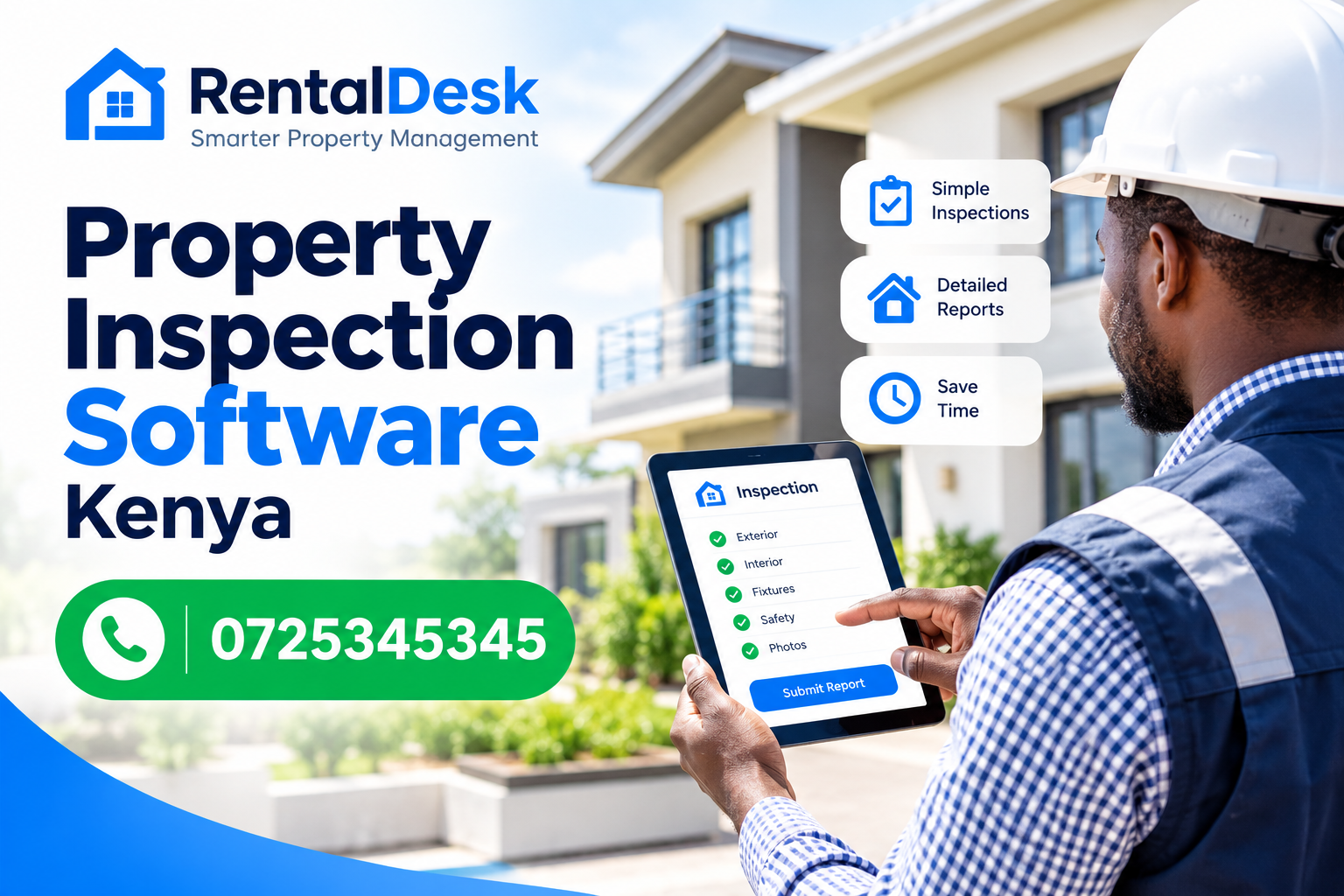
Property Inspection Software Kenya: Complete Guide for Landlords and Property Managers
Managing rental properties involves much more than collecting rent and communicating with tenants. Landlords and property managers also need to inspect units, document property conditions, identify maintenance problems, follow up on repairs, and maintain reliable records. Property Inspection Software Kenya provides a structured way to manage these activities from one platform. This guide explains how digital inspection systems work, why inspections matter, what features to look for, and how Kenyan property professionals can use technology to make property inspections more consistent and easier to manage.
For landlords with a few rental units, inspections may initially seem simple. A property manager walks through a house, checks rooms, notes defects, takes photographs, and communicates any issues to the tenant or maintenance team. The challenge becomes much greater when the number of properties, tenants, buildings, and inspection schedules increases.
A manual inspection process can involve notebooks, spreadsheets, WhatsApp messages, photographs stored on personal phones, printed checklists, and separate maintenance records. While these methods can work temporarily, they make it difficult to create one reliable history for every property.
A digital inspection platform brings these activities together. Instead of relying on disconnected records, property managers can create inspection schedules, capture observations, attach photographs, assign maintenance tasks, and keep historical information accessible.
This is particularly useful for Kenyan landlords and property managers operating residential apartments, commercial buildings, gated communities, student housing, serviced apartments, and mixed-use developments.
What Is Property Inspection Software?
Property Inspection Software Kenya refers to a digital system designed to help landlords, property managers, caretakers, and property management teams plan, conduct, document, and monitor property inspections.
The purpose is not simply to replace a paper checklist. A useful inspection system connects inspection information with the wider property management process.
For example, an inspection may reveal a leaking tap in an apartment. Instead of recording the issue in a notebook and later trying to remember which unit was affected, a digital system can associate the observation with the specific property or unit. The issue can then be followed through to maintenance and completion.
A property inspection platform can support activities such as:
- Routine property inspections
- Move-in inspections
- Move-out inspections
- Periodic unit inspections
- Maintenance follow-ups
- Condition assessments
- Common-area inspections
- Property handover inspections
- Damage documentation
- Inspection reporting
- Photograph and document management
- Issue tracking
- Follow-up activities
Property Inspection Software Kenya can therefore become an important part of a wider rental management workflow.
The system gives property professionals a central location for inspection information instead of forcing them to search through multiple files and conversations.
Why Property Inspections Matter for Rental Properties
Property inspections help landlords understand the actual condition of their buildings and units. Rental property can deteriorate gradually, and small issues can become expensive if they are ignored.
A minor water leak, for example, may initially appear insignificant. If it is not documented and addressed, continued moisture exposure can contribute to additional damage. Similarly, a damaged door lock, broken fixture, cracked tile, or electrical issue can become more difficult to manage when it is not reported promptly.
Property Inspection Software Kenya helps create a consistent process for identifying and documenting these issues.
Regular inspections can also provide useful information about:
- The condition of individual units
- Maintenance requirements
- Common-area problems
- Recurring defects
- Repairs that remain unresolved
- Property improvements
- Tenant-reported issues requiring physical verification
- Changes between move-in and move-out conditions
A structured inspection process does not eliminate maintenance problems. Instead, it improves visibility so property managers can identify and respond to problems more systematically.
The Problem With Manual Property Inspections
Manual inspections are familiar to many landlords and property managers. A caretaker may carry a notebook, record observations, and send photographs through a messaging application.
The problem is not that these methods cannot work. The problem is that they become difficult to control as operations grow.
Property Inspection Software Kenya can address several weaknesses associated with manual inspection processes.
1. Information Becomes Scattered
Inspection information may be spread across notebooks, spreadsheets, emails, phones, and messaging applications.
When someone needs to check the condition of a particular unit several months later, finding the correct information can take time.
2. Follow-Up Can Be Missed
Recording a defect is only the first step. The property manager also needs to ensure that the problem is assigned, addressed, and closed.
Without a structured workflow, issues can remain unresolved after the original inspection.
3. Historical Records Are Difficult to Compare
A property manager may want to know whether a problem has occurred repeatedly in the same unit. Manual records can make this comparison difficult.
Digital records make it easier to maintain an inspection history.
4. Reports Take Longer to Prepare
If an owner requests a report showing the condition of several properties, staff may need to collect information manually.
Property Inspection Software Kenya can simplify reporting by keeping inspection records organized in one place.
How Property Inspection Software Works
A typical inspection workflow starts with identifying the property and creating an inspection.
The inspector can then use a checklist to review different parts of the property. Depending on the type of inspection, the checklist may include rooms, fixtures, walls, floors, doors, windows, plumbing, electrical installations, appliances, external areas, security features, and other relevant components.
The inspector records observations and may attach photographs or supporting documents.
After the inspection, identified issues can be reviewed and assigned for action.
Property Inspection Software Kenya can help structure this workflow into clear stages.
A basic process may look like this:
- Select the property or unit.
- Schedule the inspection.
- Assign an inspector or staff member.
- Complete the inspection checklist.
- Record observations.
- Add photographs where necessary.
- Identify maintenance requirements.
- Assign follow-up tasks.
- Monitor progress.
- Complete and store the inspection report.
The exact workflow will depend on the software and the property manager’s operating procedures.
Key Features to Look For
Not every inspection system has the same capabilities. Before selecting a platform, landlords and property managers should identify the features that match their operations.
Property Inspection Software Kenya should ideally support a practical inspection workflow rather than simply provide a digital form.
Inspection Scheduling
Scheduling allows managers to plan inspections in advance.
A property portfolio may contain dozens or hundreds of units. Without a schedule, inspections can become irregular.
A digital calendar or inspection schedule can help managers organize recurring inspections and identify upcoming tasks.
Digital Inspection Checklists
Checklists provide consistency.
Instead of relying on individual inspectors to remember what to check, the organization can establish standard inspection items.
For a residential apartment, a checklist might include:
- Entrance door
- Locks
- Windows
- Walls
- Ceiling
- Floors
- Lighting
- Electrical sockets
- Plumbing fixtures
- Kitchen fittings
- Bathroom fittings
- Water leaks
- General cleanliness
- External areas
Property Inspection Software Kenya can help standardize these inspection points.
Photo Documentation
Photographs can provide useful visual evidence of property conditions.
An inspector can photograph a damaged wall, leaking pipe, broken fitting, stained ceiling, cracked tile, or other issue.
Photographs should complement written observations rather than replace them.
Issue Tracking
An inspection becomes more useful when identified issues can be tracked after the inspection.
For example, a report could identify three maintenance issues:
- Bathroom tap leaking
- Bedroom door handle damaged
- Kitchen cabinet hinge loose
The property manager can then monitor each item until it is resolved.
Inspection Reports
A clear report allows property owners and managers to understand the inspection results.
Reports can include the property name, unit, inspection date, inspector, observations, photographs, identified issues, and follow-up actions.
Property Inspection Software Kenya can support better organization of this information.
Move-In Inspections
A move-in inspection documents the condition of a rental unit before or around the time a tenant takes possession.
This can be useful because it creates a reference point for the property’s condition at the beginning of a tenancy.
A move-in inspection may cover:
- Walls and paint
- Doors and locks
- Windows
- Flooring
- Kitchen fittings
- Bathroom fixtures
- Lighting
- Electrical fittings
- Water fixtures
- Appliances
- External areas
Property Inspection Software Kenya makes it easier to maintain a structured record of these observations.
The tenant and landlord may also have agreed procedures for confirming the condition of the property. Digital inspection records can support that administrative process.
Move-Out Inspections
Move-out inspections assess the condition of a property when a tenant leaves.
The value of a move-out inspection increases when the property manager has a reliable move-in record for comparison.
For example, suppose the move-in inspection recorded a clean wall with no visible damage. The move-out inspection could document a large mark or physical damage found later.
Property Inspection Software Kenya can help keep these inspection records connected to the relevant unit.
The purpose is not to automatically assign responsibility for every defect. Normal wear and tear, existing problems, maintenance issues, and tenant-related damage may need to be considered according to the tenancy agreement and applicable requirements.
Routine Property Inspections
Routine inspections allow property managers to monitor properties during an active tenancy.
The frequency can depend on the type of property, management policy, tenant arrangements, and operational requirements.
For a large apartment building, routine inspections may focus on specific units, shared facilities, external areas, or maintenance concerns.
Property Inspection Software Kenya can help managers maintain inspection schedules and records over time.
Routine inspections may reveal issues that tenants have not reported or problems that are difficult to identify through communication alone.
Property Inspection and Maintenance Management
Inspection and maintenance are closely connected.
An inspection identifies a problem. Maintenance is the process of resolving it.
When these processes are managed separately, there is a risk of losing information between inspection and repair.
Property Inspection Software Kenya can support a more connected workflow by keeping inspection findings available for follow-up.
Consider a property manager inspecting an apartment and discovering water damage beneath a sink.
The inspection record can contain:
- Location of the problem
- Description
- Photograph
- Date identified
- Priority
- Person responsible for follow-up
- Repair status
- Completion date
This gives the property manager a clearer view of what happened after the inspection.
Supporting Preventive Maintenance
Property management should not focus only on fixing problems after they become serious.
Preventive maintenance involves identifying potential problems and addressing them before they create larger disruptions.
Property Inspection Software Kenya can contribute to preventive maintenance by providing historical inspection information.
Suppose inspections repeatedly identify minor leaks around the same plumbing area. That pattern may encourage the property manager to investigate the underlying cause instead of repeatedly handling the same symptom.
Similarly, recurring issues with doors, lighting, drainage, roofing, or fixtures may indicate the need for planned maintenance.
Inspection data can therefore become useful operational information rather than simply archived paperwork.
Managing Inspection Records for Multiple Properties
Portfolio size changes the inspection challenge.
A landlord with one building may be able to remember many details personally. A manager responsible for multiple properties cannot rely on memory.
Property Inspection Software Kenya helps centralize records across a portfolio.
A manager might oversee:
- Apartments in Nairobi
- Rental houses in Kiambu
- Commercial units
- Student accommodation
- Mixed-use buildings
- Residential developments in other counties
Each property may have different inspection schedules and requirements.
A centralized system can make it easier to identify which inspections have been completed and which require attention.
Property Inspection Reports
Inspection reports should be clear enough for another person to understand what was observed.
A useful report can contain:
| Report Item | Purpose |
|---|---|
| Property | Identifies the building |
| Unit | Identifies the specific rental space |
| Date | Shows when inspection occurred |
| Inspector | Records who performed it |
| Checklist | Defines areas reviewed |
| Observations | Describes findings |
| Photos | Provides visual documentation |
| Issues | Identifies required actions |
| Status | Shows progress |
| Notes | Adds relevant context |
Property Inspection Software Kenya can make these records easier to organize and retrieve.
A report should avoid vague descriptions such as “problem in bathroom.” A more useful observation would explain what was seen, where it was located, and what action may be required.
Using Photos Effectively During Inspections
Photos can strengthen inspection records, but they should be used systematically.
For example, instead of uploading dozens of unrelated photographs, an inspector can associate each photograph with a specific room or issue.
Useful photo documentation practices include:
- Take clear images.
- Photograph the wider area first.
- Capture closer images of specific defects.
- Record the location of the problem.
- Avoid unnecessary images.
- Associate images with the relevant inspection.
- Follow the organization’s privacy procedures.
Property Inspection Software Kenya can help property teams organize photographs alongside inspection information.
Good documentation makes future review easier because another person can understand what the photograph represents.
Inspection Checklists for Kenyan Rental Properties
A Kenyan residential rental property may require different inspection considerations depending on its design and use.
For example, an apartment inspection may include water supply, plumbing fixtures, electrical fittings, kitchen appliances, security doors, balconies, parking-related facilities, and shared areas.
Property Inspection Software Kenya can support customized checklists where the platform allows them.
A checklist for a basic residential unit might include:
Interior Areas
- Walls
- Ceiling
- Floors
- Doors
- Windows
- Locks
- Lighting
- Electrical outlets
Kitchen
- Sink
- Taps
- Cabinets
- Countertops
- Cooker area
- Drainage
Bathroom
- Toilet
- Shower
- Basin
- Taps
- Drainage
- Tiles
- Ventilation
External Areas
- Compound
- Parking
- Gates
- Walkways
- Drainage
- Lighting
The checklist should reflect the property’s actual features rather than include irrelevant items.
M-Pesa and Property Inspection Workflows
M-Pesa is widely used in Kenyan rental operations, especially for rent and other property-related payments. However, payment management and property inspection are different processes.
Property Inspection Software Kenya does not need to replace a rent collection system to provide value.
Instead, inspection information can complement financial and tenant records.
For example, a property manager may identify a maintenance issue during an inspection and later need to coordinate the cost, supplier, or repair process through other parts of the property management operation.
Keeping the inspection record connected to the relevant property makes it easier to understand the context.
The key point is that property inspection software should support the property management workflow rather than operate as an isolated digital checklist.
Tenant Communication and Inspections
Communication is an important part of property inspections.
Tenants may need to receive information about planned inspections, access arrangements, identified maintenance problems, or follow-up activities.
Property Inspection Software Kenya can provide a central record for inspection-related information, although communication channels will depend on the software’s available features.
A clear process can help reduce confusion.
For example:
- Notify the tenant of an inspection according to the agreed process.
- Record the scheduled inspection.
- Complete the inspection.
- Document relevant findings.
- Communicate necessary follow-up.
- Assign maintenance where required.
- Update the inspection record when work is completed.
This creates a traceable workflow instead of relying entirely on informal conversations.
Inspection Management for Apartment Buildings
Apartment buildings often contain many units with similar layouts.
That creates an opportunity for standardized inspection procedures.
Property Inspection Software Kenya can help property managers apply consistent inspection categories across units.
For example, a manager could create a standard residential apartment checklist and use it for multiple units.
The benefit is consistency. If one inspector checks ten items while another checks five, the resulting records may not be comparable.
A standardized checklist provides a common framework while still allowing inspectors to record unique observations.
Inspection Management for Commercial Properties
Commercial properties can have different inspection requirements from residential buildings.
Depending on the property, managers may need to inspect:
- Offices
- Retail spaces
- Storage areas
- Common areas
- Parking
- Entrances
- Washrooms
- Lighting
- Security features
- Mechanical or service areas
Property Inspection Software Kenya can help organize inspection records according to the property’s operational requirements.
The checklist should be designed around the actual building rather than assuming every property has the same inspection needs.
Property Condition Tracking Over Time
One of the most useful aspects of digital inspection records is the ability to build a history.
Property Inspection Software Kenya can support long-term documentation when records are consistently maintained.
Suppose a unit is inspected in January, April, July, and October.
The manager may then have four inspection records showing:
- What was working
- What had changed
- Which issues appeared
- Which issues were resolved
- Which issues recurred
Over time, this information can help managers understand property condition trends.
The quality of this historical information depends on consistent data entry. Software cannot create reliable records if inspections are not performed or documented properly.
How Inspection Software Can Improve Accountability
Property managers often coordinate several people.
A landlord may work with:
- Caretakers
- Maintenance workers
- Contractors
- Property managers
- Account staff
- Security personnel
- External service providers
Property Inspection Software Kenya can make responsibilities clearer when inspection issues are assigned and tracked.
For example, if an inspection identifies a broken light in a common area, the issue can be assigned to the relevant person or team.
The manager can then check whether the problem has been resolved rather than repeatedly asking for updates.
Reducing Administrative Work
Property inspection involves administrative tasks beyond physically checking a building.
Staff may need to create reports, organize photographs, update spreadsheets, send messages, and track unresolved issues.
Property Inspection Software Kenya can reduce some of this administrative burden by organizing inspection information digitally.
The amount of time saved will depend on the software, the size of the portfolio, and how the organization currently manages inspections.
A small landlord may see value mainly in better records, while a large property management company may benefit from scheduling, reporting, task tracking, and centralized information.
Improving Consistency Across Inspection Teams
Different inspectors may describe the same problem differently.
One person might write “leak.” Another might write “water coming from pipe beneath kitchen sink.”
A standardized process can encourage more consistent documentation.
Property Inspection Software Kenya can support standardized fields and checklists where these features are available.
Managers can establish internal guidelines covering:
- What should be checked
- How defects should be described
- When photographs are required
- How urgent issues should be escalated
- Who receives inspection reports
- How repairs are tracked
Software works best when it supports clear operational procedures.
Security and Access to Inspection Records
Inspection records may contain sensitive property information, photographs, tenant-related details, and operational notes.
Property Inspection Software Kenya should therefore be evaluated partly on how users access and manage information.
When choosing an inspection platform, property managers can ask questions such as:
- Who can access inspection records?
- Are different user roles supported?
- How are records stored?
- Can access be restricted?
- Can records be exported?
- How are backups handled?
- What happens when an employee leaves?
Security should be considered alongside functionality.
Choosing Property Inspection Software in Kenya
Choosing software requires more than comparing feature lists.
Property Inspection Software Kenya should fit the actual working environment of the landlord or property management company.
Start by documenting the existing inspection process.
Ask:
- How many properties are inspected?
- How many units are involved?
- How frequently are inspections performed?
- Who performs inspections?
- How are photographs stored?
- How are maintenance issues reported?
- How are inspection reports shared?
- How are historical records retrieved?
- Which staff members need access?
- What other property management processes need to connect with inspections?
These questions help identify the features that actually matter.
Mobile Accessibility
Property inspections are usually performed at the property rather than behind a desk.
For that reason, mobile accessibility can be an important consideration.
Property Inspection Software Kenya should be convenient for staff who need to enter information while walking through a property.
A mobile-friendly workflow can reduce the need to write notes on paper and transfer them to a computer later.
If an inspector can record findings at the time they observe them, there may be less risk of forgetting details.
Before choosing a system, teams should test how easy it is to use on the devices their staff already have.
Internet Connectivity Considerations
Connectivity can vary depending on the location and building.
Property managers should understand whether the inspection platform requires continuous internet access or supports any form of offline work.
Property Inspection Software Kenya should be evaluated against the actual connectivity conditions in the areas where inspections take place.
This is particularly relevant for organizations managing properties in different towns or counties.
The goal is to ensure that the inspection process remains practical in real working conditions.
Reports for Property Owners
Property managers may need to provide owners with periodic updates.
An owner may want to understand the condition of a building without personally visiting every unit.
Property Inspection Software Kenya can make it easier to organize information that can be used in property reports.
A report might summarize:
- Inspections completed
- Issues identified
- Maintenance requiring attention
- Completed repairs
- Recurring problems
- Units requiring follow-up
The exact reporting capabilities will depend on the selected system.
Using Inspection Data for Better Property Decisions
Inspection information can support operational decisions.
Suppose a property manager repeatedly records damaged plumbing fixtures in several units.
That pattern may justify reviewing the quality, age, or suitability of those fixtures.
Property Inspection Software Kenya can provide a historical information base from which managers can identify recurring observations.
Similarly, repeated roof leaks, drainage problems, electrical faults, or damaged common-area equipment may indicate a broader maintenance requirement.
Inspection data should not replace professional technical assessments where those are required. It provides an operational record that can help managers know when further investigation is needed.
Common Mistakes When Managing Property Inspections
Buying software alone does not guarantee an effective inspection process.
Property Inspection Software Kenya should be implemented alongside sensible procedures.
Mistake 1: No Standard Checklist
If every inspector uses a different process, records become difficult to compare.
Mistake 2: Recording Problems Without Follow-Up
An issue is not resolved simply because it appears in a report.
Mistake 3: Poor Descriptions
“Broken” is less useful than explaining what is broken, where it is located, and what was observed.
Mistake 4: Excessive Photographs Without Context
Photos should be connected to the relevant issue or area.
Mistake 5: Ignoring Historical Records
Old inspection reports can provide valuable context for recurring problems.
Mistake 6: Making the Process Too Complicated
An inspection workflow should be practical enough that staff will actually use it consistently.
How to Implement an Inspection System
A phased implementation can make the transition easier.
Property Inspection Software Kenya can be introduced using a structured process.
Step 1: Map the Current Process
Document how inspections are currently performed.
Step 2: Identify Pain Points
Find out where delays, missing information, duplication, and communication problems occur.
Step 3: Create Standard Checklists
Develop checklists for the most common inspection types.
Step 4: Configure Users and Responsibilities
Determine who performs inspections and who follows up on issues.
Step 5: Test With a Small Property Group
Use a limited number of properties before expanding across the entire portfolio.
Step 6: Train Staff
Show inspectors how to create inspections, document findings, upload photographs, and complete reports.
Step 7: Review Results
After implementation, identify what is working and what needs adjustment.
Training Property Management Staff
Training is often overlooked when organizations introduce new software.
Property Inspection Software Kenya should be simple enough for staff to learn, but training still helps establish consistent habits.
Training can cover:
- Creating inspections
- Using checklists
- Writing observations
- Taking appropriate photographs
- Reporting urgent problems
- Assigning follow-up tasks
- Completing inspection records
- Generating reports
A short practical exercise can be more useful than explaining features without demonstrating how they fit into actual property operations.
Measuring the Inspection Process
Once the system is running, managers can monitor operational indicators.
Possible measures include:
- Number of inspections completed
- Number of overdue inspections
- Number of issues identified
- Number of unresolved issues
- Average time to close issues
- Recurring maintenance problems
- Inspections completed by property
- Inspection completion rate
Property Inspection Software Kenya may provide some of these measurements depending on the platform’s reporting capabilities.
The purpose of measurement is to identify operational gaps, not simply generate numbers.
Property Inspection Software and Rental Management
Inspection management is only one part of rental management.
A broader rental operation may also involve:
- Tenant management
- Rent collection
- Invoicing
- Expense tracking
- Maintenance
- Lease management
- Property accounting
- Reporting
- Communication
- Vacancy management
Property Inspection Software Kenya can complement these activities by maintaining reliable information about physical property conditions.
For landlords, the value becomes greater when inspection information is connected to the wider management process.
Cost Considerations
The cost of software can vary depending on the provider, number of users, number of properties, features, implementation requirements, and pricing model.
Property Inspection Software Kenya should therefore be evaluated based on the organization’s actual requirements rather than price alone.
Before choosing a system, calculate the current administrative cost of inspections.
Consider:
- Staff time
- Travel
- Paper records
- Spreadsheet administration
- Report preparation
- Follow-up communication
- Lost or duplicated information
- Delayed maintenance
The goal is to determine whether the software provides practical operational value for the organization.
Questions to Ask a Software Provider
Property managers should ask specific questions before adopting a platform.
Property Inspection Software Kenya can be evaluated using questions such as:
- Can we create different inspection checklists?
- Can inspectors attach photographs?
- Can inspections be scheduled?
- Can we track unresolved issues?
- Can different staff members have different access?
- Can reports be generated?
- Is the platform mobile-friendly?
- What happens when connectivity is poor?
- Can we export our information?
- How is data backed up?
- Can the system support our number of properties?
- What training is provided?
- What customer support is available?
The answers should be compared against the organization’s actual operating requirements.
Property Inspection Software for Nairobi Property Managers
Nairobi has a wide range of rental properties, from apartment developments and bedsitters to high-end residential units and commercial buildings.
Property Inspection Software Kenya can help property managers establish a consistent process across different properties.
A Nairobi property manager may have to coordinate inspections across several neighborhoods while managing tenant communication, maintenance, rent collection, and owner reporting.
Centralized inspection records can reduce dependence on physical paperwork and scattered files.
The same principles can apply outside Nairobi.
Using Inspection Software Beyond Nairobi
Property management operations are not limited to the capital.
Landlords and managers may operate properties in Mombasa, Kisumu, Nakuru, Eldoret, Kiambu, Machakos, Kajiado, Nyeri, Meru, and other areas.
Property Inspection Software Kenya can support geographically distributed property operations when the platform fits the organization’s connectivity, device, and workflow requirements.
A centralized system can be especially useful when owners or managers are not physically present at every property.
Data Quality Matters
Digital software cannot compensate for poor data.
If inspectors enter incomplete observations, skip checklist items, upload unclear photographs, or fail to close completed tasks, the resulting records will still be unreliable.
Property Inspection Software Kenya works best when organizations establish clear data-entry standards.
For example, inspectors can be instructed to:
- Use specific descriptions.
- Select the correct property and unit.
- Record the inspection date accurately.
- Attach photographs when required.
- Mark issues according to defined categories.
- Update the status after follow-up.
Consistency is what turns individual inspection records into useful operational information.
Creating a Property Inspection Policy
Larger property management companies may benefit from a written inspection policy.
Property Inspection Software Kenya can support the policy, but the policy itself should define how inspections are conducted.
A property inspection policy may cover:
- Inspection frequency
- Inspection types
- Staff responsibilities
- Tenant notification procedures
- Checklist standards
- Photography requirements
- Issue escalation
- Maintenance follow-up
- Reporting
- Record retention
- Access permissions
A written policy creates a common standard for the entire team.
Inspection Software and Professional Property Management
Professional property management requires reliable processes.
Property Inspection Software Kenya can contribute to that professionalism by making inspection activities more organized and traceable.
The system is particularly useful when property managers need to coordinate several buildings, tenants, maintenance tasks, and owners.
Instead of asking staff to remember what happened during previous inspections, managers can refer to documented records.
That creates a stronger foundation for operational decision-making.
Frequently Asked Questions
1. What is Property Inspection Software Kenya used for?
Property Inspection Software Kenya is used to organize property inspections, record property conditions, document defects, attach photographs, generate reports, and monitor follow-up activities.
It can be useful for landlords, caretakers, property managers, and property management companies handling residential or commercial properties.
2. Can inspection software be used for rental apartments?
Yes. Property Inspection Software Kenya can be used for apartment inspections when the system supports the required property and unit structure.
Managers can create checklists for bedrooms, kitchens, bathrooms, doors, windows, electrical fittings, plumbing, common areas, and other relevant features.
3. Can property managers document damage with photographs?
Many inspection systems support photographs, although available features vary by provider.
Property Inspection Software Kenya can help organize visual documentation alongside written inspection observations where photo functionality is provided.
4. Is inspection software useful for move-in and move-out inspections?
Yes. Property Inspection Software Kenya can support move-in and move-out inspection workflows where the system provides suitable checklists and record management.
Keeping both records can make it easier to review how a unit’s condition changed during a tenancy.
5. Can inspection software help with maintenance?
It can. Property Inspection Software Kenya can connect inspection findings with follow-up activities when the software supports issue or task management.
For example, an inspector can identify a plumbing problem, document it, and create a follow-up task for the maintenance team.
6. Does inspection software replace property managers?
No. Property Inspection Software Kenya is a management tool, not a replacement for professional judgment.
Property managers still need to make decisions, communicate with tenants and owners, supervise maintenance, and ensure inspections are performed correctly.
7. Can small landlords use property inspection software?
Yes. Property Inspection Software Kenya can be useful for small landlords if the features and pricing match their requirements.
A small landlord may particularly value organized inspection histories, photographs, checklists, and maintenance follow-up.
8. What should I look for when choosing inspection software?
Look at usability, mobile access, inspection checklists, photographs, reporting, issue tracking, user permissions, data management, support, and integration with your wider rental management workflow.
Property Inspection Software Kenya should solve the specific problems your property team faces rather than simply provide a long list of features.
9. Can inspection software help manage multiple properties?
Yes. Property Inspection Software Kenya can be useful for managers overseeing multiple buildings if the platform supports multiple properties and units.
The main benefit is having structured inspection records instead of maintaining separate notebooks or spreadsheets for each building.
10. How often should rental properties be inspected?
There is no single schedule that applies to every property. The appropriate frequency depends on the property type, management policy, tenancy arrangements, maintenance needs, and other relevant considerations.
Property Inspection Software Kenya can help managers organize whichever inspection schedule they establish.
Practical Example of a Digital Inspection Workflow
Consider a property manager overseeing a residential apartment building.
Before using a digital inspection system, the caretaker records observations in a notebook and sends photographs through WhatsApp. At the end of the month, the manager collects the information and prepares a report.
With a structured digital workflow, the caretaker can select the relevant apartment, complete the checklist, record observations, attach photographs, and submit the inspection.
Property Inspection Software Kenya can help centralize those records where the selected platform provides these capabilities.
If the inspection identifies a leaking bathroom tap, the issue can be recorded for maintenance follow-up.
The manager can later review whether the problem was addressed.
The important change is not simply replacing paper with a screen. The bigger improvement is creating a traceable process from inspection to follow-up.
Building a Long-Term Property Inspection Strategy
Property inspections should be treated as an ongoing management activity.
Property Inspection Software Kenya can support a long-term strategy built around regular inspections, consistent documentation, maintenance follow-up, and historical records.
A strong strategy can include:
- Establishing inspection standards.
- Creating property-specific checklists.
- Scheduling inspections.
- Training inspection staff.
- Recording findings consistently.
- Documenting important issues with photographs.
- Assigning maintenance follow-up.
- Reviewing unresolved problems.
- Maintaining historical inspection records.
- Reviewing inspection data periodically.
This approach helps transform inspections from an occasional administrative task into a structured part of property management.
Final Considerations Before Choosing a System
Before committing to a platform, property managers should test the actual workflow.
Property Inspection Software Kenya should be assessed by asking staff to perform a realistic inspection rather than simply watching a product demonstration.
Test how easily the team can:
- Create an inspection
- Select a property
- Select a unit
- Complete a checklist
- Record a defect
- Add photographs
- Assign follow-up
- Review the inspection history
- Produce a report
If the workflow feels unnecessarily complicated during testing, staff may struggle to use it consistently after implementation.
The best software choice is one that fits the organization’s actual processes, team size, property portfolio, and reporting needs.
Conclusion
Property inspections provide important information about the condition of rental buildings and units. When inspection activities are managed manually, records can become scattered across notebooks, spreadsheets, photographs, emails, and messaging applications.
Property Inspection Software Kenya provides a structured approach to recording and managing inspection information. It can help property professionals organize inspection schedules, standardize checklists, document conditions, capture photographs, identify maintenance issues, and maintain historical records.
For Kenyan landlords and property managers, the value of an inspection system depends on how well it fits the realities of their operations. A platform should be practical for the staff who perform inspections, suitable for the properties being managed, and capable of supporting the organization’s reporting and maintenance workflows.
Property Inspection Software Kenya is particularly relevant when a property portfolio has grown beyond what can be comfortably managed through notebooks and disconnected spreadsheets.
The next step is to review your current inspection process and identify where information is being lost, duplicated, delayed, or difficult to retrieve. Then compare available systems based on the features your team actually needs.
A well-organized inspection process can give landlords and property managers clearer visibility into property conditions, help teams follow up on maintenance issues, and create better records for ongoing rental management.
Property Inspection Software Kenya can be part of that process when implemented alongside clear procedures, properly trained staff, and consistent record-keeping.
The goal should not simply be to digitize paperwork. It should be to create a practical inspection workflow that helps your property management team identify issues early, document them clearly, follow up efficiently, and maintain useful property histories over time.
Property Inspection Software Kenya gives property professionals a way to approach inspections as an organized operational process rather than a collection of disconnected notes.
For landlords and property managers evaluating their next step, start with the inspection challenges you experience today. Identify the information you need, the people involved, the reports you produce, and the follow-up process required after every inspection.
From there, choose a system that supports those requirements and can grow with your property portfolio.
Property Inspection Software Kenya can therefore be considered as part of a broader strategy for improving property inspection, maintenance coordination, documentation, and rental property management.
Property Inspection Software Kenya remains most useful when the technology is supported by consistent inspection procedures and clear responsibilities across the property management team.
Ultimately, successful property inspections depend on three things: knowing what needs to be checked, documenting what is found, and making sure identified issues receive appropriate follow-up.
Property Inspection Software Kenya can help bring these activities into a more organized workflow, giving property managers a clearer record of what has happened at each property and unit.
As rental portfolios become more complex, structured inspection records can make day-to-day management easier and provide useful information for maintenance planning, owner reporting, tenant communication, and property oversight.
Property Inspection Software Kenya can support that objective when the selected platform matches the organization’s operational needs.
A practical approach is to begin with the most common inspection types, establish standard checklists, train staff, and gradually expand the process as the team becomes comfortable with the system.
Property Inspection Software Kenya can be incorporated into this process as one component of a wider rental management strategy.
For property managers who want better visibility, more organized records, and a consistent approach to inspecting rental units, moving from disconnected manual records to a structured digital process can be a significant operational step.
Property Inspection Software Kenya provides a relevant starting point for evaluating how technology can support this part of rental property management.
Before making a decision, compare the features, usability, support, reporting capabilities, security controls, mobile experience, and overall fit with your portfolio.
Property Inspection Software Kenya can then be evaluated alongside other property management tools to determine how well it fits your organization’s inspection requirements.
The right implementation should make inspections easier to perform, easier to document, and easier to review later.
That is the real purpose of digitizing property inspections: creating reliable information that helps property managers understand what is happening across their properties and take appropriate action when issues are identified.