Rental Management Software Kenya: Complete Guide for Landlords and Property Managers
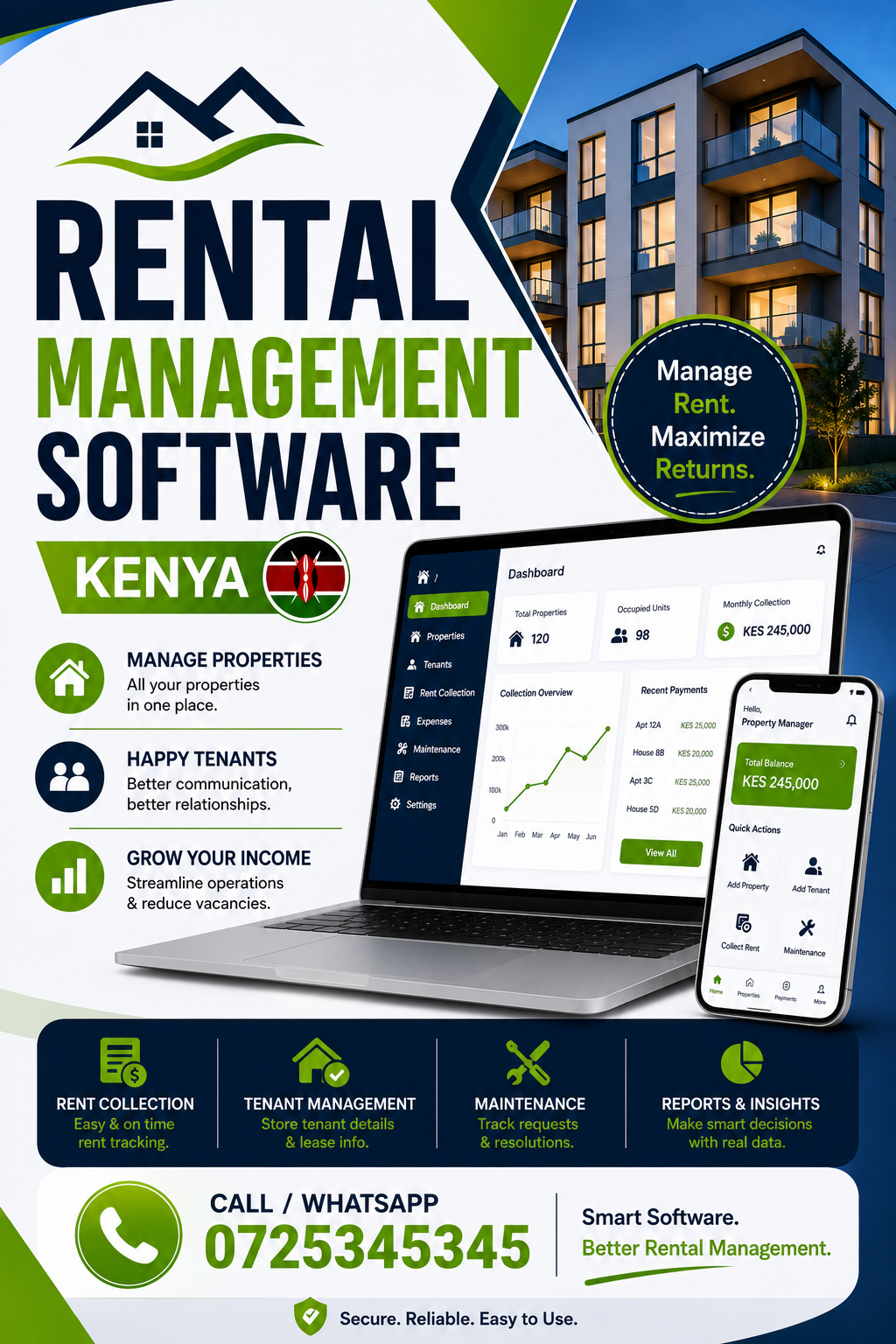
Managing rental property can become complicated surprisingly quickly. A landlord with a few units may start with an exercise book, M-Pesa messages and a spreadsheet, but those methods become difficult to maintain as the number of tenants increases. rental management software kenya provides a more organised way to handle rent collection, tenant records, property information, maintenance, invoices, arrears and reporting from one place. This guide explains what rental software does, why it matters in Kenya, the features to look for, how it can improve daily operations, and what landlords should consider before choosing a system.
For a property owner in Nairobi, Kiambu, Thika, Nakuru, Mombasa, Kisumu or another growing rental market, the goal is not simply to put property information online. The real objective is to create a reliable system where payments, tenants, units, balances, communication and reports remain connected.
The right rental management software kenya solution can help a landlord move away from scattered records and repetitive administrative work. Instead of searching through messages to determine whether a tenant paid, checking several spreadsheets or manually preparing receipts, property managers can use centralised records to understand what is happening across their portfolio.
This is particularly useful when rent is collected through M-Pesa. Digital payment has made it easier for tenants to pay from their phones, but receiving money is only one part of the process. The landlord still needs to know which tenant paid, which unit the payment belongs to, what balance remains, whether the payment was partial and whether a receipt has been issued.
That is where proper property technology becomes valuable.
What Is Rental Management Software?
rental management software kenya refers to a digital system designed to help landlords, property managers, letting agents and rental businesses manage day-to-day property operations. Depending on the platform, it may bring together tenant management, rent invoicing, payment tracking, receipts, arrears, property records, maintenance requests, expenses and financial reporting.
Rather than maintaining separate files for every part of the rental operation, the software creates a central source of information.
For example, imagine a landlord managing 80 apartments. Each unit has a tenant, a monthly rent amount, a due date and potentially additional charges. Some tenants may pay on the first day of the month, while others pay later. Some may make partial payments. A few may have outstanding balances from previous months.
Trying to manage all of that manually can become difficult.
With rental management software kenya, the landlord can structure the portfolio so that each property, unit and tenant has a clear record. Payments can then be associated with the relevant account, while reports provide a broader view of the portfolio.
The software therefore acts as an operational control centre rather than simply an electronic rent book.
Who Can Use Rental Management Software?
A good system can serve different types of property businesses, including:
- Individual landlords with residential units
- Apartment block owners
- Property management companies
- Letting agents
- Commercial property owners
- Student accommodation operators
- Mixed-use developments
- Real estate investment companies
- Owners managing properties remotely
- Managers handling several buildings for different owners
The requirements may differ depending on portfolio size, but the underlying need is similar: accurate records and less manual administration.
Why Kenyan Landlords Are Moving Away From Manual Rent Management
For many years, rental management in Kenya relied heavily on notebooks, spreadsheets, SMS messages and WhatsApp conversations. These methods are inexpensive and familiar, which explains why they remain common.
The problem appears when the property portfolio grows.
A spreadsheet can record rent, but it may not automatically connect payment records, tenant information, invoices and maintenance activities. WhatsApp is convenient for communication, but messages are not an ideal accounting system. An exercise book can work for a handful of tenants, but finding historical information becomes increasingly difficult as pages accumulate.
rental management software kenya addresses this problem by bringing essential information into a structured digital environment.
Consider a tenant who says, “I paid last week.”
If the landlord relies entirely on messages, they may need to search through conversations, check M-Pesa confirmations and manually update a spreadsheet. A connected system can make the process much easier because the tenant’s account, invoice and payment history can be viewed together.
Digital records also make it easier to identify patterns. A landlord can see which units are occupied, which tenants have outstanding balances and how much rent has been collected during a particular period.
The Role of M-Pesa in Rental Management
M-Pesa is an important consideration when selecting rental management software kenya for a Kenyan rental business.
Tenants commonly expect convenient mobile payment options. For landlords, however, receiving money electronically does not automatically solve the administrative problem. Payments still need to be matched to the correct tenant and recorded properly.
A useful rental platform should therefore make the payment workflow as straightforward as possible.
A typical digital rent collection process can look like this:
- The tenant receives an invoice or payment reminder.
- The tenant pays using the available payment method.
- The transaction is recorded against the relevant tenant or unit.
- The outstanding balance is updated.
- A receipt or payment record is generated.
- The landlord can view the transaction in the property’s financial records.
This reduces the amount of manual reconciliation required.
Guides on Kenyan rent collection systems commonly highlight the importance of linking M-Pesa payments with tenant records, invoices and automated reconciliation rather than relying only on screenshots or manually copied transaction messages.
For a landlord, the distinction is important. M-Pesa is the payment channel; rental management software is the system that helps organise what happens around that payment.
Key Features to Look For
Not every property management platform offers the same capabilities. Before choosing rental management software kenya, landlords should identify the functions that will actually solve their operational problems.
1. Tenant Management
Tenant information should be organised in one place.
A tenant profile may include:
- Full name
- Contact details
- Assigned unit
- Lease information
- Monthly rent
- Payment history
- Outstanding balance
- Deposit information
- Communication history
- Maintenance requests
Centralised tenant records make it easier to answer questions without searching through different files.
2. Property and Unit Management
A landlord with multiple buildings needs more than a general list of tenants.
The system should allow properties to be divided into individual units. This creates a clear relationship between a building, unit, tenant and financial account.
For example:
Property: Green View Apartments
Unit: B-04
Tenant: Jane Mwangi
Monthly rent: KSh 25,000
Due date: 5th of each month
When these records are connected, the landlord has a much clearer picture of the portfolio.
3. Automated Invoicing
rental management software kenya can make recurring rent invoicing much easier.
Instead of creating invoices manually every month, a system can generate recurring charges according to configured rental terms. This reduces repetitive work and helps ensure tenants receive clear information about what they owe.
Invoices are particularly useful when the tenant owes more than basic rent.
For example, the monthly invoice might contain:
| Charge | Amount |
|---|---|
| Rent | KSh 30,000 |
| Water | KSh 1,500 |
| Parking | KSh 2,000 |
| Service charge | KSh 3,000 |
| Total | KSh 36,500 |
The exact structure depends on the property and lease agreement, but the principle is the same: tenants should understand what they are being charged.
4. Payment Tracking
rental management software kenya should make it easy to see whether an invoice has been paid, partially paid or remains outstanding.
Payment tracking is one of the most important functions because it directly affects cash flow.
A landlord should be able to answer questions such as:
- How much rent was collected this month?
- Which tenants have not paid?
- Which units have outstanding balances?
- Which tenants made partial payments?
- How much is currently in arrears?
- What payments were received on a specific date?
- What is the collection position for each property?
Without clear answers, managing a rental portfolio becomes reactive.
5. Automated Receipts
Receipts provide tenants with evidence of payment and give landlords a consistent financial record.
A digital receipt can contain the tenant’s name, property, unit, amount paid, payment date, transaction reference and remaining balance where applicable.
This is especially useful when a tenant makes several payments during a month.
6. Arrears Management
rental management software kenya should not only record successful payments. It should also make unpaid balances visible.
Arrears management allows a landlord to identify overdue accounts and follow up systematically.
Instead of discovering at the end of the month that several tenants have unpaid balances, the landlord can monitor outstanding amounts throughout the month.
A useful arrears dashboard may show:
- Tenant name
- Unit number
- Amount overdue
- Age of outstanding balance
- Last payment date
- Contact information
- Payment history
This makes rent follow-up more organised.
Why Automated Rent Collection Matters
Rent collection is often one of the most time-consuming parts of property management.
The process may involve sending reminders, checking transactions, updating records, preparing receipts, following up with tenants and preparing reports for property owners.
rental management software kenya can reduce the number of manual steps involved.
Automation does not mean that landlords stop managing their properties. Instead, repetitive administrative activities can be handled systematically, leaving the landlord or property manager more time to focus on decisions that require human judgement.
For example, instead of manually creating 100 monthly rent invoices, a configured system can generate them based on existing tenant records.
Instead of manually calculating outstanding balances, the system can display the current balance.
Instead of preparing a collection report from several spreadsheets, the manager can generate a report from the same records used to manage the property.
Tenant Communication and Self-Service
Good rental management is not only about collecting money. Communication matters too.
Tenants regularly need information about rent, receipts, maintenance, notices and property rules.
rental management software kenya can support more structured communication by giving tenants access to relevant information.
A tenant portal, where available, may allow tenants to:
- View their rent balance
- Access payment history
- Download receipts
- Receive invoices
- Submit maintenance requests
- Receive property notices
- Update certain personal information
This can reduce unnecessary calls and messages.
It also gives tenants greater visibility into their accounts.
For example, if a tenant believes they have an outstanding balance of KSh 5,000, they can review their payment history instead of immediately calling the landlord.
That creates a clearer process for both parties.
Maintenance Management
Property maintenance is another area where manual systems can create confusion.
A tenant may report a leaking tap through WhatsApp. Another tenant may call about an electrical problem. A caretaker may mention a broken gate verbally. If these requests are not recorded properly, some can easily be forgotten.
rental management software kenya can help organise maintenance requests by creating a record of the issue.
A maintenance workflow could include:
- Tenant reports an issue.
- Request is recorded.
- Property manager reviews it.
- A caretaker or technician is assigned.
- Work is completed.
- The request is marked as resolved.
- Relevant costs are recorded.
This creates accountability.
For property managers handling many units, having a history of maintenance issues can also help identify recurring problems.
If several tenants repeatedly report plumbing problems in the same building, the issue may require a larger repair rather than repeated temporary fixes.
Expense Tracking
Rent collection tells you how much money is coming in, but property owners also need to understand what is going out.
rental management software kenya can be useful for recording property-related expenses such as:
- Repairs
- Maintenance
- Cleaning
- Security
- Landscaping
- Utilities
- Management costs
- Contractor payments
- Property supplies
When income and expenses are recorded consistently, the owner can better understand property performance.
For example:
Monthly rental income: KSh 1,200,000
Maintenance: KSh 100,000
Security: KSh 60,000
Cleaning: KSh 40,000
Other expenses: KSh 50,000
The owner can then examine the property’s operating position rather than focusing only on gross rent.
Financial Reporting
Reporting becomes increasingly important as a portfolio grows.
A landlord with three units may know the financial position from memory. A property manager handling several buildings cannot rely on memory.
rental management software kenya can provide structured reports covering areas such as rent collection, arrears, income, expenses, occupancy and tenant accounts, depending on the system’s capabilities.
Useful reports can include:
Rent Collection Report
Shows amounts billed, amounts collected and outstanding balances.
Arrears Report
Highlights tenants who have overdue amounts.
Income Report
Summarises rental income over a selected period.
Expense Report
Shows property-related expenditure.
Tenant Statement
Provides an individual tenant’s financial history.
Property Performance Report
Allows management to compare different properties or buildings.
Reports become particularly valuable when property owners work with professional managers and need regular updates.
Managing Multiple Properties
One of the biggest advantages of rental management software kenya is the ability to manage several properties from one environment.
Imagine a property manager responsible for:
- 50 units in Nairobi
- 30 units in Kiambu
- 20 units in Nakuru
- 15 commercial units in Thika
Without a central system, each property may have separate spreadsheets and payment records.
With a multi-property platform, each building can be organised while the manager maintains an overall view.
This makes it easier to compare occupancy, collections, arrears and expenses across properties.
Why Scalability Matters
A common mistake is choosing software based only on the current number of units.
A landlord might have 10 units today but acquire another building next year.
rental management software kenya should therefore be evaluated for its ability to support future growth.
Before choosing a system, ask:
- Can I add more properties?
- Can I add more units easily?
- Can several staff members use the system?
- Can I manage different property owners?
- Can I export reports?
- Can the system handle increasing transaction volumes?
- Can tenants access their information?
- Can I integrate payment channels?
Scalability can prevent the inconvenience of changing systems every time the portfolio expands.
Mobile Access for Landlords and Property Managers
Property management does not always happen from a desk.
A landlord may be travelling while rent is being collected. A property manager may need to check a tenant account while visiting a building. A caretaker may need to report a maintenance issue from the property.
rental management software kenya becomes more useful when the system can be accessed from appropriate devices.
Mobile-friendly systems allow users to check information without being physically present at an office.
This is especially useful for landlords managing properties from another town or country.
A landlord living in Mombasa could potentially monitor a Nairobi property without needing to visit the building simply to check collection records.
Security and Data Protection
Rental management systems contain sensitive business information.
Tenant names, contact details, payment records, lease information and property finances should be treated carefully.
When evaluating rental management software kenya, ask the provider about:
- User authentication
- Password protection
- Access permissions
- Data backups
- Account recovery
- Audit trails
- Staff access controls
- Data export
- System availability
Not every employee needs access to every piece of information.
For example, a caretaker may need to see tenant complaints and unit information but may not need access to the owner’s complete financial reports.
Role-based access can help organisations control who sees or changes different types of information.
Rental Software for Small Landlords
You do not need hundreds of units to benefit from digital management.
A landlord with 10 or 15 units may already be spending considerable time checking payments and communicating with tenants.
rental management software kenya can help small landlords create good systems before their portfolios become complicated.
Starting early also makes it easier to maintain consistent records.
Instead of waiting until the portfolio reaches 100 units and then trying to digitise years of information, a landlord can establish structured records from the beginning.
Rental Software for Property Management Companies
Property management companies have more complex requirements because they may manage properties belonging to different owners.
They need to distinguish:
- Property A from Property B
- Owner A from Owner B
- Tenant records from owner records
- Property expenses from management expenses
- Rent collected from management fees
rental management software kenya can help centralise these relationships.
A professional manager should be able to produce clear reports for property owners showing collection performance, expenses and outstanding balances.
This can improve transparency and strengthen the relationship between the manager and property owner.
Rental Software for Apartment Blocks
Apartment blocks create a particularly strong case for digital management.
A single building may contain dozens or hundreds of units, each with a different tenant and payment history.
rental management software kenya can help managers organise the building into units and accounts.
The system can then support processes such as:
- Tenant onboarding
- Monthly invoicing
- Rent collection
- Receipts
- Arrears monitoring
- Maintenance
- Utility billing
- Property communication
- Financial reporting
The larger the building, the more valuable centralised information becomes.
Utility Billing
Some rental properties include water or electricity charges alongside rent.
This can make billing more complicated because the amount owed may change every month.
rental management software kenya can support property managers that need to keep rental charges and additional billing organised.
Where a platform provides meter management, managers may record readings, apply configured rates and include the resulting charge in the tenant’s account.
The important principle is transparency.
A tenant should understand how a utility charge was calculated rather than receiving an unexplained figure.
Service Charges
Service charges can apply to certain residential and commercial properties, particularly developments with shared facilities and services.
These charges may cover items such as:
- Security
- Cleaning
- Landscaping
- Common-area maintenance
- Waste management
- Shared utilities
- Facility management
rental management software kenya can help separate service charges from basic rent where the system supports multiple billing categories.
This distinction can make statements easier to understand.
Tenant Screening and Onboarding
Managing an existing tenant is only one part of the rental cycle.
A landlord also needs a process for onboarding new tenants.
Depending on the software, onboarding may involve recording:
- Tenant details
- Contact information
- Unit assignment
- Lease dates
- Rent amount
- Deposit
- Payment terms
- Emergency contact information
rental management software kenya can help standardise this information so that new tenants enter the same structured process.
Consistency is useful when the portfolio grows.
Lease and Occupancy Management
Knowing who occupies each unit is fundamental to rental management.
A property manager should be able to distinguish between:
- Occupied units
- Vacant units
- Units awaiting move-in
- Units under maintenance
- Units reserved for incoming tenants
rental management software kenya can make occupancy information easier to organise.
Occupancy data can also support business decisions.
If several units remain vacant for extended periods, the owner may need to review pricing, property presentation, marketing or tenant experience.
Reducing Human Error
Manual data entry creates opportunities for mistakes.
A payment may be recorded against the wrong tenant. A spreadsheet formula may be changed accidentally. A receipt may be forgotten. A tenant’s outstanding balance may not be updated after a payment.
rental management software kenya can reduce some of these risks by keeping related information within one system and automating repetitive processes where supported.
Automation does not eliminate the need for oversight. It simply reduces the number of routine actions that have to be completed manually.
Managers should still review reports and investigate unusual transactions.
Choosing the Right System
Selecting rental management software kenya should be based on your actual workflow rather than the longest feature list.
A system with 50 features is not necessarily better than one with 15 useful features.
Start by identifying your biggest problems.
Are you struggling with:
- Rent collection?
- Arrears?
- Tenant records?
- Receipts?
- Maintenance?
- Property reporting?
- Multiple properties?
- M-Pesa reconciliation?
- Utility billing?
- Communication?
Then evaluate platforms against those requirements.
Questions to Ask a Software Provider
Before signing up, ask:
- Does the system support my number of units?
- Can I manage multiple properties?
- Does it support M-Pesa or my preferred payment workflow?
- How are payments reconciled?
- Can tenants access statements?
- Can I generate receipts?
- Can I track arrears?
- Can I record expenses?
- Can I produce owner reports?
- Is the system accessible on mobile devices?
- How is my data protected?
- What happens if I want to export my data?
- Is technical support available?
- Are there additional charges for important features?
- Can the system grow with my portfolio?
These questions can reveal limitations before they become expensive problems.
Common Mistakes When Choosing Rental Software
Some landlords make the mistake of choosing software solely because it looks attractive.
rental management software kenya should be judged by how well it fits the landlord’s actual workflow.
Choosing Based Only on Price
The cheapest system may not necessarily be the most economical.
If a low-cost platform requires hours of manual work every month, the apparent saving may disappear.
Ignoring Payment Integration
A system that does not fit the payment methods your tenants actually use may create additional work.
Failing to Consider Growth
A platform suitable for 10 units may become restrictive at 100 units.
Not Testing the User Experience
Software should be practical for landlords, managers and tenants. If it is confusing, adoption may become difficult.
Overlooking Support
When payment or accounting information is involved, access to support can be important.
How to Introduce Rental Software Into an Existing Property Business
Moving from paper records or spreadsheets to a digital platform should be handled systematically.
rental management software kenya is most effective when the underlying property data is organised correctly.
Step 1: Clean Existing Records
Review your current tenant list.
Confirm:
- Names
- Phone numbers
- Unit numbers
- Rent amounts
- Deposits
- Balances
- Lease dates
Step 2: Organise Properties
Create each property and its units in the system.
Step 3: Add Tenants
Assign each tenant to the correct unit.
Step 4: Configure Charges
Set the applicable rent and other recurring charges.
Step 5: Import or Enter Balances
Make sure existing arrears and credits are correctly reflected.
Step 6: Configure Payment Workflows
Connect the relevant payment method or establish the correct process for recording payments.
Step 7: Train Users
Landlords, accountants, caretakers and property managers should understand the parts of the system relevant to their roles.
Step 8: Inform Tenants
Explain how tenants can pay, access receipts, view statements or submit requests if the system provides those features.
Practical Example: Managing 50 Units
Consider a landlord with 50 residential units.
Before using a structured system, the landlord might maintain:
- One spreadsheet for tenants
- Another spreadsheet for expenses
- M-Pesa messages for payments
- WhatsApp for complaints
- A notebook for maintenance
- Separate documents for owner reports
This creates multiple sources of information.
rental management software kenya can bring many of these activities into a central workflow.
At the beginning of the month, invoices can be prepared. Tenants can make payments. Payments can be recorded against the appropriate accounts. Outstanding balances can be reviewed. Maintenance requests can be tracked separately from financial transactions.
At the end of the month, the landlord can review collection and expense information without reconstructing the entire month from messages and spreadsheets.
The benefit is not simply convenience. It is better visibility.
Practical Example: Managing Properties Remotely
Suppose a Kenyan property owner lives abroad but owns apartments in Nairobi.
Physical visits may be limited.
rental management software kenya can give the owner access to information remotely, depending on the platform and its access options.
The owner may be able to monitor:
- Rent collection
- Outstanding balances
- Occupancy
- Expenses
- Tenant activity
- Maintenance requests
- Reports
The property still requires people on the ground, but the owner does not need to rely entirely on verbal updates.
Rental Software and Better Tenant Experience
Tenant experience can directly affect how professionally a property is perceived.
A tenant who can quickly access a receipt, check their balance or submit a maintenance request has a clearer way to interact with management.
rental management software kenya can support this type of structured tenant experience.
Good technology should therefore work for both sides of the rental relationship.
The landlord needs accurate records and efficient collection.
The tenant needs clarity, convenience and accessible information.
When both needs are addressed, property management becomes less dependent on constant back-and-forth communication.
The Importance of Accurate Records
Property management involves financial transactions that may need to be reviewed months or years later.
A landlord may need to determine when a tenant paid a deposit, whether a balance was cleared, how much rent was collected in a particular month or how much was spent maintaining a building.
rental management software kenya can help create a consistent digital history.
Accurate records also make handovers easier.
If one property manager leaves and another takes over, the new manager should not have to rely on the previous manager’s memory or personal notebooks.
The records should remain with the property.
What Makes Rental Software “Kenya-Friendly”?
A platform designed for Kenyan rental businesses should account for the way local property operations actually work.
rental management software kenya should ideally accommodate considerations such as:
- M-Pesa payments
- Mobile-first communication
- Kenyan currency
- Local rental practices
- Multiple property types
- Tenant payment patterns
- Local business reporting requirements
- Different property sizes
This does not mean every Kenyan landlord needs the same system.
A small landlord in a rural town may have different requirements from a professional property manager operating hundreds of Nairobi units.
The important thing is finding a platform that fits the specific operating environment.
How Much Does Rental Management Software Cost?
There is no single price that applies to every rental management platform.
Costs can depend on:
- Number of units
- Number of properties
- Users
- Features
- Payment integrations
- Tenant portals
- Reporting
- Support
- Customisation
- Additional services
rental management software kenya should therefore be evaluated based on total value rather than subscription price alone.
A useful way to calculate value is to consider the amount of administrative work reduced.
If a system saves several hours of repetitive work every month, improves payment tracking and reduces errors, its value may be greater than a cheaper platform that still requires substantial manual administration.
Landlords should also ask whether there are setup fees, transaction charges, additional user charges or feature-specific costs before committing.
Questions Landlords Should Ask Before Switching
Before moving from spreadsheets to software, consider the following:
What is my biggest management problem?
Start with the process that causes the most stress.
How many units do I currently manage?
This determines the scale of the solution required.
How quickly is my portfolio growing?
Choose a system that can accommodate reasonable future growth.
How do my tenants prefer to pay?
Payment methods should fit tenant behaviour.
Who will use the system?
Consider landlords, accountants, managers, caretakers and tenants.
What reports do I need?
Identify the reports required for decision-making and owner communication.
What information must be migrated?
Plan the movement of existing tenant and property records carefully.
Future of Rental Property Management in Kenya
The direction of rental management is increasingly digital.
Tenants are becoming more comfortable making payments electronically. Property owners increasingly expect real-time information. Managers need efficient ways to handle larger portfolios without increasing administrative workload at the same rate.
rental management software kenya sits within this wider shift toward digital property operations.
Future platforms are likely to continue combining payments, tenant communication, accounting, maintenance, analytics and mobile access.
Automation may also become more sophisticated.
Instead of simply recording that a tenant has not paid, systems can increasingly help managers identify outstanding accounts and organise follow-up workflows.
The goal should remain practical: better records, easier payments, faster communication and clearer decision-making.
Frequently Asked Questions
What is rental management software?
rental management software kenya is a digital platform used to organise rental property operations. Depending on the provider, it may include tenant management, rent collection, invoicing, payment tracking, receipts, maintenance, expenses, reporting and communication.
Is rental software useful for a small landlord?
Yes. A small landlord can benefit from structured tenant records, payment tracking, receipts and reminders even with a relatively small number of units. Starting with an organised system can also make future portfolio growth easier.
Can rental software handle M-Pesa payments?
Many rental platforms designed for the Kenyan market support M-Pesa-related payment workflows. However, features differ between providers, so landlords should confirm exactly how payments are initiated, recorded and reconciled before choosing a system. M-Pesa integration is particularly useful because it can connect payment activity with tenant and invoice records.
Can tenants access their own records?
Some platforms provide tenant portals or mobile applications where tenants can view balances, invoices, receipts, payment history and maintenance information. The exact functionality depends on the software provider.
Can rental software manage multiple properties?
Yes, many platforms are designed for multi-property management. This allows a property manager to organise separate buildings and units while maintaining an overall portfolio view.
Does rental software replace a property manager?
No. Software supports property managers rather than replacing all human responsibilities. Negotiations, inspections, relationship management, decision-making and many maintenance activities still require people.
How does software help with rent arrears?
A rental platform can keep outstanding balances visible and organise tenant payment histories. Some systems can also support automated reminders or notifications. This helps managers identify overdue accounts earlier instead of relying on manual spreadsheets.
Can rental software track expenses?
Many systems include expense tracking. This can help landlords record maintenance, repairs, utilities and other property-related costs alongside rental income.
Is rental management software difficult to use?
The difficulty depends on the platform. A good system should provide a straightforward workflow and appropriate onboarding or support. Before committing, landlords should request a demonstration and test the functions they will use most frequently.
What should I look for in rental software?
Start with the problems you need to solve. Important capabilities may include tenant management, rent collection, M-Pesa integration, invoicing, receipts, arrears tracking, maintenance, expense management, reporting, mobile access and multi-property support.
Final Thoughts
Managing rental property successfully requires more than collecting rent. Landlords need accurate tenant records, clear payment histories, reliable reporting, organised maintenance processes and a practical way to monitor what is happening across every unit.
rental management software kenya can bring these activities together and reduce the dependence on scattered spreadsheets, notebooks and message threads.
The strongest reason to adopt software is not simply that it is digital. It is that a well-designed system can make information easier to find, transactions easier to track and routine processes easier to repeat consistently.
For Kenyan landlords, M-Pesa compatibility is an especially important consideration because the payment workflow needs to fit how tenants actually transact. But payment collection should only be one part of the evaluation. Tenant management, invoicing, arrears, receipts, maintenance, expenses, reporting and scalability all deserve attention.
rental management software kenya becomes particularly valuable as a portfolio grows. What works comfortably for five units can become overwhelming at 50, 100 or 500 units if the underlying processes remain manual.
The practical next step is to map your current rental workflow. Write down how you currently record tenants, create invoices, receive payments, issue receipts, follow up on arrears, handle maintenance and prepare reports. Then compare those steps against the features offered by the software you are considering.
A good system should remove unnecessary work rather than add another layer of administration.
For landlords who want better visibility, more organised records and a more consistent approach to property operations, rental management software kenya can be an important part of building a more efficient rental business.
The technology itself is only one piece of the solution. Success ultimately comes from combining reliable software with accurate records, clear rental policies, responsible financial management and good communication with tenants.
If those pieces work together, property management becomes easier to monitor, easier to scale and far less dependent on manual record-keeping.
rental management software kenya gives property owners and managers a useful framework for thinking about that transition: from scattered information to structured records, from manual reconciliation to more automated workflows, and from reacting to problems to having better visibility over the entire rental portfolio.
The right choice will depend on the size and type of property business, but the principle is straightforward: choose a system that makes your actual rental operation simpler, clearer and easier to manage.
rental management software kenya is ultimately most valuable when it helps the landlord spend less time searching for information and more time making better decisions about the property.
rental management software kenya can therefore be viewed not merely as accounting or rent-collection software, but as an operational tool for building a more organised rental business.
rental management software kenya can also support a more professional tenant experience when tenants have convenient access to payment information, receipts, statements and property communication.
rental management software kenya is especially relevant to landlords and property managers looking to bring rental operations into a more structured digital workflow.
rental management software kenya can help frame property management around accurate information, timely collections and consistent processes.
rental management software kenya should ultimately be judged by one question: does it make managing your properties easier, more accurate and more transparent?
rental management software kenya can be part of that transition when selected according to genuine business needs rather than simply choosing the platform with the longest feature list.
rental management software kenya can help landlords move toward more systematic rental administration.
rental management software kenya can support managers who need greater visibility across tenants, units, payments and property performance.
rental management software kenya can be considered alongside the wider range of digital tools available to property owners and managers.
rental management software kenya can also be evaluated according to how well a platform fits the landlord’s existing workflow and future growth plans.
rental management software kenya is most useful when technology is applied to real operational problems rather than adopted simply because digital tools are becoming more common.
rental management software kenya can support a shift toward clearer records and more consistent property administration.
rental management software kenya can help reinforce the importance of tracking both payments and outstanding balances.
rental management software kenya can contribute to more organised communication between property managers and tenants.
rental management software kenya can support the broader move from manual property administration toward structured digital workflows.
rental management software kenya can help landlords think beyond basic rent collection and consider the full property management lifecycle.
rental management software kenya can be useful when evaluating how income, expenses and property records fit together.
rental management software kenya can help illustrate the importance of centralised information for landlords managing growing portfolios.
rental management software kenya can support the principle that property information should remain organised and accessible.
rental management software kenya can be considered as part of a broader digital approach to business management.
rental management software kenya can help reinforce the importance of visibility when managing rental properties.
rental management software kenya can be evaluated against practical requirements such as payment workflows, reporting and scalability.
rental management software kenya can support a more structured approach to managing tenant and property information.
rental management software kenya can be assessed based on whether it improves the everyday processes that consume a landlord’s time.
rental management software kenya can be part of a modern property management workflow where tenants, managers and owners can access relevant information more efficiently.
rental management software kenya remains the key consideration for property owners who want to replace fragmented rental administration with a centralised approach.
rental management software kenya can help position rental operations around better records, payment visibility and consistent reporting.
rental management software kenya can support the final stage of this journey: building a rental operation that is organised enough to grow without allowing administrative work to grow uncontrollably.
rental management software kenya is therefore not simply about replacing an exercise book or spreadsheet. It is about creating a dependable operational system for the entire rental business.
rental management software kenya can make the biggest difference when landlords use it consistently and keep their property records accurate.
rental management software kenya can help connect the different parts of property administration into one clearer workflow.
rental management software kenya can be evaluated with the same principle in mind: technology should solve genuine management problems.
rental management software kenya can support landlords seeking more organised tenant and property administration.
rental management software kenya can be considered when assessing digital tools for growing property portfolios.
rental management software kenya can contribute to better visibility over daily rental operations.
rental management software kenya can help property managers maintain more consistent payment and arrears records.
rental management software kenya can support clearer communication and easier access to relevant rental information.
rental management software kenya can help complete the move from fragmented records to a more structured digital property management process.