Managing rental properties requires more than simply collecting money every month. Landlords and property managers need to know which tenants have paid, who has paid partially, who is overdue, how much is outstanding, and how each property is performing.
When these records are managed using notebooks, spreadsheets, bank statements, M-Pesa messages, and manual calculations, keeping accurate rent records can become difficult.
This is where rent tracking software in Kenya can make a major difference.
Rent tracking software gives landlords, property managers, and rental agencies a centralized way to monitor rent payments, tenant balances, invoices, arrears, and rental income.
For landlords managing several units or property managers responsible for multiple buildings, a digital rent tracking system can reduce manual work while providing better visibility into rental income.
What Is Rent Tracking Software?
Rent tracking software is a digital system designed to help landlords and property managers monitor rental payments and tenant balances.
Instead of recording every payment manually in an Excel spreadsheet or notebook, rental payment information can be organized according to:
- Property
- Building
- Unit
- Tenant
- Rent amount
- Invoice
- Payment
- Payment date
- Outstanding balance
- Arrears
A good rent tracking system should provide a clear picture of the financial status of each rental unit.
For example, a property manager should be able to quickly determine:
Who has paid?
Who has not paid?
Who has paid partially?
Who is in arrears?
How much has been collected?
How much remains outstanding?
This information is essential for running a rental business effectively.
Why Rent Tracking Is Important for Kenyan Landlords
Rent is the primary source of income for most rental properties. However, collecting rent is only one part of the process.
The landlord also needs to maintain accurate records of the payments.
Without proper rent tracking, several problems can occur.
1. Unclear Tenant Balances
A tenant may make a partial payment, pay for several months at once, or have an existing balance.
If payments are recorded manually, calculating the correct outstanding balance can become complicated.
Rent tracking software helps connect payments with tenant accounts and rental charges.
2. Missed Arrears
When landlords manage many tenants, it can be difficult to identify overdue accounts by checking messages and spreadsheets individually.
A digital system can organize tenants according to their payment status, making it easier to identify accounts that require follow-up.
3. Manual Reconciliation
Kenyan landlords often receive rent through M-Pesa and other payment channels.
The challenge is determining which tenant each payment belongs to and ensuring that the payment is reflected correctly in the tenant’s account.
A structured rent tracking system can make payment reconciliation more organized.
4. Difficulty Preparing Reports
At the end of the month, landlords may need to calculate total rent collected, outstanding rent, arrears, and property performance.
Doing this manually can take considerable time.
With digital rent tracking, payment information can be used to generate reports more efficiently.
Key Features of Rent Tracking Software Kenya
When choosing rent tracking software, landlords should look for features that address everyday rental management challenges.
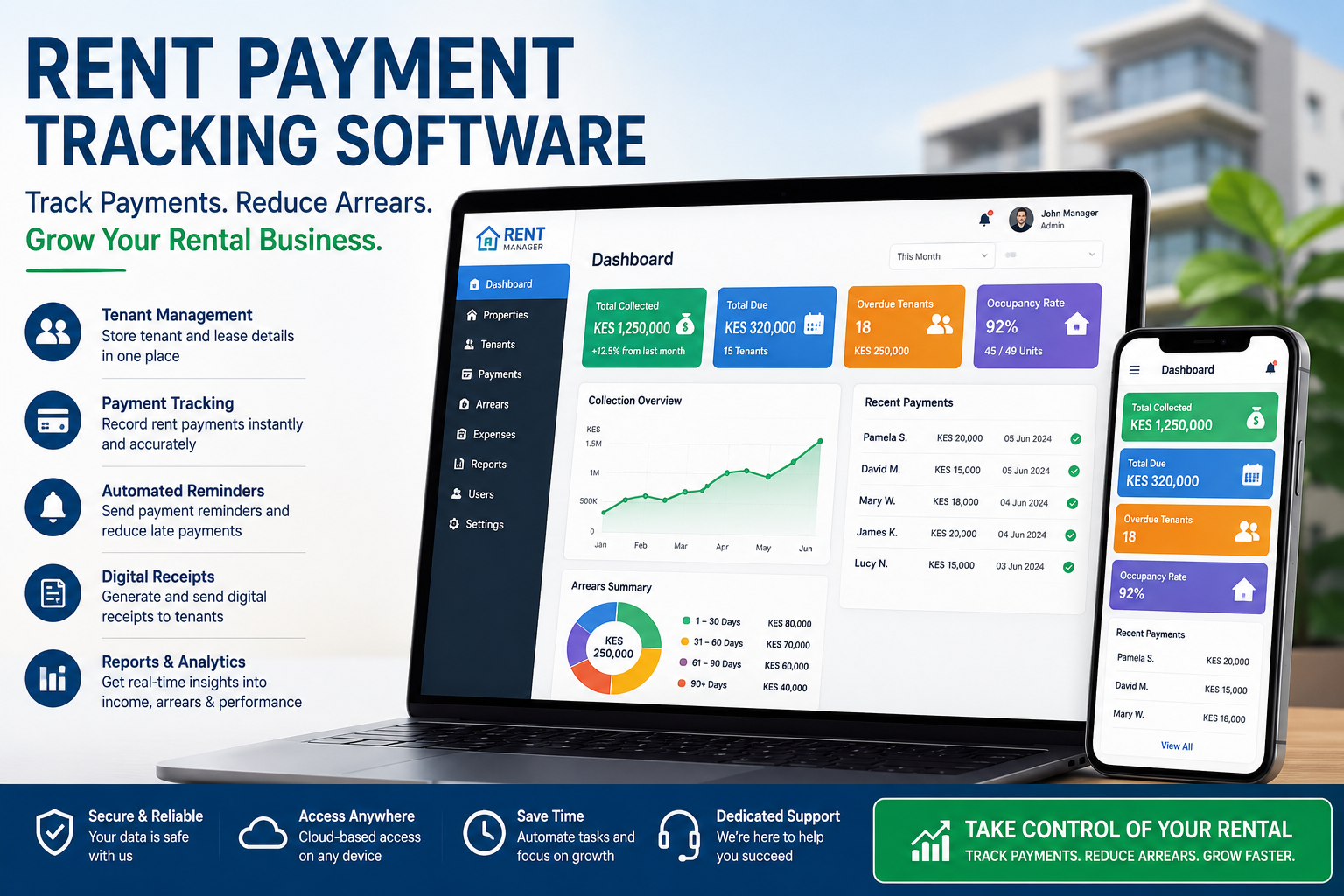
Tenant Payment Tracking
The system should allow managers to see the payment history of each tenant.
A tenant’s account can show:
- Rent charged
- Payments made
- Payment dates
- Previous balances
- Current balance
- Outstanding amounts
- Arrears
This makes it easier to understand the financial position of each tenant.
Automated Rent Invoicing
Rent invoices provide tenants with a clear record of what they are expected to pay.
Automated invoicing can help property managers create recurring monthly rent charges without manually preparing each invoice.
RentalDesk provides automated rent invoicing and recurring billing workflows alongside payment tracking.
M-Pesa Payment Tracking
M-Pesa is an important payment channel for rental businesses in Kenya.
A modern rent tracking system should therefore support workflows that connect M-Pesa payments with tenant records.
RentalDesk supports M-Pesa rent collection workflows, including STK Push and Paybill-related payment processes.
Payment Reconciliation
Receiving a payment does not automatically mean the rental records are correct.
The payment needs to be matched to the correct tenant and account.
Payment reconciliation helps ensure that incoming transactions are properly allocated.
RentalDesk includes bank and M-Pesa reconciliation tools for matching payments and reviewing exceptions.
Arrears Tracking
Arrears are one of the biggest challenges facing rental property owners.
A rent tracking system can help identify tenants who are:
- Paid
- Part-paid
- Unpaid
- Overdue
This gives property managers a clear list of accounts requiring attention.
Tenant Statements
Tenant statements provide a detailed history of charges and payments.
They can help answer questions such as:
- How much rent was charged?
- When did the tenant make payments?
- Is there an outstanding balance?
- Has the tenant accumulated arrears?
Clear statements can also help reduce disputes.
Rent Collection Reports
Reports allow landlords to evaluate rental income over time.
Useful reports may include:
- Daily rent collection
- Monthly rent collection
- Tenant payment history
- Outstanding rent
- Arrears
- Property income
- Collection performance
RentalDesk provides rent collection reports, tenant statements, and property performance reporting.
Benefits of Rent Tracking Software for Landlords
Better Financial Visibility
Instead of waiting until the end of the month, landlords can get a clearer view of rental payment activity.
Faster Arrears Follow-Up
Outstanding accounts can be identified more quickly, allowing property managers to prioritize follow-ups.
Less Spreadsheet Dependency
Spreadsheets can be useful for basic record keeping, but dedicated rental software provides workflows specifically designed for property management.
More Accurate Tenant Records
Tenant information, units, invoices, and payments can be connected in one system.
Easier Monthly Reporting
Digital records make it easier to prepare rental income and payment reports.
Supports Multiple Properties
Property managers handling multiple buildings can organize rental information from a centralized dashboard.
RentalDesk is designed to support multiple properties and units from one platform.
Rent Tracking Software vs Excel
| Excel/Manual Tracking | Rent Tracking Software |
|---|---|
| Manual data entry | Centralized digital records |
| Manual calculations | Automated balance tracking |
| Difficult payment matching | Structured reconciliation |
| Separate M-Pesa records | Payment workflows |
| Manual arrears checking | Arrears visibility |
| Time-consuming reports | Faster reporting |
| Higher risk of duplicate entries | Organized tenant records |
| Difficult to scale | Designed for growing portfolios |
Excel is not necessarily bad for a very small rental portfolio. However, as the number of units increases, dedicated rent tracking software can provide greater structure and automation.
How RentalDesk Helps Track Rent
RentalDesk is designed around a simple rental management workflow:
Property → Unit → Tenant → Invoice → Payment → Balance → Report
This allows landlords and property managers to connect rental information rather than maintaining separate records.
The platform provides tenant management, automated invoices, M-Pesa payment workflows, payment reconciliation, arrears tracking, and financial reports.
The result is a more organized way to answer one of the most important questions in property management:
Where does every tenant stand with rent?
Who Should Use Rent Tracking Software in Kenya?
Individual Landlords
Landlords with several rental units can use software to maintain organized payment records.
Property Managers
Professional property managers can track payments across multiple properties.
Real Estate Agencies
Agencies managing rental properties for different owners can benefit from centralized records and reporting.
Apartment Managers
Large apartment buildings can use rent tracking software to monitor hundreds of tenant accounts more efficiently.
Property Investment Companies
Companies with multiple properties can use centralized rent data to monitor portfolio performance.
How to Choose the Best Rent Tracking Software in Kenya
Before selecting a platform, consider:
M-Pesa Compatibility
Confirm whether the system supports the payment workflows used by your tenants.
Ease of Use
The system should be simple enough for landlords, property managers, and administrative staff.
Real-Time Payment Visibility
You should be able to identify recent payments and outstanding balances without rebuilding spreadsheets.
Reporting
Look for reports that help you understand collections, arrears, and property performance.
Multi-Property Support
If your portfolio is growing, choose software that can support multiple properties and units.
Tenant Management
Rent tracking should connect directly to tenant and unit records.
Security
Rental payment information and tenant records should be protected using appropriate access controls and security practices.
Frequently Asked Questions
What is rent tracking software in Kenya?
Rent tracking software is a digital platform that helps landlords and property managers record, monitor, and report rental payments, tenant balances, invoices, and arrears.
Can rent tracking software track M-Pesa payments?
Yes, some rental management systems provide M-Pesa payment workflows and reconciliation features. RentalDesk supports M-Pesa collection and payment tracking workflows.
Can I track rent for multiple properties?
Yes. A suitable system can organize multiple properties, buildings, units, and tenants from a centralized dashboard.
Can rent tracking software identify tenants in arrears?
Yes. Arrears tracking can categorize accounts according to payment status and outstanding balances.
Is rent tracking software better than Excel?
For growing rental portfolios, dedicated software can provide specialized features such as tenant management, invoicing, payment reconciliation, arrears tracking, and reporting that are difficult to manage efficiently with spreadsheets alone.