
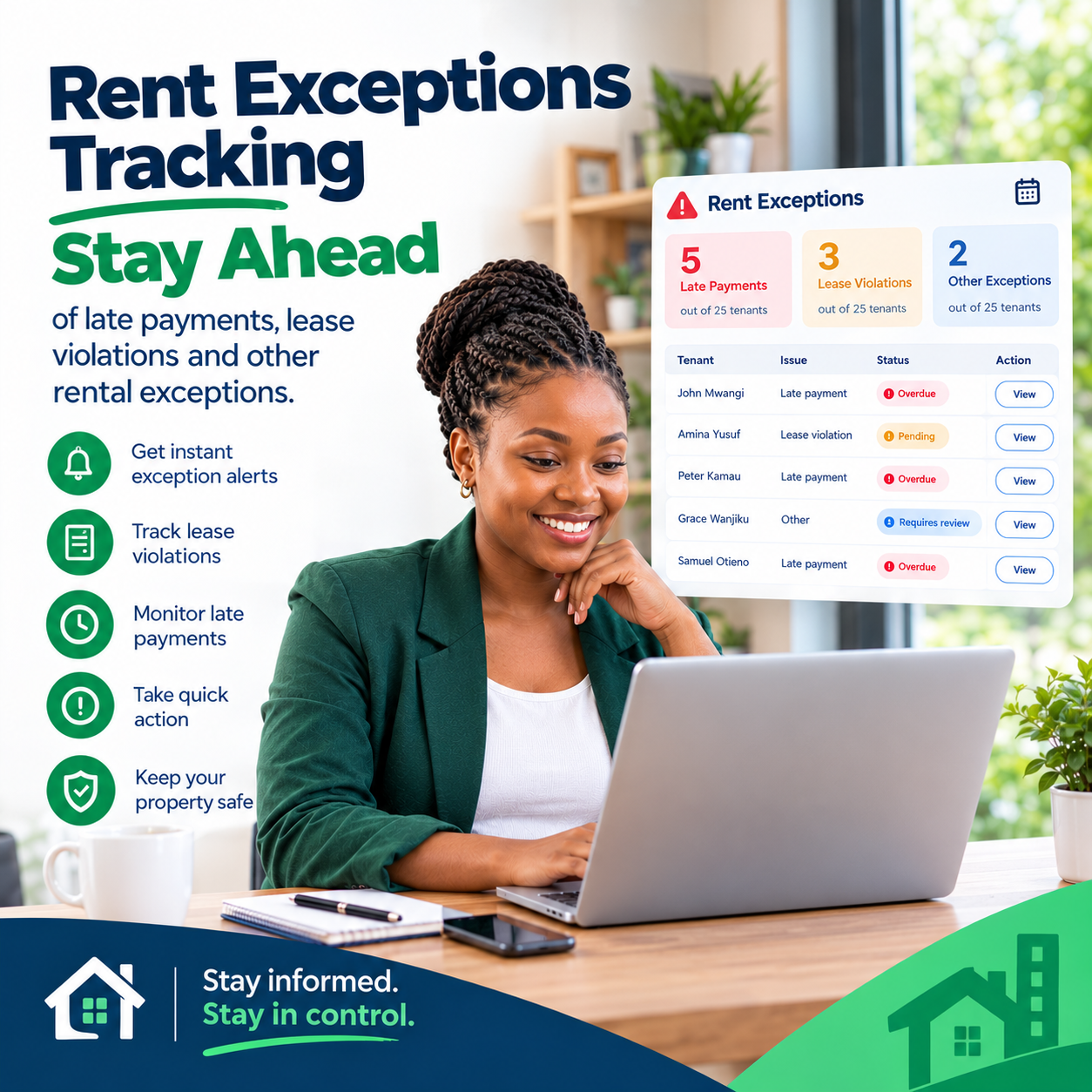
Rent exceptions tracking is the discipline of capturing, classifying, and resolving every rent payment that refuses to fit neatly into your records — the blank references, the wrong amounts, the mystery senders, and the duplicates that every real portfolio eventually produces. Smooth payments make headlines in software adverts, but exceptions are where rent management is actually won or lost. An exception handled within hours is a footnote; the same exception handled within weeks becomes a dispute, and disciplined rent exceptions tracking is the difference between the two.
Consider how exceptions actually enter a portfolio. A tenant pays in a hurry and forgets their unit number, a relative pays on someone’s behalf, a tenant settles two months at once, or money arrives from a number nobody recognizes. None of these are rare events, and every one of them stalls your records until someone resolves it — which is exactly the moment rent exceptions tracking earns its place.
This guide is the complete playbook for that discipline. We define what an exception truly is, map the full taxonomy of types, and walk through the queue workflow that professionals use to clear them fast. We also cover resolution scripts, the prevention habits that shrink exceptions at the source, and the features worth demanding from tools that automate the work.
By the end, you will be able to run rent exceptions tracking across your portfolio with the calm of a seasoned operator. Whether three tenants send you money or three hundred, the logic never changes. Every exception is a question with an answer, and the system you build exists to find that answer quickly — which is the working promise of proper rent exceptions tracking.
What Is a Rent Exception?
A rent exception is any payment or account event that cannot be cleanly matched, recorded, and closed by your standard process. It is the payment with no owner, the amount with no explanation, the entry that waits rather than files. Defining the category precisely is the first act of serious rent exceptions tracking.
The definition matters because exceptions are invisible by default. In informal systems, an unmatchable payment simply sits in a bank statement or a WhatsApp thread, invisible to every report until it becomes a quarrel. Making exceptions visible is the foundational act of rent exceptions tracking — you cannot manage what you never surface.
It helps to draw the boundary clearly. A payment that matches its unit, amount, and period is not an exception; it is income, and it files itself. Only the ambiguous, the mismatched, and the duplicated belong inside your rent exceptions tracking workflow.
The exception is also temporary by design. A well-run queue is a waiting room, not a warehouse — items enter, get resolved, and leave within days. That flow-through expectation is what distinguishes genuine rent exceptions tracking from a growing pile of mysteries.
Finally, the exception is neutral. It is not an accusation against a tenant, a failure of your system, or a sign of fraud — it is simply an unresolved question. That neutral posture is the professional tone beneath every practice of rent exceptions tracking worth adopting.
Why Exceptions Deserve Their Own Discipline
The first reason is trust on both sides. An unresolved payment leaves a tenant believing they have paid and a landlord believing they have not, and both positions are honest. Only a system for rent exceptions tracking resolves that collision before it hardens into a dispute.
The second reason is record integrity. Every unmatched payment sits outside your books — unfiled, unproven, and invisible to reports, statements, and tax records. Closing exceptions promptly is what keeps the financial picture beneath your rent exceptions tracking complete.
The third reason is speed economics. Exceptions resolved in hours cost one friendly message, while the same exceptions resolved in weeks cost confrontations, formal notices, and sometimes tenancies. That cost curve is the business case for disciplined rent exceptions tracking.
The fourth reason is pattern discovery. Exceptions are not random — they cluster around specific tenants, specific habits, and specific process gaps. Reading those patterns is the strategic dividend that only consistent rent exceptions tracking reveals over time.
The Exception Taxonomy: Six Types to Master
Type one is the missing reference — a payment that arrives with a blank or meaningless account field. This is the most common exception in the market, and it is also the most preventable. Teaching the unit-number habit is the first lesson in rent exceptions tracking practice.
Type two is the wrong reference — a payment carrying a unit number that does not match the sender or the amount. Sometimes it is a typo; sometimes it is a tenant paying for a friend; sometimes it is a genuine mistake. Each interpretation leads somewhere different, which is why rent exceptions tracking resolves cases rather than assuming them.
Type three is the wrong amount — money that arrives over, under, or split against the charge it was meant for. Underpayments become part-paid accounts, overpayments become credits, and splits must be recorded on both sides. Precision in this tier is what separates careful rent exceptions tracking from loose arithmetic.
Type four is the unknown sender — money from a number that matches no tenant on your books. Often it is a relative or employer paying on a tenant’s behalf, and often it is resolvable with one message. That resolution path is a standard lane inside rent exceptions tracking.
Type five is the duplicate payment — the same tenant paying twice for the same month, usually through haste or double-tapping. The duplicate is not extra income; it is a credit waiting to be acknowledged and returned or applied. Honest handling of duplicates is a defining habit of trustworthy rent exceptions tracking.
Type six is the orphan charge — the reverse exception, where an expected payment simply never appears. The month’s records show the charge, the tenant’s history shows payment, and the gap needs investigation rather than assumption. Covering both directions is what makes rent exceptions tracking complete rather than one-sided.
The Missing Reference: Resolving the Most Common Exception
When a payment arrives with no usable reference, work the remaining signals in order. Check whether the amount is unique among what your units owe, then whether the sender matches a known tenant’s number, then whether the timing fits a known habit. That structured elimination is the manual craft beneath all automated rent exceptions tracking.
When the signals stay silent, ask. A single courteous message — stating the amount, the date, and a request for the unit — resolves most missing-reference cases within the hour. That one template is the most valuable sentence in the entire practice of rent exceptions tracking.
Then close the loop. Once the tenant confirms, assign the payment, issue the receipt, and note the cause so the pattern is visible. Every resolved case strengthens both the record and the relationship — the twin outputs of disciplined rent exceptions tracking.
Part-Payments and Splits: The Arithmetic Exceptions
The underpayment is the gentlest exception, and it deserves the most precise handling. The payment reduces the balance, the remainder stays visible with its date, and the account moves to part-paid — never to paid. That reduce-and-keep rule is the backbone of honest rent exceptions tracking.
The split payment is its harder cousin. A tenant settling two months at once posts one amount against two charges, and the split must be recorded on both accounts with both periods credited. Split-entry discipline is a signature skill among professionals who practice rent exceptions tracking at scale.
The overpayment completes the arithmetic family. A tenant who pays ahead should carry a dated, visible credit — never an ambiguous surplus that muddies next month’s position. Crediting correctly is the fairness standard that distinguishes careful rent exceptions tracking from loose totals.
Duplicates and Wrong Numbers: The Rare but Critical Types
The duplicate payment is rare, and its handling defines reputations. When a tenant pays twice for the same month, acknowledge both transactions openly, apply one, and return or credit the other promptly with the exchange documented. That transparency is the trust test built into every serious rent exceptions tracking workflow.
The wrong-number payment is the exception that belongs to nobody on your books. Money sent in genuine error should be identified quickly, communicated about honestly, and returned promptly — with the whole exchange on record. Grace under that pressure is the reputation side of disciplined rent exceptions tracking.
Both types share one rule: they resolve through openness. Hiding, delaying, or quietly absorbing money that is not yours converts a small event into a lasting liability. Openness is the ethical floor beneath every practice of rent exceptions tracking.
The Exceptions Queue: Your Daily Workflow
The queue is where exceptions live while they wait, and its design determines whether they resolve or rot. Every unmatchable payment enters the queue with all its signals displayed — amount, date, sender, and whatever reference exists. That full visibility is the entry standard of professional rent exceptions tracking.
The queue is reviewed on a fixed rhythm, not on memory. A five-minute daily check — or a weekly session for smaller portfolios — clears new arrivals before they age. Rhythm is what separates living rent exceptions tracking from an accumulating backlog.
Each item leaves the queue through one of three exits. It resolves to a tenant and files as income, it returns to a sender as a refund, or it escalates for further investigation — and every exit is documented. That three-exit structure is the workflow core of mature rent exceptions tracking.
Aging belongs on the queue itself. Items display how long they have waited, so nothing silently becomes permanent furniture. Age-awareness is the accountability layer that keeps rent exceptions tracking honest month after month.
Resolution Scripts: Say the Right Thing, Fast
The missing-reference message is the workhorse script. “Good morning — we received a payment of KSh X on the 5th, but the unit number was not included. Kindly confirm your house number so we can receipt you correctly.” One warm message like that resolves most cases in the entire rent exceptions tracking workload.
The unknown-sender message is its sibling. “Hello — we received KSh X from this number today but cannot identify the unit. Please let us know which tenant this payment is for.” Scripts of that kind are the communication backbone of efficient rent exceptions tracking.
The duplicate and wrong-number messages share a tone: prompt, transparent, and solution-first. Acknowledge exactly what happened, state exactly what you are doing, and give a timeline for the resolution. That candor is what turns potential disputes into loyalty stories inside rent exceptions tracking.
Save every script as a template. Consistency of wording, tone, and follow-up is what makes exception handling scale beyond one person’s memory. Templated communication is the operational habit that lets rent exceptions tracking survive staff changes and busy seasons.
Prevention: Shrinking Exceptions at the Source
Prevention habit one is the reference convention. “Enter your house number as the account” — taught at onboarding and reinforced kindly — eliminates the largest exception category before it exists. No single habit pays a higher dividend across rent exceptions tracking.
Prevention habit two is knowing your senders. A register of which tenant pays from which number turns the sender signal from a mystery into a certainty, and updating it when numbers change keeps it true. That register is the quiet infrastructure behind effortless rent exceptions tracking.
Prevention habit three is pre-payment education. A short message before each due date — stating the amount, the Paybill, and the reference to use — prevents the hurry mistakes that create queues. That proactive nudge is the newest layer of sophisticated rent exceptions tracking.
Prevention habit four is pattern follow-up. When one tenant generates exceptions repeatedly, one friendly conversation about habit beats a dozen queue resolutions. Addressing causes rather than symptoms is what makes rent exceptions tracking shrink its own workload over time.
Why 2026 Is the Breakout Year
Three forces have converged to make exceptions manageable at last. First, payment data is rich by default — amounts, timestamps, senders, and references arrive with every transaction. The raw material for intelligent rent exceptions tracking now exists without extra collection work.
Second, platforms have professionalized the queue. Exceptions queues with one-tap resolution, aging views, and templated responses now run from phones at prices any landlord can justify. That accessibility is the adoption story behind rent exceptions tracking this year.
Third, tenant expectations have risen. Instant receipts and visible status are now baseline professionalism, and unresolved exceptions sit directly against both. Meeting that standard is what makes rent exceptions tracking a reputation asset rather than a back-office chore.
Features to Demand in 2026
Evaluate any platform against a short, demanding checklist. First, demand a visible exceptions queue with full signal display — amount, date, sender, and reference — for every held payment. That transparency is the entry ticket for genuine rent exceptions tracking.
Second, expect one-tap resolution with automatic receipts the moment an exception is assigned. Third, look for aging views, so nothing waits invisibly. Fourth, confirm multi-signal matching on the front end, because the best queue is the one that receives less. Those capabilities together define mature tools for rent exceptions tracking.
Fifth, verify the unified ledger — resolved exceptions must file into the same records as every other payment. Sixth, test the export door, because your exception history is part of your evidence. Finally, demand mobile-first usability on affordable phones and weak networks. Usability and portability decide whether your rent exceptions tracking becomes infrastructure or shelfware.
Choosing Your Setup and What It Costs
Selection starts from your portfolio’s real exception profile. High reference discipline and few surprises need only a light setup, while mixed payment habits need a full queue with automation. The right setup for rent exceptions tracking fits your operation exactly.
Trial with deliberately imperfect data. Send one payment with a blank reference and one with a wrong amount, and watch how the platform holds, displays, and resolves them. Those two tests reveal more about rent exceptions tracking than any polished demonstration.
The price ladder is friendly at every level. Free tiers cover small portfolios, per-unit plans commonly run KSh 20–100 monthly, and full platforms range from roughly KSh 500–5,000 depending on scale. Against one prevented dispute, any tool that powers your rent exceptions tracking repays itself immediately.
Common Mistakes to Avoid
The most common mistake is guessing under pressure. A payment assigned to a unit because “it probably was them” creates two wrong records instead of one right one, and the error surfaces exactly when evidence matters. The ask-don’t-assume rule is the first commandment of rent exceptions tracking.
The second mistake is letting exceptions age. An unresolved payment is a small task today and a large dispute next month, and the queue only works when someone works it. Prompt rhythm is the maintenance that keeps rent exceptions tracking permanently credible.
The third mistake is blaming the tenant. Most exceptions trace to honest mistakes, hurry, or untaught habits, and one warm message resolves what an accusation would inflame. Grace is the relationship standard beneath everyone who practices rent exceptions tracking well.
Real Scenarios from Real Portfolios
Picture a landlord in Nakuru with twenty-four units whose unmatched payments once accumulated as screenshots. After adopting a structured queue, exceptions resolved within a day on average, and her first-month audit surfaced three payments worth KSh 84,000 that had almost been forgotten. That single recovery justified years of her rent exceptions tracking subscription.
Picture a tenant in Kilimani who paid into a wrong Paybill digit in a moment of haste. The payment surfaced in the exceptions queue, was identified within the hour, and was resolved without a single argument. That safety net is the quiet gift of professional rent exceptions tracking.
Picture a caretaker in Embakasi whose honesty was questioned whenever balances moved for reasons nobody could trace. Once exceptions became visible, dated, and jointly resolvable, the suspicion ended — because the records finally answered the questions rumor used to raise. Mutual protection like that is the human dividend of disciplined rent exceptions tracking.
The Road Ahead: 2027 and Beyond
The trajectory points toward queues that increasingly empty themselves. Prediction is arriving — systems learning each tenant’s habits, pre-filling references, and resolving ambiguities before a human ever sees them. The rent exceptions tracking of 2027 will feel less like a queue and more like a concierge.
Integration is deepening alongside it. Matching, exceptions, receipts, and reconciliation are converging into single flows where nothing waits unwatched. That connected future is already visible across the rent exceptions tracking market, and it will accelerate.
Frequently Asked Questions
What counts as a rent exception?
Any payment or account event that cannot be cleanly matched, recorded, and closed by your standard process — missing references, wrong amounts, unknown senders, duplicates, and the expected payments that never arrive. Every portfolio produces them, and honest systems surface them rather than hide them. That visibility is the founding principle of rent exceptions tracking.
How quickly should exceptions be resolved?
Within days at most, and ideally within hours — an exception resolved on day one costs one friendly message, while the same exception resolved in week three costs a dispute. Fixed review rhythm, not memory, is what makes that speed sustainable. Promptness is the operating heart of rent exceptions tracking.
What do I do with a payment I genuinely cannot match?
Hold it visibly in your exceptions queue, contact the sender directly with the amount and date, and never assign it on a guess. If no owner emerges within a reasonable window, refund it honestly with the whole exchange documented. That ethical floor is what separates responsible rent exceptions tracking from future disputes.
How do I reduce the number of exceptions my portfolio generates?
Teach the unit-reference habit at onboarding, maintain a register of which tenant pays from which number, send pre-due-date reminders with exact payment details, and follow up patterns with individual tenants. Prevention at the source is what makes the queue a waiting room rather than a warehouse. That shrinking workload is the compounding reward of disciplined rent exceptions tracking.
Where should I start with tools that manage exceptions automatically
Start with a platform that combines verified listings with automatic matching and a visible exceptions queue, such as rentaldesk.co.ke. Pairing the right tenants with disciplined rent exceptions tracking takes you from losing payments in screenshots to resolving every question fast — exception by exception, month after month.