
Rent collection software for small landlords is the tool that turns a monthly administrative ordeal into a background process that runs without anyone remembering to run it. In Kenya, where over 90% of rent payments in urban areas flow through M-Pesa, the majority of small landlords still reconcile payments manually—matching M-Pesa messages to tenant records in a spreadsheet, chasing reminders by WhatsApp, and issuing receipts from memory. According to a 2024 survey by the Kenya Property Developers Association, over 65% of landlords with fewer than 20 units rely on manual processes for rent collection tracking.
The consequences are predictable: late payments, missed arrears, disputes, and hours of time spent on work that produces no revenue and no competitive advantage. RentalDesk provides a complete rent collection solution designed specifically for Kenyan small landlords, connecting M-Pesa collection, automated invoicing, reminder sequences, digital receipts, and financial reporting in one affordable platform.
Why Rent Collection Software for Small Landlords Matters
The case for rent collection software for small landlords rests on a simple asymmetry. Tenants have moved to digital payments almost entirely. Mobile money has taken a commanding lead over cash for monthly expenses in Kenya, rising from parity in 2021 to 68% by 2024. Yet the systems that should capture those payments are, in most small portfolios, still analogue.
That gap creates predictable problems. A landlord managing five or ten units may believe manual methods are sufficient, and for a few months they are. But the moment a tenant pays partially, or a spouse pays on behalf of the tenant, or a payment arrives with a wrong reference, the manual system breaks down. The landlord spends an afternoon matching transactions, and the tenant waits for a receipt that never arrives. Rent collection software for small landlords solves these problems by making the payment record a by-product of the payment itself, rather than a separate task that must be remembered.
The Kenya National Bureau of Statistics found that just 47.2 percent of real estate agents in Kenya use rent collection software, which means the majority of landlords are still reconciling digital payments with analogue methods. For small landlords, the gap is even wider. Most are managing their first or second property alongside a full-time job, and they do not have the time to evaluate enterprise software or the budget to pay for features they will never use.
What Small Landlords Actually Need
The rent collection software for small landlords conversation must begin with what small landlords actually need, because the market is full of tools designed for property management companies with hundreds of units. A small landlord does not need bulk import for 500 tenants. They do not need multi-level approval workflows. They do not need an enterprise dashboard with twelve charts.
A small landlord needs five things. First, a way to receive rent through M-Pesa that automatically matches the payment to the correct tenant. Second, a way to send rent reminders without manually typing them each month. Third, a receipt that issues automatically when payment arrives, so the tenant has proof and the landlord has a record. Fourth, a simple view of who has paid and who has not, without opening a spreadsheet. And fifth, an affordable price that does not eat into the rent itself.
Rent collection software for small landlords that delivers those five things is more valuable than an enterprise platform that delivers fifty features the landlord will never use. The best tool is the one the landlord will actually open every morning.
The Real Cost of Manual Rent Collection
The rent collection software for small landlords decision is ultimately an arithmetic question, and the arithmetic is not close. A landlord managing 30 units who manually reconciles M-Pesa payments typically spends 4–6 hours per month on reconciliation alone, according to surveys of Kenyan property managers. For a landlord managing ten units, the time is proportionally smaller but still significant: perhaps an hour or two each month, plus the hours spent chasing late payments, issuing receipts, and answering tenant queries about balances.
That time has an opportunity cost. A landlord who spends four hours a month on reconciliation is spending forty-eight hours a year on a task that software can complete in minutes. Over a five-year property investment, that is two hundred and forty hours—six working weeks—spent on administrative work that produces no return.
Manual collection also carries risk. A payment that is received but not matched can create almost the same problem as a payment that was not received at all. The tenant believes they have paid. The landlord believes they have not. The dispute consumes time and damages trust. A rent collection software for small landlords that matches payments automatically reduces this risk to near zero.
The M-Pesa Paybill Foundation
The rent collection software for small landlords conversation cannot proceed without addressing the payment rail, because the rail determines whether automatic reconciliation is possible at all.
M-Pesa offers three collection products, and only one of them supports automatic matching. Paybill carries an account reference field where the tenant enters their unit number. When the payment completes, Safaricom fires a C2B callback containing that reference, which the software uses to match the payment to the correct tenant. STK Push sends a payment prompt directly to the tenant’s phone, and the software already knows which tenant initiated the payment. Till Number has no account reference field, which makes automatic matching impossible. For any small landlord serious about rent collection software for small landlords, Paybill is the correct foundation.
This is the first thing a small landlord should verify when evaluating any collection tool. If the software does not connect to M-Pesa Paybill or STK Push, it cannot reconcile automatically, and the landlord will still be matching payments by hand.
How Automated Reconciliation Works for Small Portfolios
The rent collection software for small landlords becomes powerful when payments reconcile automatically. The mechanism is simpler than it sounds.
When a tenant pays via M-Pesa Paybill, Safaricom sends a C2B callback to the software containing the amount, phone number, account reference, and transaction ID. The software extracts the account reference, looks it up against tenant and unit records, and if the reference matches, posts the payment to the correct invoice. The tenant’s balance updates in real time. A receipt generates automatically. The dashboard reflects the change within seconds.
This happens without any manual intervention. The small landlord does not need to check an M-Pesa message, open a spreadsheet, or ask the tenant for clarification. The software has done the work.
RentalDesk implements this through Safaricom’s Daraja API with Instant Payment Notification callbacks. When a tenant pays, the platform extracts the amount, phone number, account reference, and transaction ID, matches the account reference to the correct tenant and unit, credits the tenant account, generates a receipt, and updates the dashboard in real-time.
A rent collection software for small landlords works best when the account reference is standardised. If tenants type “A12”, “a12”, “A 12”, “Apt 12” and “12A”, automatic matching fails. A well-designed system normalises references before matching—trimming whitespace, converting to uppercase, and stripping prefixes. But the landlord’s job is to standardise the format and communicate it in every lease and reminder.
The Four Reconciliation Failures Every Small Landlord Faces
A rent collection software for small landlords will always generate exceptions, and the quality of the tool is judged by how it handles four predictable failure modes.
Missing or wrong reference. The tenant pays without entering a reference, or enters the wrong one. The payment lands in an unmatched queue. RentalDesk provides a clear dashboard of unmatched payments where the landlord can match the payment correctly using the phone number, amount, and timing.
Partial payment. A tenant pays KSh 15,000 against a KSh 25,000 charge. A manual process either records it wrong, records it twice, or misses the second half. RentalDesk posts the partial amount against the open invoice and leaves the balance open for follow-up. The tenant is not treated as fully unpaid when they have paid part of the rent.
Duplicate payment. The tenant paid twice, often because they did not receive a receipt the first time. RentalDesk detects duplicates by transaction ID and flags them rather than auto-posting, preventing overpayments from distorting the ledger.
Third-party payment. A spouse, parent, or employer pays on behalf of the tenant. The phone number does not match the tenant record. RentalDesk records who resolved the exception and when, providing a full audit trail.
A rent collection software for small landlords that handles the straightforward payments but loses the exceptions in a manual queue is not a complete solution. The exception process must be as structured as the routine process.
What Small Landlords Should Look For
When evaluating rent collection software for small landlords, the checklist should be short and practical.
M-Pesa Paybill and STK Push integration. The software must connect directly to Safaricom’s Daraja API. Anything less is a manual process with a digital front end.
Automatic payment matching. When a tenant pays with the correct reference, the payment should post to the ledger without the landlord touching it.
Partial payment handling. The software must record partial payments accurately and keep the balance open for follow-up.
Automated reminders. The reminder ladder should run without intervention, from a friendly heads-up before the due date to a formal notice after it.
Automatic receipts. Receipts should generate and deliver via SMS, WhatsApp, or email as soon as payment is verified.
Affordable pricing. A small landlord should not pay for 500-unit capacity when they manage ten.
Local support. The software should be built for the Kenyan market, with KES pricing and support in local time zones.
RentalDesk meets all these criteria, and its pricing is designed specifically for small portfolios.
Pricing That Works for Small Landlords
The rent collection software for small landlords market has historically been priced for property management companies, not individual landlords. A small landlord with five units should not pay the same subscription as an agency with two hundred.
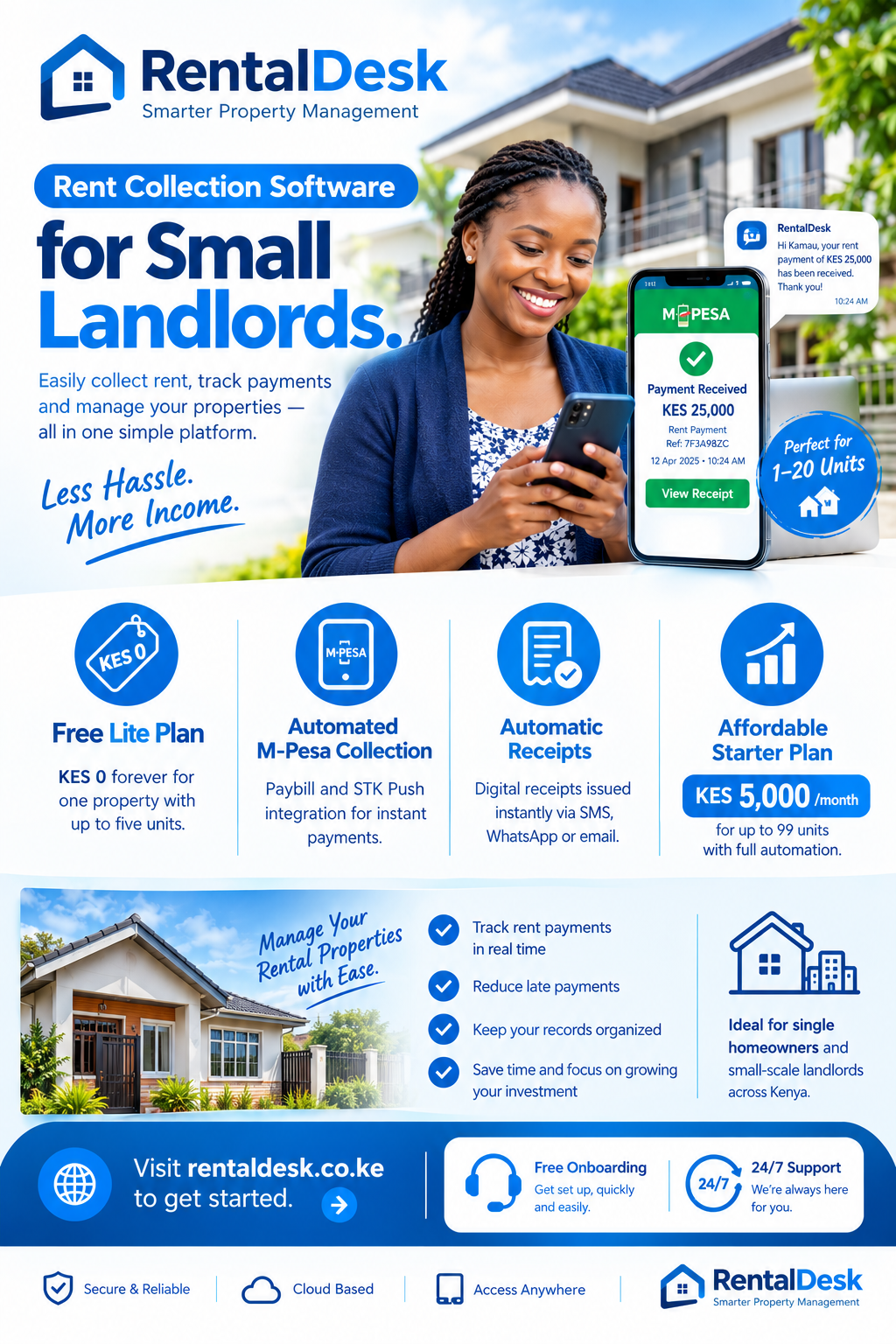
RentalDesk offers a Free Lite plan at KES 0 forever for one property with up to five units and one account owner. The Free Lite plan includes basic tenant records and invoices, balances and basic reports, and manual payment tracking. When the landlord grows beyond five units, they upgrade to the Starter Plan at KES 5,000 per month, which covers up to 99 units and includes M-Pesa collection and reconciliation, SMS reminders, bulk import, staff accounts, and advanced reports.
For a small landlord with five units paying KSh 20,000 each in monthly rent, the total rent roll is KSh 100,000. The Starter Plan at KSh 5,000 represents five percent of the rent roll—a reasonable cost for eliminating hours of manual reconciliation, reducing arrears, and generating professional receipts. And for landlords who stay within the Free Lite plan, the cost is zero.
Other platforms in the Kenyan market charge between KSh 1,500 and KSh 4,500 per month for small-portfolio plans, but they often lack the full M-Pesa integration and reconciliation features that make collection truly automatic. A rent collection software for small landlords that costs KSh 1,500 but still requires manual matching is not cheaper than one that costs KSh 5,000 and reconciles automatically. The true cost is the time saved, not the subscription fee.
How RentalDesk Works for Small Landlords
RentalDesk is built specifically for the Kenyan market, and its features are designed around the practical needs of small landlords.
M-Pesa collection and reconciliation. RentalDesk connects directly to M-Pesa Paybill and STK Push, capturing and reconciling payments automatically.
Automated invoicing and reminders. Invoices generate from the lease record, and the reminder ladder runs without intervention.
Automatic receipts. Digital receipts issue instantly once payment is verified, sent via SMS, WhatsApp, or email.
Partial payment handling. RentalDesk posts partial payments against the open invoice and keeps the balance visible.
Reconciliation queue. Unmatched, partial, and duplicate payments are flagged for review with a full audit trail.
Tenant portal. Tenants can view invoices, download receipts, and see outstanding balances at any time.
Financial reporting. Rent collection reports, arrears ageing, and owner statements generate from the same verified records.
Cloud access. RentalDesk is accessible from anywhere, which makes it suitable for landlords who travel or live abroad.
Role-based access. Even a small landlord can give a caretaker or family member limited access without exposing sensitive financial data.
Handling Partial Payments and Arrears
The rent collection software for small landlords conversation must address partial payments, because they are the most common source of reconciliation error in small portfolios.
A tenant pays half the rent now and half on payday next week. A spreadsheet-based process either records it wrong, records it twice, or misses the second half. RentalDesk handles this perfectly. It posts the partial amount against the open invoice and leaves the balance open; the next payment from the same tenant continues against the same invoice.
Arrears tracking is equally important. RentalDesk provides automated arrears reports, aging analysis showing how long payments have been overdue, and payment behaviour analysis. Tenants who haven’t paid are pinned to the top of the dashboard for quick follow-up. This visibility helps small landlords identify at-risk tenants early and take action before arrears become serious problems.
Common Mistakes Small Landlords Make
The rent collection software for small landlords journey has predictable failure modes.
Using a Till instead of a Paybill. A Till has no account reference field, which makes automatic matching impossible. If automation is the goal, Paybill is the foundation.
Letting tenants use inconsistent references. If tenants type “A12”, “a12”, “A 12”, “Apt 12” and “12A”, matching will fail. Standardise the format and communicate it repeatedly.
Treating the M-Pesa SMS as the ledger. A message proves money moved. The ledger explains why it moved and what remains due. The ledger is the authoritative record.
Reconciling at month-end instead of daily. A payment with a wrong reference sits unresolved for three weeks, and the tenant becomes anxious. Daily reconciliation resolves exceptions while they are fresh.
Choosing software based on price alone. A tool that costs less but does not reconcile automatically is not cheaper. The true cost is the time spent matching payments by hand.
Failing to migrate clean data. If tenant names, unit numbers, and phone contacts are inconsistent, the software will generate inaccurate invoices and receipts. Clean the data before going live.
How to Get Started
Implementing rent collection software for small landlords is straightforward with RentalDesk .
Step 1: Sign up. Visit RentalDesk and create your account. Start with the Free Lite plan if you have five units or fewer.
Step 2: Set up your properties and tenants. Add your properties, units, and tenants to the system. Include tenant contact details, lease agreements, rent amounts, and payment schedules.
Step 3: Standardise the account reference. Decide on a format that identifies the property and the unit. For a small portfolio, a simple unit number may suffice. Communicate it in every lease and every reminder.
Step 4: Configure M-Pesa collection. Connect your Paybill to RentalDesk so that payments reconcile automatically.
Step 5: Set the reminder ladder. Configure the timing and tone of reminders before and after the due date.
Step 6: Run a pilot cycle. Process one full billing period for a single property and count the manual interventions. That number predicts your monthly workload.
Step 7: Go live. Roll out to the full portfolio once the pilot validates the workflow, and review the exception queue each morning.
The Future of Rent Collection for Small Landlords in Kenya
The rent collection software for small landlords landscape is moving in a clear direction. Standing order features allow tenants to authorise recurring payments directly from their mobile wallets. Government tax infrastructure is integrating with property management platforms. And the gap between collection, reconciliation, and compliance is closing.
The small landlords who adopt digital collection early will not simply have tidier records. They will have lower arrears, faster reconciliation, better tenant relationships, and a compliance position that withstands scrutiny. The payment is where that chain begins.
RentalDesk provides the structured platform that makes rent collection software for small landlords work in Kenya—not as an enterprise tool scaled down, but as a solution designed from the ground up for the landlord managing five, ten, or twenty units.
- Rent collection software for small landlords
- Rent collection software for small landlords
- Rent collection software for small landlords
- Rent collection software for small landlords
- Rent collection software for small landlords
- Rent collection software for small landlords
- Rent collection software for small landlords
- Rent collection software for small landlords