
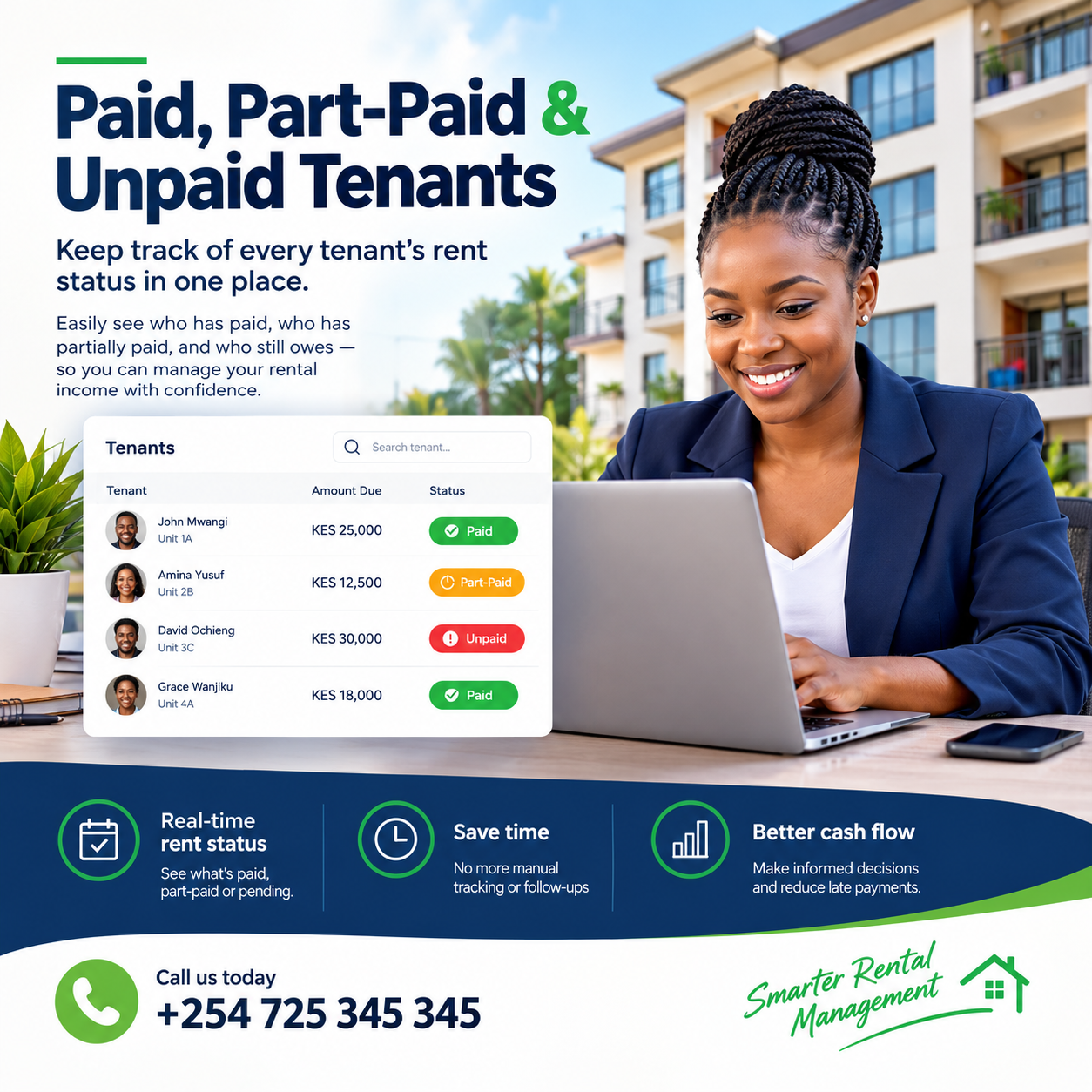
Paid part-paid unpaid tenants — those three words describe the entire daily reality of rental income management in Kenya. Every tenant you will ever have sits in one of exactly three states at any moment: fully paid, partially paid, or not yet paid. Sorting your portfolio into those three states — honestly, daily, and consistently — is the habit that separates landlords who run their income from landlords who hope about it.
The three states sound simple, and they are, but most portfolios never actually maintain them. Records blur the states together, part-payments masquerade as full ones, and “I think they paid” quietly replaces “I know they paid.” A disciplined system for sorting your paid part-paid unpaid tenants ends that drift permanently.
This guide is the complete classification-and-action playbook. We define each state precisely, explain what each one honestly means, and give you the specific protocol each state demands. We also cover the status board that displays all three, the edge cases that trip up honest classification, and the features worth demanding from tools that automate it.
By the end, you will be able to classify, read, and act on your paid part-paid unpaid tenants like a professional operator. Whether you manage four bedsitters in Rongai or forty apartments across Nairobi, the three states never change. Only your speed and confidence in acting on them improve — and that improvement is the everyday promise of running your paid part-paid unpaid tenants as a system rather than a memory exercise.
The Three States, Defined Precisely
The first state is paid, and its definition is stricter than most landlords assume. A tenant is paid only when the full amount due for the period has been received, verified, and receipted — not merely when money of roughly the right size has appeared. That strictness is what makes the paid state meaningful when you sort your paid part-paid unpaid tenants each month.
The second state is part-paid, and it is the most mishandled of the three. A tenant is part-paid when money has arrived against the charge but the full amount has not — and the remainder must stay visible, dated, and collectable. Collapsing part-paid into paid is the single most common corruption when owners sort their paid part-paid unpaid tenants informally.
The third state is unpaid, and it carries a clock. A tenant is unpaid when nothing has been received against the charge — and from that moment, the balance’s age begins counting. Age is what turns the unpaid state from a label into an urgency when you manage your paid part-paid unpaid tenants properly.
The three states are exhaustive and mutually exclusive. At any moment, every account sits in exactly one state, and every state demands a specific next action. That completeness is what makes the discipline of sorting paid part-paid unpaid tenants so powerful once it is honest.
What the states are not matters too. They are not moods, not reputations, and not judgments about tenants — they are factual positions of accounts. That neutrality is the professional posture behind every well-run system for sorting paid part-paid unpaid tenants.
Why the Three-State View Works
The first reason is cognitive: three states fit in a human mind, while forty ledgers do not. A landlord who can say “twelve green, three amber, two red” understands their portfolio in one sentence. That compression is the daily gift of sorting your paid part-paid unpaid tenants into exactly three groups.
The second reason is action: each state points to a different next move. Green needs nothing but a receipt, amber needs a remainder conversation, and red needs a follow-up today. State-linked action is what turns the chore of sorting paid part-paid unpaid tenants into a decision system.
The third reason is honesty: three states expose drift immediately. When ambers multiply or reds age, the trend is visible while it is still fixable. Pattern visibility is the compounding insight that comes from maintaining your paid part-paid unpaid tenants as live classifications rather than month-end recollections.
Green: The Paid State
The paid state is the destination, and it deserves precise handling rather than a casual tick. A tenant earns green only when the full amount has landed, matched to the right unit, and receipted to the tenant. Completing that chain is what makes a green mark trustworthy when you sort your paid part-paid unpaid tenants each month.
The paid state also has an obligation attached: acknowledgment. Receipts issued promptly, thank-you notes sent occasionally, and records updated the same day keep the green state honest on both sides. Tenants who feel confirmed stay confident — the relational dividend of handling your paid part-paid unpaid tenants with care at the finish line.
Green deserves reading over time, too. Consistently green tenants are your portfolio’s assets, and their reliability is worth protecting with renewals, modest increases, and goodwill. That stewardship is the strategic use of the green state within your paid part-paid unpaid tenants picture.
The paid state also anchors the others. Without a strictly defined green, amber and red lose their meaning, and the whole classification collapses into approximation. Rigor at the top is what keeps every sort of your paid part-paid unpaid tenants accurate.
Amber: The Part-Paid State
The part-paid state is where honesty is tested, because amber is uncomfortable in a way green and red are not. A tenant who paid half intends well, and the landlord who records the remainder is doing the harder, correct thing. Recording amber truthfully is the defining habit of owners who sort their paid part-paid unpaid tenants with integrity.
The amber state has three required facts. The amount received, the amount remaining, and the date both entered the record — all three must be visible whenever the account is viewed. Completeness of that kind is what makes the amber entries in your paid part-paid unpaid tenants classification actionable rather than awkward.
Amber demands a conversation, not a silent hope. A courteous message confirming what arrived, stating the remainder, and agreeing a date converts the part-payment into a plan. That conversation is the protocol heart of the amber state within your paid part-paid unpaid tenants routine.
Amber also needs a deadline. A remainder without an agreed date is a wish, and wishes age into disputes precisely when both parties remember them differently. Dated remainders are what turn the amber rows of your paid part-paid unpaid tenants board into commitments both sides can see.
Handled well, amber resolves forward into green most of the time. Most part-payers are honest people mid-cycle, not defaulters in disguise, and the record should reflect that optimism without abandoning rigor. Balanced handling like that is the mature art of managing the amber tier among your paid part-paid unpaid tenants.
Red: The Unpaid State
The unpaid state is where urgency lives, and it deserves speed rather than dread. A red account needs contact within days of going red — not because tenants are untrustworthy, but because early contact is simply easier for everyone. Fast response is the protocol signature of owners who manage their paid part-paid unpaid tenants at the red tier well.
Red also carries age, and age changes the conversation. A red account two days old receives a friendly reminder; a red account five weeks old receives a documented, firmer exchange. Escalation by age is the graduated discipline that separates professional handling of paid part-paid unpaid tenants from blanket pressure.
The red state needs facts attached, not just color. The amount, the age, the contact attempts made, and the responses received all belong on the account as the red period continues. Documented escalation is what gives the red tier of your paid part-paid unpaid tenants board its evidentiary weight if matters ever formalize.
Red has a humane path too. Genuine hardship, honestly disclosed, converts red into an agreed plan — which is amber with a schedule, handled with dignity. That compassionate exit is the mark of experienced owners who manage the red tier of their paid part-paid unpaid tenants without losing good tenants to awkwardness.
Red, finally, is information. Chronic reds, seasonal reds, and unit-specific reds all tell you something about pricing, tenant fit, or communication that deserves attention at the source. Diagnostic reading of the red tier is the strategic layer beneath every serious routine for sorting paid part-paid unpaid tenants.
The Status Board: Reading All Three at Once
The status board is the three states made visible, and it is where classification pays its daily dividend. Every unit appears as green, amber, or red, with counts at the top and detail one tap away. That single view is the working surface of your paid part-paid unpaid tenants system.
The board reads in seconds. Headline counts first — how many green, how many amber, how many red — then the color grid, then anything red demanding today’s attention. That two-minute read is the daily ritual built around your paid part-paid unpaid tenants classification.
Drill-down belongs beneath the board. Tapping any color reveals the units behind it, and tapping any unit reveals the amounts, dates, and history beneath it. Transparency from summary to source is what makes a paid part-paid unpaid tenants board trustworthy rather than decorative.
The board also carries the month’s story. Watch the colors move — reds turning green through the first week, ambers resolving, and stragglers surfacing — and the portfolio’s rhythm becomes visible. That motion picture is the deeper intelligence inside a well-maintained paid part-paid unpaid tenants board.
Classifying Honestly: The Edge Cases
Edge case one is the part-payment that arrives with the remainder promised verbally. The honest classification is amber with the promise noted — never green on the strength of good intentions. Promises recorded as facts are the corruption that honest sorting of paid part-paid unpaid tenants refuses.
Edge case two is the payment received for the wrong period or the wrong unit. The money is real, but it belongs to a different charge, and the current period stays red until the record is corrected. Precision over convenience is what keeps the classification of paid part-paid unpaid tenants truthful at the edges.
Edge case three is the tenant who is “about to pay” indefinitely. Until money lands, the state is red — with friendly contact, documented — because sympathy cannot substitute for classification. That firmness-with-kindness is the discipline that keeps the three states of your paid part-paid unpaid tenants meaningful month after month.
The Action Protocol: What Each State Demands
Green demands one action: acknowledge. Receipt issued, record updated, and — occasionally — appreciation expressed, then the account rests until the next cycle. That light touch is the protocol for the green tier of your paid part-paid unpaid tenants.
Amber demands one action: agree the remainder. Confirm what arrived, state what remains, and set a date both parties can see, in writing. The written remainder is the protocol heart of the amber tier within your paid part-paid unpaid tenants system.
Red demands a ladder, not a leap. A friendly reminder at day three, a firmer documented notice at two weeks, a structured conversation at a month, and formal steps only when the record supports them. The graduated ladder is the protocol spine of the red tier among your paid part-paid unpaid tenants.
Every action lands back on the record. Each message, agreement, and payment updates the state, so the board always reflects the truth as of this morning. That closed loop is what makes the entire protocol of sorting paid part-paid unpaid tenants self-maintaining.
Why 2026 Is the Breakout Year
Three forces make this the year three-state discipline goes fully digital. First, payments are digital by default, so states update themselves the moment money moves. The raw material for automatic sorting of paid part-paid unpaid tenants now exists on every portfolio.
Second, platforms have made the board accessible. Tri-state views, color coding, and drill-down now run from phones at prices any landlord can justify. That accessibility is the adoption story behind everyone managing their paid part-paid unpaid tenants through software this year.
Third, tenants expect it. Instant receipts and visible status are now the baseline of professional landlordship, not differentiators. Meeting that standard is what elevates the routine of sorting paid part-paid unpaid tenants from housekeeping to reputation.
Features to Demand if You Choose Software
Evaluate any platform against a short, demanding checklist. First, demand the tri-state view with color coding and headline counts, because anything more complicated defeats its own purpose. That simplicity is the baseline of tools that genuinely help you sort paid part-paid unpaid tenants.
Second, expect automatic state transitions from M-Pesa reconciliation, so greens and ambers update themselves. Third, look for dated remainders and aging views on amber and red accounts. Fourth, confirm drill-down from every color to the evidence beneath it. Those capabilities together define mature tools for managing paid part-paid unpaid tenants.
Fifth, verify export and data ownership, because your classification history must always be portable. Finally, demand mobile-first usability on affordable phones and weak networks. Usability and portability decide whether your tool for sorting paid part-paid unpaid tenants becomes infrastructure or shelfware.
Choosing Your Setup
Selection starts from honest self-assessment rather than the loudest advert. Portfolio size, part-payment frequency, and how you currently sort accounts should shape the choice between paper, spreadsheet, and platform. The best way to manage your paid part-paid unpaid tenants is always the one you will actually maintain.
Trial with real data, without exception. Classify your actual accounts, run one real month — a green, an amber, and a red — and judge the setup on honest use. One true cycle reveals more than any demonstration of a system for paid part-paid unpaid tenants ever will.
What It Costs
The price ladder is friendly at every level. A paper board costs almost nothing, a spreadsheet costs nothing, and free platform tiers cover small portfolios completely. Any serious routine for sorting paid part-paid unpaid tenants can begin today at effectively zero cost.
Paid software arrives only when automation earns it. Plans across the market run from free tiers to roughly KSh 3,500 monthly depending on portfolio size, with annual billing typically trimming the rate. Against one recovered remainder, any tool that helps you sort paid part-paid unpaid tenants repays itself within the first cycle.
Getting Started This Week
Begin with your true current positions. List every tenant, classify each honestly into green, amber, or red, and confirm the ambers and reds in writing with the tenants concerned. A truthful opening is what makes everything you do afterward with your paid part-paid unpaid tenants trustworthy.
Then run the protocol for one full month. Acknowledge greens promptly, convert ambers into dated plans, and walk the red ladder with documentation at every step. Within one cycle, the three-state routine becomes the quiet operating system behind your paid part-paid unpaid tenants.
Common Mistakes to Avoid
The most common mistake is letting part-payments blur into paid. Every amber recorded as green creates a phantom balance and a future argument, and the habit compounds silently. Strict amber honesty is the first commandment of anyone sorting paid part-paid unpaid tenants over years.
The second mistake is treating red with delay. Unpaid accounts age badly, and the friendly call of day three becomes the difficult conversation of week six. Early, documented contact is what keeps the red tier of your paid part-paid unpaid tenants manageable month after month.
Real Scenarios from Real Portfolios
Picture a landlord in Nakuru with eighteen units whose records mixed paid and partial into one hopeful column. After adopting the three-state system, four phantom greens surfaced in the first month, and the recovered remainders paid for her new tools many times over. That first-month discovery is the classic outcome of honestly sorting paid part-paid unpaid tenants.
Picture a young landlord in Kitengela with three ambers and no system. Dated remainder agreements converted all three to green within six weeks, and the tenants thanked him for the clarity rather than resenting the follow-up. Respect like that is the relational dividend of managing paid part-paid unpaid tenants with structured fairness.
The Road Ahead: 2027 and Beyond
The trajectory points toward states that maintain themselves. Payments will post, ambers will schedule their own remainders, and reds will trigger graduated contact automatically. The future of how landlords manage their paid part-paid unpaid tenants is hands-free — and it is arriving faster than most owners expect.
Prediction is arriving just behind. Systems are learning each tenant’s pattern to flag the amber before it forms and the red before it hardens. Owners who master the three states today will get the most from the intelligent tools emerging across how landlords sort their paid part-paid unpaid tenants in 2027 and beyond.
Frequently Asked Questions
What do the three states actually mean?
Paid means the full amount due has been received, verified, and receipted; part-paid means money has arrived with a visible, dated remainder; unpaid means nothing has been received against the charge. Every account sits in exactly one state at any moment, and each state points to its own next action. That completeness is the whole logic behind sorting paid part-paid unpaid tenants honestly.
How should I handle a tenant who pays half the rent?
Record the amount received, keep the remainder visible with its date, and agree a settlement date in writing with the tenant. The state is part-paid — never paid on the strength of a promise — until the full amount lands and is receipted. That reduce-and-agree protocol is the backbone of handling the amber tier among your paid part-paid unpaid tenants.
When should a red account escalate beyond friendly reminders?
Follow the ladder: a courteous reminder within days, a firmer documented notice at two weeks, a structured conversation at a month, and formal steps only when the documented record supports them. Age and evidence together determine the tone, never frustration. That graduated approach is the professional standard for managing the red tier of paid part-paid unpaid tenants.
Can I run this system on paper or a spreadsheet?
Yes — a per-tenant ledger with three-state marking, dated entries, and a monthly review is a genuine system for small portfolios, and a spreadsheet with filters scales it to about twenty units. Platforms earn their place when you want automatic M-Pesa updates, aging views, and drill-down. The discipline matters more than the tool, but the right software makes sorting paid part-paid unpaid tenants effortless as you grow.
Where should I start if I want everything in one place?
Start with a platform that combines verified listings with the full three-state toolkit, such as rentaldesk.co.ke. Pairing the right tenants with a disciplined routine for sorting paid part-paid unpaid tenants takes you from hoping your accounts are fine to knowing they are — green, amber, and red, every unit, every month.