
Online Rent Collection Kenya: The Complete Guide to Smarter Rental Management
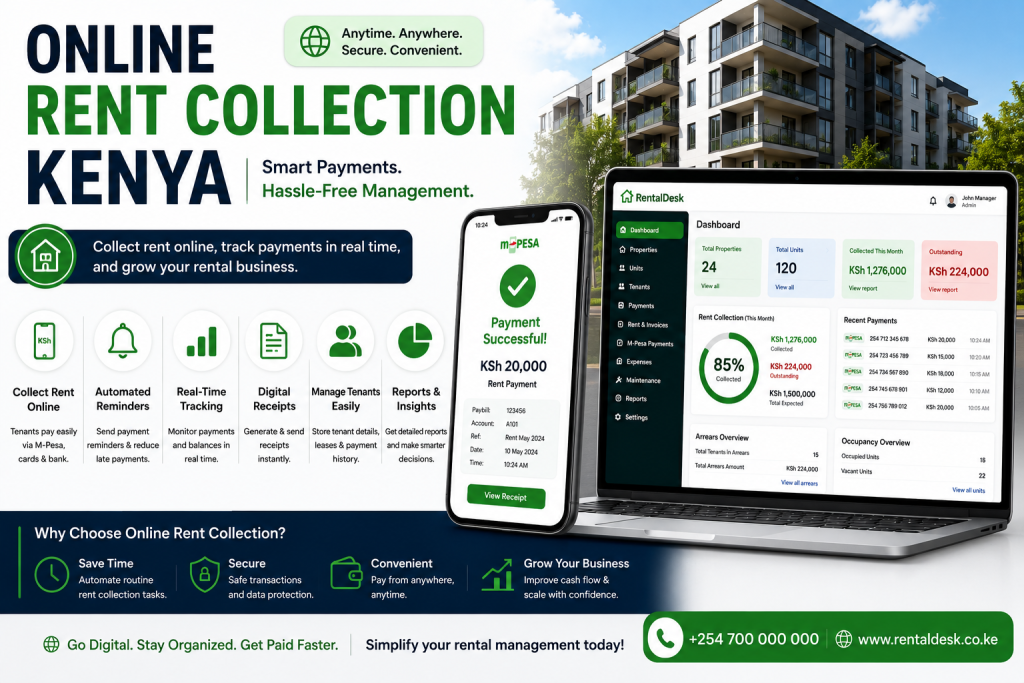
Managing rental property requires more than finding tenants and collecting monthly payments. Landlords and property managers must keep accurate tenant records, monitor rent payments, follow up on arrears, issue receipts, manage maintenance, prepare reports, and maintain good relationships with tenants. As rental portfolios grow, traditional rent collection methods can become time-consuming and difficult to control.
This is why online rent collection Kenya solutions are becoming increasingly valuable for landlords, property managers, real estate agencies, and property companies.
With a digital rent collection system, tenants can pay rent electronically while landlords can monitor payments from a centralized platform. Instead of depending on notebooks, spreadsheets, paper receipts, and manually checking mobile money messages, property owners can manage rental income through a structured digital process.
For Kenyan landlords, online payment technology also makes it possible to create a more convenient experience for tenants. Tenants can receive payment instructions, make payments remotely, receive confirmation, and maintain a digital payment history.
This guide explains everything landlords need to know about online rent collection Kenya, including how it works, its benefits, important features, implementation steps, challenges, and how digital rent collection can transform property management.
What Is Online Rent Collection?
Online rent collection Kenya refers to the use of digital platforms, mobile money, banking services, payment gateways, and property management software to collect rental payments electronically.
Instead of tenants physically delivering cash or landlords manually recording payments, rent can be paid through supported digital channels.
A modern rental payment system can connect:
- Landlords
- Property managers
- Tenants
- Rental properties
- Individual units
- Payment channels
- Tenant accounts
- Rent invoices
- Payment records
- Receipts
- Arrears reports
The objective is to make rent collection faster, easier, more transparent, and less dependent on manual administration.
Why Online Rent Collection Kenya Is Growing
The growth of digital payments has changed the way businesses operate in Kenya. Consumers are already comfortable using mobile phones for financial transactions, purchases, transfers, and bill payments.
For landlords, this creates an opportunity to move rental payments into a more organized digital environment.
A small landlord with five tenants may be able to manage payments manually. However, a property manager with 300 tenants may receive hundreds of transactions every month.
Checking every transaction manually creates several challenges.
The property manager must determine who paid, how much was paid, which unit the payment belongs to, whether the tenant has an outstanding balance, and whether a receipt has been issued.
A digital platform can bring these activities together.
How Online Rent Collection Kenya Works
The process of online rent collection Kenya can vary depending on the payment provider and software platform, but the basic workflow is straightforward.
First, the landlord registers properties and rental units in the system.
Next, tenants are added to their respective units. Each tenant can have information such as their name, phone number, rent amount, lease details, and payment history.
The system then provides the appropriate payment instructions.
When the tenant makes a payment through a supported digital channel, the payment information can be associated with the tenant’s account.
The system can then update the tenant’s payment record and display the remaining balance where applicable.
Depending on the platform, a digital receipt can also be generated.
This creates a complete payment trail from the amount expected to the amount received.
Benefits of Online Rent Collection Kenya
One of the biggest advantages of online rent collection Kenya is convenience.
Tenants do not need to travel to a property manager’s office to pay rent. They can make payments remotely using supported digital payment methods.
Landlords also benefit because they can monitor rental payments without physically handling cash.
Other benefits include:
- Faster payment processing
- Better payment visibility
- Reduced paperwork
- Easier reconciliation
- Automated reminders
- Digital receipts
- Improved tenant records
- Better arrears tracking
- Easier reporting
- Improved cash-flow visibility
These benefits become increasingly important as a rental portfolio grows.
Reduced Dependence on Cash
Cash collection can create unnecessary administrative challenges.
A landlord collecting cash must count the money, issue receipts, store the cash securely, record the transaction, and eventually deposit the money.
Digital payments reduce the need for these physical processes.
With online rent collection Kenya, tenants can pay electronically while landlords maintain digital records of transactions.
This can improve convenience for both parties.
However, landlords should still maintain appropriate financial controls and reconciliation processes to ensure that every payment is properly recorded.
Better Payment Tracking
One of the biggest challenges of manual rent collection is knowing exactly who has paid.
A landlord may receive many payment messages throughout the day. Searching through messages becomes increasingly difficult when managing many tenants.
A digital rental platform can organize payment information according to tenant and property.
For example, a dashboard can show:
| Payment Status | Number of Tenants |
|---|---|
| Fully Paid | 85 |
| Partially Paid | 10 |
| Outstanding | 15 |
| Total | 110 |
This provides an immediate overview of collection performance.
Automated Rent Reminders
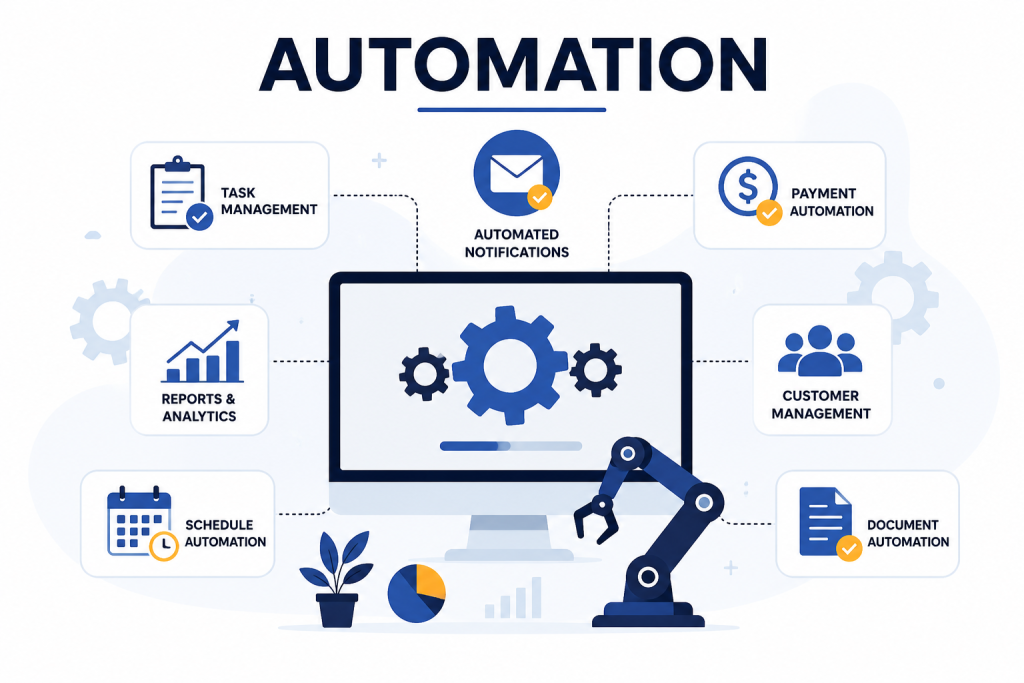
Late rent payments can affect a landlord’s cash flow.
A digital platform can support automated rent reminders.
Tenants may receive reminders before the due date, on the due date, and after the payment becomes overdue.
For example:
Before due date:
“Hello Jane, this is a reminder that your monthly rent of KSh 20,000 is due on the 5th.”
On the due date:
“Your monthly rent is due today. Please make payment using the provided payment instructions.”
After the due date:
“Our records show an outstanding rent balance. Please make payment or contact the property manager if you need assistance.”
Automated reminders reduce the need for property managers to manually contact every tenant.
Managing Rent Arrears
Arrears management is a major part of rental administration.
A landlord may have tenants who pay late, partially pay, or accumulate balances over several months.
A strong online rent collection Kenya platform should help property managers identify these accounts quickly.
The system can categorize tenants according to payment status.
For example:
- Paid
- Partially paid
- Due
- Overdue
- In arrears
This makes it easier to prioritize follow-up.
Instead of discovering arrears when preparing end-of-month reports, property managers can monitor outstanding balances throughout the month.
Handling Partial Payments
Partial payments are common in rental businesses.
Suppose a tenant owes KSh 25,000 but pays KSh 15,000.
A good system should record the KSh 15,000 payment while maintaining a KSh 10,000 outstanding balance.
This is important because simply marking the tenant as “paid” would produce inaccurate information.
With online rent collection Kenya, landlords can maintain detailed payment histories that show every transaction and remaining balance.
This provides better transparency for both landlords and tenants.
Digital Rent Receipts
Receipts provide proof that a payment was made.
Traditional paper receipts can be misplaced or damaged.
Digital receipts can be stored electronically and accessed when required.
A digital receipt may contain:
- Tenant name
- Property name
- Unit number
- Amount paid
- Payment date
- Transaction reference
- Previous balance
- Remaining balance
- Landlord or management company details
This makes record keeping easier and more professional.
Managing Multiple Properties
A landlord with one building may manage rental information manually.
But property managers often oversee multiple buildings in different locations.
A centralized online rent collection Kenya platform can help organize these properties.
For example, a property manager may manage:
- Apartments in Nairobi
- Commercial shops in Mombasa
- Residential houses in Nakuru
- Apartments in Kiambu
- Student accommodation in Eldoret
Each property can have its own units, tenants, rent amounts, and payment records.
The manager can then view individual properties or the entire portfolio from one dashboard.
Tenant Management
Rent collection works best when tenant information is organized.
A digital tenant profile can contain:
- Name
- Phone number
- Email address
- Property
- Unit
- Rent amount
- Deposit
- Lease start date
- Lease expiry date
- Payment history
- Outstanding balance
When tenant information and payment information are connected, property managers can quickly understand each tenant’s account.
For example, when a tenant calls to ask about their balance, the property manager can open their profile rather than searching through multiple documents.
Property Management Integration
The best rental payment systems do more than collect money.
They integrate rent collection with broader property management activities.
These can include:
- Tenant management
- Property management
- Maintenance
- Expenses
- Lease management
- Communication
- Reporting
- Occupancy tracking
This means online rent collection Kenya becomes part of a complete rental management process rather than an isolated payment tool.
Maintenance Management
Property maintenance is one of the most important responsibilities of landlords.
Tenants may report:
- Plumbing problems
- Electrical faults
- Broken doors
- Water leaks
- Roofing problems
- Security issues
- Damaged fixtures
A property management platform can allow these issues to be recorded and tracked.
The landlord can see which requests are new, assigned, in progress, or completed.
Combining maintenance with rent information provides a more complete view of property operations.
Expense Tracking
Rental income is only one side of property management.
Landlords also have expenses.
These can include:
- Repairs
- Cleaning
- Security
- Utilities
- Caretaker wages
- Landscaping
- Management fees
- Property improvements
A digital system can record these expenses alongside rental income.
This allows landlords to understand property performance more accurately.
For example, a building may generate KSh 800,000 in monthly rental income but incur KSh 200,000 in operating expenses.
Understanding both figures provides a clearer picture of financial performance.
Reporting and Analytics
Data is one of the biggest benefits of digital property management.
A good online rent collection Kenya platform can generate reports that help landlords make informed decisions.
Useful reports can include:
- Rent collection reports
- Arrears reports
- Tenant statements
- Property income reports
- Expense reports
- Occupancy reports
- Payment summaries
- Maintenance reports
These reports can help landlords identify trends and understand how their properties are performing.
Online Rent Collection Kenya for Small Landlords
Digital rent collection is not only for large property companies.
A landlord managing ten units can also benefit from automation.
Small landlords often perform many tasks themselves.
They may handle:
- Tenant communication
- Rent collection
- Repairs
- Receipts
- Accounting
- Inspections
A simple digital platform can reduce the amount of administrative work.
The landlord can focus more on maintaining properties and building good tenant relationships.
Online Rent Collection Kenya for Property Managers
Property managers have even greater reasons to adopt digital rent collection.
They may manage hundreds or thousands of units for multiple property owners.
A centralized system can help separate properties and provide reports for individual owners.
For example, an agency managing ten buildings can generate a report for each property.
The property owner can see:
- Expected rent
- Collected rent
- Outstanding balances
- Expenses
- Occupancy
- Maintenance activity
This improves transparency between property managers and property owners.
Online Rent Collection Kenya for Commercial Properties
Commercial properties have different payment structures from residential properties.
A landlord may manage:
- Shops
- Offices
- Warehouses
- Restaurants
- Clinics
- Business premises
Each tenant may have a different rent amount, lease period, and billing schedule.
Digital systems can accommodate these differences and provide organized records.
Commercial landlords can also use digital payment records when preparing financial reports and monitoring tenant accounts.
Improving Tenant Experience
A good rental payment system should benefit tenants as well as landlords.
Tenants want payment processes that are simple, convenient, and transparent.
With online rent collection Kenya, tenants can benefit from:
- Convenient digital payments
- Clear payment instructions
- Payment confirmations
- Digital receipts
- Accessible payment histories
- Easier communication
- Faster issue reporting
When tenants can easily confirm their payments and balances, unnecessary disputes can be reduced.
Security Considerations
Financial and tenant information must be protected.
When selecting an online rent collection Kenya platform, landlords should consider security features such as:
- Secure authentication
- Role-based access
- Data encryption
- Secure payment communication
- Backups
- Activity logs
- Controlled permissions
Property managers should also ensure that employees only have access to information relevant to their responsibilities.
Strong passwords and appropriate account security should be encouraged for all users.
How to Choose the Right Online Rent Collection System
Choosing the right platform requires careful evaluation.
Ask the following questions:
Does it support digital payments?
The system should support the payment methods relevant to your tenants and business.
Can it manage multiple properties?
This is important if you expect your portfolio to grow.
Can it track arrears?
The system should clearly show outstanding balances.
Can it manage partial payments?
This is important because tenants may not always pay the full amount at once.
Does it generate receipts?
Digital receipts improve record keeping.
Does it provide reports?
Financial and property reports are important for decision making.
Is it easy to use?
A system that is difficult to understand may have low adoption.
Does it support tenant communication?
Automated reminders and notifications can improve collections.
Does it offer customer support?
Reliable support can make implementation easier.
How to Implement Online Rent Collection Kenya
Moving from manual processes to digital rent collection should be done carefully.
Step 1: List Your Properties
Create a complete inventory of your properties and units.
Step 2: Register Tenants
Add tenant information and assign each tenant to the correct unit.
Step 3: Enter Rent Amounts
Record monthly rent and any applicable recurring charges.
Step 4: Record Existing Balances
Enter current arrears and credits accurately.
Step 5: Configure Payment Methods
Set up the appropriate digital payment channels.
Step 6: Test the System
Before going live, perform test transactions and verify that records are updated correctly.
Step 7: Inform Tenants
Provide tenants with clear payment instructions.
Step 8: Monitor Payments
Review transactions and investigate unmatched payments.
Step 9: Track Arrears
Use the system to identify overdue accounts.
Step 10: Generate Reports
Use financial and property reports to monitor performance.
Common Mistakes to Avoid
Some landlords adopt digital systems but fail to get the full benefit because implementation is poorly planned.
One common mistake is entering incorrect tenant information.
Another is failing to reconcile existing balances before migration.
Some landlords also choose software based only on price without considering functionality, security, scalability, and support.
Another mistake is failing to train staff.
A digital system is only effective when users understand how to operate it correctly.
Online Rent Collection Kenya vs Manual Rent Collection
Manual rent collection can involve:
Tenant pays → Landlord checks message → Landlord identifies tenant → Payment is recorded → Balance is calculated → Receipt is issued.
A digital process can be:
Tenant pays → Payment is processed → Tenant account is identified → Payment record is updated → Balance is calculated → Receipt is generated → Dashboard is updated.
The second process can reduce repetitive work.
However, automation does not mean landlords should stop monitoring transactions. Exceptions still need to be reviewed and resolved.
Online Rent Collection Kenya vs Excel
Excel is useful for basic record keeping.
However, spreadsheets generally require manual data entry and maintenance.
As the number of properties grows, spreadsheets can become difficult to manage.
A dedicated rental platform can connect tenants, units, payments, balances, receipts, arrears, and reports in one environment.
For a landlord managing a small number of units, Excel may remain useful. For larger portfolios, dedicated property management software can provide stronger automation and organization.
Case Study: A Nairobi Landlord
Consider a landlord managing 40 apartments in Nairobi.
Before adopting digital rent collection, the landlord checks mobile money messages and manually records payments in a spreadsheet.
At the end of the month, the landlord spends several hours calculating outstanding balances.
Some tenants make partial payments, creating additional reconciliation work.
After implementing a digital rental platform, tenants are registered against their units and rent amounts are configured.
Payments can be associated with tenant accounts, while the dashboard shows collection performance.
The landlord can quickly identify overdue accounts and focus follow-up efforts where they are needed.
The biggest improvement is not simply digital payment. It is the organization of information surrounding every payment.
Case Study: A Property Management Agency
Imagine a property management agency managing 500 units for several property owners.
Manual payment reconciliation becomes increasingly difficult.
The agency adopts a centralized digital platform.
Each property is organized separately. Tenants are assigned to units. Rent amounts are configured. Payment records are maintained electronically.
Managers can generate reports for individual properties and owners.
This improves transparency and reduces repetitive administrative tasks.
Future of Digital Rent Collection in Kenya
The future of rental management is increasingly digital.
Property owners are looking for ways to reduce administrative work, improve payment visibility, and manage growing portfolios more efficiently.
Future rental systems are likely to combine digital payments with:
- Artificial intelligence
- Automated tenant communication
- Predictive maintenance
- Digital leases
- Online tenant portals
- Financial analytics
- Smart utility management
- Automated reporting
Artificial intelligence could help property managers identify unusual payment patterns, answer common tenant questions, summarize reports, and predict maintenance requirements.
This means digital rent collection will increasingly become part of a broader property technology ecosystem.
Frequently Asked Questions
What is online rent collection?
Online rent collection allows tenants to pay rent electronically using supported digital payment channels while landlords manage payments through an online platform.
Is online rent collection suitable for Kenyan landlords?
Yes. It can be useful for landlords managing apartments, houses, commercial properties, student accommodation, and larger property portfolios.
Can tenants pay rent using mobile money?
Yes, depending on the payment channels and integration supported by the landlord’s chosen system.
Can digital systems track rent arrears?
Yes. A properly configured platform can record payments and identify outstanding balances.
Can tenants receive digital receipts?
Yes. Many rental management systems can generate digital receipts after payment confirmation.
Can landlords manage several properties?
Yes. Modern systems can support multiple properties, buildings, units, and tenants.
Is digital rent collection secure?
Security depends on the platform, payment provider, implementation, and the controls used by the business. Landlords should choose providers that use appropriate security practices.
Can small landlords use online rent collection?
Yes. Small landlords can benefit from digital payment records, automated reminders, receipts, and better tenant management.
Conclusion
The growth of online rent collection Kenya is changing how landlords and property managers handle rental payments.
Instead of depending on cash, notebooks, paper receipts, and manually updated spreadsheets, property owners can use digital platforms to organize their rental operations.
The benefits go beyond receiving money electronically.
A well-designed system can connect tenants, properties, units, rent amounts, payment records, receipts, arrears, maintenance, expenses, and reports.
This gives landlords better visibility and helps them manage their businesses more professionally.
For landlords with growing portfolios, the value of automation becomes even more obvious. Managing hundreds of payments manually can consume time that could be spent on property maintenance, tenant relationships, business development, and portfolio expansion.
Digital rent collection can reduce repetitive work while creating better financial records.
The key is to choose a solution that matches your business requirements.
Look for a platform that is easy to use, supports the payment methods your tenants prefer, provides accurate reporting, manages arrears, protects data, and can grow with your portfolio.
Property management should not become more complicated simply because the number of rental units increases.
With the right technology, landlords can create a rental business that is organized, transparent, convenient, and easier to scale.
If you are still collecting rent manually, this may be the right time to evaluate digital alternatives. Start by reviewing your current process and identifying where you spend the most time.
Do you manually check payment messages?
Do you update spreadsheets?
Do you calculate tenant balances yourself?
Do you send rent reminders manually?
Do tenants frequently ask for receipts?
Do you struggle to identify arrears?
If the answer to several of these questions is yes, a digital rental platform could significantly improve your workflow.
The goal of online rent collection Kenya is not simply to replace cash with digital payments. The bigger goal is to create a connected rental management system where every payment becomes part of an organized financial record.
For landlords and property managers, this can mean less administrative work, better visibility, improved tenant service, and greater control over rental income.
For tenants, it can mean easier payments, faster confirmations, accessible receipts, and clearer rental records.
As Kenya’s property market continues to embrace technology, digital rent collection will become an increasingly important part of professional property management.
The landlords who adopt efficient systems early can position themselves to manage larger portfolios while maintaining better control over their rental operations.
Make rent collection easier. Organize your properties. Track payments accurately. Reduce arrears and build a smarter rental business with digital property management.