
A multi-property management daily workflow in Kenya becomes harder when every building has its own naming rules, payment notes and follow-up habits. The challenge is not simply having more units. It is finding a consistent way to understand what needs attention across the portfolio.
RentalDesk is designed around rental collections, tenant visibility and daily follow-ups. A shared operating routine helps staff use that view consistently, whether they manage one busy building or several properties for different owners.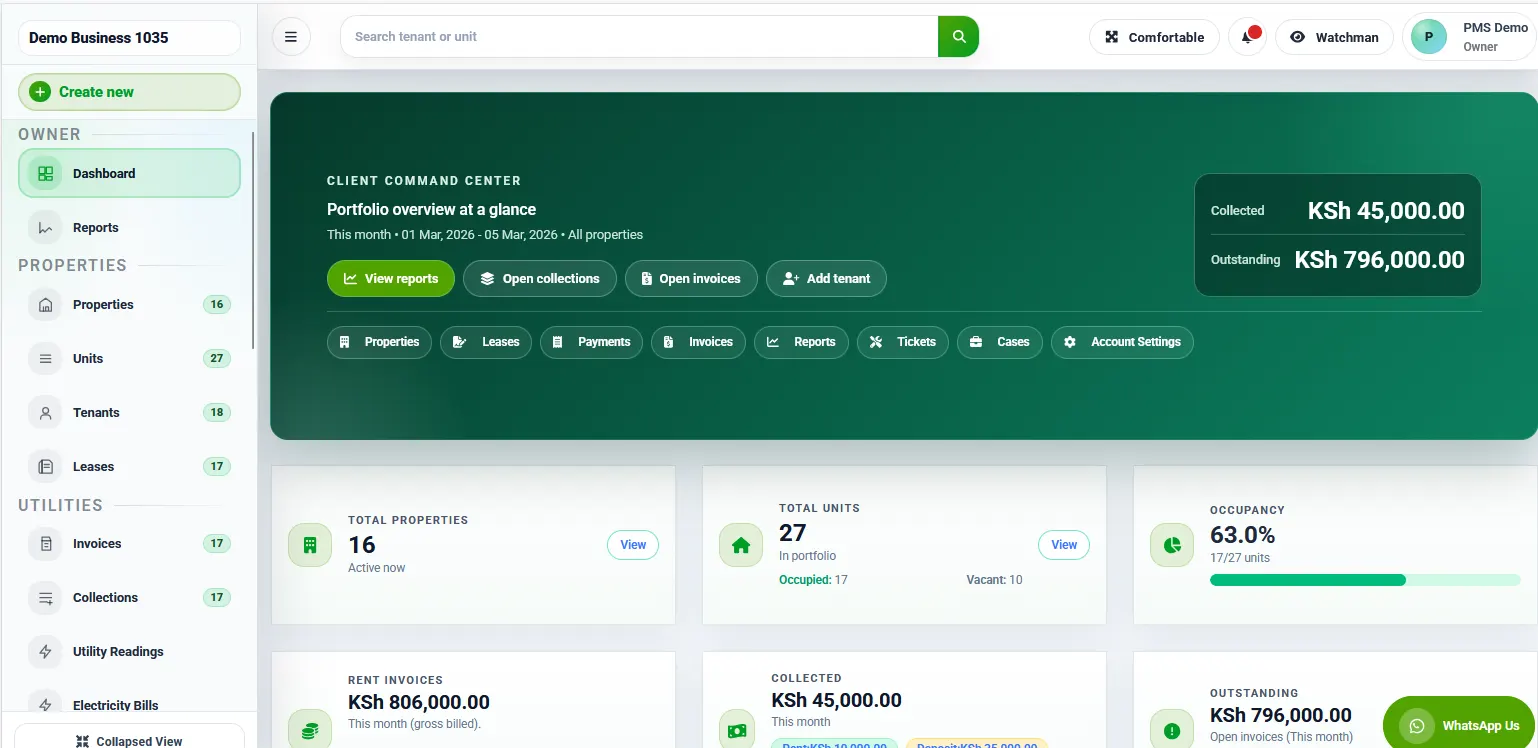
1. Use identifiers that remain clear across buildings
A unit called A1 may be unique inside one property but confusing across five. Agree on a property identifier alongside the unit name and use it consistently in tenant records, payment instructions and working notes.
Check new entries before they become part of the daily workflow. A short naming rule saves staff from interpreting slightly different versions of the same property name each time they review a payment.
2. Separate the portfolio view from property-level work
Start the day by identifying which buildings need attention, then inspect the relevant accounts. A portfolio summary helps you prioritise; the individual record explains the action. Avoid treating a total outstanding figure as enough information to contact every tenant.
For collections, review the M-Pesa payment workflow and identify where transactions require further investigation. Apply the same exception rules across properties.
3. Assign responsibilities with clear boundaries
Define who checks payments, who updates tenant information and who prepares owner reports. Discuss the access each role needs during setup. A caretaker reporting a property issue may not need the same view as the person reviewing the entire portfolio.
Plan absence cover as well. A shared record should let another authorised colleague understand the next step without relying on a private conversation with the usual account handler.
4. Keep site visits connected to the daily task list
Combine suitable inspections into a planned route and note which questions require a visit rather than a call. If the team needs transport support, Dereva’s driver marketplace is an external resource to explore separately.
After a visit, record the outcome against the relevant property or in your agreed operational notes. A trip only closes the task when the next person can understand what was found and what still needs action.
5. Use one handover format for multi-property management daily workflow
- Property and unit concerned.
- Issue or question needing attention.
- Checks already completed.
- Responsible staff member and next review date.
Keep the format short enough that staff use it consistently. Review unresolved items at an agreed time instead of adding another disconnected list.
6. Test multi-property management daily workflow with a sample working day
Before expanding the routine across every building, run a practical trial with two properties. Choose one straightforward account and one account with an unresolved payment. Ask the person covering the desk to identify the next action using only the shared records.
For example, suppose two buildings each contain a unit called A1. One tenant reports a payment without a property reference. The team should check the transaction details and supporting records, keep the payment under review if it remains unclear, and avoid closing either account prematurely. This is a useful multi-property management daily workflow test because it exposes gaps in identifiers and responsibilities.
Repeat the exercise with an owner enquiry and a maintenance follow-up. Check that staff can locate the correct record and explain the handover. Write down where information was missing, then adjust the procedure before the next trial. A successful test should demonstrate a clear action and an accountable owner, rather than merely a populated dashboard.
7. Review multi-property management daily workflow exceptions every week
A weekly review gives the team a chance to spot recurring issues that are not obvious from one day’s collection summary. Count the open questions, note how long they have remained unresolved and identify whether several come from the same building or payment-reference format.
Use the findings to improve one part of the process at a time. If wrong references keep appearing, update the tenant instructions. If inspection notes are missing, improve the handover checklist. Multi-property management becomes more dependable when each recurring problem leads to a small, specific change that staff understand.
Keep the review focused on information your team can act on. A long list of statistics adds little value if nobody knows what to do next. Start with payment exceptions, unanswered enquiries and overdue operational tasks, then agree on the person responsible for each item.
How do owners stay informed?
Maintain separate owner reporting even when the team uses a shared operational desk. RentalDesk’s owner statement workflow supports the connection between property records and landlord-facing reporting. Agree on report scope and frequency during onboarding.
Related guides for multi-property management daily workflow
Use the daily rent arrears review to organise follow-ups, and the landlord statement checklist when preparing owner reports. Together, these routines connect daily multi-property management daily workflow with a clearer month-end review.
Build a daily opening checklist
Start the rent desk with a defined opening check rather than whichever message arrives first. Confirm that the latest available payment records have been reviewed and that yesterday’s unresolved items remain visible. Identify any staff absence that changes who is responsible for the day’s work.
Then compare the list of occupied units with recent move-in or move-out notes. If a unit’s status is uncertain, assign the question for review rather than silently changing the record. A multi-property management daily workflow needs an agreed source for each update, particularly when caretakers and office staff receive information at different times.
Write down a cutoff for the opening review. Transactions received after that point can be handled during a later check without repeatedly restarting the morning summary. The aim is a useful working picture, with its timing understood, rather than a claim that every number is permanently final.
Use an exception register that people can finish
An exception is an item that cannot follow the normal process without further information. Examples include a payment with no clear reference, an invoice questioned by a tenant or an expense missing its supporting document. Keep each exception specific enough that someone knows what would resolve it.
A practical entry includes the property, unit, transaction or record reference, date raised, missing information and responsible person. Add a short next action, such as requesting a payment reference or checking the original invoice. Avoid vague notes such as “follow up” when the next colleague cannot tell what to ask.
Closing the item should be just as clear. Record the evidence reviewed and the action taken, then check the related balance or report. In a multi-property management daily workflow, an exception is resolved when the underlying record is correct and the next person can understand why, not simply when a message has been sent.
Keep tenant changes separate from payment corrections
A change of occupier can affect several records at once. Before changing the tenant attached to a unit, confirm the relevant dates and which records belong to the previous occupier. Do not treat a new contact number as sufficient evidence that the tenancy record should be replaced.
Use a short move-in checklist covering the unit identifier, contact details, agreed billing information and starting records. Keep questions about the previous account visible to the appropriate staff member instead of transferring an unexplained balance to the new occupier. The exact process should follow your agency’s approved arrangements.
This distinction is particularly helpful when the same unit has frequent changes. Your multi-property management daily workflow should preserve the explanation of each change so that an owner enquiry months later can be answered from the records rather than someone’s memory.
Make a practical staff responsibility map
List the recurring tasks down one side of a simple responsibility sheet. These might include reviewing incoming payments, correcting account references, answering tenant enquiries, recording inspection findings and preparing statements. Name a primary person and a cover person for each task.
Agree on which decisions need a manager’s review before action. For instance, the person collecting information about an unexplained entry may not be the person authorised to approve a correction. Describe that boundary in everyday language so staff can apply it without guessing.
Test the map during an ordinary absence. Ask the cover person to follow a task using the shared notes and approved access. If the process depends on a colleague’s private inbox or personal memory, improve the handover. A multi-property management daily workflow should remain understandable when the usual staff member is away.
Review property performance without mixing unlike figures
When comparing buildings, be clear about what each figure means. Rent billed, money received and outstanding balances represent different stages of the process. A building with more units may naturally have larger totals, so totals alone do not explain whether the team’s work is improving.
Start by comparing each property with its own previous review under similar conditions. Note changes in occupancy, billing dates or unresolved transactions that may explain a difference. Discuss the source records before interpreting a movement as success or failure.
Keep the operational conversation focused on actions. If one property has many unclear payment references, improve the instructions or reference format. If inspection follow-ups remain open, review the handover process. Useful reporting supports decisions within the multi-property management daily workflow instead of adding another spreadsheet that nobody maintains.
Introduce the routine in manageable stages
Choose a small group of properties for the first working cycle. Make sure the starting records are checked and the staff involved understand the daily review. Capture questions as they arise, particularly those that reveal different habits between buildings.
At the end of the cycle, ask whether the team can explain a sample tenant balance, find an unresolved payment and prepare the information needed for an owner report. Use these practical demonstrations to decide what needs improvement before adding more properties.
Expansion should follow readiness. Adding every building at once may create more unresolved questions than the team can investigate. A staged multi-property management daily workflow lets you refine naming rules, training notes and responsibilities while the number of records remains manageable.
Questions about your multi-property management daily workflow
Ask to see how a correctly referenced payment and an unclear payment are handled. Request an example of a partial payment and how its remaining balance appears. Explain whether your agency manages one owner or several so the demonstration reflects your reporting requirements.
Discuss what different staff roles can view and change. Ask how information can be exported for your own review, what support is available during setup and which features are included in the plan being discussed. Confirm current details with the provider rather than assuming every feature applies to every account.
Bring anonymised examples of your recurring problems. A demonstration built around an actual workflow question is more useful than a tour of unrelated screens. You should leave understanding the steps your team would take, the records required and the questions that still need an answer.
Keep your multi-property management daily workflow useful
Review the procedure when staff roles change, another property is added or payment instructions are revised. Update the working notes at the same time so the documented process remains consistent with what people actually do. Give staff one clear place to find the current instructions.
Return to the original purpose: identify the account or task requiring attention, understand the evidence and agree on the next action. A successful multi-property management daily workflow connects those three decisions. It does not need a complicated report for every small event, but it does need reliable records that colleagues can follow.
Test your multi-property management daily workflow with a handover
Ask a colleague who did not process yesterday’s payments to pick up today’s review. Can they identify which items are settled, which need evidence and who is responsible for the next call? This simple handover test reveals gaps that a tidy dashboard can hide.
A useful multi-property management daily workflow should explain the decision as well as record the amount. For an unresolved transaction, retain the reference, the issue being investigated and the person assigned to resolve it. For a completed item, record what evidence supported closure. Review these examples together before expanding the routine to another building.
Practical examples for a multi-property management daily workflow
Two tenants use the same unit number
Suppose two different buildings both have a unit called A4. A payment reference that only says A4 is ambiguous. The reviewer should use the building identifier and confirmed tenant account before allocating the payment. The naming convention might combine a short property code with the existing unit number, provided everyone uses the same format.
Record the unresolved reference in the exception register and contact the appropriate person for clarification. Do not allocate it to whichever tenant appears first in the list. In a multi-property management daily workflow, a clear naming rule prevents one building’s collection from appearing in another building’s figures.
A tenant pays in two instalments
Imagine an illustrative invoice of KSh 20,000 followed by confirmed payments of KSh 12,000 and KSh 8,000. After the first payment, the remaining invoice amount is KSh 8,000, assuming no other charges or adjustments. After the second payment is correctly matched, that invoice is settled. The figures are a worked example, not a pricing statement or a tenant record.
Before marking the overall account as clear, check for any other supported charges or earlier balance. The multi-property management daily workflow should distinguish settlement of one invoice from settlement of the entire account. That distinction makes conversations with tenants and owners easier to explain.
A staff member is away
When the usual reviewer is absent, the replacement should find the current list of open items and the notes attached to each. A note such as “call later” is insufficient. Record who needs to be contacted, what information is missing and when the next review is due, using only the information necessary for the task.
The multi-property management daily workflow should have a named backup for time-sensitive checks. The backup can continue routine review while leaving decisions that require approval with the authorised manager. After the usual reviewer returns, a short handover avoids duplicate calls or conflicting explanations.
An owner asks for an update before month-end
Start with a clearly stated reporting period. Explain whether the figures describe invoiced amounts, confirmed collections or outstanding balances, because those measures answer different questions. Review unresolved transactions before presenting a collection total as final.
Use the same source records that support the daily review. A reliable multi-property management daily workflow reduces the need to assemble an unrelated spreadsheet whenever an owner requests information. If an item is still being investigated, identify that limitation plainly and give a realistic date for the next update.
The same exception keeps returning
A weekly check of the multi-property management daily workflow may show that one building regularly receives payments without usable references. Instead of repeatedly fixing each item in isolation, check the payment instructions supplied to tenants. Confirm that the reference format is clear, consistent and practical to enter.
Update the instructions through the team’s normal communication process and observe whether the problem declines. This turns the multi-property management daily workflow into a source of operational improvement. Keep the original evidence and record what changed, so future staff understand the reason for the new procedure.
Build a consistent multi-property management daily workflow
Call 0725345345 or WhatsApp RentalDesk with your number of properties, staff roles and collection methods. Ask for a walkthrough based on the daily decisions your team needs to make.