Mobile app for landlords in Kenya rent tracking has evolved from a convenient luxury into an essential operational tool. In the past, landlords had to be physically present or rely on phone calls from caretakers to know what was happening on their properties. Today, the Kenyan rental market moves too fast for manual oversight. With over 90% of rent payments in urban areas flowing through M-Pesa, the data exists in the cloud. The challenge is capturing it, organising it, and making it accessible on a device that fits in your pocket.
A modern landlord is often managing multiple properties across different neighbourhoods—from Kilimani to Kasarani, and from Kitengela to Westlands—while balancing a full-time job or running another business. Relying on spreadsheets and WhatsApp messages is no longer sustainable. It leads to missed arrears, delayed maintenance, and compliance headaches.
The mobile app for landlords in Kenya rent tracking market has responded to this need with powerful, cloud-based solutions. These platforms put the entire property management dashboard into a mobile interface, allowing landlords to collect rent, reconcile payments, track expenses, and issue receipts from anywhere in the world.
Why Landlords Need a Mobile App in 2026
The case for adopting a mobile app for landlords in Kenya rent tracking is built on the realities of the modern Kenyan rental market. The days of driving to the property to collect cash are over. Tenants expect convenience, and landlords expect real-time visibility.
If you are managing more than three units, manual tracking becomes a liability. A single missed M-Pesa message can result in an untracked payment, leading to a dispute with a tenant or a lost receipt for KRA compliance.
A dedicated mobile app for landlords in Kenya rent tracking solves this by acting as a centralized command center. It provides instant notifications when rent is paid, alerts when a tenant falls behind, and generates KRA-ready financial reports without requiring a laptop.
The Shift from Desktop to Mobile-First Property Management
For years, property management software was built for desktop computers. Landlords had to wait until they got to the office to update their ledgers. This delayed reconciliation and made it difficult to make quick decisions.
The modern mobile app for landlords in Kenya rent tracking is built for a mobile-first world. Caretakers can log maintenance issues from the field using their phones. Landlords can approve expenses while travelling. Tenants can pay rent and download receipts instantly.
This accessibility ensures that the system of record is always up to date. It removes the dependency on a single desktop computer and distributes the operational capability to the people who need it most.
Core Features of a Top Mobile App for Landlords in Kenya Rent Tracking
When evaluating a mobile app for landlords in Kenya rent tracking, it is important to look beyond the basic features. The best apps combine local payment integrations with robust accounting tools.
1. Seamless M-Pesa Integration
This is the non-negotiable foundation. A mobile app for landlords in Kenya rent tracking must integrate directly with Safaricom’s Daraja API. It should support M-Pesa Paybill and STK Push.
When a tenant pays, the app should receive the C2B callback automatically. It must extract the amount, phone number, and account reference, then match the payment to the correct tenant and invoice. Without this, the app is just a digital notebook.
2. Automated Rent Reminders
Chasing rent manually is one of the most stressful parts of property management. The app should allow landlords to set up automated SMS or WhatsApp reminders.
These reminders should be sent before the due date and follow up after the due date if the rent is unpaid. The system should adjust the reminder message based on the tenant’s balance, ensuring that tenants are only asked for what they actually owe.
3. Digital Receipts and Invoicing
Tenants appreciate instant receipts, and landlords need them for compliance. The app should generate digital invoices at the start of the month and issue receipts immediately upon payment.
A high-quality mobile app for landlords in Kenya rent tracking will send these receipts via SMS, email, or WhatsApp, reducing the number of times a landlord is asked to “confirm” a payment.
4. Arrears Tracking and Aging Reports
Knowing who owes money is only half the battle. The app should categorise arrears by age—1 to 7 days, 8 to 30 days, 31 to 60 days, and 60+ days.
This aging analysis helps landlords prioritise follow-up. A tenant who is three days late is likely just forgetful, while a tenant who is sixty days late requires immediate intervention.
5. Tenant and Lease Management
The app should store all tenant contact details, lease agreements, and security deposit records. This ensures that the landlord has critical information on hand during an inspection or a dispute.
With the mobile app for landlords in Kenya rent tracking, lease renewals can be tracked automatically, and alerts can be sent to the landlord before a lease expires.
6. Expense and Maintenance Tracking
Property management is not just about collecting rent; it is also about managing costs. The app should allow landlords or caretakers to log maintenance requests, assign vendors, and record expenses.
This ensures that the true profitability of the property is tracked. Every shilling spent on repairs, security, or utilities should be logged against the correct property.
Overcoming Data Fragmentation with a Mobile App
Data fragmentation is the silent killer of property portfolios. When information is spread across notebooks, M-Pesa messages, and spreadsheets, it becomes impossible to get a clear picture of the business.
Using a mobile app for landlords in Kenya rent tracking centralizes all data. The payment records, tenant details, and maintenance logs are stored in a single secure cloud database.
This means that if a landlord is travelling abroad, they can still log in and see the exact status of every unit. If a tenant disputes a payment, the landlord can pull up the receipt and the M-Pesa transaction code instantly.
How Mobile Apps Handle Partial and Third-Party Payments
In the Kenyan rental market, partial payments and third-party payments are common. A tenant might pay half the rent now and half next week, or a spouse might pay on behalf of the tenant.
A basic mobile app for landlords in Kenya rent tracking must be able to handle these scenarios. It should post partial payments against the open invoice, leaving the balance visible.
For third-party payments, the app should offer a reconciliation queue. This allows the landlord to review payments that do not match the tenant’s registered phone number and assign them to the correct unit manually.
Automating KRA Compliance on Mobile
The Kenya Revenue Authority has increased its oversight of rental income. The Monthly Rental Income (MRI) tax regime requires landlords to file returns and pay tax by the 20th of every month.
A robust mobile app for landlords in Kenya rent tracking should generate financial reports that align with eRITS requirements. It should provide a summary of rent received, allowing the landlord to calculate the 7.5% tax easily.
By keeping accurate records, landlords can avoid penalties, backdated assessments, and the stress of an audit. The app becomes a compliance tool as much as a management tool.
Security and Data Protection in Mobile Property Apps
Security is a primary concern when managing financial data. A top-tier mobile app for landlords in Kenya rent tracking must prioritize data protection.
It should employ encryption for data in transit and at rest. It should require secure authentication, such as a PIN or biometric login.
Furthermore, the app should have role-based access controls. If a landlord delegates tasks to a caretaker, the caretaker should only be able to see rent status and maintenance requests, not the landlord’s overall financial reports.
How RentalDesk Delivers the Ultimate Mobile Experience
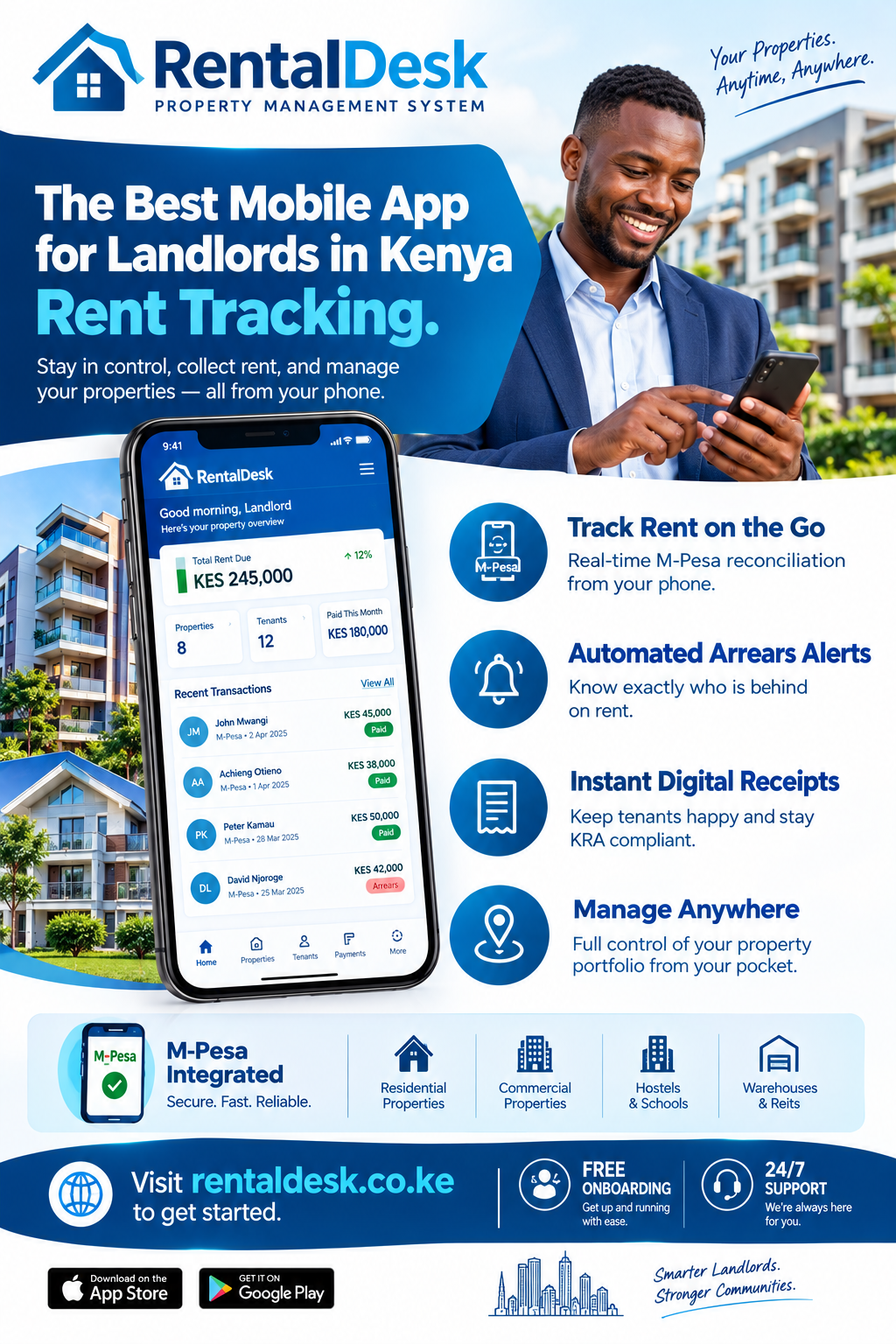
RentalDesk is a cloud-based property management system that serves as a highly effective mobile app for landlords in Kenya rent tracking. Built specifically for the Kenyan market, it combines the power of a desktop system with the convenience of a mobile-first interface.
With RentalDesk, landlords can monitor rent collection, track expenses, and manage tenants from their smartphones. The platform integrates directly with M-Pesa for real-time reconciliation.
Real-Time Dashboards
The RentalDesk dashboard provides an at-a-glance view of the entire portfolio. Landlords can see total rent collected, outstanding arrears, and upcoming vacancies instantly. This data-driven approach allows for faster, more informed decision-making.
Tenant and Landlord Portals
The platform includes a tenant portal where tenants can view invoices, download receipts, and log maintenance requests. It also features a landlord portal, giving property owners a transparent view of their investments.
Pricing Models for Mobile Apps in Kenya
The cost of a mobile app for landlords in Kenya rent tracking varies. Some apps charge a monthly subscription, while others charge per unit.
RentalDesk offers a Free Lite plan for small portfolios (up to 5 units). For larger portfolios, the Starter Plan (KSh 5,000/month) and Estate Manager Plan (KSh 9,500/month) offer advanced features like bulk invoicing, SMS reminders, and multi-property management.
The investment is easily justified by the time saved on reconciliation and the reduction in rent arrears.
Common Mistakes Landlords Make with Rent Tracking Apps
Adopting a mobile app for landlords in Kenya rent tracking is a major step, but it requires a change in habits. One common mistake is continuing to manually record payments in a spreadsheet alongside the app. This defeats the purpose of centralization.
Another mistake is ignoring the app’s automated reminders. Landlords sometimes feel uncomfortable with automated messages, but these reminders are professional and highly effective at prompting on-time payments.
Failing to standardize the account reference format is also a major pitfall. If tenants use different formats for their unit numbers, the app will struggle to auto-reconcile the payments.
Implementing the Mobile App for Landlords in Kenya Rent Tracking
To successfully integrate a mobile app for landlords in Kenya rent tracking into your workflow, start by onboarding your tenants.
Explain to them how to use the Paybill number and the correct account reference.
Then, configure your lease terms in the app. Set the due dates, rent amounts, and escalation clauses.
Once setup is complete, rely on the app’s dashboard for your daily review. Check the M-Pesa reconciliation queue every morning to resolve any unmatched payments.
The Future of Mobile Property Management in Kenya
The reliance on a mobile app for landlords in Kenya rent tracking will only grow. As the real estate market expands and more landlords acquire properties in different counties, the ability to manage operations remotely will be the defining factor of success.
Apps will become smarter, incorporating predictive analytics to forecast vacancies and identify tenants at risk of defaulting. The integration with government systems like eRITS will become seamless, making tax compliance effortless.
The mobile app for landlords in Kenya rent tracking is no longer just a tool for the tech-savvy. It is the standard operating system for the modern Kenyan landlord.