
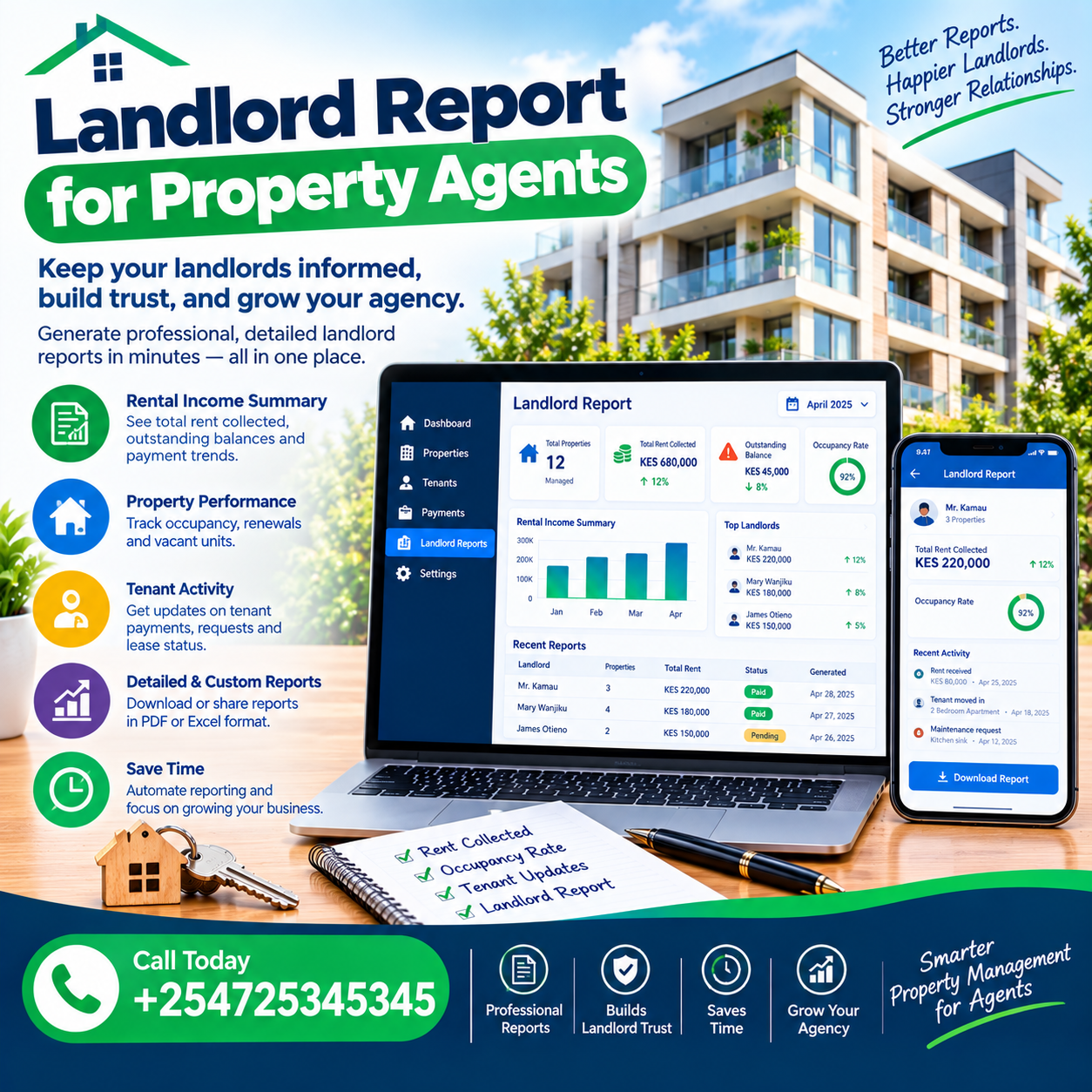
A landlord report for property agents is the single most powerful client-retention tool in the management business — and the most underused. Agencies compete hard to win mandates, yet the ones that keep clients for a decade are almost always the ones whose landlords hear from them consistently, in writing, with numbers that tell a story. When a landlord can see their portfolio’s performance on a page, trust stops being a feeling and becomes a fact.
The pattern across the market is remarkably consistent. Agencies that report poorly lose mandates quietly — the landlord never complains, never explains, and one day simply hands the properties to a competitor who showed up with better information. A disciplined landlord report for property agents routine prevents that exit long before the landlord starts comparing options.
This guide walks you through the complete practice in 2026. We cover what a landlord report actually contains, what property owners judge when they read one, and the section-by-section anatomy of a report that retains clients. We also cover frequency, delivery channels, automation, and the features worth demanding from the tools that produce them.
By the end, you will be able to build a reporting practice that wins mandates as reliably as it keeps them. Whether you manage five units for two landlords or five hundred for forty, the principle never changes. Clients renew agencies that keep them informed, and a professional landlord report for property agents is how that information gets delivered every month.
The timing matters because landlord expectations have risen across the market. Owners today compare agencies on transparency before signing anything, and they judge ongoing value through the reports they receive. The agencies that master the landlord report for property agents in 2026 will keep the clients their competitors lose — quietly, month after month. Best of all, the practice costs almost nothing once the right tools sit beneath it, which is the final argument for adopting a proper landlord report for property agents this year.
What Is a Landlord Report?
A landlord report for property agents is a periodic document that gives a property owner a complete, organized picture of how their portfolio is performing under your management. It gathers financial results, occupancy status, maintenance activity, and market context into one readable summary. Think of it as the monthly conversation between agency and owner, delivered on paper.
The report differs from the documents exchanged in daily operations. Receipts prove individual payments, statements show account balances, and portals display live data. The landlord report for property agents is the curated layer above all of it — the interpretation, the trends, and the recommendations that raw numbers cannot deliver on their own.
That interpretive role is what makes the report strategic rather than administrative. A statement says what happened; a report explains why it happened, whether it is normal, and what should happen next. Owners pay agents partly for judgment, and a thoughtful landlord report for property agents is where that judgment becomes visible.
The report also serves the agency internally. Preparing it forces a monthly review of every property, which catches problems early and keeps the whole team aligned on portfolio health. Discipline like that is a hidden operational benefit of running a consistent landlord report for property agents practice.
What Landlords Actually Judge
Understanding what owners look for is the first step in building reports they value. Landlords rarely audit every figure; instead, they read for signals about whether their property is in safe hands. Three signals dominate, and every strong landlord report for property agents is designed around them.
The first signal is money moving correctly. Rent collected, arrears handled, and remittances arriving on schedule tell the owner their income is being actively protected. The financial section is therefore the heart of any landlord report for property agents, and it must be accurate to the shilling.
The second signal is the property being watched. Maintenance handled, inspections done, and problems fixed before they escalate show the owner their asset is receiving genuine care. Owners forgive slow markets far more easily than neglect, which is why the maintenance section of a landlord report for property agents carries so much retention weight.
The third signal is honest communication. Owners trust agencies that report bad news promptly with context and a plan, and they quietly distrust the ones whose reports always look suspiciously perfect. Candor, consistently delivered, is the deepest trust engine inside a professional landlord report for property agents.
Why 2026 Is the Breakout Year
Three forces are converging to make 2026 the year disciplined reporting becomes standard across Kenyan agencies. First, landlord sophistication has risen with the market. Owners now compare agencies on reporting before signing mandates, and they judge ongoing value through the documents they receive — which makes a strong landlord report for property agents a competitive weapon rather than a courtesy.
Second, the data has become effortless to gather. M-Pesa records, maintenance logs, and occupancy registers live in systems now, so report preparation no longer means a weekend of reconstruction. Automation has turned the landlord report for property agents from a project into a byproduct of well-run operations.
Third, delivery has become free and instant. PDFs travel through WhatsApp and email in seconds, and owner portals put every report on the client’s phone the moment it is ready. Distribution — once the excuse for irregular reporting — is a solved problem for any agency producing a landlord report for property agents today.
The Types of Landlord Reports That Matter
The monthly performance report is the backbone. It summarizes the month’s collections, arrears, occupancy, and maintenance for each property, with the owner’s remittance confirmed inside. Consistency at that rhythm is what defines a professional landlord report for property agents practice.
The quarterly review goes deeper. It adds trends across three months, compares performance against previous periods, and raises strategic questions — rent reviews, renovations, or repositioning. Owners genuinely value that wider lens, and it is where a landlord report for property agents demonstrates judgment rather than just administration.
The annual statement closes the year. It aggregates the full twelve months — total income, total expenses, occupancy averages, and major works completed — and sets the agenda for the year ahead. Tax season and portfolio planning both draw on the archive that a landlord report for property agents routine builds automatically.
Event reports complete the set. A major repair, a tenant dispute, an insurance matter, or a notice received each deserves its own immediate written summary, even mid-month. Owners remember the agencies that told them first, which is the reputational power of the event layer inside a complete landlord report for property agents system.
The Anatomy of a Great Landlord Report
A report earns trust through completeness and clarity, so know exactly what to include. Every strong landlord report for property agents carries the same core anatomy, section by section. Use this checklist to audit your own reports before your landlords do.
The summary comes first — a short opening that states the month’s headline in three or four sentences. Collections, occupancy, and any issues worth attention, stated plainly before the detail begins. Owners who read nothing else still absorb that opening, which is why the summary is the most crafted part of any landlord report for property agents.
The financial section follows, with rent charged, rent collected, arrears position, and expenses itemized. Every figure should reconcile to the statement and the remittance that accompanies it. Internal consistency is the credibility test that separates a real landlord report for property agents from a newsletter.
The occupancy section lists every unit with its status — occupied, vacant, under notice, or turning over — with days-on-market attached to any vacancy. The maintenance section then covers work completed, work pending, and costs incurred, with photos where significant. Together, those two sections prove the property is genuinely watched, which is the core promise of a landlord report for property agents.
The recommendations section closes the report. Rent review suggestions, planned maintenance, and strategic opportunities — each stated with a reason and, where relevant, a cost. Agencies that advise retain clients; agencies that merely report get compared on fees, which is the strategic difference a forward-looking landlord report for property agents creates.
The Financial Section: Getting the Money Right
Money is the section landlords read most closely, so precision here is non-negotiable. Rent charged, rent received, and the gap between them should sit side by side, with every variance explained in a line. That transparency is the financial spine of a trustworthy landlord report for property agents.
Arrears deserve their own subsection. The balance, its age, the action taken, and the plan going forward — stated without drama but without hiding. Owners can handle slow payers; what they cannot handle is discovering them late, which is why candor defines the arrears treatment in a landlord report for property agents.
Remittance closes the financial story. The amount due to the owner, the disbursement date, and the channel, stated plainly beside the collections they came from. A financial section that ends with money on the way is the rhythm every landlord report for property agents should establish month after month.
Occupancy and Portfolio Health
Occupancy is the owner’s second-biggest concern, and the report should make it instantly visible. Every unit’s status, any vacancies with their duration, and the steps underway to fill them belong in this section. Visible occupancy management is the reassurance layer of a complete landlord report for property agents.
Vacancies deserve specific treatment. Days empty, cost to date, marketing channels active, and viewings conducted — each figure converts anxiety into information. Owners seeing that machinery working rarely push for fee reductions, which is the quiet commercial value of the vacancy detail inside a landlord report for property agents.
Renewals belong here too. Leases approaching expiry, renewal conversations underway, and tenants confirmed for another term all shape the owner’s income outlook. A report that surfaces renewals early gives the owner time to think — a courtesy that defines a professional landlord report for property agents.
Maintenance and Property Condition
Maintenance is where owners feel the agency’s care most directly, and the report should prove it. Work completed during the period, with costs and photos, comes first. Then work pending, with quotes, approvals sought, and expected completion dates — the full pipeline visible, which is the transparency standard of a professional landlord report for property agents.
Condition observations add preventive value. A roof approaching the end of its life, drainage that needs attention before the rains, or a water system worth upgrading — flagged early, with cost estimates. Owners consistently rank that foresight among the most valuable things an agency does, and it is the advisory depth that elevates a landlord report for property agents above mere bookkeeping.
The history completes the section. Cumulative maintenance spend for the year beside the same figure last year gives the owner context for every line item. Trends like those turn complaints about costs into conversations about strategy — the mature framing that a well-built landlord report for property agents makes natural.
Market Commentary and Rent Advice
Numbers tell an owner what happened, but context tells them whether it was good. A short market section — local rents, demand levels, and comparable properties — turns your data into judgment. That advisory layer is what makes a landlord report for property agents worth reading beyond the arithmetic.
Rent recommendations deserve careful, evidence-based framing. Proposed adjustments, supported by market comparisons and the tenant’s payment history, give the owner a decision rather than a pitch. Agencies that advise well on rent reviews earn increases in revenue and trust simultaneously — the twin dividend of a landlord report for property agents that leads with evidence.
Frequency and Delivery Channels
Consistency beats intensity in reporting, so set a rhythm and keep it. Monthly reports for managed portfolios, quarterly reviews for strategy, and event reports the moment something significant happens. That three-speed structure is the delivery standard of a professional landlord report for property agents practice.
Delivery should follow the client, not the agency’s preference. A branded PDF through WhatsApp reaches most owners instantly, email carries the formal copy, and portals give the self-service option for those who prefer to look themselves. Multi-channel delivery is the accessibility guarantee inside a complete landlord report for property agents system.
Timing within the month matters too. Reports delivered in the first week, alongside or just after remittance, ride the natural rhythm of the landlord relationship. Owners learn to expect them, and expected reports become the habit that anchors every landlord report for property agents routine worth running.
Automating the Reporting Process
Manual report preparation is the reason most agencies report irregularly, and automation removes that excuse entirely. Modern platforms compile the financial, occupancy, and maintenance sections directly from live operational data. The landlord report for property agents of 2026 is generated, not assembled.
The workflow runs itself once records are current. Collections post through M-Pesa reconciliation, maintenance closes through tickets, and occupancy updates through the register — then the report compiles on schedule. That build-from-operations design is what distinguishes a genuine landlord report for property agents tool from a template.
Branding and personalization complete the layer. Every report carries the agency’s identity, each owner’s name and properties, and a summary written in plain language. Automated output that still feels personally addressed is the craft standard of a mature landlord report for property agents implementation.
Scheduling closes the loop. Set the date, set the channel, and every owner receives their report without anyone touching a keyboard. Hands-free consistency is the operating promise of a proper landlord report for property agents system — and it survives holidays, staff changes, and busy seasons alike.
Features to Demand in 2026
If you are choosing tools, evaluate against a demanding checklist. First, demand generation from live data rather than manual entry, because reports built from operations cannot drift from the truth. That live connection is the foundation of a trustworthy landlord report for property agents.
Second, expect branded, professional PDFs with per-owner personalization produced in batch. Third, look for the full section coverage — financials, occupancy, maintenance, and recommendations — drawn from one system. Those capabilities together define a mature landlord report for property agents tool rather than a mail-merge template.
Fourth, confirm multi-channel scheduling across WhatsApp, email, and portal access. Fifth, verify the archive — every report ever sent should be searchable by owner, property, and date. Evidence depth like that is what turns the reporting habit into a permanent asset for any agency using a landlord report for property agents system.
Finally, mind the practical basics. The tool must work on affordable phones and weak networks, and it must export your records completely whenever you ask. Usability and portability decide whether your landlord report for property agents becomes infrastructure or shelfware.
Choosing the Right Tools
Selection starts from your portfolio rather than the loudest advert. Portfolio size, team structure, and where your current reporting hurts most should shape the choice. The right landlord report for property agents setup fits your operation exactly.
Trial with real data, without exception. Generate reports for three actual landlords, deliver them through real channels, and watch how the documents land. One honest cycle reveals more than any demonstration of a landlord report for property agents ever will.
What It Costs
Pricing in this category is friendly, because reports ride on systems you may already be running. Standalone generators start free, while full property management platforms include the capability in plans ranging from free tiers to a few thousand shillings monthly. Against a single retained mandate, any landlord report for property agents investment repays itself immediately.
The honest framing is that reporting is rarely a separate purchase. It is a capability inside the operations, statements, and portfolio tools covered across our other guides. That bundling makes the reporting layer one of the highest-value features per shilling in the entire property software market.
Getting Started the Right Way
Begin with one landlord rather than the whole book. Choose your most engaged client, build their report to the full anatomy above, and deliver it personally with a short explanation of the new rhythm. A warm, well-received pilot is the foundation of every successful landlord report for property agents rollout.
Then standardize and scale. Template the structure, automate the data, and schedule the delivery for every managed property on your books. Within one quarter, the practice becomes the visible identity of your agency — the quiet reputation engine of a disciplined landlord report for property agents.
Common Mistakes to Avoid
The most common mistake is reporting only good news. Owners discover problems eventually, and the discovery always costs more than the disclosure would have. Candor, delivered early with a plan, is the trust discipline of a professional landlord report for property agents.
The second mistake is irregularity. Reports that arrive for three months and then disappear read worse than no reports at all, because they suggest the agency’s attention follows its convenience. Consistency is the entire deal — the standard that separates agencies running a genuine landlord report for property agents practice from those that dabble.
Real Scenarios from Real Agencies
Picture a letting agency in Kilimani serving twenty-five landlords through occasional phone calls. After adopting a monthly reporting rhythm, mandate renewals stopped being negotiations and started being confirmations — and two competitors’ pitches failed against the agency’s documented track record. Retention like that is the classic first-year outcome of a disciplined landlord report for property agents practice.
Picture a property manager in Nakuru who lost a mandate to an agency promising lower fees. Eighteen months later, the landlord returned — the cheaper agency never sent a single report, and the owner had spent the year unable to answer basic questions about their own property. The returned client became the agency’s most vocal referral, proof of the compounding value of a landlord report for property agents done consistently.
The Road Ahead: 2027 and Beyond
The trajectory points toward reports that increasingly advise rather than describe. Prediction is arriving — systems that forecast next month’s collections, flag rent review windows, and recommend maintenance before failures happen. The landlord report for property agents of 2027 will feel less like a document and more like a consultant’s memo.
Integration is deepening alongside it. Portals, reports, statements, and approvals are converging into single flows where the owner experiences one continuous conversation with their portfolio. The connected future is already visible across the landlord report for property agents market, and it will accelerate.
Frequently Asked Questions
How often should agents send landlord reports?
Monthly performance reports are the professional standard for managed portfolios, with quarterly reviews for strategy and event reports the moment something significant happens. Consistency matters more than frequency, and automation makes that consistency effortless — which is the core promise of a landlord report for property agents system.
Is a landlord report the same as a rental statement?
No — a statement shows account activity (charges, payments, balances), while a report interprets the whole picture: financials, occupancy, maintenance, and recommendations. The strongest agencies produce both from the same records, with the landlord report for property agents carrying the strategic layer the statement cannot.
Do reports really help retain mandates?
They are among the strongest retention tools that exist in agency work, because landlords renew relationships they can see and quietly leave ones they cannot. Agencies with disciplined reporting describe mandate renewals becoming confirmations rather than negotiations — the documented pattern behind every professional landlord report for property agents routine.
Can small agencies manage this without heavy software?
Yes — start with a disciplined template and monthly delivery for your most important clients, then let tools carry the load as the book grows. Free and low-cost tiers make professional reporting accessible at any size. The habit matters more than the platform, but the right landlord report for property agents tooling is what makes the habit survive growth.
Where can agents find tools that produce these reports?
Start with platforms that combine verified listings with agency-grade reporting, such as rentaldesk.co.ke. Pairing genuine business with a disciplined landlord report for property agents routine takes your agency from hoping clients stay to knowing they will — report by report, mandate by mandate, year after year.