
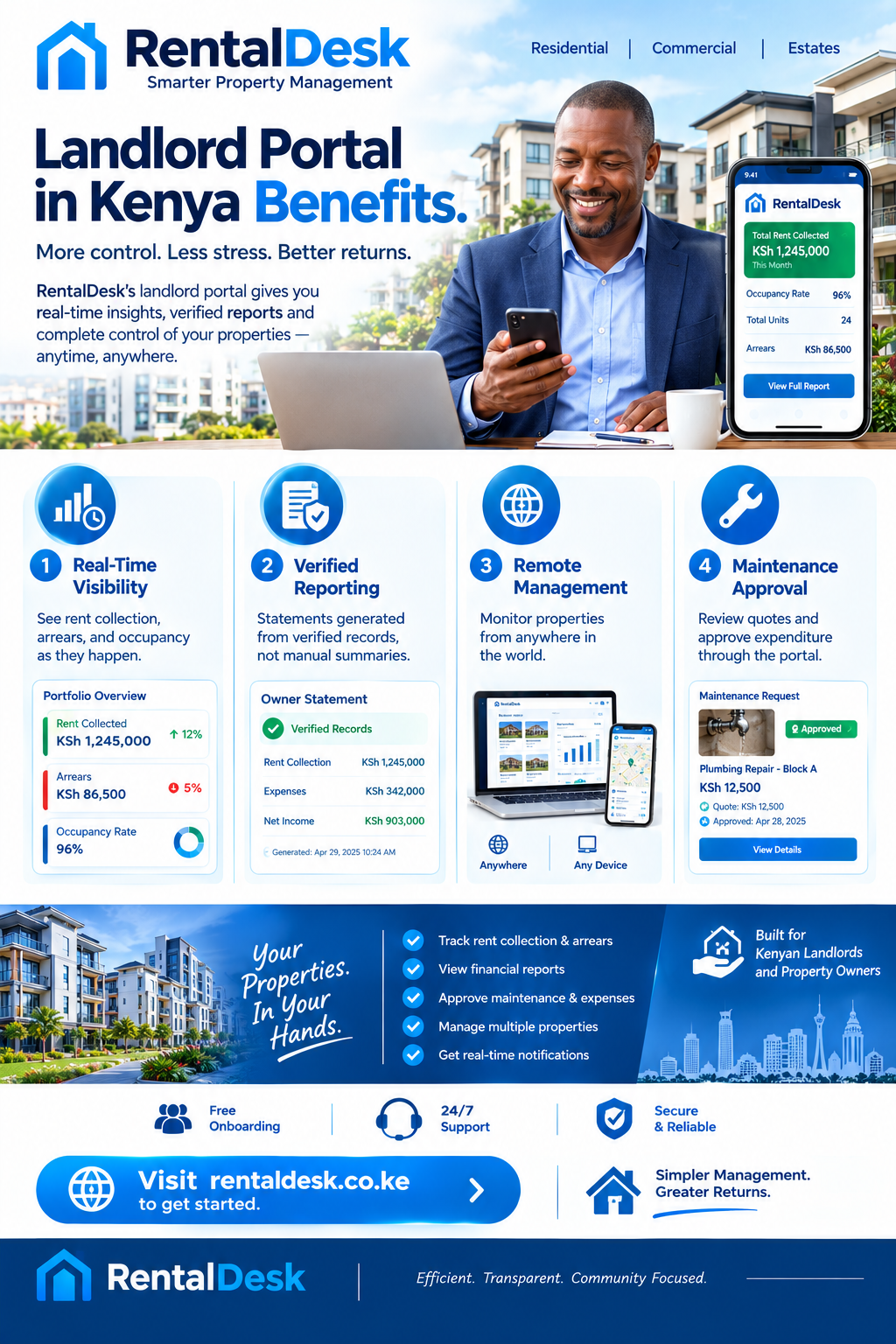
Landlord portal in Kenya benefits are easy to list and easy to underestimate. Most landlords initially think of a portal as a convenience feature — a login page where they can see a balance without calling the agent. That framing misses what the portal actually changes. It changes the landlord from a person who receives information when someone remembers to send it into a person who can retrieve information whenever they need it.
It changes the agent from a person who spends hours compiling statements into a person who releases reports that already exist. And it changes the relationship between owner and manager from one of periodic reassurance into one of continuous, verifiable transparency. A landlord portal in Kenya benefits conversation should therefore begin not with features but with the operational gap the portal closes.
Why Landlords in Kenya Need Their Own Portal
The case for understanding landlord portal in Kenya benefits rests on a structural problem in Kenyan property management. Many landlords do not live near their properties. They live in another town, another county, or another country entirely. Kenya’s diaspora community is a significant investor in rental property, and an estimated share of remittances is directed toward real estate. Distance is the defining condition.
When the landlord is distant, information flows through intermediaries. A caretaker sends updates on WhatsApp. An agent emails a statement when asked. A relative visits the property occasionally and reports what they saw. Each of these channels is informal, intermittent, and difficult to verify. The landlord receives reassurance but not evidence.
A landlord portal replaces the informal channel with a structured one. The landlord logs in and sees the same records the agent sees. The landlord portal in Kenya benefits conversation is therefore not about convenience. It is about giving the owner direct, real-time access to verified data rather than second-hand summaries.
Benefit One: Real-Time Visibility Into Rent Collection
The first and most immediate benefit is real-time visibility into rent collection. Without a portal, a landlord learns that rent was collected when the agent sends a report, which may be weekly, monthly, or whenever the landlord asks. With a portal, the landlord sees payments as they are reconciled.
RentalDesk connects the landlord portal directly to M-Pesa collection through Safaricom’s Daraja API. When a tenant pays rent via Paybill or STK Push, the system matches the payment to the correct tenant and unit, updates the balance, and reflects the change in the landlord portal within seconds. The landlord sees which units have paid, which are part-paid, and which remain unpaid — without waiting for a report and without calling anyone.
This visibility has a practical consequence. A landlord who can see that three of ten units have not paid by the fifth of the month can act early. A landlord who learns about the same problem at month-end has lost three weeks of recovery time.
Benefit Two: Arrears Visibility Without Chasing
The second benefit is arrears visibility. Most landlords discover arrears late because nobody tells them until the situation is serious. A tenant falls behind by a month, then two, and the agent manages the follow-up internally without escalating to the owner. By the time the landlord learns of the problem, the arrears are substantial.
A landlord portal in Kenya benefits picture includes aging analysis visible to the owner. The portal shows total arrears, arrears by property, and arrears by age bucket — 1–7 days, 8–30 days, 31–60 days, and 60+ days. The landlord can see at a glance whether the arrears are recent and recoverable or old and at risk of write-off.
This transparency changes the conversation between landlord and agent. Instead of the landlord asking “are there any problems?” the landlord can ask “why is unit B4 showing sixty days overdue?” The conversation becomes specific, evidence-based, and faster to resolve.
Benefit Three: Verified Reporting, Not Reassurance
The third benefit is the shift from reassurance to verification. In many agency relationships, the landlord receives a monthly statement that summarises collections, expenses, and the net remittance. The statement is prepared by the agent, and the landlord has no way to verify it independently.
With a landlord portal, the statement is generated from the same verified records the agent uses. The landlord can drill down from the summary to the individual transaction. If the statement shows KSh 450,000 collected, the landlord can see the payments that make up that figure. If an expense of KSh 30,000 is deducted, the landlord can see the invoice and the approval.
RentalDesk generates landlord statements from the same verified records used for daily operations. When a landlord queries a figure, the agent can point to the source record rather than reconstructing an explanation. This is one of the most significant landlord portal in Kenya benefits because it removes the suspicion that inevitably builds when reporting cannot be independently checked.
Benefit Four: Remote Property Management for Diaspora Landlords
The fourth benefit is remote management. For diaspora landlords, the portal is not a convenience. It is the difference between managing the property and hoping someone else is managing it.
A diaspora landlord in London, Toronto, or Dubai can log in and see rent collected, arrears outstanding, occupancy status, open maintenance requests, and the financial position of each property. They can approve expenditure, review statements, and communicate with the property manager through the same system. They no longer need to travel to Kenya to know what is happening.
RentalDesk is cloud-based, allowing landlords to access property data from anywhere — on desktop or mobile — with encrypted storage and regular backups. For the many Kenyan property owners living abroad, this is the single most valuable landlord portal in Kenya benefits outcome: the ability to oversee a Kenyan property with the same confidence as one next door.
Benefit Five: Reduced Administrative Burden on the Agent
The fifth benefit is often overlooked because it accrues to the agent rather than the landlord. When a landlord has portal access, the agent stops fielding routine queries. The landlord checks the balance themselves. The landlord downloads the statement themselves. The landlord sees the maintenance status without asking.
This frees the agent to focus on operational work: collecting arrears, coordinating repairs, onboarding tenants, and managing the portfolio. The agent’s time is spent on work that produces value rather than on answering questions whose answers are already recorded.
For agencies managing multiple landlords, the effect compounds. A landlord portal in Kenya benefits analysis should include the agent’s time savings as a legitimate benefit, because the agency’s efficiency ultimately benefits the landlord through lower management costs and better service.
Benefit Six: Faster Decision-Making on Maintenance and Expenditure
The sixth benefit is speed of decision-making. Maintenance decisions often stall because the landlord is unavailable or the information is insufficient. A caretaker reports a leaking roof. The agent takes photos. The photos are sent to the landlord via WhatsApp. The landlord asks for a quotation. The agent obtains a quotation and sends it. The landlord approves. Days have passed, and the repair has not started.
With a landlord portal, the maintenance request, the photographs, the quotation, and the approval can all move through one system. The landlord receives a notification, reviews the evidence, approves the expenditure, and the agent proceeds. The repair starts sooner, the tenant is happier, and the property suffers less damage.
RentalDesk allows tenants to submit maintenance requests with photos, agents to assign vendors and upload quotations, and landlords to review and approve through the portal. Every step is timestamped and logged. This structured workflow is among the most practical landlord portal in Kenya benefits because it converts a slow, fragmented process into a fast, documented one.
Benefit Seven: Stronger Landlord-Agent Relationships
The seventh benefit is relational. Most landlord-agent disputes originate from a perception gap. The landlord feels uninformed. The agent feels distrusted. Each side interprets the other’s behaviour through a lens of suspicion.
A portal closes that gap by making information equally available to both parties. The landlord does not need to ask for updates because updates are available on demand. The agent does not need to defend themselves against vague accusations because the records speak for themselves. The relationship shifts from one of periodic reassurance to one of continuous transparency.
A landlord portal in Kenya benefits conversation should treat this as a first-order benefit, not a soft one. Agency relationships that survive long-term are those where the landlord trusts the agent’s records. The portal is what makes that trust verifiable rather than aspirational.
Benefit Eight: Better Portfolio-Level Oversight
The eighth benefit is portfolio oversight. Landlords with multiple properties across different locations often struggle to see the whole picture. Each property may be managed by a different agent, each producing reports in a different format. Comparing performance across properties becomes difficult.
A landlord portal with portfolio-level visibility allows the landlord to see all properties in one place. Which building has the highest occupancy? Which has the highest arrears? Which is producing the best net return after expenses? These questions can be answered from the dashboard rather than from a manual consolidation of reports.
RentalDesk provides a unified dashboard where landlords can view all properties at a glance, monitor rent collection per building, track occupancy and vacancies, compare revenue performance, and analyse arrears per location. Properties can be grouped by region — Nairobi, Mombasa, Kisumu, Nakuru, Eldoret, Kiambu, Kajiado — allowing the landlord to compare performance across markets. This portfolio view is one of the strongest landlord portal in Kenya benefits for owners with more than a handful of units.
Benefit Nine: Compliance and Tax Readiness
The ninth benefit is compliance. The Kenya Revenue Authority’s Electronic Rental Income Tax System requires landlords to register each rental property, input details including property type, rent, and tenant information, and file monthly returns by the 20th of the following month. Tax is computed automatically at 7.5% of gross rent.
To file accurately, the landlord needs reliable records of gross rent received, expenses incurred, and arrears outstanding. A landlord portal that displays this information in real time gives the landlord the data required for filing without reconstructing it from bank statements and M-Pesa messages.
RentalDesk generates KRA-ready reports from the same verified records used for daily operations. The landlord can access the rent register, the collection summary, and the expense statement through the portal. This compliance readiness is an increasingly important landlord portal in Kenya benefits as the regulatory environment tightens.
Benefit Ten: Continuity When the Agent Changes
The tenth benefit is continuity. When a landlord changes agents, the handover is often chaotic. Records are incomplete. Tenant information is missing. Deposits are difficult to trace. The new agent spends weeks reconstructing the position.
A landlord portal that holds the property record independently of the agent changes this. The landlord retains access to the historic data even if the agency relationship ends. When a new agent is appointed, the landlord can grant them access to the same records rather than starting from scratch.
A landlord portal in Kenya benefits analysis should include this continuity value. The portal is not just a reporting tool for the current agent. It is the landlord’s own record of the property, held independently of whoever happens to be managing it at any given time.
What the Landlord Portal Should Include
The landlord portal in Kenya benefits conversation becomes concrete when we list what the portal should actually contain. A well-designed landlord portal should include a dashboard showing total rent expected, collected, and outstanding for the period. It should include a list of all properties with occupancy status, rent status, and arrears balances. It should include a tenant list for each property showing who is in occupation and their payment status. It should include an arrears aging report showing balances by age bucket.
The portal should allow the landlord to download monthly statements, view individual transactions, and see the supporting documentation for expenses. It should allow the landlord to approve maintenance expenditure above a defined threshold. It should allow the landlord to communicate with the agent through the portal, so that instructions and responses are logged rather than lost in WhatsApp.
RentalDesk provides these capabilities as part of its landlord portal. Landlords can view rent collected, expenses, profit statements, arrears, and payment histories. The portal is connected to the same ledger used for daily operations, so the figures the landlord sees are the figures the agent works with.
How to Get Started
Implementing a landlord portal in Kenya benefits strategy is straightforward with RentalDesk .
Step 1: Sign up. Visit RentalDesk and create your account. Choose a plan that matches your portfolio size.
Step 2: Set up properties and units. Add your properties, units, and tenants to the system, including lease agreements, rent amounts, and payment schedules.
Step 3: Configure M-Pesa collection. Connect your Paybill so that payments reconcile automatically and the portal reflects the correct balance.
Step 4: Configure landlord access. Create landlord portal accounts and scope access to each owner’s properties.
Step 5: Configure maintenance approval thresholds. Define what expenditure requires landlord approval and route those requests through the portal.
Step 6: Run a pilot. Roll out to one landlord before the full portfolio and gather feedback on usability.
Step 7: Go live. Roll out to all landlords and monitor portal usage and feedback.
Common Implementation Mistakes
The landlord portal in Kenya benefits journey has predictable failure modes. Migrating unclean data — disputed balances, inconsistent unit numbering, outdated tenant records — means the portal displays wrong information from day one, and landlords stop trusting it. Failing to connect the portal to M-Pesa reconciliation means the balance the landlord sees does not match the balance the agent holds. Skipping landlord onboarding means landlords do not know the portal exists or how to use it. Failing to enforce role-based access means a landlord can see another landlord’s properties, which is both a data protection violation and a breach of confidentiality.
How RentalDesk Delivers Landlord Portal Benefits
RentalDesk is built specifically for the Kenyan market, and the landlord portal is a core feature of the platform. The portal provides real-time visibility into rent collection, arrears, and occupancy. It generates monthly statements from the same verified records used for daily operations. It supports remote access from anywhere in the world, which is essential for diaspora landlords. It enables maintenance approval workflows with full documentation. It provides portfolio-level oversight for landlords with multiple properties. It generates KRA-ready reports for eRITS filing. And it enforces role-based access so that each landlord sees only their own properties, with every action logged.
The portal is connected to the same ledger used by the agent. When a payment is received, the portal reflects it. When a maintenance request is submitted, it enters the same workflow used by the property team. When a statement is generated, it is available for download. Nothing is duplicated, and nothing falls through the gap between the landlord-facing view and the internal record.
The Future of Landlord Portals in Kenya
The landlord portal in Kenya benefits landscape is moving in a clear direction. Government tax infrastructure is integrating with property management platforms, which means landlord records will increasingly connect to compliance reporting. Standing order features allow tenants to authorise recurring payments directly from their mobile wallets, which simplifies reconciliation. And landlords increasingly expect digital transparency as a baseline rather than a bonus.
The landlords who adopt a portal early will not simply have easier access to information. They will have stronger relationships with their agents, faster decision-making on maintenance, better compliance positions, and a property record that survives changes in management.
RentalDesk provides the structured platform that makes landlord portal benefits in Kenya a practical reality — not as a login page that shows a balance, but as a complete owner-facing system that connects landlords, agents, tenants, and records in one verified ledger.
- Landlord portal in Kenya benefits
- Landlord portal in Kenya benefits
- Landlord portal in Kenya benefits
- Landlord portal in Kenya benefits
- Landlord portal in Kenya benefits
- Landlord portal in Kenya benefits
- Landlord portal in Kenya benefits
- Landlord portal in Kenya benefits
- Landlord portal in Kenya benefits
- Landlord portal in Kenya benefits