How to prepare landlord financial year report in Kenya is the annual discipline that separates a landlord who knows the true performance of their portfolio from one who is guessing. Year-end is when scattered errors show up in tax filings and owner reports. A missed M-Pesa reconciliation from March, a mis-coded repair from July, or an arrears balance that was never written off will all surface at the same time, and they will all demand an answer. The report is not a formality.
It is the document that tells you whether the property made money, whether the tenants paid, whether the expenses were justified, and whether the figures you will file with the Kenya Revenue Authority can withstand scrutiny. A properly structured how to prepare landlord financial year report in Kenya process turns that annual scramble into a controlled close.
Why the Financial Year Report Matters in Kenya
The how to prepare landlord financial year report in Kenya conversation has acquired urgency because the compliance environment has changed. The Draft Income Tax (Residential Rental Income Tax) Regulations 2026 propose making registration on the Electronic Rental Income Tax System mandatory for landlords within the monthly rental income band. A person subject to residential rental income tax is required to keep records necessary for the determination and ascertainment of the tax in accordance with the Tax Procedure Act, 2015. The report is the evidence that those records exist and that they reconcile.
There is also a commercial reason. Landlords use financial reports for decision-making, while investors and committees use them for transparency and governance. A landlord who cannot produce a credible year-end report cannot demonstrate the performance of the portfolio to a lender, a co-investor, or a property owner on whose behalf the property is managed. The how to prepare landlord financial year report in Kenya process is therefore not only about tax. It is about credibility.
What the Financial Year Report Should Contain
The how to prepare landlord financial year report in Kenya process must begin with the report set, because the value of the exercise is determined by what it produces. A complete landlord financial year report for a Kenyan portfolio contains several interconnected documents.
The income statement. This shows revenue against expenses for the year. Income includes rent and, where applicable, service charge income. Expenses include maintenance, repairs, utilities, insurance, management fees, and other operating costs. Each expense should be coded to the right property and category so that reports can be run by property, period, and type.
The collection report. This shows what was due against what was collected. It answers the question that every landlord eventually asks: how much of the rent I billed actually arrived?
The arrears ageing report. This categorises outstanding balances by age. It shows which balances are recent and recoverable, and which are old and at risk of write-off. Documenting any amounts you will write off or pursue legally is part of the close, and a consistent policy protects you if owners or auditors ask questions.
The balance sheet. This shows the assets and liabilities of the portfolio at year-end. Tenant deposits are liabilities with a long tail — held for years, refundable on exit less legitimate deductions, and a frequent source of dispute where records are thin.
The rent register. This is the foundational document for compliance. It lists every tenant, every property, and every payment received in the period. It should reconcile to the bank statements and M-Pesa records.
Any landlord researching how to prepare landlord financial year report in Kenya should confirm that the accounting system generates all of these from the same verified records, not from separate spreadsheets that must be manually reconciled.
Step One: Reconcile Every Payment
The how to prepare landlord financial year report in Kenya process begins with reconciliation, because no report is reliable until every payment has been matched. Every M-Pesa and bank line item must be matched to tenant invoices or estate income. Unmatched items should be investigated — not carried blindly into the new year.
This is where most manual year-end processes fail. A payment from March that was never matched because the tenant used the wrong account reference sits in a suspense account. A duplicate payment that was never reversed distorts the collection figure. A payment from a spouse or employer that was never attributed to the correct tenant leaves that tenant showing as a defaulter when they have actually paid.
RentalDesk captures M-Pesa payments automatically through Safaricom’s Daraja API with Instant Payment Notification callbacks. When a tenant pays via Paybill or STK Push, the system extracts the amount, phone number, account reference, and transaction ID, matches the reference to the correct tenant and unit, credits the account, and generates a receipt. Unmatched payments enter a reconciliation queue for review rather than being auto-posted. By the time year-end arrives, the reconciliation work has already been done month by month. Any landlord mastering how to prepare landlord financial year report in Kenya should treat monthly reconciliation as the foundation of a clean annual close.
Step Two: Run the Arrears Ageing and Decide on Write-Offs
The how to prepare landlord financial year report in Kenya process must address arrears, because arrears are the largest single source of landlord losses in Kenya. Arrears should be categorised into buckets of 1–7 days, 8–30 days, 31–60 days, and 60+ days. The longer a balance sits unpaid, the lower the probability of full recovery.
At year-end, the landlord must decide which arrears are still recoverable and which should be written off. A balance that has been outstanding for more than a year and has no realistic prospect of recovery is a write-off. A balance that is 60 days old and under active follow-up is a receivable. The decision should be documented, because consistent policy protects the landlord if an auditor or owner asks why a particular balance was written off.
RentalDesk categorises arrears by age with dashboard visibility by tenant, unit, property, and owner. Payment behaviour analysis shows average days late, frequency of late payment, and the arrears trend for each tenant. At year-end, the landlord can review the ageing report and make informed decisions about which balances to pursue and which to write off. Any landlord studying how to prepare landlord financial year report in Kenya should understand that the write-off decision is part of the close, not an afterthought.
Step Three: Verify Expense Coding and Classification
The how to prepare landlord financial year report in Kenya process must verify that every expense has been coded correctly. Repairs, utilities, and management fees must sit in the right property and category. Mis-coded entries distort per-property profitability.
A repair to a leaking roof in Kilimani should be coded to the Kilimani property, not to the portfolio as a whole. A caretaker’s salary that covers three buildings should be apportioned across those three buildings. A service charge expense should be separated from a rent expense, because they are different cost centres.
RentalDesk records expenses against the correct property, unit, owner, or statement period. The system generates income versus expense reports per property and per portfolio. At year-end, the landlord can see which properties are profitable and which are not, and the figures are defensible because they are drawn from coded records rather than estimates. The how to prepare landlord financial year report in Kenya exercise becomes an exercise in verification rather than reconstruction.
Step Four: Produce Owner-Ready Reports
The how to prepare landlord financial year report in Kenya process should produce reports that owners can read and understand. Whether the landlord self-manages or uses an agent, the report is the document that demonstrates what happened to the money.
A strong owner report includes an income statement showing rent collected and expenses incurred, a collection summary showing what was due versus what was received, an arrears ageing report, and a balance sheet showing deposits held and other liabilities. These reports should be generated per property or per client, not as a single consolidated total that hides the performance of individual assets.
RentalDesk generates owner statements from the same verified records used for daily operations. The figures that appear in the owner report are the figures that appear in the ledger, the rent register, and the arrears ageing report. Nothing has to be rebuilt, and nothing is inconsistent between documents. Any landlord researching how to prepare landlord financial year report in Kenya should confirm that the platform supports per-owner reporting, because consolidated totals are not enough when multiple owners are involved.
Step Five: Align With KRA Requirements
The how to prepare landlord financial year report in Kenya process must align with the tax regime that applies to the landlord. The Monthly Rental Income regime applies to resident persons earning gross annual residential rental income between KSh 288,000 and KSh 15 million. The tax rate is 7.5% of gross rent received, and it is a final tax. No expenses are deductible.
For landlords under MRI, the year-end report is primarily a record-keeping exercise. The tax is paid monthly, and the annual report demonstrates that the monthly filings were accurate. For landlords above the KSh 15 million threshold, or those who have elected out of MRI, the annual income tax regime applies. Under that regime, expenses are allowable, and the year-end report must include a profit and loss account that supports the deductions claimed.
Commercial rental income is taxed under the annual regime regardless of the amount. Where a property has both residential and commercial tenants, the income must be apportioned. Any landlord working through how to prepare landlord financial year report in Kenya for a mixed portfolio should separate the two income streams from the first day of the year, because retroactive separation is far more difficult than ongoing classification.
RentalDesk classifies each unit as residential or commercial and applies the correct reporting treatment. The platform generates the rent register, the collection summary, and the expense statement from the same verified ledger. When KRA requires inspection, the landlord produces records that already exist rather than reconstructing them from bank statements and WhatsApp messages.
Step Six: Retain the Supporting Records
The how to prepare landlord financial year report in Kenya process is only as good as the records behind it. KRA expects landlords to maintain records necessary for the determination and ascertainment of the tax. In practice, that means a rent register, eTIMS-compliant receipts, lease agreements, and bank or M-Pesa transaction logs.
A landlord should maintain a dedicated folder containing signed lease agreements, bank statements showing rent deposits, and KRA payment receipts for every unit. Clear paper trails resolve queries quickly if the tax office questions the gross figures declared on an iTax profile.
RentalDesk stores lease agreements, receipts, payment records, and expense documentation against the tenancy. Every action is logged with a timestamp and user identification. The audit trail is complete, which means the year-end report can be supported by evidence rather than assertion.
Common Mistakes in Preparing a Landlord Financial Year Report
The how to prepare landlord financial year report in Kenya journey has predictable failure modes. Starting the close in the last week of the year is the first. Reconciliation that should have been done monthly becomes a compressed exercise that inevitably misses items. Failing to reconcile unmatched M-Pesa payments is the second. A payment with a wrong reference that sits unresolved distorts the collection figure and the arrears figure. Mis-coding expenses is the third.
A repair coded to the wrong property makes that property look more profitable than it is and another look less. Ignoring partial payments is the fourth. A tenant who paid KSh 15,000 against a KSh 25,000 charge is not fully paid, and the report must reflect the balance. Failing to document write-off decisions is the fifth. A balance that disappears from the report without explanation will raise questions at audit.
How RentalDesk Simplifies Financial Year Reporting
RentalDesk is built specifically for the Kenyan market, and financial year reporting sits at the centre of the platform.
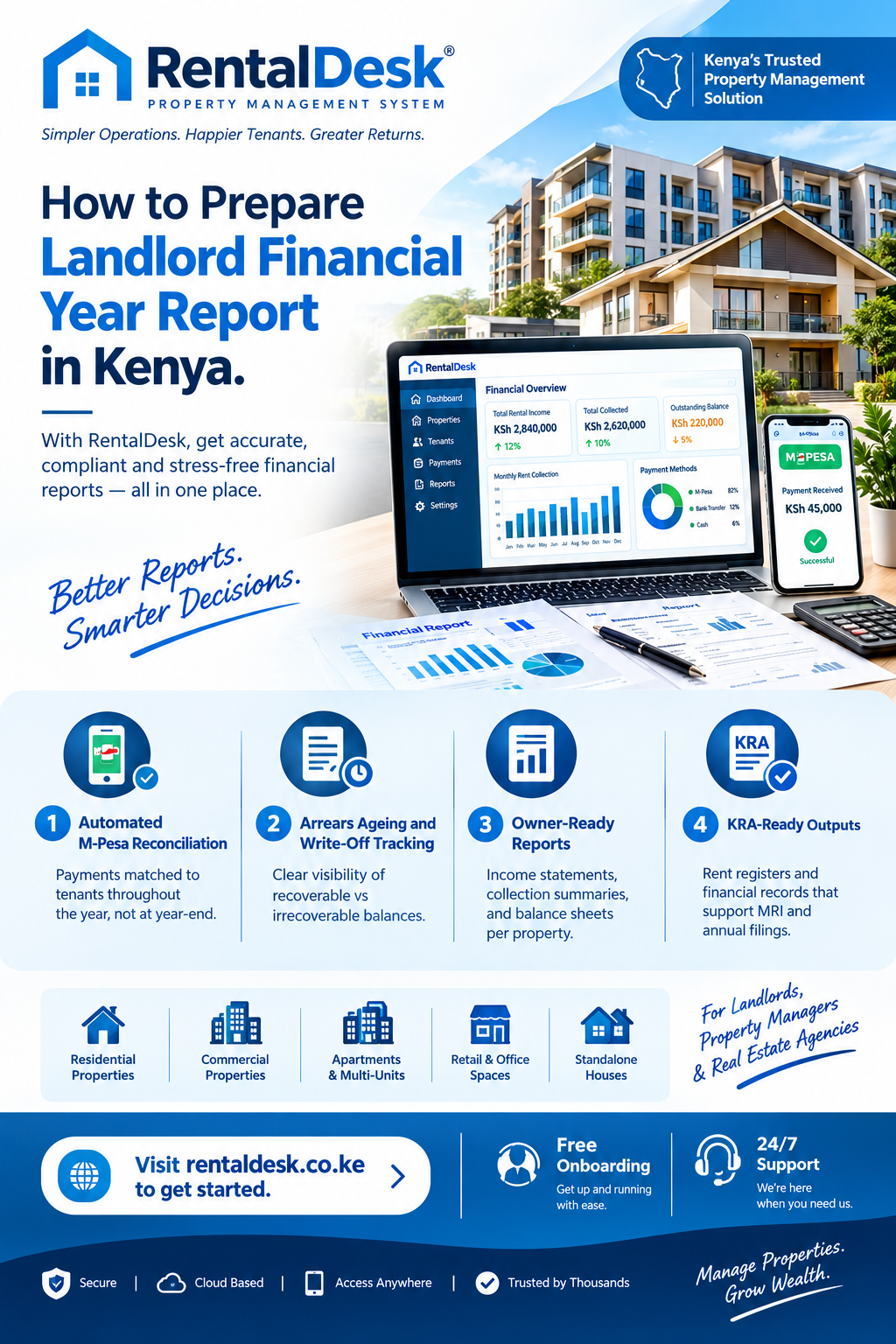
Automated M-Pesa reconciliation. Payments are matched to the correct tenant and invoice in real time, so the year-end reconciliation is a review rather than a reconstruction.
Arrears ageing. Balances are categorised by age (1–7, 8–30, 31–60, 60+ days) with dashboard visibility by tenant, unit, property, and owner.
Expense coding. Every expense is recorded against the correct property and category, so per-property profitability is accurate.
Owner-ready reports. Income statements, collection summaries, and balance sheets are generated per property or per client from the same verified ledger.
Rent register. The foundational compliance document is generated automatically and reconciles to the payment records.
KRA-ready outputs. The figures needed for MRI filing and annual income tax returns are drawn from the same verified records used for daily operations.
Role-based access. Landlords, property managers, and accountants see only what their role requires, with every action logged.
Cloud access. RentalDesk is accessible from anywhere, which matters for diaspora landlords closing the year from abroad.
How to Get Started
Implementing a structured how to prepare landlord financial year report in Kenya process is straightforward with RentalDesk .
Step 1: Sign up. Visit RentalDesk and create your account. Choose a plan that matches your portfolio size.
Step 2: Classify your properties. Record each unit as residential or commercial, and confirm your tax regime.
Step 3: Configure M-Pesa collection. Connect your Paybill so that payments reconcile automatically throughout the year.
Step 4: Record expenses as they occur. Configure expense categories and code every cost to the correct property.
Step 5: Review the arrears ageing quarterly. Do not wait until year-end to identify balances that need write-off decisions.
Step 6: Generate the year-end report set. Produce the income statement, collection report, arrears ageing, balance sheet, and rent register from the same ledger.
Step 7: File and retain. Use the reports to support your KRA filing and retain the supporting records for audit.
The Future of Landlord Financial Reporting in Kenya
The how to prepare landlord financial year report in Kenya landscape is moving toward continuous reporting rather than annual reconstruction. The eRITS platform integrates with eCitizen and GavaConnect, with future integration with Ardhisasa anticipated to boost compliance through geo-referencing and data verification of rental properties. Monthly filing obligations mean the annual report is increasingly a summary of records that have already been filed month by month.
The landlords who adopt structured accounting early will not simply have tidier year-end reports. They will have lower write-offs, faster recovery, better owner relationships, and a compliance position that withstands scrutiny. RentalDesk provides the structured platform that makes the landlord financial year report in Kenya a controlled, evidence-based close rather than an annual scramble.
- How to prepare landlord financial year report in Kenya
- How to prepare landlord financial year report in Kenya
- How to prepare landlord financial year report in Kenya
- How to prepare landlord financial year report in Kenya
- How to prepare landlord financial year report in Kenya
- How to prepare landlord financial year report in Kenya
- How to prepare landlord financial year report in Kenya
- How to prepare landlord financial year report in Kenya