
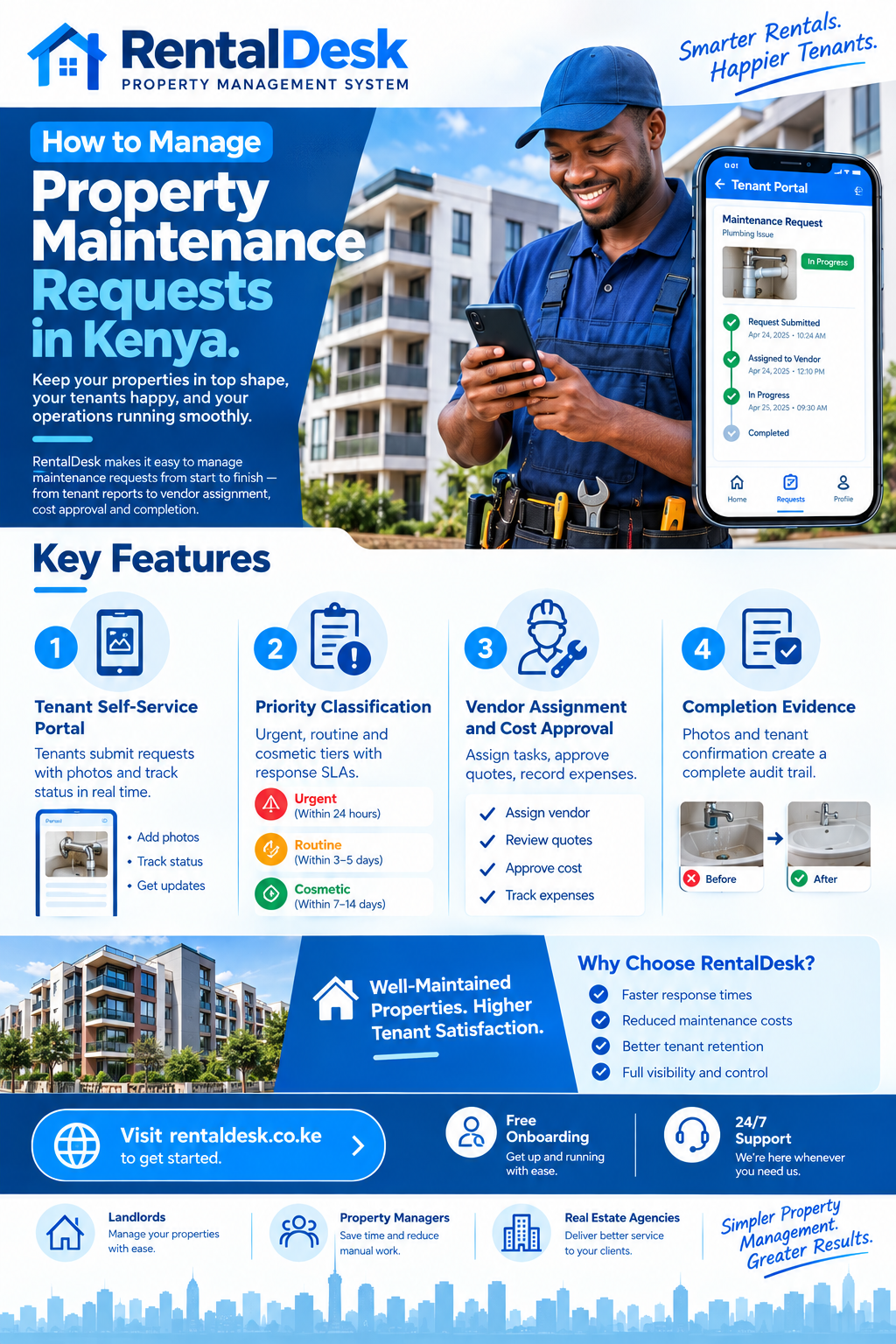
How to manage property maintenance requests in Kenya is one of the most practical and profitable questions a landlord or property manager can answer, because maintenance is where tenant satisfaction, property value and operating costs meet. In practical Kenyan rental management, repair requests frequently disappear inside phone calls, WhatsApp chats, and forgotten notebook entries.
A tenant reports a leaking roof, a caretaker promises to follow up, and three weeks later nobody can say whether the plumber was called, what the quote was, or whether the tenant was ever told anything. RentalDesk provides a complete solution for tracking maintenance requests, connecting repair workflows with rent collection, tenant records, and financial reporting, so that every request has an owner, a status, a cost, and a closure record.
Why Maintenance Request Management Matters in Kenya
The how to manage property maintenance requests in Kenya conversation matters because rental management is now a data and follow-up problem, not only a rent collection problem. Landlords need to know who has paid, who has not paid, which tenant has a balance, which unit is vacant, which issue needs attention, and what the owner should receive at the end of the month. Manual processes can work for a few units, but they become unreliable when the property has many tenants or when a manager handles several buildings.
Without a structured system, urgent and routine repairs are not prioritised consistently, contractor costs may be approved without complete evidence, and tenants receive little information about repair progress. The expected result of a structured approach is clear responsibility from request to closure, better tenant communication, and explainable maintenance spending. A strong process should log every request against the correct tenant, unit and property, set priority levels, assign responsibility, and record completion evidence. RentalDesk supports this by providing a central dashboard where authorised users can review the same current records. That consistency matters when a landlord, agent, accountant and caretaker are involved in one portfolio. Each person can work within an assigned role while management retains visibility and an audit trail.
The Real Cost of Unmanaged Maintenance
The how to manage property maintenance requests in Kenya conversation must begin with the financial reality. A self-managing Kenyan landlord spends an average of 48 hours to fix one maintenance task. That figure is not just about time. It represents delays, repeated visits, tenant frustration, and sometimes property damage that could have been prevented.
Industry data consistently shows that unresolved maintenance is one of the leading causes of tenant turnover. A tenant who waits weeks for a leaking tap or a broken door handle begins to question whether the landlord cares about the property at all. When the lease comes up for renewal, that tenant leaves, and the landlord faces vacancy costs, marketing expenses, and the administrative burden of finding a replacement. The cost of a single month of vacancy on a KShs. 25,000 unit is KShs. 25,000 in lost income, not counting the turnover costs.
The opposite is also true. Properties with structured maintenance tracking see faster resolution times and higher tenant retention. Tenants notice when their requests are acknowledged, assigned, and completed within a reasonable time. That reliability builds trust, and trust keeps tenants in place.
Common Maintenance Problems in Kenyan Rental Properties
The how to manage property maintenance requests in Kenya process must address the problems that actually occur in Kenyan rental properties. These include tenants reporting leaking sinks, electrical faults, or blocked drains informally through calls and WhatsApp messages. Caretakers forget which repairs are pending because the information lives in their memory rather than in a system. Landlords approve repair costs without a clean record of what was quoted, what was done, and what was paid. Agencies struggle to link repair expenses to owner statements. Tenants do not know whether a request has been received, assigned, or completed.
These problems share a common root: the absence of a single, structured workflow that captures every request from the moment it is reported to the moment it is closed. RentalDesk addresses this root cause by giving tenants a structured way to report issues, giving caretakers a clear assignment system, giving managers a real-time dashboard, and giving landlords a complete record of what was spent and why.
Setting Up a Maintenance Request Workflow
The how to manage property maintenance requests in Kenya process should follow a defined workflow that answers five questions quickly: what is broken, who reported it, who is handling it, what it costs, and whether it is resolved. A recommended workflow for Kenyan rental properties runs as follows.
Step 1: Tenant Submits a Request
The workflow begins when a tenant submits a request with issue type, description, unit number, and an optional photo. RentalDesk allows tenants to submit maintenance requests directly through the tenant portal. They can describe the issue, attach a photo, and track the status from reported to in progress to completed. This creates a record of every repair, which helps with accountability and planning. For landlords and agents, it reduces repetitive questions and keeps every tenant interaction organised in one place.
The photo attachment is particularly valuable because it helps contractors understand the issue before arriving on site. Instead of receiving a vague description of a leak, the plumber can see exactly where the water is coming from. This reduces diagnostic time and improves first-time fix rates.
Step 2: Caretaker or Manager Reviews and Assigns
Once a request is submitted, the caretaker or property manager reviews it and assigns it to the appropriate person. RentalDesk enables property managers to capture requests with full details, assign and track each issue through stages, keep status updates visible until closure, and maintain a resolved history for accountability. This ensures that all issues are handled efficiently, reducing tenant complaints and improving retention.
Step 3: Technician or Staff Member Updates Status
The person assigned to the repair updates the status as work progresses. A simple status model works well: open, in progress, awaiting parts, completed. RentalDesk allows the assigned technician or staff member to update the repair status from their device, so the record stays current without anyone needing to relay messages manually.
Step 4: Landlord or Agency Approves Costs
Where a repair involves a cost above a defined threshold, the landlord or agency approves the expenditure. RentalDesk supports cost approval workflows, so the person authorising the spend has the quotation and context in front of them before approving. This prevents the common problem of approving costs without a clean record.
Step 5: Expense Is Recorded
Once the work is completed and the cost is confirmed, the expense is recorded against the property, unit, owner, or statement period. RentalDesk links the expense to the maintenance request, so the repair history and the financial record are connected. This makes owner reporting and property performance analysis far more accurate than a system where repair costs are recorded separately from the repairs themselves.
Step 6: Tenant and Manager See Closure
The final step is closure. The tenant sees that the issue is resolved, and the manager has a complete record of what was reported, what was done, and how much was spent. RentalDesk allows both tenant and manager to see whether the issue is open, in progress, or closed. This transparency reduces follow-up calls and builds trust.
Classifying Maintenance Requests by Urgency
The how to manage property maintenance requests in Kenya process should set priority, responsibility, and expected response time. Not all maintenance requests are equally urgent, and treating them as if they are creates two problems: urgent issues get delayed behind routine ones, and routine issues get escalated unnecessarily.
A practical priority classification for Kenyan rental properties uses three tiers:
Urgent: Issues that pose a safety risk or could cause significant property damage if not addressed immediately. Examples include gas leaks, electrical faults, burst pipes, flooding, and structural damage. The target response time for urgent issues should be within 24 hours.
Routine: Issues that affect habitability or comfort but do not pose an immediate risk. Examples include leaking taps, broken door handles, faulty light fittings, and appliance malfunctions. The target response time for routine issues should be 7 to 14 days.
Cosmetic: Issues that affect appearance but not function. Examples include peeling paint, cracked tiles, and worn fixtures. The target response time for cosmetic issues should be up to 30 days.
RentalDesk allows landlords and property managers to classify requests by priority and set expected response times. This ensures that urgent and routine jobs are prioritised consistently, which is one of the most common failures in manual maintenance management.
Assigning Caretakers and Contractors
The how to manage property maintenance requests in Kenya process must include clear assignment of responsibility. A request without an owner is a request that will be forgotten. RentalDesk enables property managers to assign requests to maintenance staff or contractors, track the progress of each request, and update tenants on status.
For caretakers, the system provides clear visibility into assigned tasks with due dates and visible status. This reduces the dependence on verbal instructions and ensures that everyone on the team knows exactly what they are responsible for. The expected result is clearer daily responsibility and faster escalation of tenant and maintenance issues.
For contractors, RentalDesk supports a directory of approved vendors with performance records. Over time, property managers can see which contractors respond quickly, which ones charge fairly, and which ones complete work to a satisfactory standard. This information is invaluable when deciding who to assign to future jobs.
Quotation and Approval Controls
The how to manage property maintenance requests in Kenya process should include quotation and approval controls for any repair above a defined spending threshold. Without these controls, maintenance costs can spiral, and it becomes difficult to justify expenditure to property owners.
RentalDesk allows property managers to record quotations, submit them for approval, and track whether the work was authorised. The approval workflow can be configured to match the authority matrix of the property business. A caretaker might be authorised to approve repairs up to KSh 5,000 without further approval. Anything above that requires a quotation and sign-off from the property manager or owner.
This structure protects the business from unauthorised spending while also protecting honest employees from suspicion. When every approval is recorded, there is no ambiguity about who authorised what.
Tracking Labour, Materials, and Expenses
The how to manage property maintenance requests in Kenya process must track not just whether a repair was done, but what it cost. This means recording labour costs, materials, and any other expenses associated with the repair.
RentalDesk records maintenance expenses against the correct property, unit, owner, or statement period. This allows property managers to review maintenance cost and recurring-issue reports monthly, identify which properties generate repeated costs, and make more informed preventive-maintenance decisions.
The link between maintenance requests and expense records is particularly valuable for owner reporting. When a property owner asks why maintenance costs were high in a given month, the property manager can show exactly which repairs were done, what they cost, and what evidence was recorded. This transparency builds owner trust and reduces disputes.
Tenant Communication During Repairs
The how to manage property maintenance requests in Kenya process should keep tenants informed throughout the repair cycle. A tenant who has submitted a request and heard nothing for two weeks will assume the worst. A tenant who receives a status update that says “assigned to plumber, scheduled for Tuesday” will wait patiently.
RentalDesk provides automated status updates to tenants when a request is received, assigned, in progress, or completed. This reduces the number of follow-up calls and WhatsApp messages that property managers receive, and it improves tenant satisfaction because tenants feel informed.
The tenant portal also gives tenants a place to check the status of their requests at any time. Instead of calling the caretaker to ask whether the plumber is coming, the tenant can log in and see the current status. This self-service capability reduces administrative burden and improves the tenant experience.
Completion Photos and Confirmation
The how to manage property maintenance requests in Kenya process should require evidence of completion. A repair is not complete until there is a record showing that the work was done and done properly. RentalDesk allows technicians or caretakers to attach completion photos to the maintenance request. The tenant can then confirm that the issue has been resolved, or flag that it has not.
This evidence requirement serves several purposes. It protects honest contractors from false claims that work was not done. It gives property managers a record they can show to owners. And it creates a feedback loop where the tenant’s confirmation becomes part of the permanent record.
Recurring Faults and Asset History
The how to manage property maintenance requests in Kenya process should capture data that helps identify recurring faults. If the same unit has a leaking roof every rainy season, that is not a series of unrelated repairs. It is a recurring fault that needs a permanent solution.
RentalDesk maintains a complete history of every maintenance request against each unit and property. Over time, this history reveals patterns. A particular building might have repeated plumbing issues. A specific appliance might fail every few months. A property manager who can see these patterns can address the root cause rather than repeatedly paying for temporary fixes.
This is also where AI and data analytics can add value. By clustering recurring issues, identifying properties with unusually high repair spend, and suggesting preventive work before a small issue becomes an expensive outage, property managers can move from reactive to proactive maintenance.
Preventive Maintenance Planning
The how to manage property maintenance requests in Kenya process should include preventive maintenance, not just reactive repairs. Preventive maintenance helps identify and fix problems before they escalate into costly repairs, and regular upkeep extends the life of appliances and building systems.
RentalDesk allows property managers to schedule preventive maintenance tasks, such as generator servicing, elevator inspections, security system checks, and seasonal roof inspections. These scheduled tasks are tracked just like reactive maintenance requests, with status updates and completion evidence. This ensures that preventive maintenance is actually performed, not forgotten or delayed.
The financial impact of preventive maintenance is significant. A single emergency repair can cost three to five times more than scheduled preventive maintenance. By planning ahead, landlords can budget for maintenance expenses more accurately and avoid surprise costs that disrupt cash flow.
Emergency Repair Procedures
The how to manage property maintenance requests in Kenya process must include clear procedures for emergency repairs. When a burst pipe is flooding a unit, or an electrical fault is creating a safety hazard, there is no time for a standard approval workflow.
A practical emergency procedure should define what qualifies as an emergency, who is authorised to act without prior approval, what spending limit applies, and what documentation must be provided afterwards. RentalDesk supports this by allowing caretakers to log emergency repairs immediately and attach evidence once the immediate crisis is under control. The expense is recorded against the correct property, and the property manager is notified.
This structure protects the property from further damage while ensuring that emergency spending is still recorded and justified.
Managing Contractors Across Multiple Properties
For property managers handling multiple buildings, the how to manage property maintenance requests in Kenya process becomes more complex. A single contractor might be responsible for several properties. A single property might need several different trades. The coordination requirements multiply.
RentalDesk allows property managers to view all maintenance requests across all properties from one dashboard. They can assign requests to the right contractor based on location and trade, track progress across multiple sites, and compare contractor performance across the portfolio. This centralised view is essential for property management companies that cannot afford to manage maintenance property by property.
Common Maintenance Management Mistakes
The how to manage property maintenance requests in Kenya journey has predictable mistakes that undermine even well-intentioned maintenance efforts.
Allowing requests to arrive through scattered channels. When requests come through calls, WhatsApp, SMS, and in-person conversations, some are inevitably lost. The first step in structured maintenance management is to require that all requests are logged in one system.
Failing to set priority levels. If every request is treated as equally urgent, nothing is actually prioritised. A blocked drain in a ground-floor unit that could cause flooding should not wait behind a request to replace a light bulb.
Approving costs without a record. When a landlord approves a repair verbally or via WhatsApp, there is no clean record of what was approved, by whom, and for how much. The expense becomes difficult to justify later.
Not requiring completion evidence. A repair is not complete until there is evidence that it was done. Photos of completed work, along with tenant confirmation, provide the proof that the repair was actually performed.
Leaving tenants in the dark. A tenant who does not know the status of their request will assume the worst. Automated status updates and portal access reduce follow-up calls and improve satisfaction.
Treating maintenance as separate from finance. When repair costs are recorded in one system and maintenance requests in another, it becomes impossible to see the true cost of maintaining each property. The two records should be linked.
Measuring Maintenance Performance
The how to manage property maintenance requests in Kenya process should include measurement. Without metrics, it is impossible to know whether the maintenance workflow is actually improving.
Useful maintenance metrics for Kenyan rental properties include:
Average response time: How long does it take from request submission to assignment?
Average resolution time: How long does it take from assignment to closure?
Cost per property per month: What is the total maintenance spend for each property?
Cost by category: How much is spent on plumbing, electrical, structural, and cosmetic repairs?
Recurring fault rate: How many requests relate to issues that have been reported before?
Contractor performance: Which contractors respond fastest, complete work most reliably, and charge fairly?
RentalDesk generates reports that cover these metrics, giving property managers the data they need to improve performance over time.
How RentalDesk Simplifies Maintenance Request Management
RentalDesk is built specifically for Kenyan rental operations, supporting maintenance request tracking alongside rent collection, tenant management, M-Pesa visibility, arrears tracking, receipts, owner statements, accounting, and portfolio reporting.
Tenant Self-Service
RentalDesk allows tenants to submit maintenance requests directly through the tenant portal with photos and descriptions. They can track the status of their requests from reported to in progress to completed. This creates a record of every repair and reduces repetitive questions.
Centralised Dashboard
RentalDesk provides a central dashboard where authorised users can review the same current records. Property managers can see all open requests, track progress, and identify which issues need attention.
Assignment and Tracking
RentalDesk enables property managers to assign requests to maintenance staff or contractors, track the progress of each request, and update tenants on status. The system supports priority classification, due dates, and escalation when a request is not resolved within the expected time.
Cost Approval and Expense Recording
RentalDesk supports quotation and approval workflows, so the person authorising expenditure has the context they need before approving. Once approved, the expense is recorded against the correct property, unit, owner, or statement period.
Completion Evidence
RentalDesk allows technicians or caretakers to attach completion photos to the maintenance request. The tenant can confirm that the issue has been resolved, creating a complete record from request to closure.
Preventive Maintenance Scheduling
RentalDesk allows property managers to schedule preventive maintenance tasks and track them alongside reactive repairs. This ensures that preventive maintenance is performed consistently.
Reporting
RentalDesk generates maintenance reports that show cost by property, cost by category, resolution times, and recurring issues. These reports help property managers identify trends and improve performance.
How to Get Started
Implementing a structured approach to how to manage property maintenance requests in Kenya is straightforward with RentalDesk .
Step 1: Sign up for RentalDesk. Visit RentalDesk and create your account. Choose a plan that matches your portfolio size.
Step 2: Set up your properties and units. Add your properties, units, and tenants to the system. Include all relevant details for maintenance tracking.
Step 3: Configure maintenance workflows. Set up request categories, priority levels, and assignment rules. Define the approval thresholds for repair spending.
Step 4: Invite your team. Create user accounts for caretakers, contractors, and property managers with appropriate permissions.
Step 5: Train users. Train caretakers and managers on how to use the maintenance workflow. RentalDesk offers free onboarding support.
Step 6: Go live. Start using RentalDesk for all maintenance requests. The platform will begin tracking requests, assignments, costs, and completion evidence immediately.
Step 7: Review and improve. Use RentalDesk reports to monitor maintenance performance and identify opportunities for improvement.
The Future of Maintenance Management in Kenya
The how to manage property maintenance requests in Kenya landscape is evolving. AI and data analytics are beginning to play a role in maintenance planning. AI can cluster recurring issues, identify properties with unusually high repair spend, and suggest preventive work before a small issue becomes an expensive outage. It can also summarise work order history so managers know what keeps failing.
However, AI cannot replace physical inspection or accountability. An AI model cannot inspect a leaking roof, verify electrical safety, or judge whether a vendor quote is fair without real context. The best approach combines structured digital records with human judgement and physical verification.
The landlords and property managers who succeed will be those who treat maintenance as a core operational discipline, not an afterthought. They will capture every request in one system, set clear priorities and response times, assign responsibility, track costs, require completion evidence, and review performance data regularly.
RentalDesk provides the structured platform that makes this possible. It gives property teams the tools to move from reactive firefighting to proactive maintenance management, protecting property value, improving tenant satisfaction, and controlling operating costs.
- How to manage property maintenance requests in Kenya
- How to manage property maintenance requests in Kenya
- How to manage property maintenance requests in Kenya
- How to manage property maintenance requests in Kenya
- How to manage property maintenance requests in Kenya
- How to manage property maintenance requests in Kenya
- How to manage property maintenance requests in Kenya
- How to manage property maintenance requests in Kenya
- How to manage property maintenance requests in Kenya
- How to manage property maintenance requests in Kenya
- How to manage property maintenance requests in Kenya
- How to manage property maintenance requests in Kenya
- How to manage property maintenance requests in Kenya
- How to manage property maintenance requests in Kenya
- How to manage property maintenance requests in Kenya
- How to manage property maintenance requests in Kenya
- How to manage property maintenance requests in Kenya
- How to manage property maintenance requests in Kenya
- How to manage property maintenance requests in Kenya
- How to manage property maintenance requests in Kenya