How to manage 1 bedroom rentals in Nairobi is a critical operational question for investors targeting the city’s most competitive housing segment. The 1-bedroom apartment is the sweet spot for Nairobi’s young professionals, students, and couples. It offers more privacy than a bedsitter while remaining significantly more affordable than a 2-bedroom unit. However, this segment also comes with high tenant turnover, intense competition, and strict compliance requirements.
Learning how to manage 1 bedroom rentals in Nairobi requires moving away from informal methods. You cannot rely on a caretaker’s memory or a messy spreadsheet to track rent, maintenance, and lease renewals. You need a structured, automated system that ensures you collect every shilling you are owed while keeping your tenants satisfied.
Understanding the 1-Bedroom Rental Market in Nairobi
The market for 1-bedroom rentals in Nairobi spans a wide spectrum. On the lower end, you find units in areas like Kasarani, Pipeline, and Githurai, where rents might range from KSh 10,000 to KSh 18,000. On the higher end, neighborhoods like Kilimani, Westlands, and Lavington offer 1-bedroom units with amenities like gyms, swimming pools, and backup generators, commanding rents from KSh 35,000 to over KSh 70,000.
To master how to manage 1 bedroom rentals in Nairobi, you must understand the demographic you are serving. Tenants in this segment are often young professionals who value convenience, reliable internet, and quick maintenance responses. They are also highly mobile; if a unit does not meet their expectations, they will move out at the end of the lease.
This mobility means that vacancy periods are a major risk. The cost of losing a tenant and finding a replacement—including marketing, cleaning, and lost rent—can easily erase months of profit. Efficient management is not just about collecting rent; it is about tenant retention and operational speed.
The Financial Mathematics of a 1-Bedroom Rental
To properly plan your operations, you must understand the numbers. Let’s assume you own a 1-bedroom unit in Roysambu that rents for KSh 20,000 per month. Your gross annual income is KSh 240,000.
Your expenses include service charges (say KSh 2,000/month), land rates, insurance, and maintenance. You also have the 7.5% Monthly Rental Income (MRI) tax. If you lose one month of rent due to a vacancy, you lose KSh 20,000, plus the cost of repainting (KSh 15,000) and finding a new tenant (agency fee of KSh 10,000).
This means a single vacancy can wipe out nearly three months of profit. Therefore, efficient rent collection and rapid maintenance are not just conveniences; they are the difference between a profitable asset and a loss-making one.
Legal Frameworks and Tenancy Agreements
The first step in learning how to manage 1 bedroom rentals in Nairobi is establishing a solid legal foundation. A verbal agreement is a recipe for disaster. Every tenancy must be backed by a comprehensive written lease agreement.
The lease should clearly outline the rent amount, due date, security deposit terms, and the notice period required for termination. It should also specify the landlord’s obligations regarding repairs and the tenant’s responsibilities regarding utilities and property care.
It is vital to classify the tenancy correctly. While the Rent Restriction Act governs controlled tenancies (where the standard rent is below KSh 2,500), most 1-bedroom units fall outside this threshold. However, that does not mean you can ignore tenant protections. Court rulings have repeatedly penalized landlords who use self-help measures like locking out tenants or disconnecting water without a court order.
By adhering to the law and documenting every agreement, you protect your investment from costly legal battles. This is a fundamental rule of how to manage 1 bedroom rentals in Nairobi. The deposit should be held securely and utilized only for lawful deductions such as unpaid rent, damages beyond normal wear and tear, and unpaid utilities.
Tenant Screening and Selection
When exploring how to manage 1 bedroom rentals in Nairobi, the quality of your tenants determines the quality of your experience. A tenant who consistently pays late will cost you more in time and stress than the rent they bring in.
Thorough screening is your best defense. Request the tenant’s National ID or Passport, and verify their employment or source of income. For professionals, ask for three months of payslips or an employment letter. If they are self-employed, request bank statements or business registration documents.
Reference checks are equally important. Contact the previous landlord to ask about their payment history and how they treated the property. A tenant who has a history of disputes or late payments is a red flag.
Once you have selected a qualified tenant, a joint move-in inspection is essential. Document the condition of the unit with dated photographs and a signed checklist. This baseline protects you when the tenant moves out, allowing you to make fair and substantiated deductions from the security deposit. This thorough approach is the core of effective how to manage 1 bedroom rentals in Nairobi.
Rent Collection and M-Pesa Automation
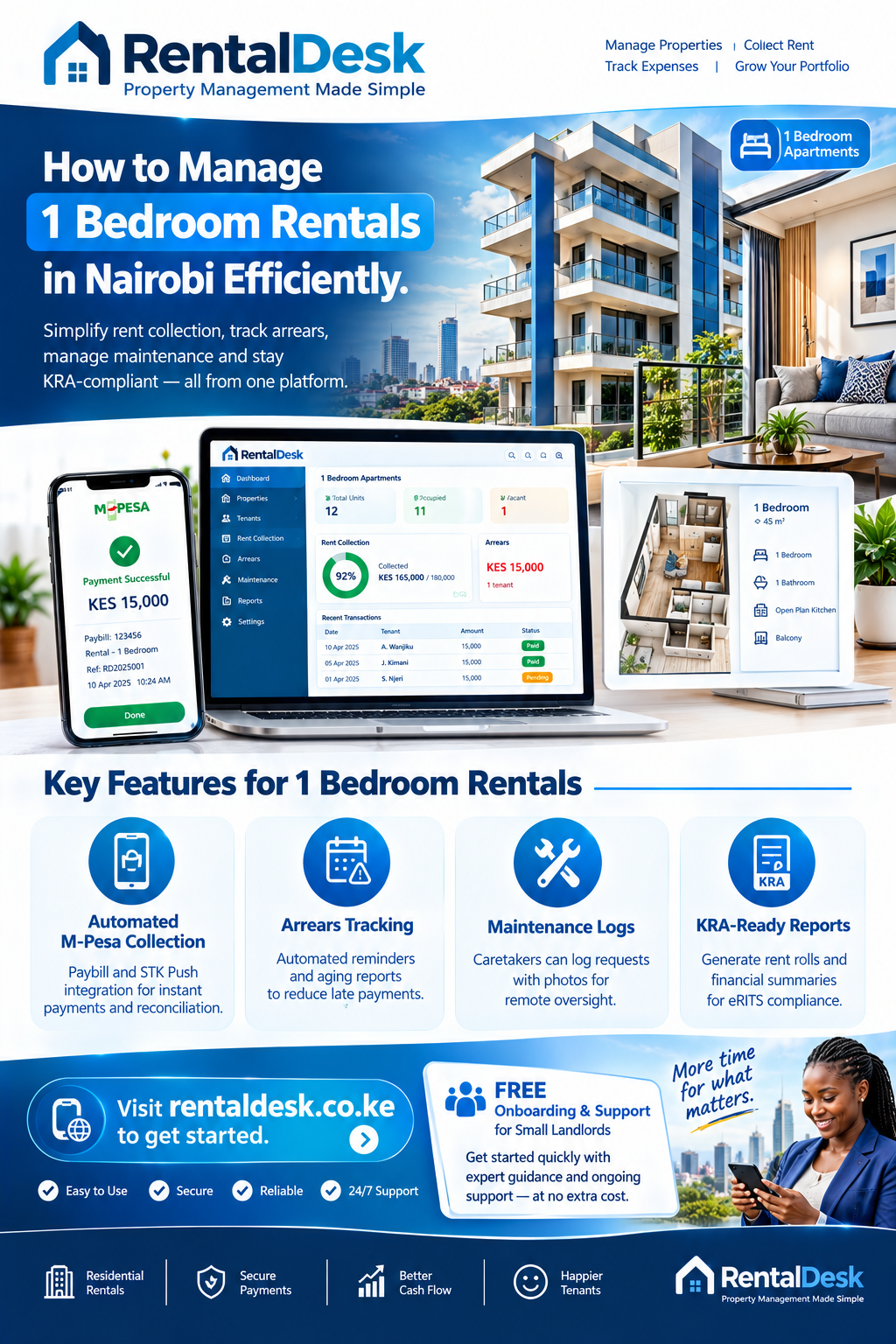
The operational heart of how to manage 1 bedroom rentals in Nairobi is the rent collection process. In Kenya, mobile money is king. Over 90% of urban rent payments flow through M-Pesa, and tenants expect to pay via Paybill or STK Push.
If you are still accepting cash or manually reconciling M-Pesa messages against a spreadsheet, you are losing hours every month. Manual reconciliation is prone to errors, especially when tenants make partial payments, use the wrong account reference, or pay from a third-party phone number.
Automation is the solution. By integrating your Paybill number with a property management system like RentalDesk, you can automate the entire collection cycle. The system generates an invoice at the start of the month and sends an automated reminder to the tenant.
When the tenant pays, the system captures the M-Pesa C2B callback, extracts the account reference, and matches the payment to the correct tenant and invoice. This immediate reconciliation eliminates manual data entry. It also generates a digital receipt instantly, which is sent to the tenant via SMS or email. This transparency builds trust and stops the “I paid” versus “I didn’t receive it” disputes.
For landlords trying to figure out how to manage 1 bedroom rentals in Nairobi, automation is the key to scalability. Whether you own two units or fifty, the system handles the volume effortlessly.
Understanding the M-Pesa Daraja API
The magic behind automated rent collection is the M-Pesa Daraja API. This is the interface that allows your property management software to communicate directly with Safaricom’s servers.
When a tenant enters your Paybill number and their unit reference, Safaricom processes the payment and immediately sends a digital notification (a callback) to the software. The software reads the amount and the reference, matches it to the tenant’s ledger, and clears the invoice.
Without this API integration, you are stuck checking your phone manually. With it, the entire process is hands-free.
Handling Partial Payments and Arrears
Even with automation, tenants will sometimes pay late or pay in instalments. A key aspect of how to manage 1 bedroom rentals in Nairobi is having a system that handles these exceptions gracefully.
If a tenant pays KSh 15,000 against a KSh 25,000 rent charge, the system must record the partial payment and carry forward the remaining balance. It should not mark the invoice as fully paid.
Furthermore, the system should automatically categorise arrears by age. A balance that is one week old requires a gentle nudge. A balance that is 60 days old requires a more formal demand letter or legal intervention. By tracking the aging of arrears, you can prioritize your follow-up efforts and maximize recovery.
A robust system will also manage the escalation of reminders. It starts with a polite SMS before the due date, moves to a firmer message after the due date, and culminates in a formal notice. This consistency is far more effective than sporadic phone calls from the landlord.
Maintenance and Repairs
Maintenance is the most common source of friction between landlords and tenants. The best way to handle how to manage 1 bedroom rentals in Nairobi regarding maintenance is to establish a clear reporting channel.
Tenants should be able to submit maintenance requests through a tenant portal or via a dedicated WhatsApp line. The request should include a description and photos of the issue. This helps you or your caretaker understand the problem before arriving.
For property managers, speed is critical. A leaking tap or a faulty electrical socket can escalate into significant water damage or a safety hazard if ignored. Once a request is logged, it should be assigned to a vendor and tracked until completion.
Tracking maintenance costs is also vital for profitability. You need to know how much you are spending on repairs per unit. If a particular 1-bedroom unit requires constant repairs, it might be a sign of a deeper structural issue or a tenant who is not taking care of the property.
When conducting inspections, distinguish between normal wear and tear and tenant damage. Faded paint and minor scuffs are normal wear. Broken tiles, holes in doors, and burnt countertops are tenant damage and should be charged to the tenant.
Utilities and Service Charges
Unlike bedsitters, many 1-bedroom rentals in Nairobi are located in apartment blocks with service charges. If you are learning how to manage 1 bedroom rentals in Nairobi, you must know how to handle these shared costs.
Service charges cover security, garbage collection, water, and common area lighting. These costs must be billed accurately to the tenant or accounted for in the rent. Sub-metering for water and electricity is highly recommended to ensure tenants pay for their actual consumption.
This prevents disputes and ensures you do not absorb the cost of a tenant who leaves the taps running. A property management system can help you record meter readings and generate utility bills alongside the rent invoice.
Financial Reporting and KRA Compliance
A crucial but often overlooked aspect of how to manage 1 bedroom rentals in Nairobi is tax compliance. The Kenya Revenue Authority (KRA) has tightened the noose on rental income tax evasion. The Monthly Rental Income (MRI) tax regime requires landlords to pay 7.5% of gross rent by the 20th of the following month.
Filing these returns manually is a nightmare if you have multiple units. However, a property management platform can generate a rent register that shows exactly what was collected and what is outstanding. This report is essential for filing your returns accurately.
Accurate record-keeping also protects you in the event of an audit. You must maintain records of all M-Pesa transactions, receipts, and lease agreements. RentalDesk automates this by providing an immutable audit trail of every transaction, ensuring you are always ready for KRA scrutiny.
Vacancy Management and Tenant Retention
In the 1-bedroom market, vacancies can eat into your profits quickly. The most effective way to handle vacancies is to prevent them through tenant retention.
Respond promptly to maintenance requests. Communicate clearly about any disruptions. Offer reasonable lease renewal terms. A good tenant is worth their weight in gold, and retaining them saves you the cost of marketing and turnover.
When a vacancy does occur, you need a system to track the turnaround process. From the move-out inspection to the final deposit refund, every step must be documented. The unit must be cleaned and repaired quickly to minimize the days it sits empty.
This is where a platform focused on how to manage 1 bedroom rentals in Nairobi becomes indispensable. It provides a dashboard that shows exactly which units are vacant and which leases are expiring, allowing you to plan ahead.
Common Mistakes to Avoid
The journey to mastering how to manage 1 bedroom rentals in Nairobi involves avoiding a few common pitfalls.
One major mistake is failing to standardize the account reference for M-Pesa payments. If tenants use different formats for their unit numbers, automatic reconciliation fails. You must communicate a strict format, such as “APT-12” or “B12”, and enforce it.
Another mistake is ignoring the move-in inspection. Without a documented baseline, you cannot fairly assess damages at move-out. This often leads to disputes and delays in re-letting the unit.
Finally, many landlords fail to separate their personal finances from their rental income. This makes tax filing and financial analysis impossible. Always use a dedicated business account and a property management system to track income and expenses.
Why You Need a Property Management System
The fragmented nature of managing 1-bedroom rentals makes it a prime candidate for digital transformation. Relying on a caretaker with a notebook creates an information bottleneck. If the caretaker is sick or leaves, the property loses its operational memory.
Cloud-based software like RentalDesk acts as the operational backbone. It turns a stressful, reactive side hustle into a predictable rental business. By automating rent collection, invoicing, and reporting, it allows you to focus on strategic decisions rather than administrative chores.
The software gives you real-time visibility. You can see exactly who has paid, who owes, and what maintenance issues are outstanding. This is the digital equivalent of having a live rent desk—an always-on point of contact where every payment and dispute is handled the moment it arises.
How to Get Started with RentalDesk
Implementing a structured management system is the most effective way to scale your business. RentalDesk offers a Free Lite plan for small portfolios (up to 5 units). For larger portfolios, the Starter Plan (KSh 5,000/month) and Estate Manager Plan (KSh 9,500/month) offer advanced features like bulk invoicing, SMS reminders, and multi-property management.
By following this structured approach, you can transition from manual chaos to automated control. This is the practical answer to how to manage 1 bedroom rentals in Nairobi.
To truly excel in how to manage 1 bedroom rentals in Nairobi, you must stay updated with Nairobi real estate market trends. Knowing when to adjust rents or renovate based on market conditions can significantly boost your yield.
Understanding the legal framework is essential for how to manage 1 bedroom rentals in Nairobi. Always consult the Kenya Revenue Authority guidelines for tax compliance to avoid penalties.
A critical part of how to manage 1 bedroom rentals in Nairobi is data security. Ensure compliance with the Data Protection Act when handling tenant IDs and financial records.
When integrating technology for how to manage 1 bedroom rentals in Nairobi, developers rely on the M-Pesa Daraja API to ensure seamless automated payments and reconciliation.
Mastering how to manage 1 bedroom rentals in Nairobi also means knowing your rights and obligations under the Rent Restriction Act and other tenancy laws.