
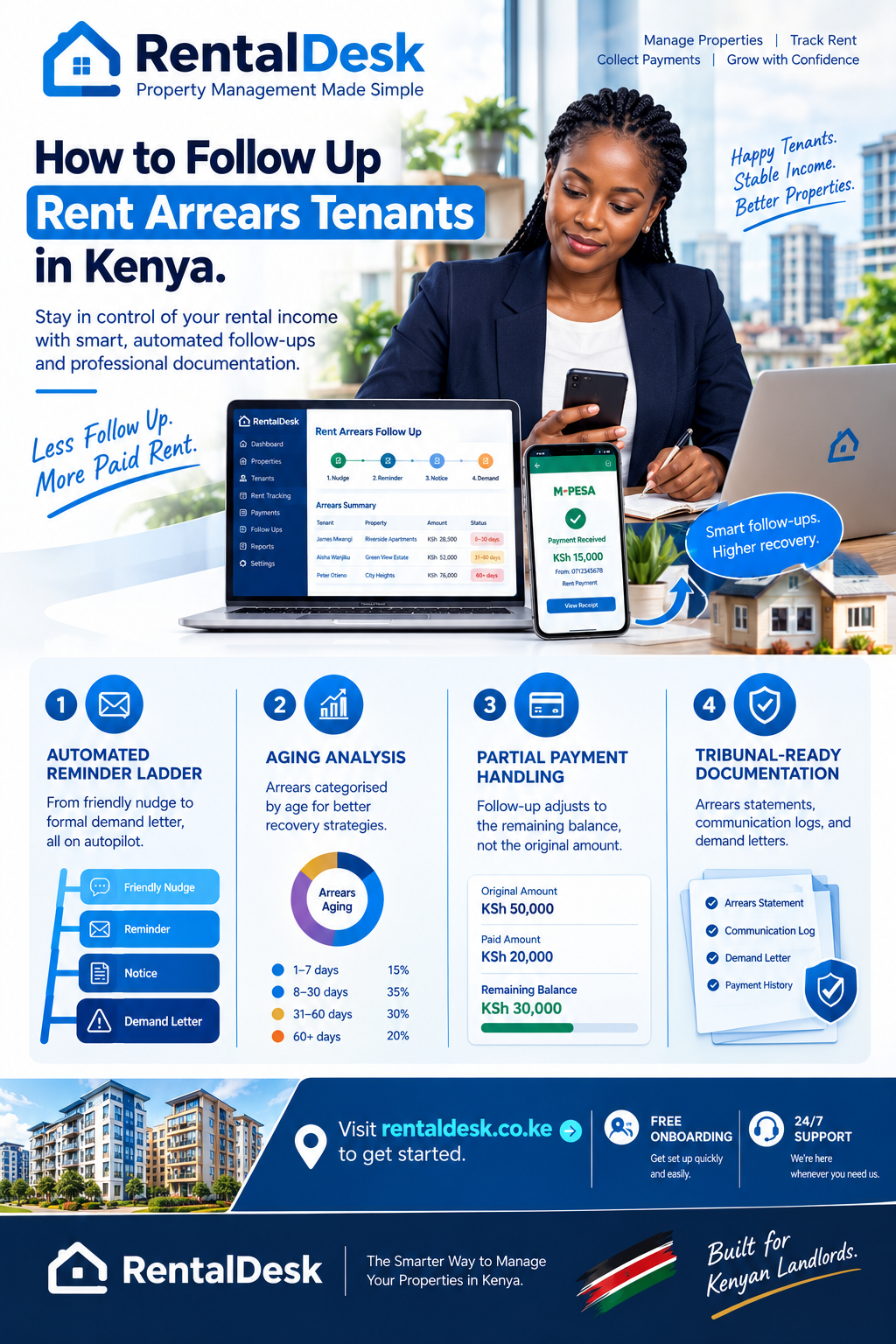
How to follow up rent arrears tenants in Kenya is the operational discipline that determines whether a property investment produces income or merely produces a tenant. The answer is not a single conversation or a stern message. It is a defined sequence of contact, escalation, documentation, and legal action that begins before the first payment is missed and continues until the balance is recovered or written off.
Most Kenyan landlords run this process without a process at all — a phone call here, a message there, a threat when frustration peaks — with no record of what was said, no consistency between tenants, and no clear idea at any given moment of who owes what or for how long. RentalDesk provides the structured platform that converts that improvisation into a repeatable system.
Why Following Up Rent Arrears Matters in Kenya
The case for a structured approach to how to follow up rent arrears tenants in Kenya rests on two kinds of damage that originate from improvised collection.
The first is financial. Arrears that were recoverable at one month become unrecoverable at five, because nobody acted while the sum was manageable. A tenant who misses one month of rent often becomes a tenant who misses two, and by the time the problem is noticed, the deposit is gone and the tenant has moved out. Small delays compound across a portfolio, since ten tenants each two weeks late is a month of income arriving late.
The second is legal. A landlord who runs out of patience and changes the locks, removes a door, or cuts the water has quite possibly committed an offence regardless of how much is owed, and has converted a debt they were owed into a claim against them. Kenyan law protects tenants from self-help remedies, and if a landlord skips the legal sequence, the tenant can flip the situation and sue for illegal eviction, harassment, or unlawful distress, even if they genuinely owe money.
Understanding how to follow up rent arrears tenants in Kenya systematically means engaging at one week overdue rather than waiting for three months, when recovery rates have already collapsed. The habit is set early: a tenant who learns that late payment attracts no response pays late, and one who learns it attracts prompt courteous contact pays on time.
The Reminder Ladder: A Structured Follow-Up Sequence
The foundation of how to follow up rent arrears tenants in Kenya is the reminder ladder — a scheduled sequence of messages that escalates in tone and urgency without ever starting hostile. The ladder most Kenyan landlords find works follows a predictable pattern.
Three Days Before the Due Date
The first message is a friendly heads-up. Its purpose is to prompt the tenant to move money from wherever it lives into M-Pesa before the due date. The tone is helpful, not demanding. This message alone recovers a significant share of what would otherwise become late payments, because it removes the surprise element from rent day.
On the Due Date
The second message is neutral. It states the amount due, the unit, the Paybill number, and the account reference. This is the point at which the tenant has the information they need to pay immediately. The message itself should carry an STK Push prompt so the tenant can complete payment without leaving the conversation.
One Day After the Due Date
The third message is still neutral but firmer. It notes that the payment has not been received and mentions any late-fee terms that apply under the lease. This is the stage where most tenants who were simply distracted will pay.
Three Days After the Due Date
The fourth message becomes factual. The word “arrears” enters the message. The running balance is stated. The tenant is made aware that the account is now past the grace period and that follow-up will continue.
Seven Days After the Due Date
The fifth message is a formal notice. This message becomes part of the paper trail if the matter ever reaches the Rent Tribunal. It should be timestamped, logged, and retained.
Fourteen Days After the Due Date
The sixth stage is an escalation flag rather than a tenant-facing message. The system notifies the landlord or property manager that this tenant now needs a human conversation, with the full payment history attached.
RentalDesk implements this ladder automatically. The tone hardens at each stage but never starts hostile. Any landlord researching how to follow up rent arrears tenants in Kenya should understand that the first polite reminder does more work than every subsequent message combined.
Aging Analysis: Prioritising Follow-Up Where It Matters
The how to follow up rent arrears tenants in Kenya conversation must address aging analysis, because it determines which cases require immediate attention and which can wait.
Arrears aged in buckets — 1–7 days, 8–30 days, 31–60 days, and 60+ days — allow property teams to see which balances are still recoverable and which are bleeding out. Tenants slip into the next bucket without the property manager doing anything. The longer a balance sits unpaid, the lower the probability of full recovery.
1–7 days overdue: Almost always recoverable. The tenant forgot, payday slipped, or M-Pesa is still on their phone. A reminder is usually enough.
8–30 days overdue: Still recoverable but needs an escalating sequence and usually a direct conversation. Late fees may apply.
31–60 days overdue: Act now. A demand letter, a scheduled payment plan, or a tribunal package preparation is required. Recovery rates drop sharply past this point.
60+ days overdue: Tribunal or write-off. The decision comes down to taking the matter to the Rent Tribunal or writing it off and moving on.
RentalDesk surfaces this aging breakdown on the dashboard so landlords can act on what matters — cleaning up the 60+ day cases before they become write-offs. This visibility is the core of how to follow up rent arrears tenants in Kenya effectively.
The First 48 Hours: Getting the Initial Response Right
The how to follow up rent arrears tenants in Kenya conversation must address the critical first 48 hours, because the initial response sets the tone for everything that follows.
In the first 48 hours after rent goes unpaid, send a polite, written reminder stating the amount owed, the due date, and a request for an update. Do not threaten or accuse. This step often resolves the issue immediately, and if it does not, it creates the documented paper trail needed later.
A sample message: “Hi [Tenant’s Name], hope you’re well. Just following up on the rent for [Month] of [Amount], which was due on [Date]. Please let me know if there’s an issue or when I can expect payment. Thanks.”
Too many landlords either go silent and let the debt grow, or fire off an angry message that puts them on the back foot. Both are mistakes. The first move should be calm and professional.
Legal Boundaries: What You Cannot Do
The how to follow up rent arrears tenants in Kenya conversation must acknowledge the legal framework, because self-help measures are illegal and expensive.
The Myth of “My House, My Rules”
Many landlords believe that if a tenant signs a contract saying “If I delay rent by one day, the landlord can lock me out,” then it is legal. Legal reality: a contract cannot override the law. Any clause that contradicts the Rent Restriction Act (for residential) or the Landlord and Tenant Act (for commercial) is void.
The Danger of Self-Help Eviction
You cannot simply remove the roof, disconnect water, or lock the tenant out to force them to leave. This is “constructive eviction” and is illegal. To evict a tenant who refuses to leave, you usually need an eviction order from a court or the Rent Tribunal. In Il Mattarello Limited v Michael Bell & another [2018] KEHC 3212 (KLR), the court found extra-judicial conduct unlawful and awarded the plaintiff punitive and exemplary damages of Kshs 2,000,000.
Distress for Rent
Distress is a specific remedy to recover money, not the house. It allows a landlord to seize goods to pay off arrears. The golden rule: never act alone. Distress must be levied by a licensed auctioneer. If you or your caretaker enters the tenant’s house to take a television, you are committing a criminal offence.
The legal steps are: instruct a licensed auctioneer, the auctioneer issues a 14-day notice (residential) or 7-day notice (commercial), the auctioneer visits and lists the goods, and if payment is not made, goods are collected and auctioned.
Handling Partial Payments and Broken Promises
The how to follow up rent arrears tenants in Kenya conversation must address partial payments, because they are a routine feature of the Kenyan rental market and a common cause of follow-up confusion.
A tenant pays KSh 15,000 against a KSh 25,000 charge and promises the rest next week. The follow-up must adjust to chase the remaining KSh 10,000, not the original KSh 25,000. A system that continues to demand the full amount will frustrate a tenant who has demonstrated willingness to pay.
RentalDesk posts partial payments against the open invoice and leaves the balance open for follow-up. The reminder ladder adjusts to reflect the outstanding balance rather than the original invoice amount. When the balance is cleared, the reminders stop. Any landlord learning how to follow up rent arrears tenants in Kenya should understand that partial payments require a different follow-up from full non-payment.
Payment Plans and Negotiated Arrangements
The how to follow up rent arrears tenants in Kenya conversation should include payment plans, because not every arrears case requires legal action. A tenant experiencing temporary hardship may be willing and able to pay if given a structured plan.
The method accepted by Kenyan tenancy tribunals typically follows: no arrears → reminder (day 5) → formal notice (day 15) → notice to vacate (day 30) → eviction notice (day 60) → legal → resolved.
RentalDesk supports payment plan tracking. When a plan is agreed, the system records the terms and monitors compliance. If the tenant misses an agreed payment, the system escalates automatically. If the tenant honours the plan, the arrears reduce over time and the tenancy is preserved.
Documentation: The Paper Trail That Protects You
The how to follow up rent arrears tenants in Kenya conversation must emphasise documentation, because the paper trail is what protects the landlord if the matter reaches a tribunal.
Every reminder, notice, and demand letter must be timestamped and logged. Every payment must be recorded with its transaction ID, date, and the invoice it settled. Every communication with the tenant should be documented.
RentalDesk logs every follow-up automatically. The system maintains a complete communication history for every tenant, including reminders sent, notices issued, and payments received. When a matter reaches the Rent Tribunal, the landlord has a complete file rather than a collection of WhatsApp screenshots.
Escalation to Formal Demand Letters
The how to follow up rent arrears tenants in Kenya process should escalate to a formal demand letter at the appropriate threshold.
The sequence typically runs: polite SMS reminder with M-Pesa Paybill and account details on day one; firmer SMS with running balance on days 3–7; email and SMS arrears notice on day 14; auto-generated demand letter pre-filled with lease details on day 21; escalation to the landlord or manager with full arrears statement on day 30.
RentalDesk generates the demand letter automatically, pre-filled with lease details and the outstanding balance. The letter is delivered via SMS, email, or PDF and is logged for the tribunal record.
Automated Follow-Up vs Manual Follow-Up
The how to follow up rent arrears tenants in Kenya conversation ultimately comes down to automation versus manual effort.
Manual follow-up is inconsistent, time-consuming, and prone to error. Automated follow-up is consistent, documented, and scalable. Landlords using automated reminders commonly see a meaningful drop in arrears within the first two or three billing cycles. Automation also matters because reminders work best when they are boring. Manual reminders slip when you are busy. Automated ones do not.
A landlord managing 30 units who follows up manually spends several hours each month on reminder calls, WhatsApp messages, and the reconciliation that follows. An automated system reduces that to minutes.
How RentalDesk Delivers Structured Arrears Follow-Up
RentalDesk is built specifically for the Kenyan market, and arrears follow-up sits at the centre of the platform.
Automated reminder ladder. The full sequence from pre-due nudge to formal notice runs without intervention.
Aging analysis. Arrears are categorised by age (1–7, 8–30, 31–60, 60+ days) with dashboard visibility.
Partial payment handling. Partial payments post against the open invoice and the follow-up adjusts to the remaining balance.
Demand letter generation. Auto-generated demand letters pre-filled with lease details, delivered via SMS, email, or PDF.
Tribunal-ready documentation. Arrears statements, communication logs, and demand letters are generated from verified records.
M-Pesa reconciliation. Payments are matched automatically, so follow-up stops the moment rent is received.
Role-based access. Caretakers, managers, and accountants see only what they need to see.
How to Get Started
Implementing a structured approach to how to follow up rent arrears tenants in Kenya is straightforward with RentalDesk .
Step 1: Sign up. Visit RentalDesk and create your account. Choose a plan that matches your portfolio size.
Step 2: Record your lease terms. Enter rent amounts, due dates, billing frequencies, and late-fee terms for each tenancy.
Step 3: Configure M-Pesa collection. Connect your Paybill to RentalDesk so that payments reconcile automatically and follow-up stops on receipt.
Step 4: Set the reminder ladder. Configure the timing and tone of follow-ups before and after the due date.
Step 5: Configure escalation thresholds. Set the points at which a formal notice and demand letter are generated.
Step 6: Run a pilot cycle. Process one full billing period for a single property and count the manual interventions.
Step 7: Go live. Roll out to the full portfolio once the pilot validates the workflow, and review the arrears aging report each morning.
The Future of Arrears Follow-Up in Kenya
The how to follow up rent arrears tenants in Kenya landscape is moving in a clear direction. The Kenya Revenue Authority’s eRITS system is designed to integrate with property management platforms, and accurate rent records are now a compliance requirement. Automated reminders and digital payment rails are reducing the frequency of arrears. And the gap between follow-up, collection, and documentation is closing.
The landlords who adopt structured arrears follow-up early will not simply have tidier records. They will have lower arrears, faster reconciliation, better tenant relationships, and a legal position that withstands scrutiny.
RentalDesk provides the structured platform that makes rent arrears follow-up work in Kenya — not as a series of uncomfortable conversations, but as a defined process that protects both the landlord’s income and their legal position.
- How to follow up rent arrears tenants in Kenya
- How to follow up rent arrears tenants in Kenya
- How to follow up rent arrears tenants in Kenya
- How to follow up rent arrears tenants in Kenya
- How to follow up rent arrears tenants in Kenya
- How to follow up rent arrears tenants in Kenya
- How to follow up rent arrears tenants in Kenya
- How to follow up rent arrears tenants in Kenya
- How to follow up rent arrears tenants in Kenya
- How to follow up rent arrears tenants in Kenya
- How to follow up rent arrears tenants in Kenya
- How to follow up rent arrears tenants in Kenya