
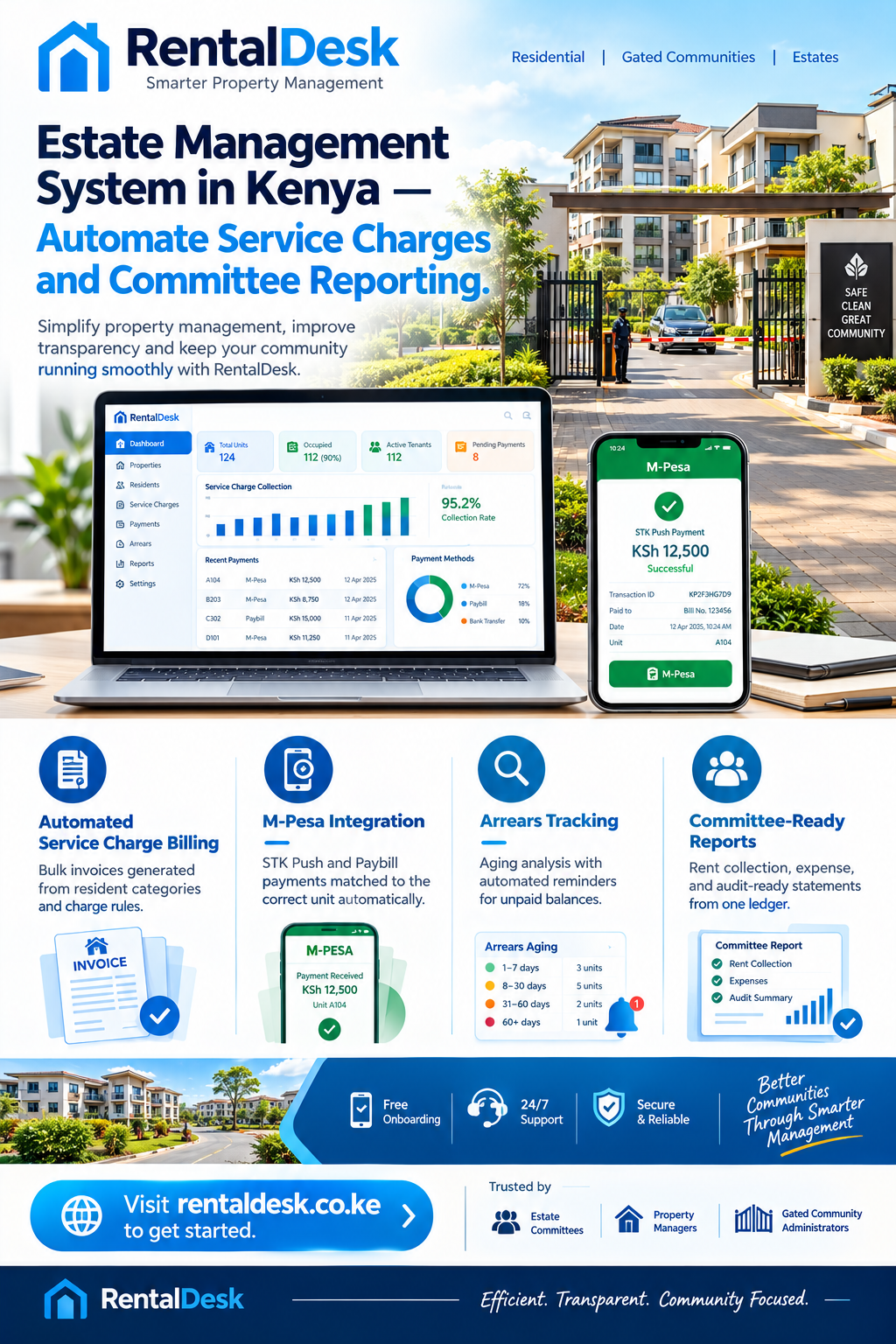
Estate management system in Kenya is the digital platform that turns a shared residential community from a collection of WhatsApp groups and spreadsheets into a governed financial operation. In a Kenyan gated community, the estate is not simply a place where people live. It is a shared business. Service charges fund security, garbage collection, water, landscaping, and common area maintenance. Every resident contributes. Every committee is accountable. And every month, the records either add up or they do not.
The problem is that most estates in Kenya still run these operations on manual systems, and the failure modes are predictable. Service charge arrears accumulate unnoticed. M-Pesa payments arrive without matching to the correct unit. Committee members cannot produce an audited statement when a resident challenges a figure. And the residents who do pay on time become resentful when they see no consequence for those who do not.
A properly implemented estate management system in Kenya changes this. It creates one connected sequence from resident and unit records, through recurring charge configuration and bulk invoice generation, to payment recording, arrears visibility, and committee-ready reports. The value is not the dashboard. The value is the continuity of the records.
Why Estate Management Systems Matter in Kenya Now
The conversation around an estate management system in Kenya has acquired urgency because the legal and operational environment for gated communities has shifted. The Sectional Properties Act, 2020, transitioned property management from external companies to owner-controlled corporations governed by elected boards. Under the previous regime, management companies operated with considerable autonomy, and financial mismanagement became commonplace, with opaque accounting practices and misappropriation of funds. The new framework mandates owner corporations, requires signatures from at least two board members for legal instruments, and establishes Internal Dispute Resolution Committees for conflicts between owners.
That shift places greater responsibility on committees to maintain accurate records, demonstrate transparency, and account for every shilling collected. An estate management system in Kenya is no longer a convenience for large estates. It is the operational infrastructure that makes owner-controlled governance viable.
The Estate as a Shared Financial Operation
An estate is a shared financial operation, not a landlord-tenant arrangement. Even where a caretaker handles day-to-day coordination, service-charge records often pass through an administrator, a finance user, a manager, and a committee. If every person keeps a separate spreadsheet, the estate ends up with several versions of the truth.
A useful estate management system in Kenya creates one connected sequence. It sets up the estate workspace, units and resident records. It groups residents into categories where billing rules differ. It configures recurring service charges for the period. It generates invoices in bulk for eligible residents. It records payments against the correct invoices. It keeps pending, partly paid and settled positions visible. It issues resident statements and reviews arrears. And it exports invoice and payment reports for management or committee use.
The links between these steps matter. An incorrect category can create a wrong invoice. A payment allocated to the wrong invoice can distort a statement. The value of the system is the continuity of the records, not a decorative dashboard.
Resident and Unit Structure: The Foundation
Before any billing can happen, the estate must define what it is actually managing. This means a clear structure of units, residents, and categories. A resident record should be tied to the correct unit and placed in the correct category. Categories help when an estate has different approved charge rules. For example, apartments and townhouses might pay different rates. Occupied and developer-held units might be treated differently. Homes in different phases might have different charges.
Consider a 120-home estate in Kiambu with 80 townhouses and 40 apartments. The committee has approved a different monthly charge for each group. In a flat spreadsheet, someone must filter, copy, and check two amounts every month. With resident categories and recurring charges configured in an estate management system in Kenya, the rule is preserved and the appropriate invoices generate for each group automatically.
Good setup also reduces ambiguity during handovers. When a resident changes, the team needs a controlled way to update the current record while retaining useful transaction history. The objective is not to collect every possible detail. It is to keep the minimum accurate information required for billing, payments, statements, and reporting.
Service Charge Billing Automation
Service charge billing is the heart of estate management. In a manual system, invoices are generated unit by unit. Amounts are copied from last month’s spreadsheet. Some residents are missed. Others are billed the wrong amount. The committee cannot say with confidence how much was invoiced, how much was collected, or what remains outstanding.
An estate management system in Kenya automates this entirely. It generates invoices in bulk for all eligible residents based on the recurring charges configured for each category. It sends the invoices via SMS, email, or the resident portal. It tracks which invoices have been paid, which are part-paid, and which are unpaid. And it generates arrears reports showing aging balances by resident and by unit.
For estates in Kenya, the system should also handle different charge types within the same invoice. Service charge, water, garbage, security, and parking can all be itemised. Where utilities are metered, the system should record meter readings per unit and calculate consumption automatically. This transparency reduces disputes because residents can see exactly what they are being charged for.
M-Pesa Integration: The Collection Rail
Kenya runs on M-Pesa, and so should the estate. The majority of residents expect to pay service charges through mobile money. The estate management system in Kenya must integrate directly with M-Pesa Paybill so that payments are captured and matched automatically.
RentalDesk connects to Safaricom’s Daraja API with Instant Payment Notification callbacks. When a resident pays service charge via Paybill, the system extracts the amount, phone number, account reference, and transaction ID, matches the reference to the correct unit and resident, credits the account, generates a receipt, and updates the dashboard in real time. No more manual confirmation messages. No more screenshots pasted into a WhatsApp group. No more reconciliation mysteries at month-end.
The system should support STK Push as well. Residents receive a payment prompt directly on their phone when they click “Pay Service Charge” on their invoice. They enter their PIN and the payment completes. This convenience improves collection rates because it removes the friction between intention and payment.
Utility Billing for Estates
Many Kenyan estates manage shared utilities. Water is billed to the estate and then recovered from residents. Garbage collection is charged as a fixed fee. Electricity may be sub-metered. Security is a core service funded by the service charge.
An estate management system in Kenya should record meter readings, calculate usage, generate automated bills, and track unpaid balances. For water billing, the system should allow readings to be entered per unit and compared against previous periods to flag anomalies. A sudden spike in consumption might indicate a leak, and the system should surface it before the resident receives a bill they will dispute.
The utility billing module connects to the same ledger as service charge billing. When a resident pays, the payment is applied to the oldest outstanding charge first, whether that is service charge, water, or garbage. The resident statement shows the complete position, not just the service charge balance.
Arrears Tracking and Aging Analysis
Service charge arrears are the single most common financial problem in Kenyan estates. Residents who do not pay become a burden on those who do, and the committee’s ability to maintain security, garbage collection, and common areas degrades.
An estate management system in Kenya should track arrears with aging analysis, categorising balances by 1–7 days, 8–30 days, 31–60 days, and 60+ days. The longer a balance sits unpaid, the lower the probability of full recovery. The system should surface the 60+ day cases on the dashboard so the committee can act on what matters rather than treating every arrears case identically.
RentalDesk provides automated arrears reports, aging analysis, and payment behaviour analysis. Tenants who are behind on service charges are visible on the dashboard with their full payment history attached. The system also supports automated reminders sent via SMS and email, escalating from a friendly heads-up to a formal notice.
Committee Reporting and Transparency
Under the Sectional Properties Act, owner corporations are governed by elected boards and must demonstrate accountability to residents. The estate management system in Kenya must generate the reports that make this possible.
The system should produce rent collection reports showing total charges billed, total collected, and outstanding balances. It should generate expense reports showing where the money was spent. It should produce a reserve fund statement if the estate maintains one. And it should generate resident statements showing each resident’s complete payment history and running balance.
RentalDesk generates rent collection reports, income versus expense reports, occupancy reports, arrears summaries, and audit-ready financial statements from the same verified records used for daily operations. The figures that appear in a committee report are the same figures that appear in the resident statements and the arrears aging report. Nothing has to be rebuilt, and nothing is inconsistent between reports.
Resident Communication and the Portal
Communication is where many estates fail. Notices are printed and posted on notice boards that nobody reads. WhatsApp groups become chaotic. Residents miss important announcements. Committee meetings are poorly attended because members do not have the information they need to participate.
An estate management system in Kenya should include a resident portal where residents can view their service charge balance and payment history, download receipts, see invoices, receive announcements, and submit maintenance requests. The portal reduces the number of routine inquiries the estate office receives. Residents check their own balance instead of calling the caretaker. They download their own receipt instead of requesting one.
The system should also support bulk SMS and email for announcements, payment reminders, and emergency notices. When a water interruption is scheduled, every resident receives a message. When the committee meeting is rescheduled, every resident is notified. This professionalises communication and reduces the friction that erodes trust.
Maintenance Request Tracking
Maintenance is a major operational responsibility for estates. Common areas need repair. Streetlights fail. Security gates need servicing. Water pumps need maintenance. Without a system for tracking these requests, they are forgotten or delayed, and residents become frustrated.
An estate management system in Kenya should allow residents to submit maintenance requests through the portal with photos and descriptions. The committee or property manager can assign requests to vendors, track progress, approve quotations, and record completion with evidence. This structured approach ensures no repair is forgotten and all costs are properly documented.
For estates with multiple blocks and common areas, the maintenance log becomes a portfolio-wide view of open repairs. Repairs that would otherwise be forgotten inside WhatsApp threads become tracked tasks with owners, deadlines, and completion evidence.
Multi-Estate Management for Property Managers
Some property management companies and estate management firms handle multiple estates. They need a system that supports portfolio-wide visibility without losing estate-level detail. The estate management system in Kenya should allow the firm to manage multiple estates from one dashboard, with separate records for each estate, estate-specific role permissions, and consolidated portfolio reporting.
RentalDesk supports multi-property management. The firm can view all estates at a glance, monitor service charge collection per estate, compare performance across different communities, and generate estate-specific reports for each committee. Role-based access ensures that the manager responsible for Estate A does not inadvertently see the financial records of Estate B.
Implementation: How to Choose and Deploy
Choosing an estate management system in Kenya should begin with requirements, not features. Turn broad frustrations into testable requirements. “Our records are confusing” is difficult to score. “A resident statement must show invoices, recorded payments and a running balance” can be demonstrated. “We need better accountability” becomes “different roles have appropriate access and activity history shows changes”.
Separate mandatory outcomes from desirable extras and assign evidence to every requirement. Evidence might be a live workflow, a sample statement, an export, or an access test. This prevents a committee from giving full marks to capabilities that were mentioned but never shown.
Before migration, inventory every unit, resident, category, and opening balance. Clean resident names and unit numbers before loading data. Define the charge rules for each category. Configure the recurring charges and generate the first invoices in a pilot batch before rolling out to the full estate. Run the system in parallel with the existing method for one full billing cycle and reconcile the results. Resolve every variance before switching off the old process.
Pricing Considerations
Estate management system pricing in Kenya varies by unit capacity and feature set. Public plans for platforms like EstateAdmin range from KSh 5,000 per month for up to 100 units, to KSh 10,000 per month for up to 500 units, to KSh 20,000 per month for unlimited units with advanced integrations. RentalDesk offers a Free Lite plan at KES 0 forever for one property with up to five units, a Starter Plan at KES 5,000 per month covering up to 99 units, and an Estate Manager Plan at KES 9,500 per month for 100–999 units.
The monthly subscription is only part of the total cost. Data preparation, onboarding, training, and the operating work that remains after implementation all contribute to the total cost of ownership. A plan may be inexpensive yet unsuitable if the team must keep a parallel spreadsheet for partial payments, arrears, or statements.
Common Implementation Mistakes
The estate management system in Kenya journey has predictable failure modes. Migrating unclean data — disputed balances, inconsistent resident names, incorrect unit assignments — transfers problems rather than solving them. Failing to define categories before billing means some residents are charged the wrong amount. Skipping the parallel run means configuration issues are discovered in production rather than in a controlled test. Turning off reminders means the automation ends at the invoice. Leaving the ledger disconnected from M-Pesa reconciliation means the balance the resident sees does not match the balance the committee holds.
How RentalDesk Supports Estate Management in Kenya
RentalDesk is built specifically for the Kenyan market and supports the estate management workflow from setup to reporting.
Resident and unit management. The platform maintains digital resident profiles, unit allocation, owner and tenant records, and occupancy tracking.
Service charge billing automation. Invoices are generated in bulk for all eligible residents based on the recurring charges configured for each category.
M-Pesa integration. STK Push and Paybill payments are captured and matched to the correct unit automatically, with real-time reconciliation.
Utility billing. Meter readings are recorded per unit, consumption is calculated, and automated bills are generated.
Arrears tracking. Balances are categorised by age (1–7, 8–30, 31–60, 60+ days) with dashboard visibility and automated reminders.
Committee reporting. Rent collection reports, income versus expense reports, arrears summaries, and audit-ready financial statements are generated from verified records.
Resident portal. Residents can view balances, download receipts, receive announcements, and submit maintenance requests through a self-service portal.
Role-based access. Committee members, estate managers, caretakers, and residents see only what their role requires, with every action logged.
The Future of Estate Management in Kenya
The estate management system in Kenya landscape is moving toward greater digitisation. The Sectional Properties Act, 2020, explicitly recognises digital solutions. Corporations are now empowered to conduct voting electronically and communicate with members through digital platforms, improving governance transparency and owner participation. Government tax infrastructure is integrating with property management platforms. And residents increasingly expect the same digital convenience from their estate that they get from every other service provider.
The estates that adopt a structured management system early will not simply have tidier records. They will have higher collection rates, better financial transparency, stronger committee governance, and a community that trusts the numbers. RentalDesk provides the structured platform that makes an estate management system in Kenya work — not as a collection of spreadsheets held together by memory, but as a governed operating model with automated billing, M-Pesa reconciliation, and committee-ready reporting.
- Estate management system in Kenya
- Estate management system in Kenya
- Estate management system in Kenya
- Estate management system in Kenya
- Estate management system in Kenya
- Estate management system in Kenya
- Estate management system in Kenya
- Estate management system in Kenya
- Estate management system in Kenya
- Estate management system in Kenya
- Estate management system in Kenya
- Estate management system in Kenya
- Estate management system in Kenya
- Estate management system in Kenya