
An owner report cutoff answers a small but important question: what did the figures represent when the report was prepared? A statement closed on Monday evening can correctly show an unpaid balance even when Tuesday’s live ledger shows a payment.
Take a fictional tenant owing KSh 8,000 at Monday’s close who pays KSh 3,000 on Tuesday. Assuming no other entries, the current balance is KSh 5,000. The Monday snapshot still shows KSh 8,000. Label the report date and the transaction period separately so readers can reconcile the difference.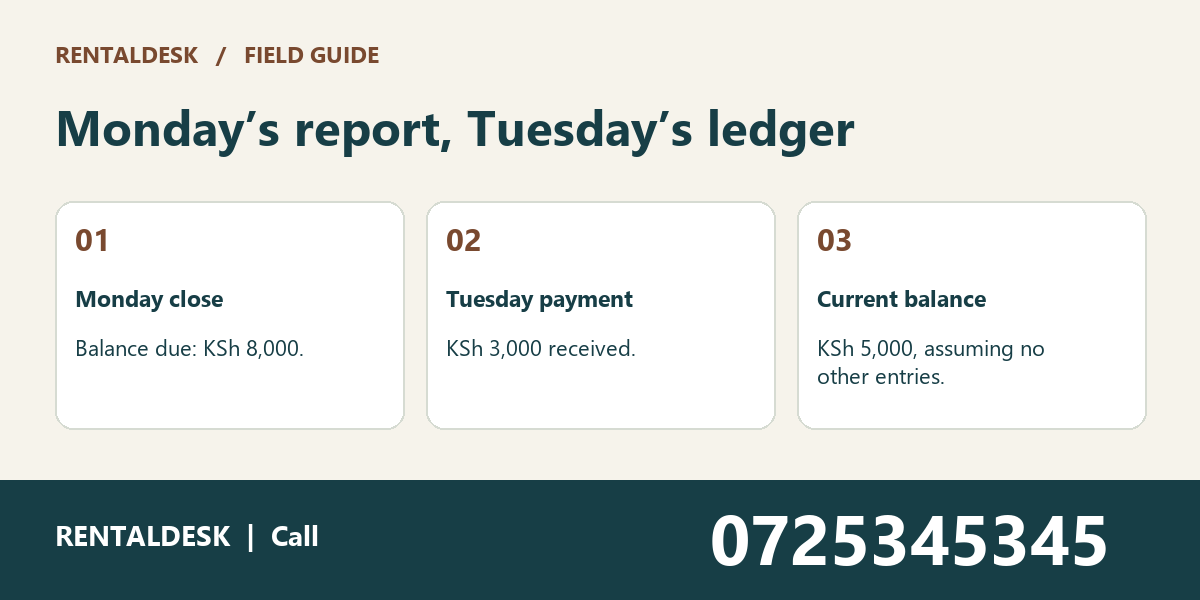
Keep the two records distinct
For a chama-owned building, member contributions recorded in a tool such as TAS answer a different question from tenant rent collections. Identify the source of each total before presenting it to members. If an attachment is shared through an external link such as Awasa, check its destination and audience before including private records.
Owner report cutoff: what a useful result looks like
The report boundary belongs in the heading, not only in a conversation with the preparer. An owner should be able to tell which property, period and version a figure describes after the attachment has been forwarded or reopened later. Label the reporting cutoff and the time the file was produced because those are different pieces of information.
When a number changes, build a bridge rather than arguing about which screen looks newer. Start from the issued amount and identify the confirmed later entries that lead to the current view. A tidy presentation does not make an unexplained adjustment correct.
Keep the demonstration fictional when asking a software provider how its reports work. Choose a simple account, a known balance and one receipt after the boundary. Ask the presenter to show the historic report and the current ledger separately. Confirm the available filters and reporting basis rather than assuming every report treats dates identically.
1. Owner report cutoff: Tuesday’s payment follows Monday’s close
A fictional account owes KSh 8,000 at Monday close. A KSh 3,000 payment is received on Tuesday.
Start the owner report cutoff exercise by naming the question in full: can the team demonstrate explaining exactly which transactions belong in the issued owner statement? A general impression from a property office producing a period-end statement is useful background, but it does not establish what happened in this particular example.
Identify the agreed reporting boundary and show the Tuesday receipt in the subsequent activity explanation. Assuming no other entries, Monday remains KSh 8,000 while the later live balance is KSh 5,000.
The first entry on the statement reconciliation sheet should give the next reader a place to start. Write the property, period and issue version beside the observation, then add the source used for comparison. Label the Monday figure and Tuesday update separately. If that final instruction cannot be carried out yet, leave the item open and say exactly what is missing.
2. Receipt date and posting date differ
A payment was received before the reporting boundary but entered by staff the next morning.
Before deciding what to change, separate what was observed from what someone expected. For owner report cutoff, the useful comparison here is the approved ledger view for the stated reporting period. Make sure it addresses the same question as the original observation; otherwise a second result may introduce another difference instead of explaining the first.
Check the organisation’s approved basis for inclusion, the actual receipt date and the posting record. The two dates describe different events. Whether to revise an issued report depends on the approved reporting process.
A handover note can be short. Use three lines: what was reported, what was compared, and what the comparison established. Explain the treatment rather than silently editing the earlier file. A colleague who receives that note should know whether to repeat a check or refer a specific question to the person responsible.
3. Owner report cutoff: A report was generated after the period
A file generated on Wednesday covers transactions through Monday. A reader assumes it includes Wednesday’s receipts.
Give the report preparer a clean copy of the example. Ask them to identify the dated transaction without using the previous colleague’s private notes. If they cannot do that, pause before interpreting the result. An ambiguous starting point can make an otherwise careful comparison misleading.
Label both the covered period and generation date in the heading or cover note. A recent filename does not make the underlying selection current to that date.
For this part of owner report cutoff, record the outcome in factual language. Ask the reader to identify the reporting boundary from the file alone. Keep the original observation visible alongside the new one. That lets someone reviewing the case later distinguish a confirmed change from a difference in how the two observations were made.
4. Two buildings are mixed in one total
The owner expects one building, but the export includes another property with a similar label.
This example is a useful test of the team’s assumptions about owner report cutoff. Ask two colleagues to explain what the initial information proves. If their answers differ, identify the missing detail instead of choosing the explanation that sounds most confident.
Check the property selector, approved references and counts by property before interpreting the total. A period can be correct even when the property scope is wrong.
Use the statement reconciliation sheet to preserve the distinction. A note such as “checked” is hard to act upon; a note naming the comparison and its outcome is useful even after the original preparer leaves. Regenerate the scoped report and identify the version it replaces. Record any open dependency with the person expected to resolve it.
5. Owner report cutoff: A correction changes a previously issued figure
An authorised correction is made to an entry that appeared in a statement already delivered to the owner.
An earlier successful check can still be relevant without settling the present question. Look for a change in time, scope, location or responsibility. In owner report cutoff, that change may explain why two apparently conflicting observations can both be accurate.
Follow the approved correction process and record which statement, item and version are affected. A revised figure needs an explanation of the change, not an unexplained replacement file.
Ask the report preparer to state the current position in one sentence. Then ask what would cause that sentence to change. Notify the appropriate recipient of the current authorised version. This gives the next reviewer a specific condition to investigate instead of a vague instruction to monitor the situation indefinitely.
6. An owner group asks about contributions
A chama-owned building receives rent while members also make contributions to a separate group account.
The important detail here is the boundary between an old arrangement and the current one. For owner report cutoff, record when the new information became relevant and which earlier instruction it replaces. Without that distinction, two colleagues can follow different instructions while both believe they are using the latest record.
Identify which source and purpose each total represents before presenting a combined explanation. Member contributions and tenant rent are not interchangeable simply because the same people review both reports.
Once the responsible person confirms the change, check the actual working copy that the next person will use. Keep the statement labels and sources distinct. Do not assume that updating a private note also updates every place where the earlier arrangement was recorded or communicated.
7. Owner report cutoff: A live dashboard no longer matches the statement
The owner opens the live dashboard days later and sees a different balance from the issued report.
Use this final case as a handover exercise. The outgoing colleague should explain the current position without relying on labels such as “sorted” or “fine.” The receiving colleague should be able to identify the dated transaction, find the comparison and name the next action.
Build a short bridge from the statement amount through subsequent confirmed transactions to the current figure. A changed live balance is not automatically a statement error. Differences need a dated explanation.
For owner report cutoff, the handover is complete when the owner can reconcile the issued statement with later activity without mixing periods. Give the owner the reconciliation and any unresolved exception. If another decision is still needed, state who owns it and how its outcome will return to the current record. That is a more useful finish than merely crossing an item off a list.
A practical owner report cutoff worksheet
Keep the statement reconciliation sheet short enough to update while the work is happening. Give each entry a reference that another colleague can find. Include the property, period and issue version, the time or period of the observation, the person responsible for checking it and the next agreed action. Use the organisation’s normal storage and access arrangements.
For owner report cutoff, add one column for evidence and another for the conclusion. Evidence describes what someone could check again; a conclusion explains what the team currently thinks it means. If the source changes, the explanation may need to change too. That is why an answer copied from an earlier record should not automatically become the answer for a new case.
For example, start with this observation: A fictional account owes KSh 8,000 at Monday close. A KSh 3,000 payment is received on Tuesday. Follow it with the specific comparison rather than a general assurance: Identify the agreed reporting boundary and show the Tuesday receipt in the subsequent activity explanation. The entry now gives the next person enough context to continue without needing a separate conversation to discover what was originally meant.
Questions to settle before closing the review
Who can confirm the source for owner report cutoff? For owner report cutoff, start with the person responsible for the approved ledger view for the stated reporting period. A colleague can report a symptom or tell you what they saw without necessarily having authority to change the source or approve an action. Keep the report and the decision distinguishable.
What if owner report cutoff leaves the result uncertain? Mark it as an open question, describe the missing information and agree on the next check. For owner report cutoff, an incomplete but accurate statement reconciliation sheet is more useful than a finished-looking entry that hides an assumption. Do not repeat an action merely to create a more convenient outcome.
When should the team repeat its owner report cutoff review? Recheck it when the relevant property, period and issue version changes, when another source contradicts it or when the receiving colleague cannot reproduce its meaning. Use the dated transaction and the original comparison as the starting point rather than trying to reconstruct the whole history from memory.
Owner report cutoff: a worked handover note
A simple reconciliation note might read: “Monday closing balance KSh 8,000; Tuesday receipt KSh 3,000; current balance KSh 5,000, assuming no other entries.” Put the dates and property reference alongside the figures. If a different transaction also occurred, include it rather than forcing the bridge to match the example. If the final balance remains unexplained, record the amount of the difference and the source that needs review. Give the owner a clear distinction between a later event and a correction to an earlier report.
For a second practice exercise, give the receiving colleague the case titled “A report was generated after the period” without its conclusion. Ask them to identify the original observation, the comparison and the action owner. Then compare their answer with the decision recorded above. A difference in interpretation is a reason to clarify the note while the person who prepared it can still explain the evidence.
For more examples, explore the RentalDesk property management guides. Take the statement reconciliation sheet to your next review so the discussion starts with a specific case.
Use the RentalDesk export review before releasing a statement. Ask one colleague to explain the Monday and Tuesday figures without reopening the full ledger. For help preparing an owner reporting demonstration, call 0725345345. Include that cutoff in the filename as well as the report itself.
Send the owner the dated explanation alongside the statement, and retain the approved version.