
A water meter rollover is one possible reason a current reading is lower than the previous one.
Start with the unit, meter identifier and dates. Compare both photographs and check the register’s actual capacity. If you use a custom reporting portal, such as one commissioned through Zama, check that leading zeros remain visible. A displayed value of 12 does not tell you how many digits the physical register has.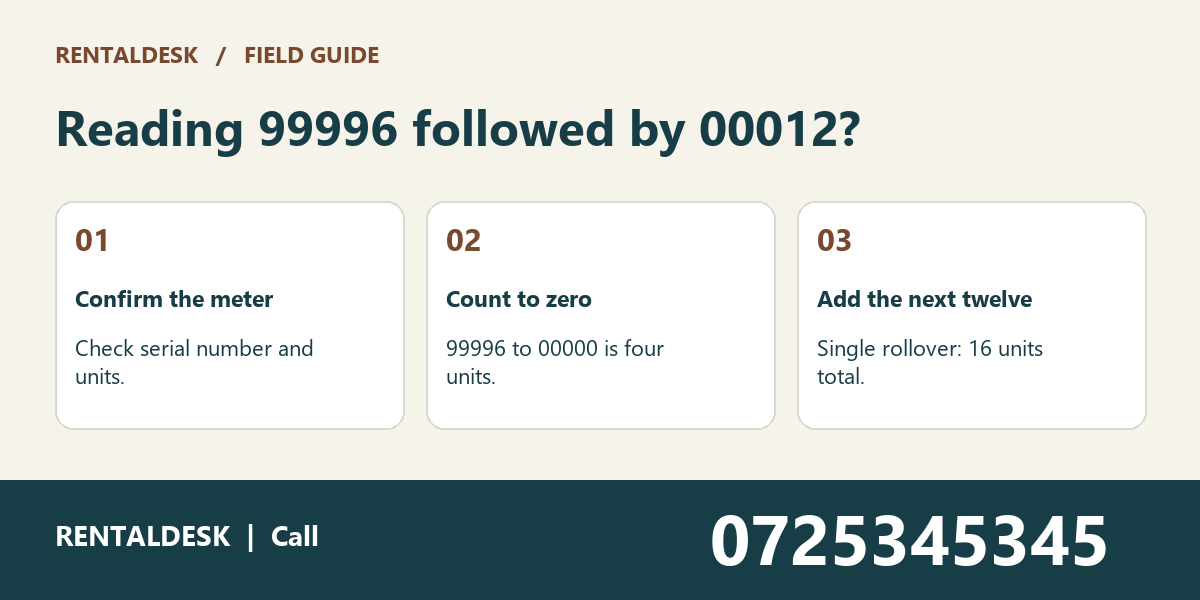
Work the example before billing
For a five-digit whole-unit register that wraps from 99999 to 00000, a change from 99996 to 00012 represents 16 units: four to reach zero and twelve more afterwards. That arithmetic applies only after confirming the same meter, the same units and a single rollover.
Water meter rollover: what a useful result looks like
A rollover calculation starts with the physical register, not with a spreadsheet formula. A lower current number is a prompt to investigate, not permission to assume a wrap.
Keep measurement and billing separate while the reading is under review. A caretaker may be able to confirm a serial number or take another photograph without having authority to approve a charge. Record the verified quantity before applying the authorised billing process. This article’s numerical examples illustrate register arithmetic; they do not establish a tariff or an amount due.
Make the photographs usable to the next reviewer. The date, property reference and physical identifier should allow someone to locate the correct meter without relying on a nickname. When discussing the software with a provider, use fictional readings instead of a resident’s private account information.
1. Water meter rollover: A five-digit register wraps once
The earlier whole-unit reading is 99996 and the verified current reading is 00012. The same five-digit register is in both photographs.
Start the water meter rollover exercise by naming the question in full: can the team demonstrate explaining a lower current reading before any charge is released? That wording keeps the discussion tied to the task. A general impression from a building with individually labelled water meters is useful background, but it does not establish what happened in this particular example.
Confirm the register cycles at 100000. Calculate 100000 minus 99996 plus 12 and retain both photos. The result is 16 units, not a negative change or a reason to guess a replacement charge.
The first entry on the meter exception worksheet should give the next reader a place to start. Write the meter identifier, unit and reading date beside the observation, then add the source used for comparison. Document the single-rollover assumption beside the calculation. If that final instruction cannot be carried out yet, leave the item open and say exactly what is missing.
2. The serial number changed
The old meter shows 43891 while the current meter shows 00012. Their serial numbers are different.
Before deciding what to change, separate what was observed from what someone expected. For water meter rollover, the useful comparison here is the earlier photograph of the same physical register. Make sure it addresses the same question as the original observation; otherwise a second result may introduce another difference instead of explaining the first.
Locate the approved replacement record, final reading from the old meter and starting reading from the new one. A replacement is not a wrap of the same register. Consumption on each meter needs its own interval.
A handover note can be short. Use three lines: what was reported, what was compared, and what the comparison established. Hold the exception open when a boundary reading is missing. A colleague who receives that note should know whether to repeat a check or refer a specific question to the person responsible.
3. Water meter rollover: The digits include a decimal place
One photograph shows 1234.8 and the next was entered as 12352 because the decimal point was omitted.
Give the meter reading reviewer a clean copy of the example. Ask them to identify the meter photograph without using the previous colleague’s private notes. If they cannot do that, pause before interpreting the result. An ambiguous starting point can make an otherwise careful comparison misleading.
Read the register markings and units before calculating. Compare the displayed digits with the recorded values. When the second reading is actually 1235.2, the difference from 1234.8 is 0.4 in the same units.
For this part of water meter rollover, record the outcome in factual language. Record the confirmed precision instead of silently removing the decimal. Keep the original observation visible alongside the new one. That lets someone reviewing the case later distinguish a confirmed change from a difference in how the two observations were made.
4. Adjacent meter labels look alike
Two meter boxes carry similar handwritten flat numbers and the caretaker photographs the neighbouring register.
This example is a useful test of the team’s assumptions about water meter rollover. Ask two colleagues to explain what the initial information proves. If their answers differ, identify the missing detail instead of choosing the explanation that sounds most confident.
Match the physical serial number, property and unit to the approved mapping. Repeat the observation if necessary. A plausible looking number from the wrong meter is not evidence of consumption at the intended flat.
Use the meter exception worksheet to preserve the distinction. A note such as “checked” is hard to act upon; a note naming the comparison and its outcome is useful even after the original preparer leaves. Correct the mapping question before using the value. Record any open dependency with the person expected to resolve it.
5. Water meter rollover: An image has leading zeros
The physical register reads 00012 but a spreadsheet displays 12. A reviewer assumes the entire register has two digits.
An earlier successful check can still be relevant without settling the present question. Look for a change in time, scope, location or responsibility. In water meter rollover, that change may explain why two apparently conflicting observations can both be accurate.
Keep the original photo and record the physical digit capacity separately from the numeric value. Leading zeros do not change the value twelve, but they help interpret the register capacity in a rollover calculation.
Ask the meter reading reviewer to state the current position in one sentence. Then ask what would cause that sentence to change. Keep a readable display reference as well as the quantity. This gives the next reviewer a specific condition to investigate instead of a vague instruction to monitor the situation indefinitely.
6. A long gap leaves the interval uncertain
An unusually long interval separates readings. A simple calculation assumes exactly one wrap without supporting evidence.
The important detail here is the boundary between an old arrangement and the current one. For water meter rollover, record when the new information became relevant and which earlier instruction it replaces. Without that distinction, two colleagues can follow different instructions while both believe they are using the latest record.
Review intermediate readings, replacement events and normal usage context. Ask the responsible reviewer to resolve uncertainty. The two end readings alone may not establish how many wraps occurred or whether the register was replaced.
Once the responsible person confirms the change, check the actual working copy that the next person will use. Avoid issuing an estimated charge as confirmed measured use. Do not assume that updating a private note also updates every place where the earlier arrangement was recorded or communicated.
7. Water meter rollover: A corrected quantity needs a second check
The reading reviewer resolves the difference but the billing worksheet still uses the earlier mistaken quantity.
Use this final case as a handover exercise. The outgoing colleague should explain the current position without relying on labels such as “sorted” or “fine.” The receiving colleague should be able to identify the meter photograph, find the comparison and name the next action.
Trace the corrected reading through the approved billing workflow. Compare quantity, period and unit before release. A correct calculation in a private notebook does not establish that the intended account was updated.
For water meter rollover, the handover is complete when the reviewer can explain the consumption in consistent units using confirmed readings. Have the second reviewer check the actual billing record. If another decision is still needed, state who owns it and how its outcome will return to the current record. That is a more useful finish than merely crossing an item off a list.
A practical water meter rollover worksheet
Keep the meter exception worksheet short enough to update while the work is happening. Give each entry a reference that another colleague can find. Include the meter identifier, unit and reading date, the time or period of the observation, the person responsible for checking it and the next agreed action. Use the organisation’s normal storage and access arrangements.
For water meter rollover, add one column for evidence and another for the conclusion. Evidence describes what someone could check again; a conclusion explains what the team currently thinks it means. If the source changes, the explanation may need to change too. That is why an answer copied from an earlier record should not automatically become the answer for a new case.
For example, start with this observation: The earlier whole-unit reading is 99996 and the verified current reading is 00012. The same five-digit register is in both photographs. Follow it with the specific comparison rather than a general assurance: Confirm the register cycles at 100000. Calculate 100000 minus 99996 plus 12 and retain both photos. The entry now gives the next person enough context to continue without needing a separate conversation to discover what was originally meant.
Questions to settle before closing the review
Who can confirm the source for water meter rollover? For water meter rollover, start with the person responsible for the earlier photograph of the same physical register. A colleague can report a symptom or tell you what they saw without necessarily having authority to change the source or approve an action. Keep the report and the decision distinguishable.
What if water meter rollover leaves the result uncertain? Mark it as an open question, describe the missing information and agree on the next check. For water meter rollover, an incomplete but accurate meter exception worksheet is more useful than a finished-looking entry that hides an assumption. Do not repeat an action merely to create a more convenient outcome.
When should the team repeat its water meter rollover review? Recheck it when the relevant meter identifier, unit and reading date changes, when another source contradicts it or when the receiving colleague cannot reproduce its meaning. Use the meter photograph and the original comparison as the starting point rather than trying to reconstruct the whole history from memory.
Water meter rollover: a worked handover note
Write the equation alongside the physical observations: cycle capacity minus previous value plus current value. For the single wrap in this example, that is 100000 minus 99996 plus 12. Before accepting the answer, ask the reviewer to point to the actual evidence for each number and each assumption. The capacity comes from the register, the previous and current values come from dated readings, and the single wrap needs a reasonable basis for that interval. If those details are unavailable, label the calculation provisional rather than billing it as measured consumption.
For a second practice exercise, give the receiving colleague the case titled “The digits include a decimal place” without its conclusion. Ask them to identify the original observation, the comparison and the action owner. Then compare their answer with the decision recorded above. A difference in interpretation is a reason to clarify the note while the person who prepared it can still explain the evidence.
For more examples, explore the RentalDesk property management guides. Take the meter exception worksheet to your next review so the discussion starts with a specific case.
Keep an unexplained difference open for review rather than billing a guessed quantity. Ask RentalDesk to demonstrate the water billing workflow using those sample readings. Call 0725345345 with a fictional example; keep tenant details out of a general demonstration. Log the meter serial number too.
Before approving the charge, read the serial number with the caretaker and compare both dated photographs. Ask the reviewer to reproduce the calculation independently, then file the result with the readings.