
Rental reports and accounting in Kenya have become the operational discipline that determines whether a landlord can demonstrate compliance, recover arrears, and make informed investment decisions. The Kenya Revenue Authority has made this urgent. The Draft Income Tax (Residential Rental Income Tax) Regulations 2026, open for public comment until May 25, 2026, propose making registration on the Electronic Rental Income Tax System mandatory for all landlords within the existing monthly rental income tax band. KRA collected roughly KSh 17 billion annually from rental income tax against a government estimate of at least KSh 100 billion in potential revenue—a gap that has persisted even after the Finance Act 2023 cut the rate from 10% to 7.5% to encourage compliance.
A person subject to residential rental income tax is required to keep records necessary for the determination and ascertainment of the tax in accordance with the Tax Procedure Act, 2015, and to submit a return and pay the tax due on or before the 20th day of the month immediately following the month in which the rent was received. A properly structured rental reports and accounting in Kenya system is no longer an administrative preference. It is the foundation of every compliance decision a landlord makes.
Why Rental Reports and Accounting in Kenya Matter Now
The rental reports and accounting in Kenya conversation has acquired urgency because the voluntary era is ending. The eRITS platform, formally rolled out in September 2025 with a stated target of KSh 80 billion in annual collections, had onboarded just 1,412 landlords and 26,668 units by April 2026. KRA’s 2022 audit found underreporting as high as 75% in some Nairobi neighbourhoods, and the authority estimates over 60% of landlords remain entirely outside the formal tax system. The regulations propose mandatory registration for landlords earning gross rental income above KSh 288,000 but not exceeding KSh 15 million annually, who pay a flat 7.5% tax on gross receipts with no deductions permitted.
Understanding what rental reports and accounting in Kenya actually requires means understanding what KRA expects to see. A rent register showing every tenant, every property, and every payment received in the period. eTIMS-compliant receipts issued to tenants. Lease agreements for the tenancies that generated the rent. And bank statements or M-Pesa transaction logs showing the rent received. The introduction of eRITS does not lead to any change in the current tax compliance requirements for taxpayers. What changes is the mechanism. Filing and payment move to a digital platform that integrates with eCitizen and GavaConnect, with future integration with Ardhisasa anticipated to boost compliance through geo-referencing and data verification of rental properties.
What a Complete Rental Accounting System Should Contain
The rental reports and accounting in Kenya conversation must begin with what the accounting system actually needs to track. Most landlords operate with a bank statement and a memory. That is not an accounting system. A complete system contains several interconnected components.
Every invoice raised. Each charge should record the amount, the due date, the billing period, and any additional charges such as service charge, water, garbage, or parking. Without the invoice record, the payment record has nothing to be measured against.
Every payment received. The system records the amount, the date received, the payment method, and the transaction reference. For M-Pesa payments, this data arrives automatically through Safaricom’s C2B callback. For cash payments, it must be recorded at the point of collection.
Every allocation decision. When a payment is received, it must be allocated to a specific invoice. A partial payment must be posted against the open invoice, with the balance remaining visible.
Every expense recorded. Property income is incomplete without expenses. Landlords need to record repairs, caretaker payments, cleaning, security, water, electricity, service charges, commissions, legal costs, and other property expenses.
The running balance. The running balance after each transaction shows not just what was paid but what remained outstanding at each point in time. This is the figure that answers the question “how far behind was this tenant, and when?”
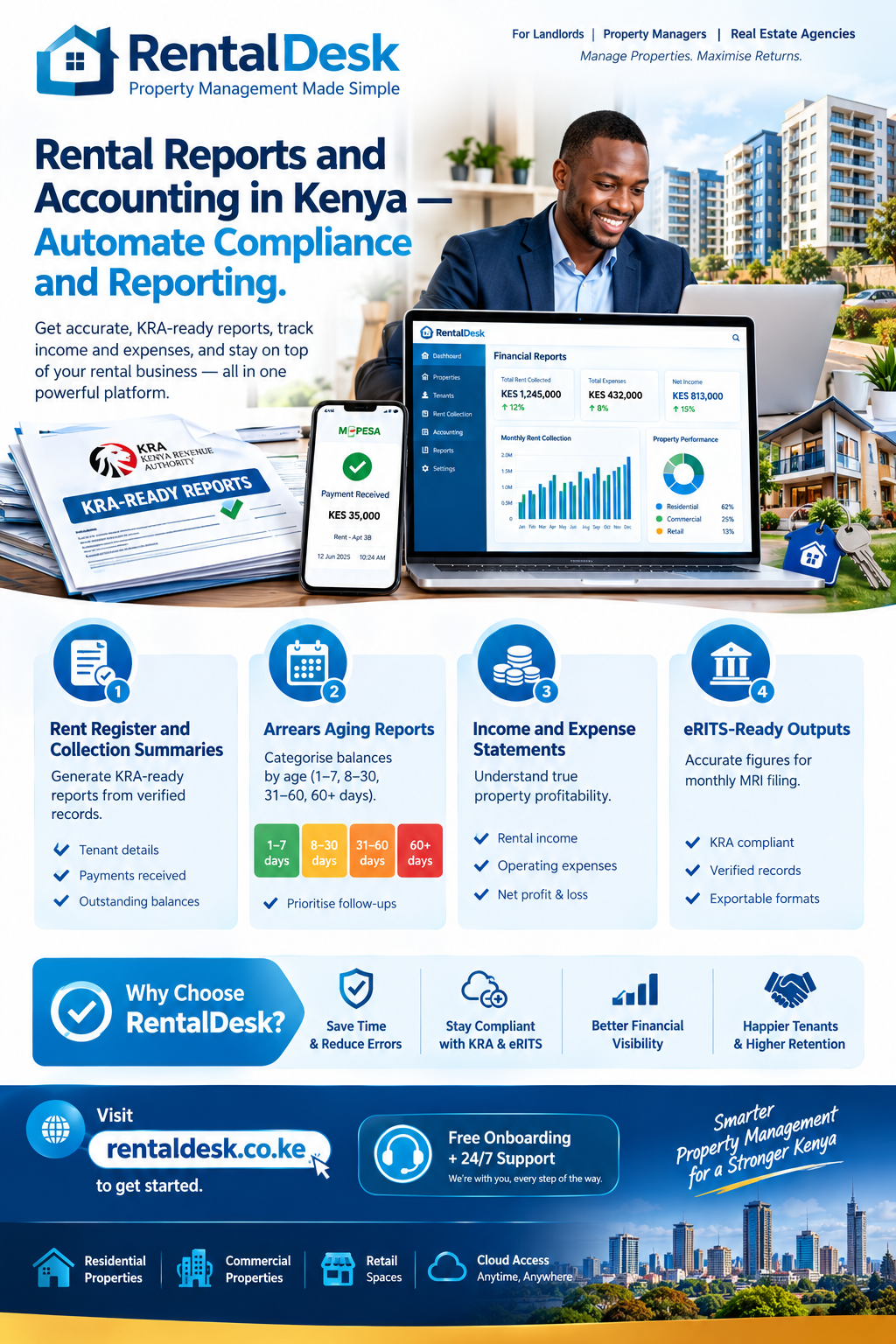
The reports. Rent collection summaries, arrears aging reports, income and expense statements, tenant statements, and KRA-ready financial reports. Any landlord researching rental reports and accounting in Kenya should confirm that the platform generates all of these automatically.
The Rent Register: KRA’s First Expectation
The rental reports and accounting in Kenya conversation must address the rent register, because it is the foundational document for compliance. KRA expects landlords to be able to produce a rent register showing every tenant, every property, and every payment received in the period.
The rent register should list each tenant, their unit, the rent charged, the amount paid, the date paid, and the outstanding balance. It should reconcile to the bank statements and M-Pesa records. It should be generated from the same verified records used for daily operations, not reconstructed at tax time.
RentalDesk generates the rent register automatically from reconciled payment records. The register is available on demand, covering any date range, and reconciles to the payment ledger. When KRA requires inspection of records, the landlord can produce the register immediately rather than scrambling through bank statements and WhatsApp messages.
Arrears Aging and Recovery Reporting
The rental reports and accounting in Kenya conversation must include arrears reporting, because arrears are the largest single source of landlord losses in Kenya. A single arrears total tells a landlord that something is wrong. An aging breakdown tells them where to act first.
Arrears should be categorised into buckets of 1–7 days, 8–30 days, 31–60 days, and 60+ days. The logic behind the buckets is straightforward. A payment one week late is almost always recoverable. A payment thirty days late requires structured follow-up. A payment ninety days late is often a legal matter. A payment a year late is usually a loss.
RentalDesk categorises arrears by age with dashboard visibility by tenant, unit, property, and owner. The 60+ day cases are surfaced so landlords act on what matters rather than treating every arrears case identically. Payment behaviour analysis shows average days late, frequency of late payment, and the arrears trend for each tenant—the metrics that inform tenancy renewal decisions.
Income and Expense Statements
The rental reports and accounting in Kenya conversation must address profitability, because rent collection alone does not tell a landlord whether a property is making money. The income and expense statement shows rent collected minus expenses incurred for a property or portfolio over a period.
Expenses include maintenance, caretaker salaries, utilities, security, cleaning, service charges, insurance, management fees, and any other costs associated with the property. Without expense tracking, a landlord may believe a property is profitable when it is actually losing money after costs.
RentalDesk records expenses against the correct property, unit, owner, or statement period. The system generates income versus expense reports per property and per portfolio. For property managers, this reporting is essential for owner accountability. An owner who sees rent collected, expenses incurred, and net income clearly stated is an owner who trusts the management.
Tenant Statements and Dispute Prevention
The rental reports and accounting in Kenya conversation must address tenant statements, because they prevent disputes before they escalate. A tenant statement shows the complete payment history for a single tenant: every invoice raised, every payment received, every adjustment made, and the running balance after each transaction.
When a tenant queries their balance, the statement answers the question with evidence rather than assertion. When a dispute arises, the statement is the evidence. When a tenancy ends, the statement supports the deposit settlement.
RentalDesk generates tenant statements on demand, covering any date range, reconciling to the ledger. The statement shows the partial payments, the outstanding balances, and the running position. A landlord who can produce a tenant statement immediately is a landlord who resolves disputes before they reach the tribunal.
Partial Payments and the Accounting Ledger
The rental reports and accounting in Kenya conversation must handle partial payments correctly, because they are the most common source of accounting error. When a tenant pays KSh 15,000 against a KSh 25,000 charge, the accounting system must post the partial amount against the open invoice and leave the balance open for follow-up.
A system that marks the invoice as paid loses the balance. A system that leaves the invoice unpaid misrepresents the payment. A system that splits the payment across months distorts the ledger. RentalDesk posts the partial amount against the open invoice and leaves the balance open. The next payment from the same tenant continues against the same invoice. The ledger reflects the true position at all times.
KRA Compliance and eRITS Reporting
The rental reports and accounting in Kenya question has acquired a compliance dimension that did not exist a few years ago. The eRITS platform supports voluntary compliance by integrating with existing Kenyan government digital platforms like eCitizen and GavaConnect. Landlords are required to register each rental property on eRITS, with registration applied at the individual unit level rather than just the landlord level.
RentalDesk generates KRA-ready reports that support MRI filing through eRITS. The platform tracks rental income, expenses, and arrears, providing the accurate records needed for monthly returns and avoiding penalties associated with inaccurate or late filings. The regulations prescribe that a person who fails to comply with the submission requirements shall be liable to the penalty prescribed in section 83 of the Tax Procedure Act, 2015. A landlord with clean digital records can populate the return accurately and avoid these penalties.
Data Protection and Accounting Records
The rental reports and accounting in Kenya conversation must acknowledge the legal boundary on how tenant data is used. Under Kenya’s Data Protection Act, 2019, tenant data—including names, phone numbers, National ID numbers, payment history, and arrears balances—is personal data. Landlords are required to register as data controllers or processors with the Data Protection Commissioner and designate a Data Protection Officer responsible for ensuring compliance with the DPA.
RentalDesk processes customer and tenant data in alignment with the Kenya Data Protection Act, 2019. The platform uses encrypted transport via HTTPS, role-based access controls, permission boundaries, operational monitoring and audit logs, and backup and disaster recovery controls. Every action taken within the system is logged with a timestamp and user identification. A rental accounting system without access controls is a data protection risk.
Common Accounting Mistakes Landlords Make
The rental reports and accounting in Kenya journey has predictable failure modes.
Mixing rent and deposits in one account. Deposits are the tenant’s money, held as security. Rent is the landlord’s income. Mixing them creates accounting confusion and, in some cases, legal exposure.
Failing to record expenses. A rent collection report without expenses presents a misleading picture of profitability. Maintenance costs, caretaker salaries, and utility bills must be recorded.
Reconciling at month-end instead of daily. A payment with a wrong reference sits unresolved for three weeks, and the tenant becomes anxious. Daily reconciliation resolves exceptions while they are fresh.
Treating the M-Pesa SMS as the ledger. A message proves money moved. The ledger explains why it moved and what remains due. The ledger is the authoritative record.
Failing to retain records. KRA can request records going back several years. A landlord who cannot produce the rent register, the receipts, and the lease agreements is exposed to penalties.
How RentalDesk Delivers Rental Reports and Accounting
RentalDesk is built specifically for the Kenyan market, and rental reporting and accounting sit at the centre of the platform. The platform generates the rent register, the rent collection summary, the arrears aging report, the income and expense statement, the tenant statements, and the owner statements from the same verified records used for daily operations.
It captures M-Pesa payments automatically through Safaricom’s Daraja API with Instant Payment Notification callbacks. It posts partial payments against the open invoice and maintains an accurate running balance. It generates KRA-ready reports for eRITS filing. It enforces role-based access so that caretakers, managers, and accountants see only what their role requires. And it maintains a complete audit trail, so every transaction, adjustment, and resolution is logged with a timestamp and user identification.
How to Get Started
Implementing rental reports and accounting in Kenya is straightforward with RentalDesk .
Step 1: Sign up. Visit RentalDesk and create your account. Choose a plan that matches your portfolio size.
Step 2: Record your lease terms. Enter rent amounts, due dates, billing frequencies, and any additional recurring charges for each tenancy.
Step 3: Configure M-Pesa collection. Connect your Paybill to RentalDesk so that payments reconcile automatically.
Step 4: Record expenses. Configure expense categories and record all property-related costs.
Step 5: Run a pilot cycle. Process one full billing period for a single property and reconcile the reports against the underlying records.
Step 6: Go live. Roll out to the full portfolio and review the arrears aging report each morning.
The Future of Rental Accounting in Kenya
The rental reports and accounting in Kenya landscape is moving in a clear direction. Government tax infrastructure is integrating with property management platforms, which means rental accounting will increasingly connect to compliance reporting. Standing order features allow tenants to authorise recurring payments directly from their mobile wallets. And the gap between collection, reporting, and compliance is closing.
The landlords who adopt structured rental reporting and accounting early will not simply have tidier records. They will have lower write-offs, faster recovery, better owner relationships, and a compliance position that withstands scrutiny. RentalDesk provides the structured platform that makes rental reports and accounting in Kenya work—not as a year-end reconstruction exercise, but as a continuous, verified record that protects the landlord’s income and satisfies the tax authority.