
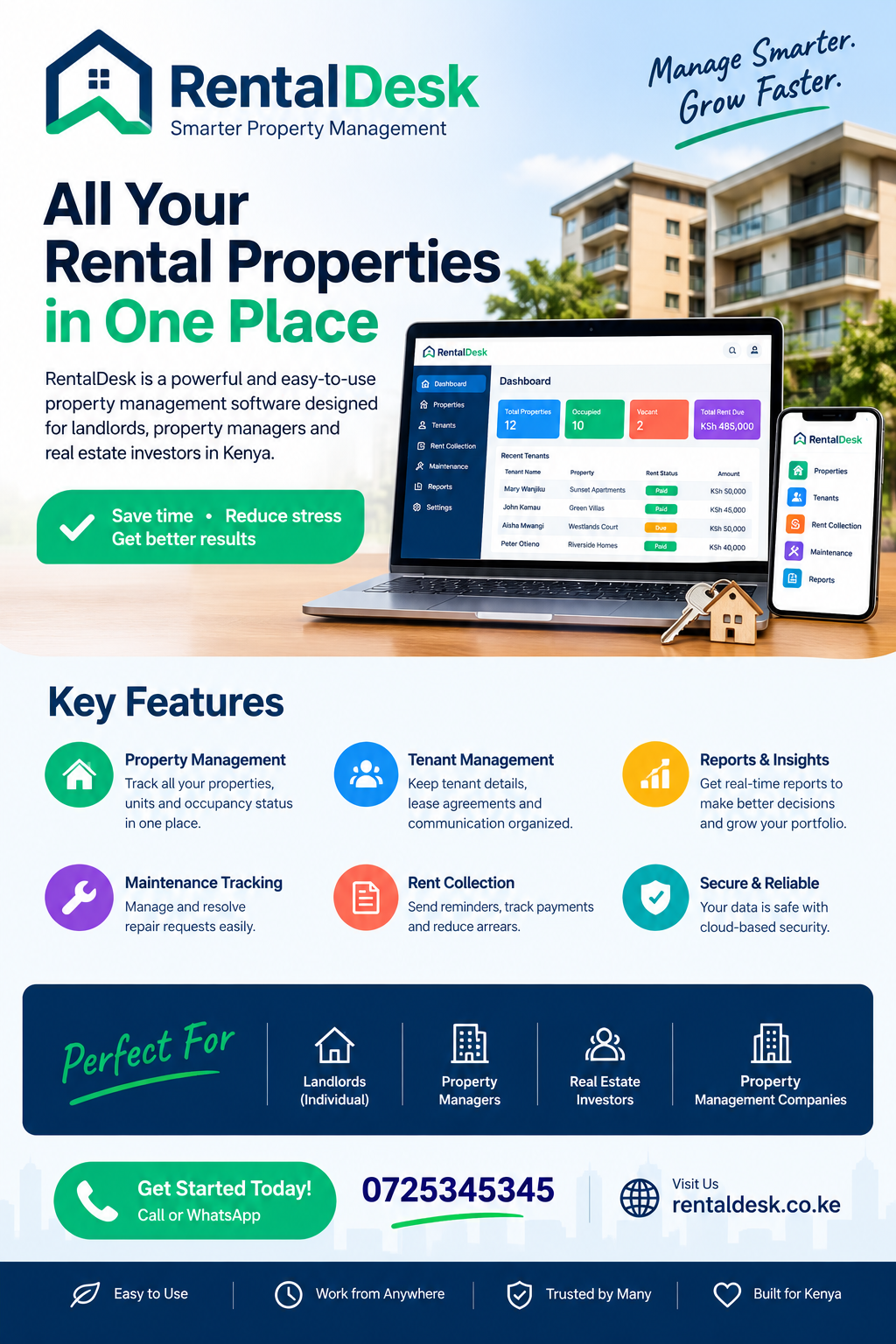
Rental Records Management Software Kenya: A Complete Guide for Landlords and Property Managers
Managing rental property involves much more than collecting rent every month. Landlords and property managers must keep accurate tenant details, organize tenancy agreements, record payments, monitor outstanding balances, track maintenance requests, and maintain reliable financial information. As a rental portfolio grows, managing these responsibilities using notebooks, paper files, and scattered spreadsheets becomes increasingly difficult. Rental Records Management Software Kenya provides a useful starting point for understanding how digital tools can simplify these responsibilities and help property owners maintain organized rental operations.
For landlords in Nairobi, Kiambu, Mombasa, Kisumu, Nakuru, Thika, and other Kenyan towns, accurate records support better decisions and more consistent property management. A missing receipt, outdated tenant contact, unsigned agreement, or incorrectly recorded payment can create unnecessary disputes and administrative work.
This guide explains what rental records management software does, the records every landlord should maintain, the benefits of digitization, the features worth considering, and the practical steps for implementing a reliable record-keeping process. It also examines Kenyan rental operations, including M-Pesa payments, rent arrears, lease documentation, maintenance expenses, and data protection.
1. What Is Rental Records Management Software?
Rental records management software is a digital system designed to organize information associated with rental properties, tenants, payments, agreements, and property operations. Instead of maintaining separate files for each responsibility, a landlord can use a centralized platform to access relevant information in one place.
A well-designed system helps users retrieve information quickly, update records consistently, and maintain a clearer history of rental transactions.
For example, a landlord with eight residential units might currently use a notebook to record rent, WhatsApp messages to communicate with tenants, a spreadsheet for expenses, and a cabinet for signed agreements. Each method may work independently, but together they can create confusion.
A digital platform such as the solutions explored through Rental Records Management Software Kenya can help landlords understand the value of bringing these records into a more structured process. The appropriate system depends on the property’s size, operational needs, budget, and existing workflow.
What records can the software manage?
Depending on its features, a rental records system may organize:
- Property names, locations, and unit numbers.
- Tenant names and contact information.
- Tenancy start dates and expiry dates.
- Monthly rent amounts and payment histories.
- Receipts and outstanding balances.
- Security deposit records.
- Lease agreements and related documents.
- Maintenance requests and repair expenses.
- Utility bills and service charges.
- Landlord income and property-related expenses.
- Inspection reports and property condition records.
- Tenant communications and important notices.
Not every platform provides all these features. Landlords should confirm which functions are included before purchasing a subscription or committing to a particular provider.
How is it different from ordinary spreadsheets?
Spreadsheets can be effective for simple rental portfolios. However, they depend heavily on accurate manual entry and consistent file management.
A specialized system may provide tenant profiles, automated calculations, document storage, reminders, reporting, and controlled user access. These capabilities can reduce repetitive work when configured correctly.
| Record-keeping method | Main advantage | Potential limitation |
|---|---|---|
| Paper files | Simple to start | Difficult to search and vulnerable to physical damage |
| Spreadsheets | Flexible and inexpensive | Manual updates can create inconsistencies |
| General accounting software | Useful for financial records | May lack tenancy and property-specific functions |
| Rental management platform | Can combine tenant, property, and payment records | Features, costs, and integration quality vary |
The best option is the one that supports the actual work required rather than the one with the longest feature list.
2. Why Accurate Rental Records Matter in Kenya
Rental income can involve frequent transactions, changing tenancy arrangements, repairs, utility charges, and communication with multiple occupants. Without a consistent record-keeping process, even a small property portfolio can become difficult to manage.
Landlords searching for Rental Records Management Software Kenya should consider the operational problems they want to solve before choosing a platform.
Better visibility into rental income
Knowing how much rent should be collected is only the first step. Property owners also need to understand how much has been received, which payments remain outstanding, and whether expenses are reducing the property’s profitability.
Accurate records make it easier to compare expected income against actual receipts.
Consider a landlord who owns twelve residential units, each rented for KSh 12,000 per month. The expected monthly rent is KSh 144,000 before vacancies, concessions, or other adjustments.
If the landlord receives KSh 120,000, the difference is KSh 24,000. A reliable rent register should identify the units associated with that difference rather than simply showing a total amount received.
This distinction helps the landlord follow up appropriately and investigate recording errors.
Fewer administrative mistakes
Manual record keeping creates several opportunities for error:
- Entering a payment under the wrong tenant.
- Recording the same payment twice.
- Forgetting to update a tenant’s outstanding balance.
- Misplacing a receipt.
- Using an expired rental agreement.
- Confusing payments for different units.
- Forgetting to record a maintenance expense.
A structured digital workflow can reduce these problems by connecting information to specific properties and tenants. However, staff must still review transactions and correct discrepancies.
Easier access to historical information
A tenant may ask for a receipt from several months earlier. A property owner may need to check when a deposit was received, or a manager may need to confirm when a repair was completed.
A properly organized record system makes these questions easier to answer.
Instead of searching multiple folders or scrolling through old messages, an authorized user can retrieve the relevant record using a tenant name, unit number, transaction date, or document reference, where those search features are available.
Improved accountability
Property owners sometimes delegate rent collection, inspections, or repairs to caretakers and property managers. Clear records make it easier to understand what was collected, what was spent, and which tasks remain incomplete.
For landlords evaluating Rental Records Management Software Kenya, accountability should be a central consideration alongside convenience and cost.
3. Essential Rental Records Every Landlord Should Maintain
A rental management process is only as reliable as the information supporting it. Before moving records into a digital platform, landlords should identify the documents and transactions they need to maintain.
Property and unit records
Each property should have a distinct profile. For multi-unit buildings, every unit should also have a unique identifier.
Property records may include:
- Property name and physical location.
- Unit numbers and property type.
- Number of bedrooms or other relevant characteristics.
- Current occupancy status.
- Agreed rent for each unit.
- Utility arrangements.
- Property ownership or management references.
- Relevant inspection and maintenance information.
For example, a building in Ruiru may contain twenty apartments. Recording payments against the building alone makes it difficult to identify which tenants have paid. Separate unit records provide a clearer view of occupancy and income.
Tenant records
Tenant information should be accurate, relevant, and protected.
A tenant profile may include the tenant’s full name, approved contact details, associated unit, tenancy dates, agreed rent, emergency contact information where appropriate, and relevant communication history.
Landlords should avoid collecting unnecessary personal information. They should also restrict access to sensitive details and update records when circumstances change.
When a tenant moves out, the landlord should preserve the necessary historical records according to applicable legal and operational retention requirements while updating the unit’s occupancy status.
Tenancy agreements
A signed tenancy agreement helps document the terms agreed between the landlord and tenant. Depending on the arrangement, relevant information may include:
- Parties to the agreement.
- Property or unit covered by the tenancy.
- Rent amount and payment frequency.
- Deposit terms.
- Start date and applicable duration.
- Responsibilities for utilities and repairs.
- Applicable notice provisions.
- Signatures and dates.
- Any agreed amendments.
Digital document storage makes it easier to locate the current agreement. A good filing process should also distinguish the latest version from previous versions.
Rent payment records
Every payment should have a clear audit trail.
A useful payment record contains the date received, amount, tenant, property or unit, payment method, transaction reference where applicable, and the period or charge being settled.
If a tenant pays KSh 8,000 toward monthly rent of KSh 10,000, the record should show the partial payment and the remaining balance. It should not incorrectly mark the entire month as paid.
Deposit records
Security deposits should be tracked separately from ordinary rent income. Landlords should document the amount received, the date, the tenant, the property, any permitted deductions, and the amount returned when the tenancy ends.
Clear deposit records reduce disagreements about what was paid and how the final balance was calculated.
For landlords assessing Rental Records Management Software Kenya, the ability to distinguish deposits, rent, utility charges, and other transactions is an important feature to evaluate.
4. How Digital Rental Records Improve Rent Collection
Rent collection is a major administrative responsibility for many Kenyan landlords. The process may involve bank transfers, M-Pesa payments, cash receipts, and payments handled by an authorized agent.
The challenge is not simply receiving money. It is recording each transaction accurately and connecting it to the correct tenant and obligation.
Maintain a clear rent register
A rent register should show, for each unit:
- The amount due for the relevant period.
- Payments received.
- Dates and payment references.
- Adjustments or credits.
- The remaining balance.
- Follow-up actions where necessary.
A digital system can calculate balances from recorded transactions, provided the opening balances, charges, and payment allocations are correct.
Record M-Pesa payments accurately
M-Pesa is widely used for everyday transactions in Kenya, making it a practical payment channel for many rental arrangements.
However, a payment notification alone does not guarantee that a rental ledger is accurate. The landlord should confirm the amount, transaction reference, recipient account, and tenant or unit associated with the payment.
Where software supports M-Pesa integration, establish whether it uses a supported payment connection, imports transaction information, or merely allows manual entry. These are different capabilities.
Do not assume a system offers automatic reconciliation simply because its marketing mentions digital payments.
Handle partial payments properly
Suppose monthly rent is KSh 15,000 and a tenant pays KSh 10,000.
The ledger should record:
| Item | Amount |
|---|---|
| Monthly rent charged | KSh 15,000 |
| Payment received | KSh 10,000 |
| Outstanding balance | KSh 5,000 |
The next action should follow the tenancy agreement and the landlord’s established procedures. The record should not imply that the tenant has paid in full.
Generate consistent receipts
A receipt should identify the payer, amount, payment date, payment reference where available, and the charge being settled.
Consistent receipts help both parties maintain matching records. If a payment is later disputed, the landlord can compare the receipt with the transaction history.
Reduce forgotten follow-ups
Reminders can help property managers identify approaching due dates and outstanding balances. They should be factual, professional, and consistent with the tenancy agreement and applicable law.
A reminder should not automatically be treated as a formal legal notice. Where a legal notice is required, the landlord should follow the applicable procedure.
For these workflows, Rental Records Management Software Kenya is a useful keyword to explore while comparing digital record-keeping approaches and related property management needs.
5. Managing Rental Expenses and Financial Reports
Rental property income should be evaluated alongside operating expenses. A landlord who records only incoming payments may overestimate the financial performance of a property.
Typical expenses include repairs, plumbing, electrical work, cleaning, security, common-area maintenance, insurance, management fees, and other property-related costs.
Record every expense
An expense entry should identify:
- The date the cost was incurred or paid.
- The supplier or service provider.
- The property and unit involved.
- The amount.
- The purpose of the expense.
- The payment method.
- A supporting receipt or invoice where available.
- The person who approved or recorded it.
This information helps distinguish legitimate property expenses from unrelated personal spending.
Separate recurring and one-off expenses
Recurring expenses may include routine cleaning, security services, and contracted maintenance. One-off expenses may include replacing a damaged water pump or repairing a roof.
Separating these categories allows landlords to identify patterns and budget for recurring obligations without overlooking exceptional costs.
Understand gross income and net operating performance
Suppose a property receives KSh 180,000 in rental income during a month. Recorded operating expenses total KSh 42,000.
The difference is KSh 138,000 before any additional costs or obligations not included in that calculation.
This figure should not automatically be described as taxable profit or final take-home income. The treatment of expenses, financing costs, taxes, capital expenditure, and other items depends on the landlord’s circumstances and applicable accounting rules.
Produce useful reports
A good rental report should answer specific questions rather than present numbers without context.
Useful reports may include:
- Rent billed and rent collected.
- Outstanding tenant balances.
- Monthly income by property.
- Expenses by category.
- Vacant units and occupancy changes.
- Deposit balances.
- Maintenance expenditure.
- Tenancy renewals and expiries.
Landlords comparing Rental Records Management Software Kenya should check whether the reports available in a platform match their actual reporting requirements. They should also confirm whether reports can be exported for accounting, review, or record retention.
6. Managing Tenancy Agreements and Important Documents
Rental records include more than payment information. Agreements, inspection reports, invoices, notices, and correspondence may be essential to understanding the history of a tenancy.
A reliable document management process helps ensure that important records remain identifiable and retrievable.
Create a consistent folder structure
Whether documents are stored in a software platform or a secure digital filing system, use a predictable naming convention.
For example:
- Property name.
- Unit number.
- Document type.
- Relevant date.
- Version number where necessary.
A file might be named Ruiru-Unit-04-Lease-2026-01.pdf. This is easier to identify than a file called scan003.pdf.
Avoid placing every tenant’s documents into one folder without meaningful organization.
Track agreement expiry dates
A tenancy agreement may contain important dates for review, renewal, or other contractual actions. A system with date-based reminders can help the property manager review these dates in advance.
The reminder should prompt the manager to inspect the agreement and applicable requirements. It should not automatically determine the legal outcome of the tenancy.
Keep amendments with the original agreement
If rent changes or the parties agree to another contractual adjustment, the relevant documentation should be stored alongside the original agreement.
The record should make clear which version is current, when the change took effect, and which parties agreed to it.
Protect document integrity
Access controls, reliable backups, and appropriate version management reduce the risk of unauthorized changes or accidental deletion.
Landlords should confirm whether their chosen software supports document downloads, backup recovery, activity logs, and appropriate access permissions.
For document-heavy rental operations, Rental Records Management Software Kenya can serve as a starting point for researching organized digital record management.
7. Maintenance Records and Property Inspections
Maintenance affects tenant satisfaction, property condition, expenditure, and long-term planning. Poorly documented repairs can lead to repeated complaints and confusion about who authorized a particular job.
Maintain a maintenance register
Each request should record the tenant or person reporting the problem, the affected unit, the date reported, the nature of the problem, the assigned service provider, the action taken, the cost, and the completion date.
For example, if a tenant reports a leaking kitchen pipe, the manager should record the complaint and arrange the appropriate response. Once the repair is completed, the record should include the work performed and any supporting invoice.
Prioritize urgent problems
Not every repair has the same level of urgency. A major water leak, electrical hazard, or serious security problem may require faster attention than a cosmetic issue.
A maintenance workflow should make urgent cases visible and allow managers to assign responsibility. The appropriate response depends on the situation, contractual responsibilities, and relevant safety requirements.
Document routine inspections
Inspection records may cover plumbing, electrical fittings, walls, windows, locks, water systems, common areas, and other relevant features.
Photographs and dated notes can help document property condition, provided they are collected and stored appropriately.
An inspection report should distinguish between an observed problem and an assumption about its cause. It should also identify the action required and whether the issue has been resolved.
Analyze recurring repair costs
If the same plumbing problem appears repeatedly, the property owner may need to investigate the underlying cause rather than continue paying for temporary repairs.
Historical maintenance records help reveal patterns that would be difficult to recognize from individual invoices.
Landlords exploring Rental Records Management Software Kenya should consider whether their preferred platform can connect maintenance tasks, supplier information, and expense records.
8. Tenant Communication and Rental Record Accuracy
Communication problems can create administrative difficulties even when payment and tenancy records are otherwise accurate.
A tenant may report a repair through WhatsApp, make a payment through M-Pesa, and send a tenancy question by email. If these interactions are not organized, the property manager may struggle to reconstruct what happened.
Keep relevant communication records
A useful communication history may document:
- Rent reminders sent.
- Tenant payment confirmations.
- Maintenance complaints.
- Repair appointments.
- Agreement amendments.
- Notices and acknowledgements.
- Responses to billing questions.
Record only information relevant to the management of the tenancy. Personal conversations and unrelated information should not be collected unnecessarily.
Use professional, consistent messages
Rental communications should state the issue, relevant dates, amounts where applicable, and the action expected.
For example, a payment follow-up can identify the unit, rental period, amount recorded as due, and a request for the tenant to provide proof if the payment has already been made.
This approach leaves room for correcting errors before escalating a disagreement.
Reconcile before sending reminders
An automated reminder can save time, but it can also create frustration if a tenant has already paid and the transaction has not been recorded.
Before sending a formal or sensitive follow-up, confirm the ledger, payment reference, and allocation of any recent transactions.
The most useful automation supports sound administrative decisions rather than replacing them.
For landlords considering Rental Records Management Software Kenya, communication history and the ability to retrieve supporting records deserve attention alongside payment features.
9. Security, Privacy, and Data Protection
Rental records may contain personal information, contact details, identification information, financial transactions, and signed agreements. Protecting these records is an important responsibility.
In Kenya, the Data Protection Act, 2019, and applicable regulations provide a framework for handling personal data. Landlords and property managers should understand their obligations based on the information they collect and the activities they conduct.
Collect only necessary information
Before collecting tenant information, identify the purpose and ensure that the collection is appropriate for that purpose.
Do not collect additional personal information simply because a form allows it. Limit the information retained to what is justified by the tenancy, operational requirements, and applicable legal obligations.
Restrict access
A caretaker may need access to unit occupancy information but not necessarily to every financial report or tenant document.
A property owner, accountant, and maintenance contractor may have different responsibilities. Where the software supports user permissions, assign access according to each person’s role.
Shared passwords should be avoided because they make it difficult to establish who accessed or changed a record.
Use strong authentication
Strong passwords, multi-factor authentication where available, and prompt removal of former employees’ access can reduce account risks.
Landlords should also understand the provider’s procedures for recovering an account if the primary administrator loses access.
Check backups and recovery
A backup is useful only if the data can be restored when needed.
Before choosing a provider, ask how frequently backups occur, how recovery works, and whether records can be exported if the service is discontinued.
For sensitive records, review the provider’s privacy documentation, data storage arrangements, access controls, and incident-response procedures.
Establish a retention policy
Keeping records indefinitely may not be appropriate for every type of information. At the same time, deleting important tenancy or financial records too early can create operational and legal problems.
A retention policy should reflect applicable requirements, contractual obligations, legitimate business needs, and data protection principles.
Property managers researching Rental Records Management Software Kenya should include security and privacy in their selection criteria rather than treating them as secondary concerns.
10. Choosing the Right Rental Records System
Different landlords have different requirements. A person managing two apartments may need a simpler solution than a company overseeing several buildings, multiple staff members, and hundreds of tenants.
The best approach is to define the work that needs to be done before comparing providers.
Identify your essential requirements
Write down the problems that currently consume the most time.
Examples include:
- Missing payment records.
- Difficulty identifying arrears.
- Disorganized tenancy documents.
- Repeated tenant complaints.
- Inaccurate expense reports.
- Delayed rent reconciliation.
- Unclear staff responsibilities.
Separate essential features from desirable extras. This helps prevent paying for capabilities that do not improve your actual workflow.
Evaluate usability
A system may have many advanced features but still be unsuitable if staff find it difficult to use.
Request a demonstration where possible. Test common tasks such as registering a tenant, recording rent, finding an agreement, generating a report, and correcting an erroneous entry.
The person responsible for daily administration should participate in the evaluation.
Check mobile accessibility
Property managers and caretakers may work away from an office. Mobile access can be useful for recording inspections, checking occupancy, and reviewing maintenance tasks.
Confirm whether the system works through a mobile browser, a dedicated application, or both. Ask whether all important features are available on mobile devices.
Evaluate support and training
Implementation may require importing records, setting up properties, configuring user permissions, and training staff.
Ask what onboarding support is available, how technical issues are handled, and whether assistance is included in the subscription.
A low-cost platform may not be the most economical choice if it requires extensive manual work or lacks adequate support.
Compare providers fairly
When evaluating Rental Records Management Software Kenya, compare the same requirements across every shortlisted option. Do not assume that similarly named products provide identical functionality.
A structured evaluation can include:
| Evaluation area | Questions to ask |
|---|---|
| Tenant records | Can every tenant be linked to the correct unit? |
| Payments | Can partial payments and payment references be recorded? |
| Reporting | Can rent due, payments received, and balances be reviewed? |
| Documents | Can agreements and receipts be stored and retrieved? |
| Maintenance | Can requests, assignments, and expenses be tracked? |
| Security | Are user permissions and appropriate safeguards available? |
| Backups | Can records be recovered or exported? |
| Support | Is training or technical assistance provided? |
| Cost | What setup, subscription, and additional charges apply? |
The answers should be based on actual demonstrations, documentation, or written confirmation from the provider.
11. Understanding Rental Software Costs in Kenya
There is no single price that applies to every rental records platform. Costs vary according to the provider, features, number of units, number of users, integrations, and level of support.
Landlords should request a clear breakdown rather than relying only on a headline subscription price.
Common cost components
Potential costs include:
- Initial setup.
- Monthly or annual subscription.
- Additional properties or units.
- Extra user accounts.
- Data migration.
- Training.
- Payment processing or integration fees.
- Customization.
- Technical support.
- Data export or account closure arrangements, where applicable.
Not every provider charges for all these items. Confirm the actual pricing terms before making a decision.
Compare cost against administrative savings
Suppose a landlord spends several hours each month reconciling rent, searching for documents, and preparing reports.
A suitable system may reduce some of that work. The value depends on the time saved, the frequency of errors avoided, and the cost of using the platform.
A useful evaluation is to estimate the current administrative workload and compare it with the likely workload after implementation.
Avoid assuming that automation eliminates all manual work. Transactions still require oversight, and incorrect opening balances can produce incorrect reports even when calculations are automated.
Start with a manageable implementation
If the landlord is uncertain about the system’s suitability, a demonstration or trial may be helpful where available.
Start by testing the workflow using a limited set of records, then confirm that calculations, permissions, receipts, and reports behave as expected.
Before entering sensitive tenant information, review the provider’s security and privacy arrangements.
12. Moving From Paper Files to Digital Records
Digitizing rental records requires planning. Simply scanning paper documents and uploading them without a structure may reproduce the same problems in a different format.
A controlled migration helps establish reliable information from the beginning.
Step 1: Audit existing records
Gather the current rent register, tenancy agreements, payment histories, deposit records, expense documents, and maintenance information.
Identify duplicate files, incomplete entries, missing receipts, and inconsistent tenant names.
Do not silently guess missing information. Mark uncertain records for review.
Step 2: Create a property register
Assign a unique reference to each property and unit.
Confirm each unit’s current occupancy status and agreed rent. Where a building contains several apartments, ensure that unit identifiers match the labels used by staff and tenants.
Step 3: Verify tenant details
Check contact information, tenancy dates, rent amounts, and agreement status against the available records.
Where information conflicts, investigate the discrepancy before importing it.
Step 4: Reconcile balances
For each tenant, calculate the balance using the relevant opening balance, charges, payments, credits, and other justified adjustments.
Compare the result with the existing register and supporting payment evidence.
A digital system cannot automatically correct an inaccurate starting balance simply by storing it.
Step 5: Upload and classify documents
Use a consistent naming convention for agreements, receipts, inspection reports, and other documents.
Link each document to the appropriate tenant or property when the platform supports it.
Check that uploaded files open correctly and that access permissions are appropriate.
Step 6: Test real workflows
Before relying on the system for all rental operations, test common scenarios:
- A full rent payment.
- A partial payment.
- A payment received after the due date.
- A deposit received from a new tenant.
- A maintenance expense.
- A tenant moving out.
- A correction to a wrongly allocated payment.
Verify the resulting balances and reports.
Step 7: Establish staff procedures
Document who records payments, who approves expenses, who manages tenancy documents, and who reviews outstanding balances.
A clear process helps prevent different employees from making inconsistent changes.
Step 8: Review the first reporting cycle
During the first month, compare digital reports against independent source records. Resolve discrepancies before treating the system as the sole reference point.
Landlords exploring Rental Records Management Software Kenya should remember that successful implementation depends on data quality and consistent procedures as much as on the technology itself.
13. Common Rental Record-Keeping Mistakes to Avoid
Even a well-equipped digital system can produce poor results if the underlying processes are weak.
Mixing personal and rental transactions
Using the same financial records for personal spending and rental income makes it harder to understand property performance.
Maintain clear records for rental transactions and use suitable accounting practices for the business or individual circumstances.
Recording payments without references
An amount entered without a date, tenant, or transaction reference may be difficult to verify later.
Capture enough information to identify the payment and reconcile it with the relevant account or receipt.
Failing to update tenant information
When a tenant changes units, renews an agreement, or leaves the property, update the relevant records promptly.
Outdated information can cause incorrect bills, misplaced notices, and confusion over occupancy.
Deleting historical records unnecessarily
Deleting a tenant profile may remove useful payment or agreement history, depending on the system.
Follow the platform’s record-retention procedures and applicable legal obligations. Where possible, close or archive a tenancy while preserving the necessary historical information.
Relying entirely on automation
Automatic reminders and calculations can improve consistency, but they depend on accurate inputs.
Review unusual balances, payment allocations, duplicate transactions, and exceptions before taking action.
Ignoring backups
Hardware failure, account problems, accidental deletion, or a service interruption can make important information inaccessible.
Understand the backup process and periodically confirm that records can be recovered or exported.
Failing to review reports
Recording information is not enough. Property owners should examine the reports and use them to identify outstanding payments, repeated repairs, and unexplained expenses.
For landlords comparing Rental Records Management Software Kenya, these operational safeguards should be part of the evaluation.
14. Practical Example: Managing a Small Rental Property in Kenya
Consider a landlord with ten apartments in Kiambu County. Each unit has a different tenant, and monthly rent is KSh 14,000 per apartment.
If all ten units are occupied at the agreed rent, expected monthly rental income is KSh 140,000 before any adjustments.
The landlord currently maintains a paper rent book, keeps receipts in a folder, and uses mobile money transaction messages to confirm payments.
At the end of the month, the landlord has to check each unit individually to establish which tenants have paid and whether any balances remain outstanding.
Before introducing a digital system
The landlord faces several practical challenges:
- Some receipts are difficult to locate.
- Payment messages do not always identify the relevant unit.
- Maintenance expenses are recorded separately from rental income.
- Tenancy agreements are stored in different folders.
- Preparing the monthly report requires manual calculations.
These issues consume time and make it harder to identify discrepancies quickly.
After organizing the records
The landlord establishes a unique profile for each unit and connects every tenant to the appropriate property.
Each payment is recorded with its amount, date, reference, and rental period. Expenses are assigned to the relevant property, while agreements and inspection reports are stored under consistent names.
The landlord can then review a monthly summary showing:
- Expected rental income.
- Payments recorded.
- Outstanding balances.
- Vacant units.
- Maintenance expenses.
- Upcoming agreement reviews.
If a tenant disputes an outstanding balance, the landlord can inspect the transaction history before responding.
What this example demonstrates
The main benefit is not simply that the information is digital. It is that the records are organized around a consistent structure.
The landlord can answer practical questions with less searching and fewer manual calculations.
Results will depend on the quality of the initial data, the platform’s capabilities, and how consistently staff use it. A digital system should support sound management rather than replace the need for accurate records and professional judgment.
15. Rental Records Management for Property Managers With Multiple Clients
Property managers handling several landlords have additional record-keeping responsibilities. They must distinguish properties belonging to different owners, report collections accurately, and maintain a clear audit trail for expenses and decisions.
Separate records by property and owner
Each property should have identifiable ownership or client information where relevant. Income and expenses should be allocated to the correct property and client.
A manager should not rely on memory to determine which owner should receive a report or which property incurred a repair expense.
Standardize monthly reporting
A consistent report structure allows property owners to compare performance from month to month.
Reports may show collections, outstanding balances, maintenance expenses, and significant operational changes.
The reporting period, accounting basis, and treatment of adjustments should be clear so that figures are not misinterpreted.
Define approval responsibilities
Property management agreements may specify who can authorize repairs, approve spending, or make particular decisions.
The record-keeping process should reflect those responsibilities. Where the software supports approval workflows, configure them according to the actual agreement and internal procedures.
Maintain a clear audit trail
When an employee changes a payment allocation or corrects an expense entry, the reason should be documented where appropriate.
This helps the manager explain changes and investigate discrepancies.
For managers assessing Rental Records Management Software Kenya, the ability to manage multiple properties and users should be evaluated carefully. Confirm that the system’s reporting and permissions match the scale of the operation.
16. How Rental Records Support Better Business Decisions
Reliable records help landlords move from reacting to individual problems toward understanding the performance of their property portfolios.
Identify recurring arrears
A history of payment delays may reveal a pattern that needs further investigation. The landlord can review payment dates, communication history, and outstanding balances to understand what is happening.
Records should support fair, consistent treatment of tenants and compliance with the tenancy agreement and applicable law.
Improve maintenance planning
Historical repair expenses can reveal recurring faults or unusually expensive properties to maintain.
This information can help landlords decide whether a problem requires a permanent repair, further inspection, or a revised maintenance budget.
Evaluate occupancy
Vacancy records help property owners understand how much time units remain unoccupied and how occupancy changes affect rental income.
A vacancy report should distinguish between a unit that is genuinely available and one undergoing repairs or awaiting an agreed move-in date.
Prepare realistic budgets
Historical income and expense information can inform future budgets.
For example, a property owner can review the previous year’s maintenance costs and identify recurring services that should be budgeted for in advance.
Past expenses do not guarantee future costs, but they provide a more useful starting point than estimates based entirely on memory.
Support professional accounting
Organized rental records make it easier to share relevant documents and transaction information with an accountant.
However, property management software is not necessarily a substitute for accounting advice. The appropriate accounting treatment depends on the nature of the transaction and the landlord’s circumstances.
Landlords researching Rental Records Management Software Kenya should look for reporting that supports their actual operational and accounting processes rather than assuming every property platform provides full accounting functionality.
17. Legal and Tax Considerations for Kenyan Landlords
Rental record keeping can support compliance, but software alone does not establish that a landlord has met every legal obligation.
Landlords should understand the requirements that apply to their property, tenancy arrangements, business structure, and rental income.
Maintain supporting financial documents
Keep appropriate evidence of rent received, expenses incurred, deposits, agreements, and other relevant transactions.
Supporting documents help explain how figures were calculated and make it easier to answer questions from an accountant or relevant authority.
Understand applicable tax obligations
Rental income may be subject to tax obligations that depend on the type of property, the taxpayer’s circumstances, and the applicable Kenyan tax rules.
Landlords should consult current guidance from the Kenya Revenue Authority or a qualified tax professional to establish which obligations apply.
Do not rely on a software-generated figure as definitive tax advice without checking the underlying transactions and applicable rules.
Keep tenancy documentation organized
Different rental arrangements may be governed by different legal requirements. The appropriate agreement, notice procedure, or record-retention period should not be assumed to be identical for every property.
Where a dispute or complex tenancy issue arises, seek advice from a qualified Kenyan legal professional.
Review data protection responsibilities
Landlords and property managers should consider whether their data processing activities require particular registrations, safeguards, notices, or other steps under Kenya’s data protection framework.
The relevant requirements depend on the circumstances. Guidance from the Office of the Data Protection Commissioner can help establish the applicable obligations.
A record system is most useful when it supports compliance and sound administration without encouraging users to treat automated outputs as legal or tax determinations.
18. The Role of Automation in Rental Record Management
Automation can reduce repetitive administrative work, but it should be applied to processes that are sufficiently clear and reliable.
Payment reminders
A system may help schedule reminders around rental due dates. The messages should reflect the actual tenant balance and the relevant agreement.
Before enabling automatic reminders, test how the system handles partial payments, credits, disputed charges, and payments that have not yet been reconciled.
Agreement date alerts
Date-based alerts can remind managers to review agreements or contact tenants about an upcoming contractual milestone.
The alert should lead to a review of the applicable terms rather than automatically trigger a legal or contractual action.
Recurring charges
Some systems support recurring rent entries or other scheduled charges. The landlord should verify the amount, frequency, effective date, and applicable unit before activating the process.
A recurring entry should not continue unchanged after a valid amendment or tenancy termination.
Expense summaries
Automated reports can group recorded expenses by property or category. Managers should review unusual entries and confirm that expenses have been allocated correctly.
Automation can make a good process more efficient, but it cannot reliably fix missing information or inconsistent procedures without additional checks.
For landlords reviewing Rental Records Management Software Kenya, the key question is whether the available automation reduces real work while preserving accurate oversight.
19. Frequently Asked Questions
1. What is rental records management software?
Rental records management software is a digital tool for organizing property, tenant, rent, agreement, deposit, maintenance, and expense information. The functions available vary by provider, so landlords should verify that a platform supports their specific requirements.
2. Why should Kenyan landlords digitize rental records?
Digital records can make it easier to find agreements, track payments, review balances, prepare reports, and maintain a history of repairs. The benefits depend on accurate data entry, appropriate security, and consistent use.
3. Can rental software help track M-Pesa payments?
Some platforms may support M-Pesa integration or payment-reference recording, while others rely on manual entry. Landlords should confirm the exact integration method and reconciliation capabilities before relying on them.
4. Can I use rental software for a small property portfolio?
Yes, a suitable platform can be useful for a small portfolio if it solves practical problems and its cost is justified. Landlords with only a few units should compare specialized software with simpler record-keeping options.
5. What tenant information should be stored?
Store information that is necessary for legitimate rental management purposes, such as relevant contact details, tenancy dates, unit allocation, payment history, and agreement records. Apply appropriate safeguards and comply with applicable data protection requirements.
6. Can software automatically calculate rent arrears?
Some systems calculate outstanding balances from recorded charges and payments. The result is reliable only when the underlying records, payment allocations, opening balances, and adjustments are accurate.
7. How can landlords protect digital rental records?
Use appropriate access controls, strong authentication, secure devices, reliable backups, and a clear retention policy. Review the software provider’s privacy and security arrangements before storing sensitive tenant information.
8. Is rental records software the same as accounting software?
Not necessarily. Rental management platforms may focus on tenants, units, agreements, and property operations, while accounting software focuses on financial transactions and reporting. Some products combine these capabilities, but their actual features should be verified.
9. How much does rental records software cost in Kenya?
Pricing varies according to the provider, subscription model, property count, features, integrations, and support. Request a current quotation and check for setup fees, extra-user charges, and other additional costs.
10. How do I choose the right rental management platform?
List your essential requirements, compare providers against the same criteria, test common workflows, examine security and backup arrangements, and confirm the total cost. A practical demonstration is more useful than relying on a feature list alone.
20. Conclusion: Build a More Organized Rental Business
Good rental management depends on reliable information. Landlords need to know which units are occupied, which payments have been received, what remains outstanding, where agreements are stored, and how much is being spent on repairs and operations.
A structured record-keeping process makes these responsibilities easier to manage. It also provides a stronger foundation for budgeting, tenant communication, financial review, and long-term property planning.
Before selecting a platform, assess the size of your portfolio, the records you need, your reporting requirements, the time currently spent on administration, and your budget. Test the software with realistic examples, verify its capabilities, and make sure its security and backup arrangements meet your needs.
Most importantly, establish consistent procedures for entering payments, storing documents, reconciling balances, and reviewing reports. The value of digital tools comes from combining suitable technology with accurate information and responsible management.
For Kenyan landlords and property managers, the objective is straightforward: maintain dependable rental records, reduce avoidable administrative mistakes, and make property decisions using information that can be checked and understood.
Rental Records Management Software Kenya
Rental Records Management Software Kenya
Rental Records Management Software Kenya
Rental Records Management Software Kenya
Rental Records Management Software Kenya
Rental Records Management Software Kenya
Rental Records Management Software Kenya
Rental Records Management Software Kenya
Rental Records Management Software Kenya
Rental Records Management Software Kenya
Rental Records Management Software Kenya
Rental Records Management Software Kenya
Rental Records Management Software Kenya
Rental Records Management Software Kenya
Rental Records Management Software Kenya
Rental Records Management Software Kenya
Rental Records Management Software Kenya
Rental Records Management Software Kenya
Rental Records Management Software Kenya
Rental Records Management Software Kenya
Rental Records Management Software Kenya
Rental Records Management Software Kenya
Rental Records Management Software Kenya
Rental Records Management Software Kenya
Rental Records Management Software Kenya
Rental Records Management Software Kenya
Rental Records Management Software Kenya
Rental Records Management Software Kenya
Rental Records Management Software Kenya
Rental Records Management Software Kenya
Rental Records Management Software Kenya
Rental Records Management Software Kenya
Rental Records Management Software Kenya
Rental Records Management Software Kenya
Rental Records Management Software Kenya
Rental Records Management Software Kenya
Rental Records Management Software Kenya
Rental Records Management Software Kenya
Rental Records Management Software Kenya
Rental Records Management Software Kenya
Rental Records Management Software Kenya
Rental Records Management Software Kenya
Rental Records Management Software Kenya
Rental Records Management Software Kenya
Rental Records Management Software Kenya
Rental Records Management Software Kenya
Rental Records Management Software Kenya
Rental Records Management Software Kenya
Rental Records Management Software Kenya
Rental Records Management Software Kenya