
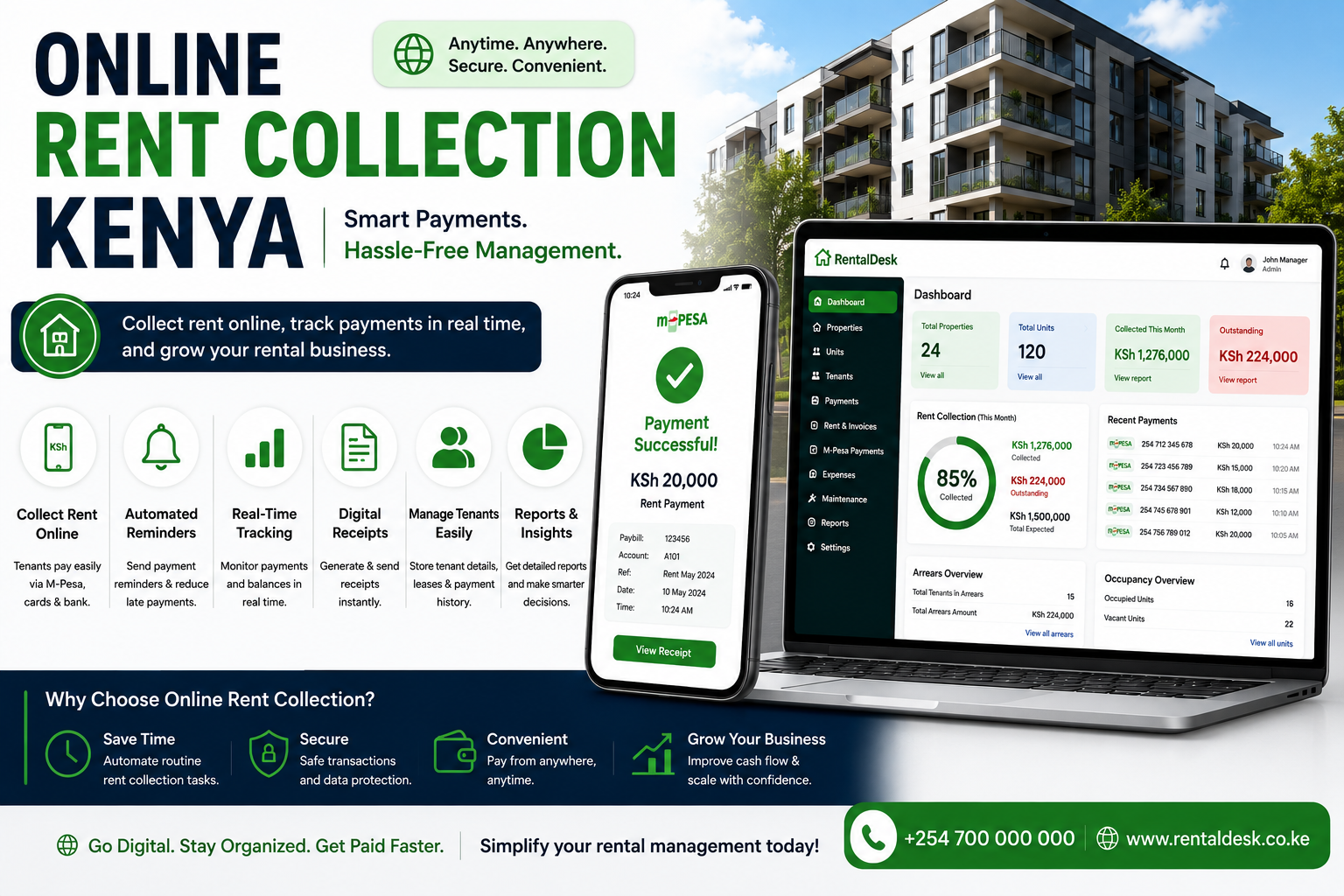
Collecting rent is one of the most important responsibilities for every landlord and property manager.
For years, many landlords in Kenya have relied on M-Pesa messages, bank statements, spreadsheets, notebooks, receipts, phone calls, and WhatsApp conversations to manage rental payments.
While these methods may work for a small number of tenants, they become difficult to manage as a rental portfolio grows.
A landlord managing 10 units may be able to check payments manually. But managing 50, 100, or several hundred tenants requires a more organized system.
This is where online rent collection in Kenya can help.
Online rent collection allows landlords and property managers to digitize the process of billing tenants, receiving payments, recording transactions, updating balances, monitoring arrears, and generating reports.
Instead of treating rent collection as a single payment transaction, an online system connects the entire payment process.
What Is Online Rent Collection?
Online rent collection is the process of allowing tenants to pay rent digitally while the landlord or property manager uses a digital platform to manage and monitor those payments.
A complete online rent collection workflow can include:
- Creating a rent invoice
- Notifying the tenant
- Making a payment
- Capturing the transaction
- Matching the payment to the tenant
- Updating the tenant balance
- Recording the payment
- Issuing payment confirmation
- Updating arrears status
- Generating reports
This is much more organized than simply receiving an M-Pesa message and manually updating an Excel spreadsheet.
Why Online Rent Collection Is Important in Kenya
Kenyan rental businesses handle thousands of rental transactions every month.
When payments are managed manually, landlords can face several challenges.
Manual Payment Confirmation
A landlord may receive an M-Pesa message but still need to determine:
- Which tenant paid?
- Which unit does the tenant occupy?
- What invoice was being paid?
- Was the payment full or partial?
- Does the tenant still have a balance?
Online rent collection systems can connect these details.
Payment Reconciliation
Payment reconciliation becomes increasingly important as the number of tenants increases.
If several tenants make payments around the same time, manually matching each transaction can become time-consuming.
A digital rent collection system can provide tools for matching payments with tenant accounts.
Arrears Management
The objective of rent collection is not simply receiving payments.
Landlords also need to identify tenants who have not paid.
Online rental platforms can provide visibility into paid, partially paid, unpaid, and overdue accounts.
Better Financial Records
Digital transactions create structured records that can be used for statements and reports.
This can make it easier for property owners to understand rental income and outstanding balances.
How Online Rent Collection Works
A typical online rent collection workflow can look like this:
Step 1: Add the Property
The landlord adds the property and its rental units to the system.
Step 2: Add Tenants
Tenant information is connected to the appropriate units.
Step 3: Set Rent Amounts
The rent amount and billing information are recorded.
Step 4: Generate the Invoice
The system generates the rent invoice according to the configured billing cycle.
Step 5: Tenant Receives Payment Instructions
The tenant receives the relevant payment information or payment request.
Step 6: Tenant Pays
The tenant completes the payment using the available payment method.
For Kenyan rental businesses, M-Pesa is particularly important.
Step 7: Payment Is Recorded
The payment is captured and connected to the tenant’s account.
Step 8: Balance Is Updated
The tenant’s outstanding balance is updated according to the payment received.
Step 9: Receipt or Confirmation
The tenant can receive confirmation of the payment where the system supports it.
Step 10: Landlord Monitors Collections
The landlord can review payment activity, outstanding balances, and arrears through the management dashboard.
RentalDesk describes its collection workflow around capturing, matching, posting, and reporting rental payments, including M-Pesa transactions.
M-Pesa and Online Rent Collection in Kenya
For Kenyan landlords, M-Pesa is an important consideration when choosing an online rent collection system.
A useful system should not simply provide a place to record that a tenant paid.
It should help connect the payment to the correct rental account.
RentalDesk supports M-Pesa payment workflows including STK Push and Paybill-related payments, together with payment reconciliation and tenant balance tracking.
This creates a workflow such as:
Tenant → M-Pesa → Payment Capture → Tenant Matching → Ledger Update → Receipt → Reporting
Such a workflow can reduce the amount of manual work required from property managers.
Benefits of Online Rent Collection Kenya
1. Faster Rent Collection
Digital payment workflows can make it easier for tenants to pay and for landlords to monitor incoming payments.
2. Reduced Manual Work
Property managers spend less time copying payment information from messages into spreadsheets.
3. Better Payment Visibility
A centralized dashboard can show payment status across properties and tenants.
4. Easier Arrears Follow-Up
Managers can quickly identify tenants with outstanding balances.
5. Improved Tenant Experience
Tenants benefit from clear invoices, payment instructions, confirmations, and statements.
6. Better Record Keeping
Digital payment records are easier to organize and retrieve than scattered paper receipts and messages.
7. Easier Reporting
Managers can generate reports based on collected rent, outstanding balances, payment history, and property performance.
8. Supports Portfolio Growth
As the number of units increases, automation becomes increasingly valuable.
RentalDesk is designed for landlords and property managers managing both smaller portfolios and larger multi-property operations.
Online Rent Collection vs Manual Rent Collection
| Manual Rent Collection | Online Rent Collection |
|---|---|
| Check M-Pesa messages manually | Digital payment workflow |
| Update Excel manually | Automated/structured records |
| Manual balance calculations | Tenant balance visibility |
| Difficult arrears monitoring | Arrears tracking |
| Paper receipts | Digital payment records |
| Separate payment records | Centralized payment history |
| Manual reporting | Digital reports |
| Time-consuming reconciliation | Structured reconciliation |
| Difficult to scale | Supports growing portfolios |
Key Features to Look for in Online Rent Collection Software
M-Pesa Integration
M-Pesa compatibility should be one of the first things Kenyan landlords check.
Automated Invoicing
The platform should allow recurring rent invoices to be generated efficiently.
Payment Reconciliation
The system should help match incoming transactions with tenant accounts.
Tenant Ledgers
Each tenant should have a clear payment and balance history.
Arrears Tracking
The platform should identify overdue accounts.
Payment Notifications
Tenants should be able to receive payment confirmations and relevant reminders.
Financial Reports
The system should provide reports that help landlords understand rental income.
Multi-Property Management
If you manage multiple buildings, you should be able to manage them from one platform.
RentalDesk combines property management, tenant management, rent invoicing, M-Pesa payments, reconciliation, arrears tracking, and financial reporting in one rental workflow.
How RentalDesk Supports Online Rent Collection
RentalDesk is built around Kenyan rental operations and provides a centralized workflow for rent collection.
The platform allows property managers to organize properties, units, tenants, invoices, payments, balances, and reports.
Its M-Pesa-focused collection workflow supports payment capture, tenant matching, balance updates, and reconciliation.
For landlords, this means rental payment information does not have to remain scattered across:
- M-Pesa messages
- Excel spreadsheets
- Paper receipts
- Bank statements
- WhatsApp conversations
- Personal notebooks
Instead, rental information can be brought into one structured system.
Who Can Benefit From Online Rent Collection?
Landlords
Individual landlords can use online rent collection to reduce manual payment tracking.
Property Managers
Property managers handling multiple properties can centralize collections and arrears monitoring.
Rental Agencies
Agencies can manage payments and tenant accounts on behalf of property owners.
Apartment Managers
Apartment buildings with many tenants can use digital payment workflows to reduce administrative work.
Real Estate Companies
Companies managing multiple properties can gain better visibility into rental income and outstanding balances.
How to Implement Online Rent Collection
Moving to online rent collection requires more than activating a payment option.
You should first organize your rental operations.
Organize Your Properties
Create accurate records of your buildings and rental units.
Organize Tenant Records
Ensure every tenant is connected to the correct unit.
Set Correct Rent Amounts
Enter the correct rent for every unit.
Configure Billing
Set up the appropriate rent billing frequency.
Configure Payment Methods
Set up the payment workflows your tenants will use.
Test the Payment Process
Before going fully live, test the payment process and reconciliation workflow.
Communicate With Tenants
Explain the new payment process clearly to tenants.
Monitor the First Payment Cycles
Review payments and reconciliation carefully during the initial implementation period.
Common Mistakes to Avoid
Using Multiple Unconnected Payment Records
Keeping payment information across different spreadsheets and notebooks can create inconsistencies.
Failing to Reconcile Payments
A payment should be matched to the correct tenant and account.
Ignoring Partial Payments
A tenant who pays part of the rent should not automatically be considered fully paid.
Not Following Up on Arrears
Outstanding rent should be monitored consistently.
Choosing Software Without Local Payment Support
Kenyan rental businesses should consider whether the platform supports the payment workflows they actually use.
Focusing Only on Payment Collection
Rent collection should connect with tenant records, invoices, balances, statements, and reporting.
Frequently Asked Questions
What is online rent collection in Kenya?
Online rent collection is a digital process that allows landlords and property managers to receive, record, reconcile, and monitor rental payments using an online platform.
Can tenants pay rent through M-Pesa?
Yes. Online rent collection platforms designed for Kenya can support M-Pesa payment workflows. RentalDesk provides M-Pesa-focused rent collection features.
Can online rent collection track arrears?
Yes. A complete rental payment system can monitor tenant balances and identify outstanding rent.
Is online rent collection suitable for small landlords?
Yes. Even landlords with a small number of units can benefit from organized payment records and reduced manual administration.
Can online rent collection support multiple properties?
Yes. Property management platforms can allow landlords and property managers to manage multiple properties and units from one dashboard.
Does online rent collection eliminate manual reconciliation?
It can significantly reduce manual work, although exceptions such as unmatched or unclear payments may still require review. RentalDesk includes a reconciliation workflow for reviewing such exceptions.