Property Management App for Landlords: The Complete Guide to Smarter Rental Management
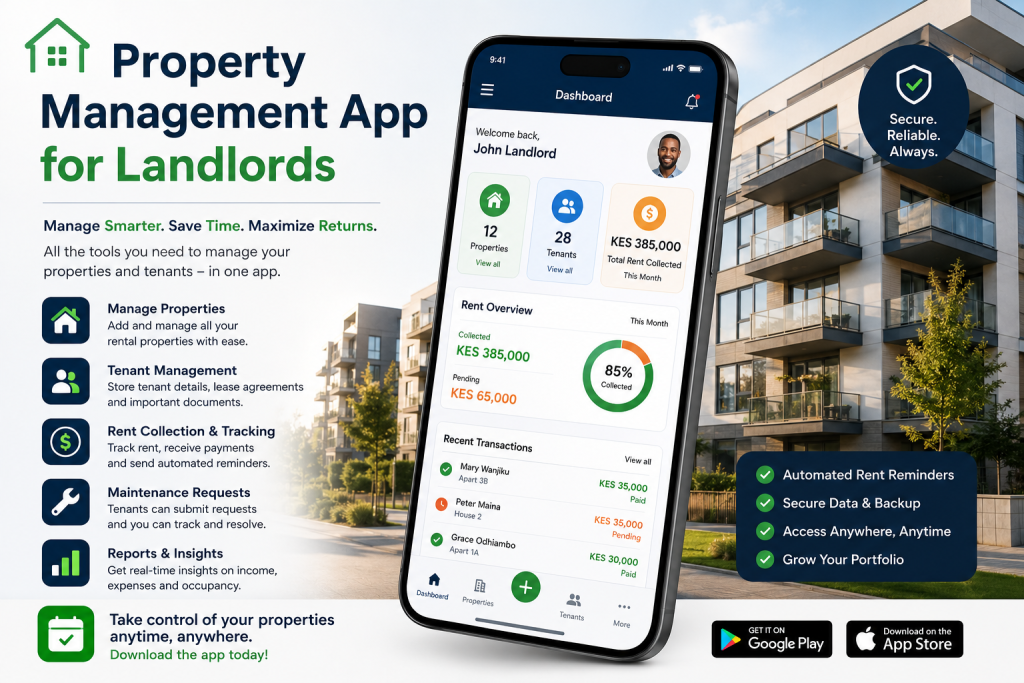
Managing rental property can be profitable, but it can also become stressful when landlords have to handle tenants, rent payments, maintenance, inspections, vacancies, arrears, receipts, and financial reports manually.
A landlord managing one property may be able to keep records in a notebook or spreadsheet. However, as the number of properties and tenants increases, manual property management becomes harder to control.
This is where a property management app for landlords can make a significant difference.
What Is a Property Management App for Landlords?
A property management app for landlords is a digital platform that helps property owners manage rental properties, tenants, rent payments, maintenance, communication, and financial information.
Depending on the software provider, the platform may be accessible through a smartphone, tablet, computer, or web browser.
A typical property management app for landlords can help landlords manage:
- Properties
- Buildings
- Rental units
- Tenants
- Rent payments
- Rent arrears
- Leases
- Maintenance requests
- Expenses
- Receipts
- Notifications
- Reports
- Occupancy
- Property performance
The main purpose of property management app for landlords is to reduce repetitive manual work while giving landlords better control over their rental businesses.
Instead of asking a caretaker to send payment updates manually or searching through multiple spreadsheets, the landlord can access organized information through one system.
Why Landlords Need property management app for landlords
Property management involves many moving parts.
A landlord may have to remember when each tenant’s rent is due, which units are occupied, which tenants have arrears, which properties need repairs, and how much money was collected during the month.
As the portfolio grows, remembering everything becomes nearly impossible.
A property management app for landlords provides a centralized digital record.
This can help landlords move away from scattered information and create a more organized management process.
property management app for landlords does not eliminate the responsibilities of a landlord. Instead, it gives landlords better tools to perform those responsibilities.
Problems With Manual Property Management
Many landlords still rely on notebooks, Excel spreadsheets, paper receipts, phone calls, SMS, and WhatsApp messages.
These methods may work initially, but they can create several challenges.
Lost Information
Paper documents can be misplaced, while important messages can become difficult to find.
Duplicate Records
When several people update different spreadsheets, the information may not always match.
Payment Errors
Manual recording can lead to incorrect balances or payments being assigned to the wrong tenant.
Delayed Follow-Up
A landlord may discover rent arrears several weeks after the payment was due.
Difficult Reporting
Preparing monthly or annual reports manually can take considerable time.
Poor Visibility
Landlords may know that money is coming in without having a clear picture of the overall financial position of their properties.
A property management app for landlords addresses many of these challenges by bringing property information into a centralized system.
Key Features of a property management app for landlords
The best application should offer features that solve real problems for landlords.
1. Property Management
Landlords should be able to add and organize multiple properties.
For each property, the system can contain information about buildings, floors, units, rent amounts, occupancy, and tenants.
This makes it easier to manage a growing portfolio.
2. Tenant Management
A landlord should be able to create a profile for every tenant.
Information may include:
- Full name
- Phone number
- Email address
- Rental unit
- Monthly rent
- Lease dates
- Payment history
- Outstanding balance
- Emergency contact
Having these details in one location makes tenant management easier.
3. Rent Payment Tracking
Rent collection is one of the most important features.
The application should help landlords determine which tenants have paid and which tenants still owe money.
For landlords using digital payment methods such as M-Pesa, payment integrations can make the process even more efficient.
A property management app for landlords can connect payment information with individual tenant accounts, depending on the available integrations.
4. Rent Arrears Management
Late rent payments can negatively affect cash flow.
A good platform should make outstanding balances easy to identify.
Landlords can view tenants with:
- Current payments
- Partial payments
- Outstanding balances
- Overdue rent
- Long-term arrears
This allows landlords to prioritize follow-up.
5. Automated Rent Reminders
Tenants sometimes forget their rent due dates.
Automated reminders can help reduce this problem.
A system may send reminders before rent is due and follow-up notifications when a payment becomes overdue.
This reduces the need for landlords to call every tenant individually.
6. Digital Receipts
Digital receipts give tenants confirmation that their payments have been recorded.
They also provide landlords with organized transaction records.
Instead of writing paper receipts manually, the system can generate digital confirmations.
7. Maintenance Management
Property maintenance is another major responsibility.
Tenants may report:
- Plumbing problems
- Electrical faults
- Broken doors
- Water problems
- Leaking roofs
- Damaged fixtures
- Security concerns
A digital platform can help landlords record, assign, track, and close maintenance requests.
This creates a clearer maintenance history.
8. Financial Reports
Reports help landlords understand how their properties are performing.
A platform can provide information about:
- Rent collected
- Rent outstanding
- Expenses
- Property income
- Arrears
- Occupancy
- Payment history
These insights support better financial decisions.
Benefits of Using a Property Management App
The adoption of a property management app for landlords can provide several important benefits.
Save Time
Manual property management requires repetitive data entry and constant communication.
Automation can reduce these tasks.
Instead of checking every tenant’s payment individually, landlords can review a dashboard showing overall payment performance.
Improve Accuracy
Automated calculations can reduce mistakes when calculating balances and arrears.
Accurate records are particularly important when managing many tenants.
Improve Rent Collection
Payment reminders and convenient payment channels can encourage tenants to pay on time.
Landlords can also identify late payments quickly.
Improve Tenant Service
Tenants expect faster communication.
A centralized platform makes it easier to respond to questions about rent, receipts, maintenance, and account balances.
Manage Properties Remotely
One of the biggest advantages of a digital platform is remote access.
A landlord does not necessarily need to be physically present at a property to monitor rental activity.
This is especially useful for landlords managing properties in different towns or cities.
Improve Accountability
If a landlord works with caretakers, agents, accountants, or property managers, digital records create greater visibility.
Different users can be assigned appropriate permissions.
This helps property owners monitor operations more effectively.
How a Property Management App Works
The process generally begins by creating an account and registering properties.
The landlord enters each property and rental unit.
Tenants are then assigned to their respective units.
Monthly rent amounts are configured.
The landlord or authorized staff can then begin recording payments, managing maintenance requests, and monitoring tenant accounts.
When a tenant pays rent, the transaction can be recorded manually or integrated with a supported payment system.
The tenant balance is updated.
If the payment is overdue, the system can identify the outstanding amount.
Reports can then be generated from the accumulated data.
The workflow can be summarized as:
Property → Unit → Tenant → Rent Due → Payment → Receipt → Balance Update → Reporting
This structured approach makes rental management easier to understand and control.
Property Management App for Small Landlords
Small landlords often assume that property management software is only useful for large real estate companies.
That is not necessarily true.
A landlord with five, ten, or twenty rental units can also benefit from digital organization.
Even a small portfolio involves rent collection, tenant communication, maintenance, and record keeping.
A property management app for landlords can help small property owners establish professional processes from the beginning.
This can also make it easier to scale the rental business later.
Property Management App for Large Portfolios
Large rental portfolios create a different set of challenges.
A landlord managing 300 or 1,000 units cannot reasonably rely on notebooks and scattered spreadsheets.
There may be hundreds of monthly payments, dozens of maintenance requests, and multiple employees involved.
A centralized platform can help manage this complexity.
Landlords can organize properties by location, building, or portfolio.
They can also monitor performance across different properties.
M-Pesa and Property Management
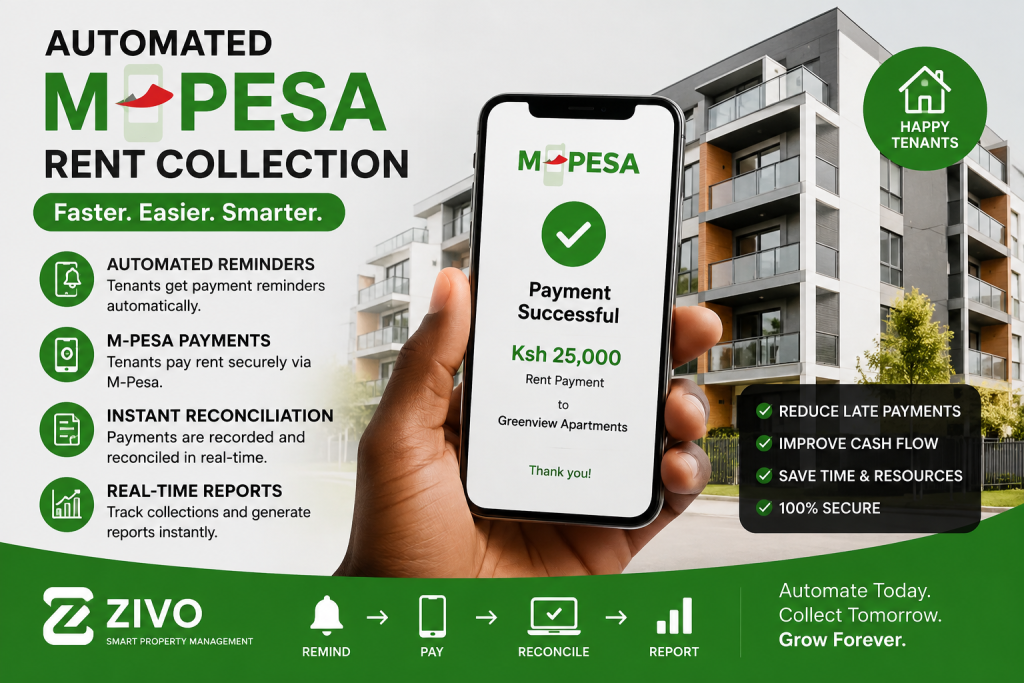
In Kenya, digital payments play an important role in rental management.
Many tenants prefer paying rent through M-Pesa because of its convenience.
A suitable rental platform can integrate payment processes with tenant accounts where supported.
This can help landlords reduce manual reconciliation.
For example, when a tenant makes a payment, the transaction can be associated with the appropriate tenant account.
The system can then reflect the payment and calculate any remaining balance.
A property management app for landlords that supports relevant payment integrations can therefore make rent collection more efficient.
Managing Rent Arrears
Rent arrears should not be ignored.
A small unpaid balance can become a significant financial problem if it continues for several months.
Landlords should have a system for identifying overdue payments quickly.
A digital dashboard can categorize accounts based on payment status.
For example:
Paid
The tenant has completed the required payment.
Partially Paid
The tenant has paid some of the required rent.
Due
Rent is expected but has not yet been recorded.
Overdue
The payment deadline has passed.
Arrears
The tenant has accumulated an outstanding balance.
This classification makes it easier to prioritize collection efforts.
Automated Communication
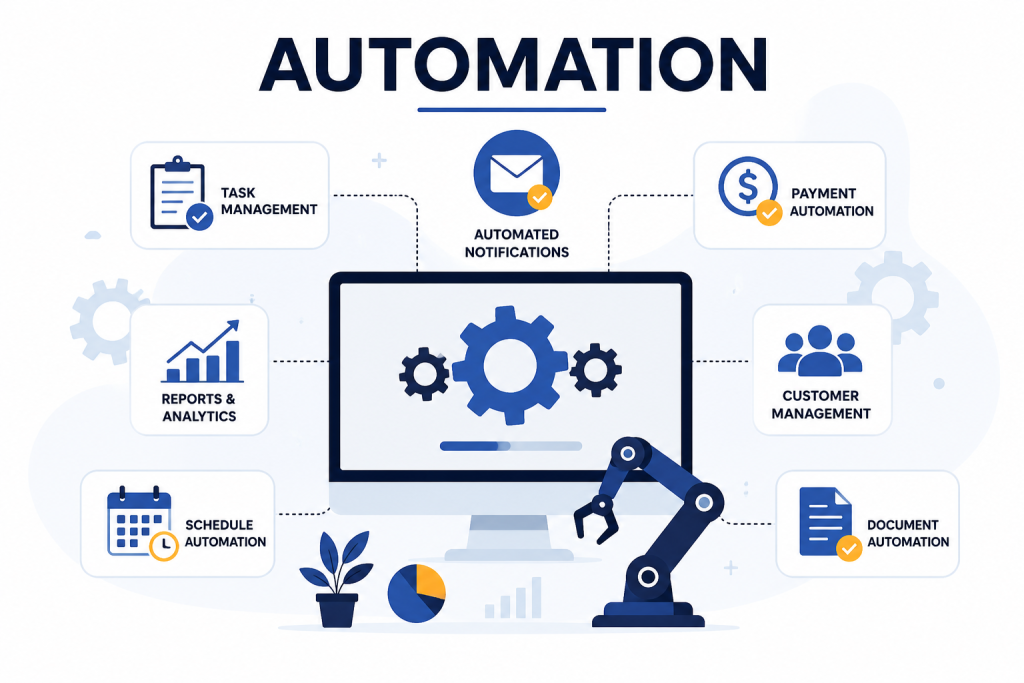
Communication is a major part of property management.
Landlords may need to send:
- Rent reminders
- Payment confirmations
- Maintenance updates
- Lease notifications
- Inspection reminders
- General announcements
Sending these messages manually can take considerable time.
Automation allows common communications to be scheduled or triggered based on specific events.
This means a property management app for landlords can help landlords communicate consistently without having to send every message manually.
Case Study 1: Nairobi Apartment Owner
Consider a hypothetical landlord managing 80 apartments in Nairobi.
Before adopting a digital platform, the landlord relied on Excel and M-Pesa messages.
At the beginning of every month, the property manager had to review payment messages and update a spreadsheet.
The process took several days.
Some tenants also complained about delays in receiving receipts.
After implementing a property management app for landlords, the landlord centralized tenant records and payment tracking.
The property manager could view payment status from one dashboard.
Outstanding accounts became easier to identify.
Digital receipts reduced paperwork.
The landlord also gained better visibility into property performance.
The major improvement was not simply the technology itself. It was the creation of a consistent management process.
Case Study 2: Property Manager in Mombasa
Consider a property management agency managing 250 units across several properties in Mombasa.
The agency had multiple employees responsible for tenant communication, rent collection, and maintenance.
Previously, employees used separate spreadsheets.
This created challenges when management needed accurate reports.
After moving to a centralized property management platform, the company organized all properties and tenants in one system.
Employees could access the information they needed according to their responsibilities.
Management could generate reports more quickly.
The agency also introduced automated rent reminders.
This helped reduce repetitive communication and allowed staff to focus on tenant service and property operations.
Case Study 3: Landlord Managing Properties Remotely
Consider a landlord who owns properties in Kenya but spends much of the year outside the country.
Previously, the landlord depended heavily on caretakers for information.
Monthly payment reports were sent through WhatsApp, while maintenance updates were handled by phone.
This created limited visibility.
After adopting a property management app for landlords, the owner could access rental information remotely.
The landlord could monitor rent collections, outstanding balances, tenant records, and maintenance requests.
The technology did not replace the caretaker.
Instead, it created greater transparency between the owner, caretaker, and tenants.
These case studies are illustrative examples. Replace them with verified customer data before publishing them as actual business case studies.
Customer Testimonials
“We save hours every month.”
“Before using property management software, our team spent a lot of time updating spreadsheets and checking payment messages. Having everything organized in one platform has made our work much easier.”
— Property Manager, Nairobi
“It gives me better visibility.”
“I manage properties in different locations, so being able to check tenant and payment information remotely is extremely helpful. I no longer have to depend entirely on manual reports.”
— Property Owner, Kenya
“Tenant communication is easier.”
“Our tenants can receive payment confirmations and our team can respond to requests faster. The system has helped us become more organized.”
— Property Management Company, Mombasa
These testimonials are illustrative marketing examples and should be replaced with verified customer testimonials before publication.
Service Description
A professional property management app for landlords should provide a complete set of tools for managing rental operations.
A comprehensive service can include the following:
Property Setup
Register residential and commercial properties and organize units within each property.
Tenant Management
Store tenant information, lease details, rent amounts, contacts, and payment history.
Rent Collection
Record and monitor rental payments while supporting available digital payment integrations.
Arrears Control
Identify overdue balances and provide reports that help landlords follow up on outstanding rent.
Automated Reminders
Send rent due reminders and overdue notifications to tenants.
Digital Receipts
Provide tenants with payment confirmations and maintain digital transaction records.
Maintenance Management
Track tenant maintenance requests from reporting through completion.
Expense Tracking
Record property-related expenses and use the information to understand profitability.
Financial Reporting
Generate reports on rent collection, arrears, expenses, and property performance.
User Management
Give property managers, accountants, caretakers, and other staff appropriate system access.
Dashboard
Provide a centralized overview of rental operations.
These services transform property management from a collection of disconnected tasks into a structured digital process.
Property Management App vs Excel Spreadsheet
Excel can be useful for basic record keeping, but it has limitations.
| Feature | Excel | Property Management App |
|---|---|---|
| Tenant management | Manual | Centralized |
| Rent tracking | Manual | Automated or simplified |
| Arrears | Manual calculation | Built-in tracking |
| Reminders | Manual | Automated |
| Receipts | Manual | Digital |
| Maintenance | Separate records | Centralized |
| Reports | Manual | Automated |
| Multi-property management | Difficult | Designed for it |
| Remote access | Depends on setup | Usually supported |
For a small portfolio, a spreadsheet may initially appear sufficient.
However, dedicated software becomes increasingly valuable as the number of tenants and properties increases.
Improving Landlord Productivity
Landlords should spend their time on activities that grow and protect their investments.
They should be able to focus on:
- Finding quality tenants
- Improving properties
- Managing contractors
- Planning investments
- Reducing vacancies
- Improving tenant satisfaction
Automation can reduce the time spent on repetitive administration.
A property management app for landlords helps move routine property management activities into a structured digital environment.
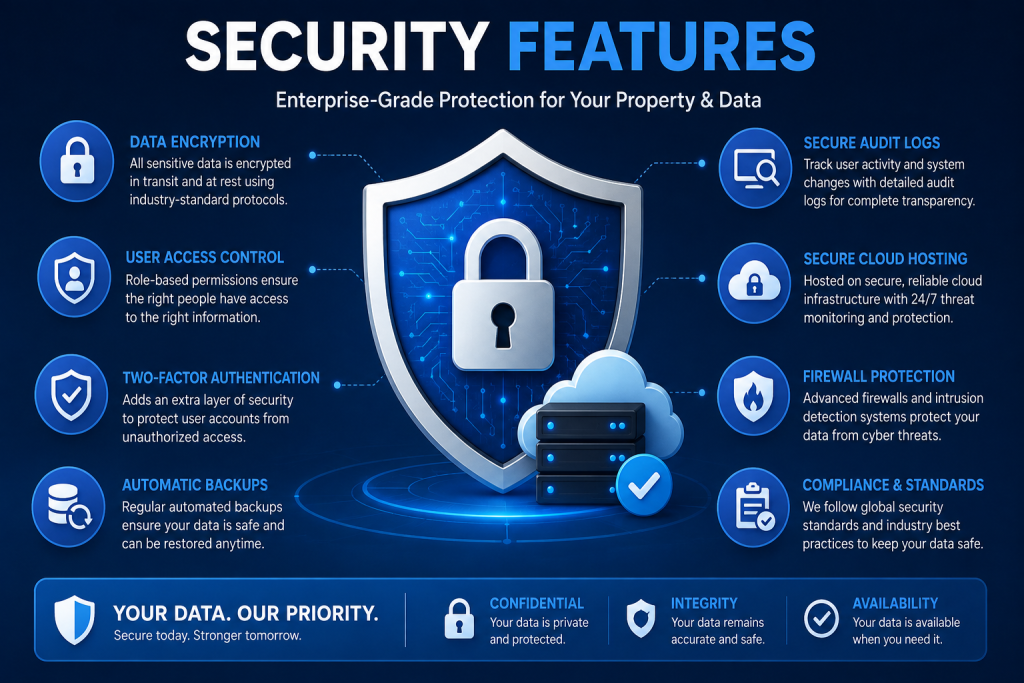
Security and Data Protection
Property management systems contain sensitive information.
This may include tenant names, phone numbers, payment records, lease information, and financial data.
Landlords should therefore evaluate the security features of any platform they choose.
Important considerations include:
- User authentication
- Role-based permissions
- Data backups
- Secure connections
- Access controls
- Account management
- Reliable hosting
Landlords should also ensure that staff members only receive access appropriate to their responsibilities.
Frequently Asked Questions
What is a property management app for landlords?
It is a digital platform designed to help landlords manage properties, tenants, rent payments, arrears, maintenance, expenses, communication, and reports.
Can a landlord manage multiple properties?
Yes. Many modern platforms are designed to manage multiple properties and rental units from one account.
Can the app track rent arrears?
Yes. Rental management platforms can provide tools for identifying outstanding tenant balances and overdue rent.
Can tenants pay rent through property management app for landlords?
Depending on the provider, the platform may support payment integrations that allow tenants to use supported digital payment channels.
Can landlords manage properties remotely in property management app for landlords?
Yes. Cloud-based platforms can allow authorized users to access property information from different locations.
Can the software manage maintenance?
Many platforms include maintenance tracking features that allow landlords to record and monitor repair requests.
Is a property management app for landlords suitable for small landlords?
Yes. Small landlords can use digital systems to organize their operations and prepare for future portfolio growth.
Can property managers use property management app for landlords?
Yes. Property managers can use the platform to manage properties on behalf of property owners.
Is property management app for landlords better than Excel?
For larger or growing portfolios, dedicated property management software can offer more automation, centralized data, reporting, tenant management, and scalability than a basic spreadsheet.
The Future of property management app for landlords
Property management is becoming increasingly digital.
Future applications are likely to include more automation, artificial intelligence, advanced reporting, digital payments, predictive analytics, and integrated communication.
Artificial intelligence could help identify tenants who are at higher risk of becoming overdue.
Automated systems could recommend follow-up actions.
Property managers could receive alerts about unusual payment activity..
A property management app for landlords provides that foundation by bringing important rental activities into one organized platform.
A property management app for landlords provides a smarter way to organize rental operations.
Ready to Simplify Your Property Management?
If you are still managing your rental properties through spreadsheets, notebooks, paper receipts, and scattered WhatsApp messages, now is the time to consider a more organized approach.
A professional property management app for landlords can help you centralize your rental operations, track payments, control arrears, manage tenants, monitor maintenance, and generate useful reports.
With the right solution, you can spend less time chasing information and more time growing your property business.
Take the Next Step
Explore a modern rental management solution designed to help landlords and property managers simplify their daily operations.
Visit RentalDesk today to learn how you can manage your properties, track rent payments, control arrears, and improve your rental business from one centralized platform.
Stop managing your properties manually. Start managing them smarter.
Get started today and take control of your rental portfolio.