
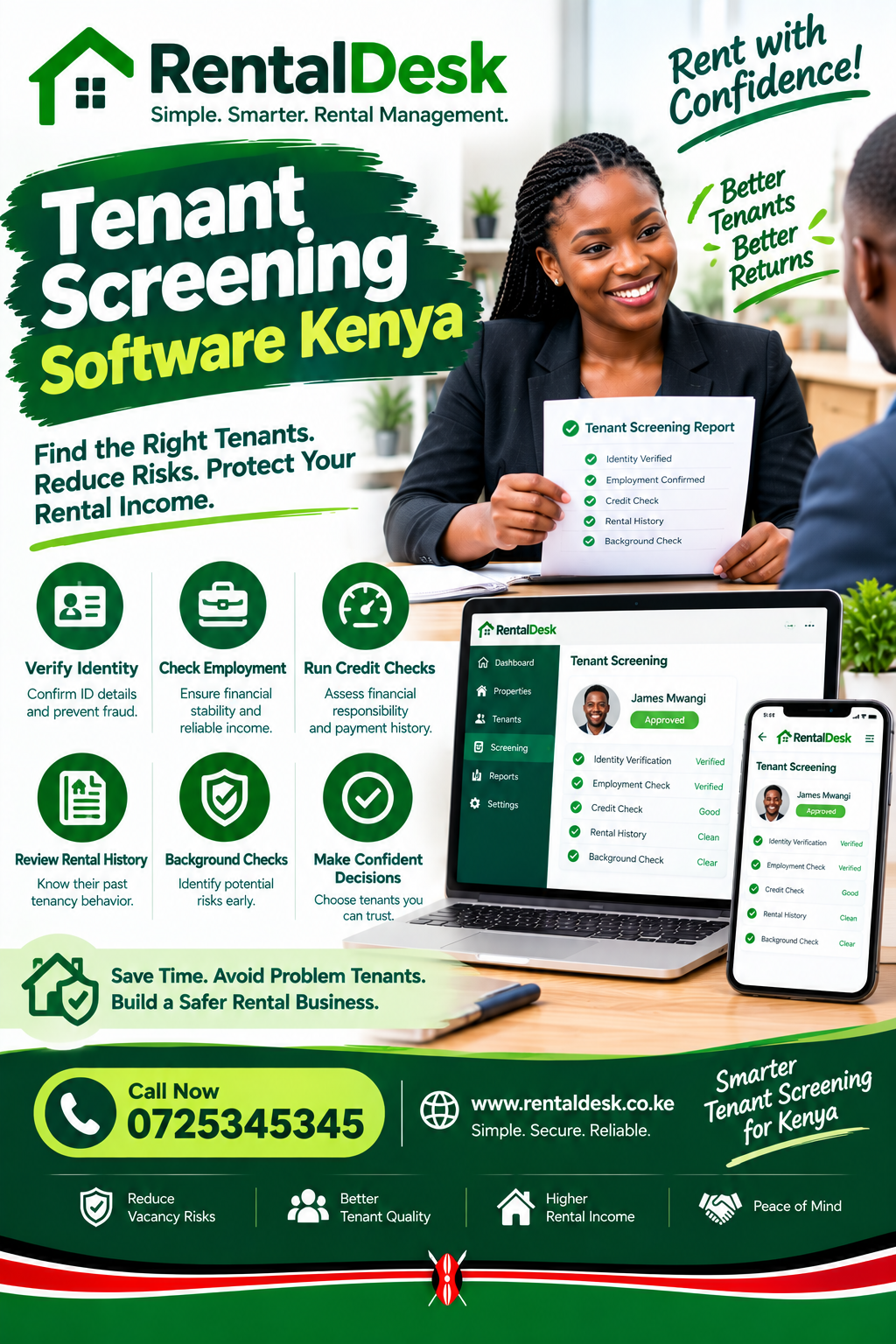
Tenant Screening Software Kenya: Complete Guide for Landlords and Property Managers
Choosing the right tenant can have a significant impact on rental property operations. Tenant Screening Software Kenya gives landlords and property managers a structured way to organize rental applications, collect required information, document verification steps, maintain applicant records and move approved applicants into the wider tenant-management process. For Kenyan rental businesses, the goal is not simply to accept applications faster. It is to create a consistent, documented and responsible process that helps management make informed leasing decisions.
Tenant screening is an important stage between advertising a vacant unit and signing a lease. A landlord may need to review an applicant’s identity information, contact details, references, affordability information, employment or business information where appropriate, previous tenancy information and other documents relevant to the tenancy. Handling these details through notebooks, email threads, WhatsApp conversations and spreadsheets can become difficult as the number of applications increases.
A digital screening process can make the workflow easier to organize. It can help a property manager know which applications have been received, which information is missing, which checks have been completed and which applications are ready for a decision.
This guide explains how tenant screening works, why it matters in Kenya, what landlords should look for in screening software, how screening connects to tenant onboarding, how digital records can support rental operations, and how RentalDesk fits into the wider property-management workflow.
What Is Tenant Screening?
Tenant Screening Software Kenya refers to a digital approach to organizing the information and workflow involved in evaluating prospective tenants. Rather than relying entirely on paper application forms and informal conversations, a screening system can help property managers structure the process around defined stages.
A screening process can include collecting an application, confirming required information, recording consent where applicable, reviewing supporting documents, checking references, assessing affordability information and documenting the final decision.
The software does not need to make the decision automatically. In many cases, the most useful role of technology is to make the process organized and repeatable while leaving the actual judgment to the landlord or authorized property manager.
For example, a landlord may establish a standard checklist for every applicant. This can help reduce situations where one applicant receives a detailed review while another is assessed using a completely different process.
Consistency is particularly important when several employees or property managers are involved in leasing units.
Why Tenant Screening Matters in Kenya
Tenant Screening Software Kenya can help Kenyan landlords approach tenant selection as an organized business process rather than an informal conversation. Rental properties involve financial commitments, contractual obligations, property access and ongoing relationships between owners, managers and tenants.
A tenant may remain in a property for months or years. During that period, the landlord may need to manage rent, maintenance, communication, inspections, lease renewals and eventual move-out procedures.
The screening stage cannot predict every future event, but it can help management establish a consistent process before the tenancy begins.
For landlords with several units, consistency also makes the leasing operation easier to manage. Instead of relying on memory, the property team can follow the same broad workflow for every application while adapting requirements to the particular property.
Screening should always be based on relevant and lawful criteria. Property managers should avoid making unsupported assumptions about applicants and should handle personal information responsibly.
The Problems With Manual Tenant Screening
Tenant Screening Software Kenya becomes particularly useful when landlords move beyond a small number of units. A landlord with one vacant apartment might comfortably manage applications using paper documents and phone calls. A property manager with hundreds of units can receive applications from many prospective tenants at the same time.
Manual processes can create several problems.
An application may be misplaced. A reference call may not be recorded. A document may remain in an email attachment. A manager may forget which applicant has already been contacted. Another staff member may duplicate the same verification work because there is no shared status.
Spreadsheets can improve organization, but they can also become difficult to maintain when several people edit them or when information is distributed across multiple files.
A centralized digital workflow provides a single place to track the application’s progress.
What Information Should a Rental Application Contain?
Tenant Screening Software Kenya can help organize the information landlords decide to collect during the application process. The exact requirements should depend on the property, tenancy type and the landlord’s documented policies.
Common information may include:
- Applicant’s full name
- Contact information
- Identification information
- Intended occupancy
- Employment or business details where relevant
- Previous landlord or tenancy references
- Emergency contact information where appropriate
- Income or affordability information where appropriate
- Supporting documentation
- Preferred move-in date
- Unit applied for
The objective should be to collect information that has a legitimate purpose in evaluating and administering the tenancy.
Collecting unnecessary information can create additional privacy and security responsibilities. A good screening process should therefore be deliberate about what information is requested and why.
Creating a Standard Screening Checklist
Tenant Screening Software Kenya can help transform a general screening policy into a practical checklist. A checklist makes it easier for staff to know what has been completed and what remains outstanding.
A simple workflow might look like this:
| Screening Stage | Status |
|---|---|
| Application received | Pending/Complete |
| Required information supplied | Pending/Complete |
| Consent recorded where applicable | Pending/Complete |
| Identity information reviewed | Pending/Complete |
| References contacted | Pending/Complete |
| Financial information reviewed | Pending/Complete |
| Supporting documents reviewed | Pending/Complete |
| Decision recorded | Pending/Complete |
| Applicant notified | Pending/Complete |
The exact process can be adapted to the property.
For example, a commercial property may require business documentation that would not be relevant to a residential bedsitter. A student accommodation provider may use different requirements from a manager of premium apartments.
Identity Verification and Tenant Records
Tenant Screening Software Kenya can support the organization of identity-related information provided by applicants. Identity verification is an important part of establishing who is applying for a tenancy, but it should be performed responsibly and according to applicable requirements.
A digital system can help management record that an identity document was received and reviewed without forcing staff to search through physical folders every time they need to check an application.
The same record can eventually form part of the tenant’s broader profile after approval.
This continuity can be useful because tenant management involves more than screening. Once a tenant moves into a property, the management team may need to maintain lease dates, rent details, deposit information, payment history, maintenance requests and communication records.
Reference Checks
Tenant Screening Software Kenya can help landlords organize reference checks. References may provide useful context about an applicant’s previous tenancy or other relevant circumstances, depending on the screening policy.
A reference workflow can record:
- Reference name
- Relationship to applicant
- Contact details
- Date contacted
- Questions asked
- Response received
- Follow-up required
- Verification status
The purpose of documentation is accountability. If a property manager contacts a previous landlord and receives information relevant to the application, that information should not remain solely in the manager’s memory.
The record should also distinguish between verified information and unverified claims.
Good screening does not mean accepting every statement as fact. It means using defined processes to gather relevant information and making decisions based on appropriate evidence.
Affordability Assessment
Tenant Screening Software Kenya can help structure the financial-information stage of an application. Landlords commonly want confidence that an applicant can meet the financial obligations associated with the tenancy.
However, affordability should be assessed using a clear and consistently applied policy rather than arbitrary assumptions.
Depending on the tenancy, a landlord may consider information such as employment, business activity, income documentation, previous payment history where legitimately available, or other relevant evidence.
The exact requirements should be proportionate to the property and tenancy.
A digital system can make the process easier to document. Staff can record which financial information was requested, whether it was supplied and whether the application meets the property’s stated criteria.
This makes the process easier to review later.
Avoiding Discriminatory Screening
Tenant Screening Software Kenya should support consistency rather than encourage arbitrary decisions. Tenant screening should be based on objective, relevant criteria and should avoid discriminatory practices.
A software system cannot make an unethical screening policy acceptable. Technology only organizes the process. The underlying criteria still need to be appropriate.
Property managers should therefore establish clear screening standards before applications are reviewed.
For example, the same documented affordability requirement should generally be applied consistently to comparable applicants. If requirements differ because of the property type or tenancy arrangement, those differences should be based on legitimate business reasons.
Responsible screening protects both applicants and landlords by creating a clearer decision-making process.
Screening Different Types of Rental Properties
Tenant Screening Software Kenya can support different screening workflows depending on the type of property.
Residential apartments may focus on household information, affordability, references and intended occupancy.
Student housing may require information relevant to the student and, where applicable, the responsible payer or guarantor.
Commercial premises may require business information, intended business activity, references and financial documentation appropriate to the lease.
Serviced or specialized accommodation may have different requirements altogether.
This is why landlords should avoid choosing software simply because it has a generic “tenant screening” label. The system should support the workflow that the property actually requires.
Screening Vacant Units Efficiently
Tenant Screening Software Kenya can help property managers organize applications when several prospective tenants are interested in the same vacant unit.
Vacancies can create pressure because landlords want to reduce the period during which a unit remains unoccupied. However, speed should not replace responsible screening.
A good digital process can reduce administrative delays without removing important checks.
For example, once an applicant submits the required information, the manager can immediately see which documents are missing rather than repeatedly calling the applicant to ask what remains outstanding.
The manager can then progress the application through defined stages.
This can make the leasing process more predictable while preserving appropriate review standards.
Comparing Applicants Consistently
Tenant Screening Software Kenya can provide a structured way to organize multiple applications. When several people apply for one unit, the landlord needs a fair and practical method of evaluating them against the property’s requirements.
The system should not necessarily rank applicants automatically. Instead, it can organize information so the authorized decision-maker can review applications against the established criteria.
For example, the manager may compare whether each applicant has supplied the required documentation, whether references were successfully contacted and whether the applicant meets the property’s affordability requirements.
Documented criteria reduce the risk of making decisions based solely on first impressions.
Tenant Screening and Privacy
Tenant Screening Software Kenya involves personal information, which means privacy should be considered from the beginning of the process.
Applicants may provide identity information, contact details, financial information, employment information and references. Property managers should therefore have appropriate procedures for collecting, storing, accessing and retaining this information.
The principle of data minimization is useful: collect information that is genuinely needed for the stated purpose rather than gathering everything that might possibly be useful.
Access should also be limited to authorized users.
A landlord may not want every employee to access sensitive applicant information. Role-based permissions can help separate operational responsibilities.
Secure Digital Records
Tenant Screening Software Kenya can reduce dependence on physical application folders, but digital records also need appropriate protection.
When evaluating a platform, landlords should ask how user access is managed, how information is protected, how accounts are secured and what happens when an employee leaves the organization.
Good record management should include clear procedures for user accounts and permissions.
Managers should also think about retention. Applicant information that is no longer required should not necessarily be kept indefinitely.
A digital platform makes information easier to organize, but responsible data management remains a management responsibility.
Tenant Screening and Tenant Onboarding
Tenant Screening Software Kenya is most useful when screening connects naturally to tenant onboarding.
Once an applicant is approved, the property team may need to prepare the lease, allocate a unit, record the deposit, establish rent billing, capture contact information and complete move-in procedures.
Duplicating all of the information from the screening record into a separate tenant record creates unnecessary work and opportunities for mistakes.
A connected rental management workflow can allow the relevant information to continue into the tenant’s profile.
RentalDesk’s current tenant-management materials describe tenant profiles, lease information, payment history, contact information and tenant status as part of the broader rental workflow.
Connecting Screening With Tenant Management
Tenant Screening Software Kenya should therefore be viewed as part of the broader tenant lifecycle rather than an isolated feature.
The lifecycle can include:
- Vacancy creation
- Property marketing
- Application
- Screening
- Approval
- Lease preparation
- Deposit recording
- Move-in
- Rent billing
- Payment collection
- Maintenance
- Communication
- Renewal
- Move-out
Connecting these stages can reduce duplicate data entry.
For example, once a tenant has been approved, their contact information does not need to be collected again simply because the process has moved from application to tenancy.
Tenant Screening and Lease Management
Tenant Screening Software Kenya can support a more organized transition from application to lease management.
A landlord should know which applicants have been approved, which units they are associated with and when their tenancy is expected to begin.
The lease then becomes the formal basis for ongoing rental management.
RentalDesk’s wider platform currently includes leases, tenants, properties, units, rent invoicing, payment tracking, maintenance and reporting capabilities.
This means screening can be considered within a broader system rather than as a completely separate administrative activity.
The connection becomes particularly useful when a property manager is responsible for a large number of units.
Tenant Screening and Rent Collection
zamacore.com can be useful as part of the wider process surrounding Tenant Screening Software Kenya, because screening determines who enters the tenant-management workflow while rent collection becomes one of the key responsibilities after move-in.
Kenyan landlords frequently use M-Pesa for rental payments. RentalDesk currently highlights M-Pesa collection and payment recording as part of its rental-management platform.
Once an applicant becomes a tenant, the important information is no longer only about whether the application was approved. The property team must also manage invoices, payments, balances and arrears.
This demonstrates why connected systems can be valuable.
Tenant Screening and M-Pesa Records
Tenant Screening Software Kenya focuses on applicants, but the applicant eventually becomes part of a financial relationship with the property.
After onboarding, payment history becomes part of the tenant record.
RentalDesk’s current platform includes M-Pesa-related rental workflows and payment records.
A connected tenant profile can help the property manager move from an application record to an ongoing tenancy record.
For landlords, this creates continuity.
The screening stage answers questions about the applicant before approval. The tenant-management stage then records what happens during the tenancy.
Previous Tenant Payment History
Tenant Screening Software Kenya can also be relevant when an existing tenant is applying for another unit managed by the same landlord.
Where policies permit, the property manager may already have historical information about the tenant’s previous tenancy, including rent payment patterns, arrears, lease compliance and previous tenancy dates.
Such information should be handled responsibly and used according to the landlord’s documented policies.
A centralized tenant record can make legitimate historical information easier to locate.
This is another reason why tenant screening and tenant management should not always be treated as completely separate systems.
Screening and Rental Risk Management
Tenant Screening Software Kenya is one part of a broader rental risk-management process.
A landlord should not assume that screening eliminates future problems. Even a carefully screened tenant may experience changes in employment, business conditions, family circumstances or other factors.
Risk management therefore continues throughout the tenancy.
Property managers should also monitor:
- Rent payments
- Arrears
- Lease compliance
- Maintenance
- Property inspections
- Tenant communication
- Lease renewals
- Deposit records
- Move-out procedures
A strong tenant-management system helps maintain this ongoing visibility.
Remote Landlords
Tenant Screening Software Kenya can be particularly useful for landlords who manage Kenyan rental properties from another county or another country.
A remote landlord may not be present when an applicant views a unit or submits documents. The local property manager therefore becomes responsible for maintaining accurate records and communicating decisions.
A digital workflow can give the owner better visibility into application status and tenant onboarding.
RentalDesk positions its platform for landlords and property managers who need centralized rental operations, including tenants, leases, rent, maintenance and reporting.
For a remote owner, this broader visibility can be more valuable than having a standalone screening checklist.
Screening for Property Management Companies
Tenant Screening Software Kenya can help property management companies standardize their tenant-selection processes across multiple properties.
A property management company may manage buildings for different owners, each with different leasing requirements.
The company therefore needs a system that can separate properties and units while maintaining consistent operational controls.
Staff members should be able to identify which application belongs to which property, who is responsible for the review and whether the applicant has progressed to onboarding.
A centralized platform can also make staff training easier because employees can learn one standard workflow rather than developing their own individual methods.
Screening for Apartment Managers
Tenant Screening Software Kenya can support apartment managers who receive frequent inquiries about vacant units.
The screening process can begin when an applicant expresses interest and continue through application, document collection, verification and approval.
Apartment managers should establish requirements before advertising units. This makes communication clearer because prospective tenants know what information they will need to provide.
A digital process can then track each application.
For busy apartment buildings, this can prevent applications from being lost among unrelated conversations.
Screening for Commercial Properties
Tenant Screening Software Kenya can also be adapted to commercial property leasing, although the screening criteria may differ significantly from residential rental properties.
A commercial landlord may need information about the business, intended activity, references, financial capacity and other lease-related considerations.
The system should allow the manager to document the relevant checks without forcing residential assumptions onto commercial applicants.
This is an important consideration when comparing rental software because property types can have very different operational requirements.
Screening for Residential Properties
Tenant Screening Software Kenya is particularly relevant to residential landlords managing apartments, houses, bedsitters and other rental homes.
Residential screening commonly involves confirming applicant details, understanding the intended occupancy, reviewing references and assessing the applicant’s ability to meet the rent obligation.
The landlord should establish objective requirements and communicate them clearly.
A software system can then organize applications according to these requirements.
The result is a process that is easier to explain, repeat and audit internally.
Handling Application Documents
Tenant Screening Software Kenya can help property teams organize application-related documentation.
The precise documents required depend on the landlord’s policy and the tenancy. Common examples may include identification documents, references, financial documentation or other information relevant to the application.
The important point is to avoid treating document collection as an unstructured activity.
A manager should be able to identify which required documents have been supplied and which remain outstanding.
Digital records can make this easier than manually searching through folders.
Recording Screening Decisions
Tenant Screening Software Kenya can provide a structured place to document the outcome of an application.
Possible statuses might include:
- New application
- Information required
- Under review
- Verification in progress
- Approved
- Declined
- Withdrawn
- Awaiting applicant response
The actual terminology can be customized to suit the property business.
Recording the decision is important because a rental application is part of a business process. The property manager should be able to understand what happened without relying on personal memory.
Communicating With Applicants
Tenant Screening Software Kenya can support a more organized applicant communication process.
Applicants may need to know whether their application has been received, whether information is missing or whether a decision has been reached.
Clear communication can reduce unnecessary follow-up calls.
The system does not need to replace every phone call or message. Instead, it should help the team know what communication is required and when.
For example, if an application is waiting for a missing document, the manager can identify that status and contact the applicant with a clear request.
Mobile Access
Tenant Screening Software Kenya can be useful for property managers who spend significant time outside the office.
A manager may be showing an apartment in the morning, meeting a contractor in the afternoon and reviewing applications in the evening.
If the system is accessible through a suitable web or mobile interface, the manager can keep application records current without waiting until they return to the office.
RentalDesk describes itself as a web-accessible rental platform and provides tenant-facing digital workflows through its tenant portal.
Mobile access should therefore be evaluated based on practical usability rather than simply the existence of a mobile claim.
Centralized Tenant Records
Tenant Screening Software Kenya becomes more valuable when the screening information forms the beginning of a centralized tenant record.
A complete tenant profile may eventually include:
- Contact information
- Lease dates
- Unit information
- Deposit
- Rent amount
- Payment history
- Arrears
- Maintenance requests
- Communication history
- Move-in information
- Move-out information
RentalDesk’s tenant portal currently gives tenants access to balances, invoices, receipts, profile details and support requests, while managers retain control through roles and workflows.
This illustrates how applicant information can eventually become part of a broader rental relationship.
Reducing Duplicate Data Entry
Tenant Screening Software Kenya can reduce the need to repeatedly enter the same information during different stages of the tenant lifecycle.
Consider a tenant’s name, phone number and email address. If those details are captured during application and then manually retyped during onboarding, errors can occur.
A connected workflow can carry relevant information forward.
This does not mean every screening field should automatically become a permanent tenant record. Management should decide which information remains relevant after approval.
The important principle is controlled continuity.
Reporting for Property Owners
Tenant Screening Software Kenya can also contribute to management reporting.
A property owner may want to know how many applications were received for a vacant unit, how many were approved, how many withdrew and how long the leasing process took.
These metrics can help management understand the efficiency of the leasing process.
However, reports should be meaningful. A large number of applications does not necessarily indicate success if most applicants fail to meet the property’s legitimate requirements.
Quality, consistency and processing efficiency are more useful measures than raw application volume.
Screening and Vacancy Management
Tenant Screening Software Kenya can connect tenant screening with vacancy management.
When a unit becomes vacant, the property manager needs to know that it is available, market it, receive applications, evaluate applicants and eventually move an approved tenant into the unit.
The faster these steps are organized, the easier it becomes to manage vacancy periods.
However, speed should not come from removing appropriate checks.
Instead, software should reduce administrative friction while maintaining the screening standards established by the landlord.
Screening and Tenant Portals
Tenant Screening Software Kenya can be considered alongside tenant portals and other digital rental tools.
RentalDesk’s current tenant portal allows tenants to access balances, invoices, receipts, profile information and support requests.
Although a tenant portal primarily serves people after onboarding, it demonstrates the value of maintaining structured tenant records.
The more organized the tenant record, the easier it can be to provide appropriate digital services throughout the tenancy.
Staff Roles and Permissions
Tenant Screening Software Kenya should be evaluated for staff access controls.
A leasing officer may need to manage applications. A property manager may need broader access. An owner may primarily require reports. A caretaker may not need access to applicant financial information.
Role-based access helps organizations assign responsibilities without giving every user unrestricted access.
This is particularly important for property management companies where many employees may work on the same portfolio.
Access policies should be reviewed whenever staff responsibilities change.
Screening Audit Trails
Tenant Screening Software Kenya can help create a clearer history of application activity when the system records changes and actions.
An audit trail can help management understand who updated an application, when a status changed or when a decision was recorded.
This can be useful when multiple employees are involved.
The objective is accountability rather than surveillance. Staff should know what information they are expected to record and why accurate records matter.
A documented process can also help managers identify where applications are getting delayed.
Integrating Screening Into Rental Operations
Tenant Screening Software Kenya is most effective when it fits naturally into the broader rental operation.
A landlord does not manage screening in isolation. The same organization may also manage:
- Properties
- Units
- Tenants
- Leases
- Rent
- Deposits
- Payments
- Maintenance
- Expenses
- Utilities
- Owner statements
- Reports
RentalDesk currently presents these areas as connected components of its broader rental-management platform.
This broader integration is useful because the applicant’s relationship with the property continues after screening.
Choosing Tenant Screening Software
Tenant Screening Software Kenya should be selected based on actual operational needs rather than the number of features listed on a sales page.
Important questions include:
- Can the system store applicant information?
- Can applications have clear statuses?
- Can documents be organized?
- Can staff record verification steps?
- Can users have different permissions?
- Can approved applicants move into tenant records?
- Does the system support multiple properties?
- Can managers access information remotely?
- Can screening connect with wider tenant management?
- Is the workflow simple enough for daily use?
A system that employees avoid using will not solve a manual-management problem.
Cost Versus Value
Tenant Screening Software Kenya should also be evaluated based on value rather than price alone.
A low-cost tool may appear attractive but create additional work if staff have to export information into spreadsheets, duplicate tenant records or maintain separate systems for rent and property management.
A more integrated platform may provide greater value if it reduces administrative duplication and improves visibility.
The right decision depends on the size of the portfolio, number of users, workflow complexity and broader business requirements.
Landlords should request demonstrations and evaluate the actual workflow before making a purchase decision.
Implementing a Screening Workflow
Tenant Screening Software Kenya can be implemented gradually.
A practical rollout can follow these stages:
Stage 1: Document the current process
Write down how applications are currently received, reviewed and approved.
Stage 2: Establish screening criteria
Define objective requirements appropriate to each property type.
Stage 3: Assign responsibilities
Determine who receives applications, performs checks, makes decisions and communicates with applicants.
Stage 4: Configure the software
Set up properties, units, users, permissions and application stages.
Stage 5: Test the workflow
Use sample applications before going live.
Stage 6: Train the team
Make sure staff understand how to update records and handle applicant information.
Stage 7: Review performance
After implementation, assess whether processing has become more consistent and visible.
Common Tenant Screening Mistakes
Tenant Screening Software Kenya can help reduce administrative mistakes, but software alone cannot solve poor screening policies.
Common mistakes include:
- Screening applicants inconsistently
- Asking for unnecessary information
- Failing to document checks
- Making decisions based on unsupported assumptions
- Allowing sensitive information to be accessed unnecessarily
- Losing track of incomplete applications
- Failing to communicate clearly
- Treating all property types identically
- Ignoring applicable privacy obligations
- Choosing software that staff find difficult to use
The best system is one that reinforces good processes.
Why Documentation Matters
Tenant Screening Software Kenya provides value by making the screening process more documented.
Suppose a landlord has several applicants for an apartment. Without records, the manager may later struggle to explain why one application was approved and another was not.
A documented process makes the decision easier to review internally.
Documentation should focus on relevant facts rather than subjective comments.
The goal is to create an accurate business record of the application process.
Tenant Screening for Growing Landlords
Tenant Screening Software Kenya becomes increasingly important as a landlord acquires more properties.
A landlord managing five units may know every tenant personally. A landlord managing 200 units cannot rely on personal memory.
At that scale, structured records become essential.
The same applies when landlords hire employees or property managers. The owner needs a process that can be followed by someone else without losing important information.
Digital tenant management creates a foundation for growth.
Tenant Screening for Diaspora Property Owners
Tenant Screening Software Kenya can help diaspora property owners maintain better visibility over the leasing process.
A landlord living outside Kenya may not be available to meet applicants, inspect documents physically or follow up with references.
A local property manager can handle these responsibilities while maintaining structured records.
The owner can then review the status of applications and the outcome of the leasing process.
This is particularly useful when the owner has several properties in different Kenyan locations.
Tenant Screening and Maintenance
Tenant Screening Software Kenya begins before a tenant moves in, but the quality of the tenant record can affect later property management.
After onboarding, maintenance requests become part of the tenant relationship.
RentalDesk currently includes maintenance workflows alongside tenant, property, lease and payment management.
A centralized record allows management to connect the tenant with their unit and relevant operational information.
This makes the tenant lifecycle easier to manage from application through move-out.
Tenant Screening and Tenant Communication
Tenant Screening Software Kenya can also support communication by giving the property team a clear view of application status.
Applicants should not have to repeatedly explain where they are in the process.
A manager can see whether the application is waiting for information, under review or ready for a decision.
This improves internal coordination and can make external communication more professional.
Clear communication is especially important when a unit is highly sought after and several applicants are waiting for an update.
Tenant Screening and Property Management Software
Tenant Screening Software Kenya should ideally fit into the landlord’s broader property management strategy.
Standalone tools may be useful for specific purposes, but landlords should consider whether they want separate applications for screening, tenant management, rent collection, maintenance and reporting.
An integrated platform can reduce the number of systems staff must learn.
RentalDesk positions its product as a broader rental-management platform covering properties, units, tenants, leases, rent invoices, M-Pesa payments, reconciliation, utilities, maintenance, accounting and reporting.
Evaluating Software Demonstrations
Tenant Screening Software Kenya should be tested using real-world scenarios during a software demonstration.
Instead of asking only whether the software has “screening,” ask the provider to demonstrate an actual application.
For example:
- Create a vacant unit.
- Receive an application.
- Add applicant details.
- Mark missing information.
- Record verification.
- Approve the applicant.
- Convert the applicant into a tenant.
- Create the tenancy record.
- Show how the tenant appears in the wider system.
This practical demonstration is more informative than a generic feature list.
Questions to Ask a Software Provider
Tenant Screening Software Kenya buyers should ask practical questions before subscribing.
Consider asking:
- How are applicant records stored?
- How are users and permissions managed?
- Can applications be linked to specific units?
- Can the workflow be customized?
- How does applicant information become a tenant record?
- What reporting is available?
- Is the system accessible remotely?
- How is support handled?
- What happens when an employee leaves?
- How is information protected?
- Can the system manage multiple properties?
The answers should be evaluated against the actual needs of the rental business.
Frequently Asked Questions
1. What is Tenant Screening Software Kenya?
Tenant Screening Software Kenya is software or a digital workflow used by landlords and property managers to organize rental applications, verification steps, supporting documents, decisions and applicant records. It can form part of a broader tenant-management system.
2. Is tenant screening necessary for every landlord?
The appropriate screening process depends on the landlord, property and tenancy. However, having a consistent process can help landlords make more organized decisions and maintain better records.
3. Can tenant screening software check applicants automatically?
Tenant Screening Software Kenya does not necessarily need to make decisions automatically. A system may primarily organize information and workflow while authorized property managers perform the actual evaluation.
4. Can screening software manage tenant documents?
Yes, depending on the platform. Landlords should verify exactly which documents can be stored, how access is controlled and how information is protected.
5. Can screening connect to tenant management?
Yes. Tenant Screening Software Kenya can be part of a wider tenant lifecycle where approved applicants become tenant records and are then managed through leases, rent, payments, maintenance and communication.
6. Is tenant screening software useful for small landlords?
Yes. Tenant Screening Software Kenya can help small landlords establish organized processes before their portfolios become larger. The system should be appropriately simple for the size of the business.
7. Can screening software support multiple properties?
Yes. Tenant Screening Software Kenya can be particularly valuable to landlords and property managers handling applications across multiple buildings, units or property types.
8. How does screening relate to rent collection?
Screening occurs before the tenancy, while rent collection occurs after onboarding. Tenant Screening Software Kenya can fit into a connected workflow where the applicant becomes a tenant and then enters the rent-management process.
9. What should landlords consider when choosing screening software?
Tenant Screening Software Kenya should be evaluated for usability, application workflows, document management, permissions, property and unit records, reporting, security and integration with broader rental management.
10. Does RentalDesk support tenant management?
RentalDesk currently provides broader tenant-management functionality, including tenant profiles, leases, payments, maintenance and related rental workflows. Its tenant portal also provides access to balances, invoices, receipts, profile details and support requests.
Final Checklist for Landlords
Before adopting a screening system, landlords can use the following checklist:
Process
- Define the information required from applicants.
- Establish objective screening criteria.
- Decide who reviews applications.
- Define approval responsibilities.
- Establish a process for communicating decisions.
Technology
- Choose a system that is easy to use.
- Confirm user permissions.
- Check how documents are handled.
- Confirm whether properties and units can be connected to applications.
- Review reporting capabilities.
Tenant Lifecycle
- Connect approved applicants to tenant records.
- Maintain lease information.
- Track deposits.
- Manage rent.
- Record payments.
- Handle maintenance.
- Maintain communication records.
- Manage renewals and move-outs.
Data Management
- Collect only appropriate information.
- Restrict access to sensitive records.
- Maintain clear retention procedures.
- Train employees on responsible data handling.
- Review permissions regularly.
Conclusion
Tenant screening is an important part of professional rental management. It sits at the point where a vacant unit moves toward a potential tenancy, making the quality of the process important for both landlords and applicants.
A structured Tenant Screening Software Kenya workflow can help landlords organize applications, document verification, monitor missing information and maintain consistent processes. It does not replace human judgment, and it should never be treated as a guarantee that a tenancy will be problem-free.
Instead, the value comes from organization.
For landlords and property managers, a reliable screening process can reduce administrative confusion and create a clearer transition from application to tenancy. When screening connects with tenant profiles, leases, rent billing, M-Pesa payments, maintenance and reporting, the entire rental operation can become easier to manage.
Tenant Screening Software Kenya is therefore best understood as part of a wider digital property-management strategy. The most useful platform is not necessarily the one with the longest feature list. It is the one that fits the landlord’s actual workflow, supports responsible record keeping and can scale as the rental portfolio grows.
RentalDesk currently positions itself as a broader rental-management platform for Kenyan landlords and property managers, with tenant management, leases, rent invoicing, payments, maintenance, reporting and related operational capabilities.
For a landlord moving away from notebooks, scattered spreadsheets and disconnected communication, digital tenant management can provide a more structured foundation for growth.
The right approach is to define the screening policy first, choose software that supports it, train the people responsible for using it and regularly review whether the process remains effective.
Ultimately, responsible tenant screening is about making informed, consistent and documented leasing decisions while respecting applicant information. A well-organized digital workflow can make that process easier to manage and connect it smoothly to the rest of the rental business.