
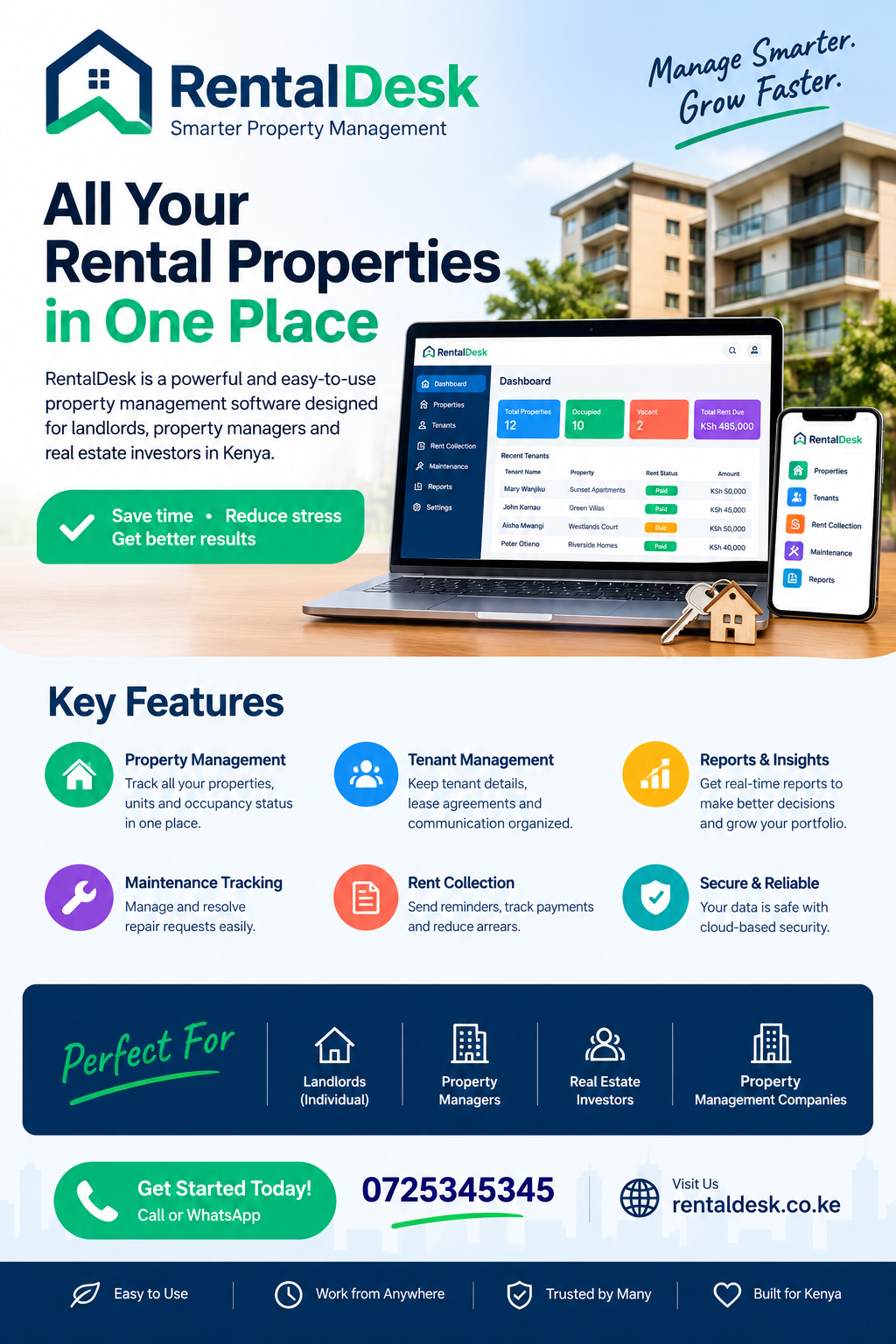
Tenant Move-Out Software Kenya: A Practical Guide to Faster Tenant Exits and Better Property Management
When a tenant leaves a rental property, the landlord must do more than collect the keys. There may be unpaid rent, outstanding utility bills, damaged fittings, maintenance requests, deposit calculations and records to update before the next tenant arrives. Tenant Move-Out Software Kenya helps property owners and managers organise these activities in one workflow instead of relying on scattered notebooks, spreadsheets, phone calls and paper forms.
Tenant departures can become particularly difficult for landlords managing several apartments, houses or residential units. One tenant may give notice early, another may leave unexpectedly, and a third may return the keys while outstanding charges remain unresolved. Without a consistent process, important details can be missed, disputes can develop and vacant units can take longer to prepare for occupation.
A structured digital process makes these responsibilities easier to coordinate. Property managers can record the tenant’s notice, schedule an inspection, document the property’s condition, calculate outstanding balances, coordinate repairs and maintain a clear record of the handover. These records also help landlords explain decisions to tenants and identify recurring property maintenance problems.
This guide explains how digital move-out management works, which features matter, how to handle inspections and deposits, and how Kenyan landlords can improve the transition between outgoing and incoming tenants.
1. Understanding Tenant Move-Out Management
Tenant move-out management is the process of handling the activities that take place when a tenant ends an occupancy arrangement and returns a rental unit to the landlord or property manager.
The process starts when a tenant communicates an intention to leave. It ends when the departure has been documented, relevant financial matters have been reviewed, necessary maintenance has been addressed and the unit is ready for its next occupant.
Tenant Move-Out Software Kenya is useful when a property manager needs a repeatable method for coordinating these steps across multiple properties. In practice, the software should support the workflow rather than replace the landlord’s judgement, tenancy agreement or applicable legal obligations.
What happens during a tenant move-out?
A typical departure involves several activities:
- Receiving and recording the tenant’s notice.
- Confirming the expected departure date.
- Reviewing the tenancy agreement and applicable notice requirements.
- Arranging the final property inspection.
- Comparing the property’s condition with its earlier records.
- Recording keys, access cards and other items returned.
- Checking rent, utilities and other agreed charges.
- Reviewing the security deposit and any proposed deductions.
- Assigning repairs and cleaning tasks.
- Updating occupancy records.
- Preparing the property for advertising or a new tenancy.
Each task depends on information from the others. For example, the final deposit calculation may depend on the rent ledger, utility readings, inspection report and tenancy agreement. Keeping those records connected reduces the risk of making decisions using incomplete information.
Why manual processes create difficulties
A landlord with one property may manage a tenant’s exit through a few messages and a paper checklist. This can work when the process is simple and the records are easy to retrieve.
The same approach becomes harder when several tenants leave within a short period. A property manager may forget to follow up on a repair, overlook a meter reading or struggle to locate photographs taken during the original inspection.
A digital workflow creates a central reference point. Staff members can see what has been completed, what remains outstanding and who is responsible for the next action.
2. Why Kenyan Landlords Need a Better Move-Out Process
Rental properties require careful coordination between occupancy, maintenance and financial administration. Tenant departures can expose weaknesses in all three areas.
Reducing administrative pressure
Landlords often handle tenant communication alongside rent collection, supplier coordination, inspections and marketing vacant units. Repeating the same administrative steps manually consumes time that could be spent on property performance and tenant service.
Tenant Move-Out Software Kenya can help standardise the work by providing consistent checklists, digital records and task reminders. Staff members follow the same procedure rather than depending entirely on individual memory.
Improving financial visibility
A tenant’s departure does not automatically mean every payment has been settled. Rent may be outstanding, utility charges may require confirmation, or an agreed service charge may still need reconciliation.
A well-organised process makes these items visible before the account is closed. It also separates confirmed charges from amounts that require further investigation.
This distinction is important because an estimated bill or an unverified damage claim should not automatically be treated as a final liability. The landlord should check supporting documents, the tenancy agreement and applicable requirements before finalising the account.
Keeping properties occupied
Vacant days can affect rental income. If a property is not inspected promptly or maintenance work is assigned too late, the next tenant may have to wait longer than necessary.
A clear departure workflow helps property managers identify the earliest point at which a unit can be cleaned, repaired, photographed, advertised and shown to prospective tenants.
The aim is not to rush the outgoing tenant. It is to coordinate responsibilities early enough that avoidable delays do not continue after the keys have been returned.
Supporting better tenant relationships
Move-out discussions can become sensitive when they involve deposits, damage or outstanding payments. Accurate records help the parties discuss specific facts rather than relying on conflicting recollections.
A documented process also allows the property manager to communicate the next steps clearly. Tenants should understand when the inspection will happen, what records are being reviewed and how any disputed item can be raised.
3. Essential Features of a Digital Move-Out System
Not every landlord needs an elaborate property management platform. The right solution should match the number of units managed, the complexity of the tenancy arrangements and the responsibilities assigned to staff.
Tenant Move-Out Software Kenya should make the departure process easier to follow, not introduce unnecessary administrative work.
Tenant notice and departure tracking
The system should record when notice was received, the intended move-out date and any relevant communication.
Useful information includes:
- Tenant name and contact details.
- Property and unit identification.
- Tenancy start and expected end dates.
- Notice date and supporting correspondence.
- Planned inspection date.
- Expected key-return date.
- Current move-out status.
These details help staff distinguish between a tenant who has announced an intention to leave and one whose tenancy has actually ended.
Inspection checklists
An inspection checklist provides a consistent structure for reviewing the unit. It can cover walls, floors, ceilings, doors, windows, locks, plumbing, electrical fittings, appliances and other items relevant to the property.
A digital checklist should allow staff to record observations, attach photographs where supported and mark issues requiring follow-up.
The checklist should also distinguish ordinary wear from possible damage. The correct assessment depends on the facts, the condition at the start of the tenancy, the tenancy agreement and applicable legal requirements.
Deposit and balance reconciliation
The system should help staff assemble the information required to review the tenant’s account. This may include rent records, agreed charges, utility bills, documented damage and payments already made.
Where a deposit is held, the landlord should review the relevant terms and applicable law before deciding whether any deduction is justified.
Tenant Move-Out Software Kenya can support this process by keeping account details and supporting records organised. It should not make unsupported deductions automatically or treat every inspection issue as a chargeable expense.
Maintenance task management
Inspection findings often lead to practical work. A leaking tap may require a plumber, a damaged lock may need replacement, and a dirty unit may need professional cleaning.
A useful task record identifies the problem, the responsible person, the priority, the target date and the completion status. Photographs, quotations and invoices can provide additional evidence when the platform supports attachments.
Occupancy status updates
Once a tenant has departed, the property record should reflect the actual situation. A unit may be awaiting inspection, undergoing repairs, ready for viewing or prepared for a new tenant.
Clear statuses help prevent staff from advertising a unit as ready when it still has outstanding work. They also make it easier to identify which vacant properties need attention first.
4. Creating a Consistent Move-Out Workflow
A digital system works best when the team agrees on a standard procedure. Software alone cannot compensate for unclear responsibilities or missing records.
Step 1: Record the notice
The process begins when the tenant communicates the intention to leave. Record the date, intended departure date and the relevant details of the tenancy agreement.
The property manager should confirm receipt and explain any next steps. If the notice period or departure date is disputed, the matter should be reviewed before the schedule is treated as final.
Tenant Move-Out Software Kenya can provide a central record for tracking the notice and its progress, particularly where several staff members handle the same property.
Step 2: Prepare the tenant’s account
Review the rent ledger and identify any amounts that require reconciliation. Confirm the payment history rather than relying only on the most recent message or a manually calculated balance.
Check whether utilities, service charges or other agreed obligations apply. Some bills may arrive after the physical departure, so the property manager should document what is known and what remains pending.
Step 3: Arrange the final inspection
Agree on an inspection time and communicate what the visit will cover. The inspection should be practical, respectful and consistent with the tenancy agreement and applicable access requirements.
Where possible, use the original inventory or move-in report as a reference. Without a reliable starting record, it may be difficult to determine whether an issue existed before the tenant moved in.
Step 4: Record the condition of the unit
Review each relevant area systematically. Record the condition of fittings, fixtures, appliances and any other items included in the tenancy arrangement.
Photographs can help show the condition of an item at a particular time. They should be dated or associated with the inspection record wherever the system permits.
The report should describe the observed issue rather than make unsupported assumptions about who caused it.
Step 5: Confirm key handover
Record the return of keys, access cards, remotes and any other items issued to the tenant. If something remains outstanding, document it and arrange the appropriate follow-up.
The property manager should also confirm when possession was returned and whether any authorised access arrangements remain in place.
Step 6: Review financial matters
Bring together the tenancy terms, rent ledger, payment records, utility information and inspection findings.
Classify each amount clearly as confirmed, disputed or awaiting verification. This helps the landlord avoid confusing a proposed deduction with an agreed and final deduction.
Tenant Move-Out Software Kenya illustrates the role of structured digital records in administrative workflows; for rental operations, the selected platform should specifically support the landlord’s property and tenancy requirements.
Step 7: Assign cleaning and repairs
Create a task for each confirmed maintenance issue. Set a priority and target completion date, and assign responsibility to the appropriate worker or contractor.
Avoid combining unrelated issues into one vague instruction such as “fix the house.” Specific tasks make it easier to estimate costs, monitor progress and confirm completion.
Step 8: Close the move-out record
Before marking the process complete, check that the inspection, key handover, account review and outstanding work have been recorded.
If some items remain unresolved, retain an appropriate status instead of treating the departure as fully closed. A clear audit trail makes later questions easier to answer.
5. Conducting Fair and Useful Final Inspections
The final inspection is one of the most important stages of a tenant’s departure. It provides an opportunity to document the unit’s condition, identify maintenance requirements and compare the current state with the move-in record.
Tenant Move-Out Software Kenya can help organise inspection information when the platform includes suitable checklists, notes and supporting attachments.
Inspect each room systematically
Start at the entrance and move through the property in a consistent order. Depending on the unit, the checklist may include:
- Main entrance, locks and security fittings.
- Walls, ceilings and painted surfaces.
- Floors, skirting boards and tiles.
- Windows, glass and curtains where provided.
- Kitchen cabinets, sinks and worktops.
- Taps, showers, toilets and drainage.
- Electrical switches and accessible fittings.
- Appliances included in the tenancy.
- Balconies, yards, parking areas or storage spaces.
- Any shared items assigned to the tenant.
Not every item applies to every property. A furnished apartment, for example, may require a detailed furniture inventory, while an unfurnished unit may need fewer item-specific checks.
Distinguish wear from damage
A faded wall, minor surface marks and normal deterioration may be different from a broken door, missing fixture or damage caused by misuse. The correct treatment depends on the facts and the applicable agreement and legal framework.
The inspection report should therefore describe what is visible. For example, “a crack approximately ten centimetres long on the bedroom window” is more useful than “tenant carelessly damaged window” if the cause has not been established.
Keep evidence organised
Inspection photographs should be linked to the relevant room or item. If an issue is disputed, staff can retrieve the original inventory, earlier photographs and maintenance records without searching through unrelated phone galleries.
Digital evidence is most useful when it has context. A photograph should identify the property, inspection date and item being reviewed wherever practical.
Share the findings appropriately
The property manager should communicate relevant findings to the outgoing tenant through an agreed channel. If the tenant disputes an observation, record the response and review the available evidence.
A fair inspection process does not guarantee that every disagreement will disappear. It does, however, make decisions easier to explain and gives both parties a clearer record of what was observed.
6. Managing Security Deposits and Final Balances
Deposit reconciliation requires care because financial decisions can affect trust and lead to disputes. A landlord should not treat a deposit as unrestricted income or assume that every unpaid estimate can be deducted.
Tenant Move-Out Software Kenya can be part of a broader digital workflow, but deposit decisions must still be based on accurate records, the tenancy terms and applicable requirements.
Start with the tenancy agreement
Review the provisions relating to the deposit, rent, notice, utilities, damage and the return of possession. If a clause is unclear or conflicts with applicable law, obtain appropriate advice instead of relying on an assumption.
The system should preserve the relevant documents or make them easy to retrieve.
Prepare an itemised account
A useful reconciliation statement may include:
| Item | Information to verify |
|---|---|
| Rent | Period covered, amount due and payments received |
| Utilities | Meter readings, bills and allocation method |
| Agreed service charges | Relevant agreement and payment history |
| Property damage | Inspection evidence and reasonable supporting costs |
| Missing items | Inventory record and evidence of the missing item |
| Deposit | Amount received and terms governing its treatment |
| Refund or balance | Calculation, supporting records and status |
This table is a working checklist, not a declaration that every listed amount may lawfully be deducted from a deposit.
Separate confirmed amounts from estimates
A final utility bill may not yet be available when the tenant returns the keys. A repair quotation may also change after the contractor examines the problem.
Record the uncertainty rather than presenting an estimate as a confirmed liability. The property manager should follow the applicable process for communicating, verifying and resolving the amount.
Maintain a clear record of decisions
Each proposed deduction should have a reason and supporting evidence. Staff should be able to identify who reviewed the item, what information was considered and whether the matter remains disputed.
Tenant Move-Out Software Kenya supports the broader principle of organising information digitally, while a rental-specific platform should provide the records and controls needed for tenancy administration.
Communicate the outcome
Once the review is complete, explain the calculation to the tenant in plain language. Identify the amounts considered, the supporting documents and the resulting balance.
Avoid unexplained deductions or vague statements such as “cleaning charges applied.” A clear description of the service, evidence and calculation makes it easier to understand the decision.
7. Coordinating Repairs, Cleaning and Unit Readiness
A property can remain vacant for longer than necessary when repairs are discovered late, tasks are assigned informally or contractors receive incomplete instructions.
The move-out process should therefore connect inspection findings to a practical maintenance plan.
Prioritise urgent issues
Not all repairs have the same urgency. A security problem, major leak or serious electrical concern should be handled differently from a minor cosmetic issue.
A useful priority system might include:
- Urgent: An issue that creates an immediate safety, security or serious property-damage concern.
- High: A repair that could prevent safe or practical occupation if left unresolved.
- Routine: Work that should be completed during normal maintenance scheduling.
- Cosmetic: Improvements that can be planned after essential work, depending on budget and condition.
These are operational categories, not substitutes for professional assessment where a problem presents a safety risk.
Give contractors clear instructions
A maintenance request should explain the issue, its location, the expected work and any access arrangements. Include relevant photographs when available.
For example, “inspect the kitchen sink because water is leaking beneath the cabinet” is more useful than “check the kitchen.” The clearer instruction reduces unnecessary visits and helps contractors prepare suitable materials.
Tenant Move-Out Software Kenya can help teams coordinate this kind of work when the chosen system supports maintenance assignments, progress tracking and completion records.
Verify work before closing tasks
A contractor’s statement that a job is complete should be followed by an appropriate check. Depending on the repair, this may involve testing a tap, confirming that a lock works or reviewing an invoice.
Record the completion date and any remaining concern. This gives the property manager a more reliable basis for deciding whether the unit is ready for viewing or occupation.
Prepare the unit for marketing
Once essential work is finished, the landlord can coordinate cleaning, photographs, viewing arrangements and listing updates.
The property description should accurately reflect the unit’s condition and availability. If work remains incomplete, the listing and viewing process should be managed accordingly rather than promising immediate occupation without confirmation.
8. Preventing Disputes Through Better Documentation
Tenant move-out disagreements often concern facts that were not recorded clearly at the beginning or end of the tenancy. Examples include the condition of a wall, the return of a key, the timing of a payment or responsibility for a repair.
Digital records help by bringing relevant information together.
Keep move-in and move-out records comparable
A useful system makes it possible to compare the original inventory with the final inspection. The comparison should focus on the same areas and items wherever practical.
If the original inspection report is incomplete, the manager should acknowledge that limitation. Missing evidence should not be replaced with confident assumptions.
Record communications
Keep important notices, inspection arrangements, payment confirmations and explanations of disputed charges in an organised record.
The aim is not to preserve every casual message indefinitely without purpose. It is to retain relevant information according to a sensible record-retention policy and applicable data-protection requirements.
Tenant Move-Out Software Kenya reflects the value of organised digital processes, while a property management solution should connect communications to the relevant tenant and unit.
Use consistent decision-making
Two tenants in similar circumstances should be assessed using consistent criteria. Different outcomes may be justified by different evidence or agreement terms, but the reason should be documented.
A standard checklist reduces the chance that one inspector records every minor issue while another overlooks important defects.
Protect personal information
Tenant records can contain phone numbers, identification details, financial information and private correspondence. Access should be limited to people who need the information for their responsibilities.
Use appropriate account permissions, secure authentication and sensible retention practices. Avoid sharing tenant documents through public links or unsecured channels when a safer method is available.
9. Choosing Software That Fits a Kenyan Rental Business
The best platform is not necessarily the one with the longest feature list. It is the one that supports the landlord’s actual workflow, provides dependable records and can be used consistently by the people responsible for the work.
Tenant Move-Out Software Kenya should be assessed against practical needs rather than promotional claims alone.
Evaluate the full property management workflow
Move-out management rarely operates in isolation. It connects to tenant records, rent collection, maintenance, financial reporting and occupancy tracking.
Consider whether the system can access the relevant tenancy information without requiring staff to enter the same details repeatedly.
Check mobile usability
Property inspections often happen at the rental unit rather than at an office. Staff may need to check a tenant record, update a checklist or attach a photograph while on site.
Ask whether the platform works well on the devices your team uses, including under the connectivity conditions encountered at your properties.
Review financial record capabilities
A landlord should be able to trace relevant payments, charges and balances. Where payment integrations are advertised, verify which providers are supported, how transactions are reconciled and what evidence is available when a payment cannot be matched automatically.
For Kenyan properties, M-Pesa may be part of the payment workflow, but integration details and available features should be confirmed directly with the provider.
Examine user permissions and security
Not every staff member needs access to every financial or personal record. Ask whether roles can be assigned according to responsibilities and whether important changes can be traced.
Also review the provider’s backup practices, support arrangements, export options and procedures for recovering access.
Ask for a practical demonstration
During a demonstration, ask the provider to show a complete move-out case from notice to unit readiness. A realistic scenario is more informative than a list of features.
Confirm that the system supports the required workflow before paying for a plan. If a necessary function is unavailable, establish whether a reasonable alternative exists and what extra work it would create.
10. Understanding Costs and Potential Return on Investment
Software costs vary by provider, subscription structure, property portfolio and available features. A landlord should compare the total cost of operating the system with the time and administrative effort it is expected to save.
Tenant Move-Out Software Kenya should be evaluated as part of the cost of managing the rental business, not only as a monthly subscription.
Identify direct and indirect costs
Potential costs include:
- Monthly or annual subscription charges.
- Initial setup and data migration.
- Staff training.
- Additional user accounts.
- Optional integrations.
- Support or customisation fees.
- Devices or connectivity required by the team.
Ask the provider to explain which features are included and which incur additional charges.
Estimate administrative time saved
Consider how long the team currently spends collecting inspection notes, checking tenant accounts, arranging repairs and answering questions about deposits.
For example, a landlord managing several units might track the average time required to complete a move-out manually and compare it with the time required after introducing a structured digital process.
The comparison should use actual experience rather than an assumed percentage of savings.
Consider avoidable vacancy delays
A better workflow may help staff discover maintenance needs earlier and coordinate repairs more efficiently. However, software cannot guarantee that a contractor will be available or that a new tenant will be found immediately.
A realistic assessment should distinguish improvements the system can influence from factors outside the landlord’s control.
Review value over time
The platform may become more useful as the property portfolio grows, but additional units may also increase subscription costs or training requirements.
Review the arrangement periodically. Confirm that the features remain useful, the records are reliable and the administrative benefits justify the total cost.
11. Common Mistakes to Avoid During Tenant Move-Out
Even with a digital system, poor procedures can undermine the results. Landlords should address the following problems before relying on automation.
Waiting until the tenant leaves to prepare
A departure should not come as an administrative surprise when notice has already been received. Early preparation allows the manager to schedule the inspection, review the account and plan maintenance.
Failing to document the initial condition
Without a move-in inventory, it may be difficult to establish whether a problem developed during the tenancy. Create a consistent initial inspection process for every new occupant.
Treating every defect as tenant damage
A defect may result from age, ordinary wear, a maintenance problem or another cause. Record the evidence and assess the issue fairly before proposing a charge.
Tenant Move-Out Software Kenya is included here only as the next destination in the requested linking sequence; for property operations, the important principle is that software should support evidence-based decisions rather than automatically assign blame.
Mixing estimates with final charges
Unconfirmed utility amounts and preliminary repair quotations should remain identifiable as estimates until verified. Clear financial statuses prevent avoidable confusion.
Forgetting keys and access devices
A unit may appear vacant while copies of keys or access devices remain unaccounted for. Include a handover checklist and record the items returned.
Assigning vague maintenance jobs
General instructions make it difficult to track work or assess completion. Create separate tasks with clear descriptions, priorities and responsible people.
Closing records too early
Do not mark a departure fully complete while important matters remain unresolved. Use statuses that accurately reflect pending bills, disputed charges or incomplete maintenance.
Giving too many people access to records
Shared logins and unrestricted access make accountability more difficult. Assign appropriate user permissions and remove access when staff responsibilities change.
12. Practical Example: Managing an Apartment Move-Out
Consider a landlord managing an apartment in Nairobi. A tenant provides notice, and the landlord expects the unit to become vacant at the end of the agreed period.
Under a manual process, the landlord might save the notice in a messaging application, write the inspection date in a notebook, keep photographs on a personal phone and calculate the final balance in a separate spreadsheet. The plumber’s details may be stored elsewhere, while the tenant’s deposit information sits in a paper file.
The problem is not that any one of these tools is inherently unsuitable. It is that the records are separated and depend on someone remembering where each item is stored.
Tenant Move-Out Software Kenya is the next link in the prescribed rotation; in this rental scenario, the appropriate software workflow would bring the relevant tasks and records together.
Before the departure
The property manager records the notice and expected departure date. The tenant’s account is reviewed to identify confirmed rent payments and any outstanding questions.
The manager arranges the final inspection and prepares a checklist based on the original inventory. If a utility reading will be required, the team plans how and when to record it.
On inspection day
The manager checks the rooms, records the condition of relevant fittings and takes photographs of any issues. The key handover is recorded separately so that possession and inspection information are not confused.
Suppose the inspection reveals a leaking tap and a cracked tile. The manager documents both observations and checks the earlier property records before determining the next steps.
After the inspection
The leaking tap is assigned to a plumber. The cracked tile is assessed to establish the appropriate repair and supporting cost.
The tenant’s account is reconciled using verified records. If a bill remains outstanding, it is marked as pending rather than treated as a confirmed amount without evidence.
Before a new tenant moves in
The manager checks that repairs are complete, cleaning has been done and the unit’s status is accurate. The property can then be advertised or offered for occupation according to its actual readiness.
This example shows how a consistent workflow helps connect the physical condition of a property with its financial and occupancy records. The outcome still depends on good judgement, timely communication and reliable information.
13. Measuring Whether the Process Is Improving
A landlord should assess move-out management using practical measures rather than relying only on whether the software has been installed.
Tenant Move-Out Software Kenya can support a structured approach to administration, while the property manager should decide which indicators best reflect the portfolio’s actual needs.
Time from notice to inspection
Track how long it takes to schedule and complete the final inspection after the notice has been recorded. A long delay may indicate a scheduling problem, unclear responsibilities or difficulty coordinating access.
The appropriate target depends on the tenancy arrangement and the agreed departure schedule.
Time required to prepare a vacant unit
Measure the period between the return of possession and the point at which the unit is genuinely ready for its next occupant.
Record the reasons for delays, such as extensive repairs, contractor availability, late utility information or cleaning requirements. This helps distinguish process problems from unavoidable work.
Outstanding move-out tasks
Monitor how many departures still have unresolved inspections, account questions, missing keys or maintenance tasks.
A growing backlog may indicate that staff need clearer responsibilities or that the team has more work than it can reasonably complete.
Financial reconciliation accuracy
Review whether final statements are supported by the relevant records and whether errors are identified and corrected promptly.
A useful process should make it easier to trace the figures and explain how a balance was calculated.
Recurring maintenance issues
Look for patterns across properties. Repeated plumbing problems, damaged locks or faulty appliances may indicate the need for preventive maintenance rather than repeated repairs after each tenancy.
Use these findings to improve property upkeep and budget planning.
14. Preparing Your Team for Digital Move-Out Management
Introducing software changes the way people record information and coordinate tasks. A successful rollout should therefore include clear procedures and practical training.
Define staff responsibilities
Decide who receives notices, schedules inspections, checks accounts, approves repairs and communicates the final statement. Some businesses may assign several responsibilities to one person, while larger portfolios may separate them.
The important point is that every task has an identifiable owner.
Standardise checklists and statuses
Agree on the information that must be captured during every move-out. Use consistent terms for stages such as notice received, inspection scheduled, inspection completed, financial review pending, repairs in progress and unit ready.
Consistent labels make reports easier to interpret and reduce confusion between staff members.
Train staff using real examples
Use a sample tenancy to demonstrate the full workflow. Include a straightforward departure and a more complicated case involving repairs or a disputed charge.
Ask staff to complete the tasks themselves so that training reveals practical difficulties before the system is used for live records.
Review the first completed cases
After the initial move-outs, ask the team what information was missing, which steps caused delays and where the system created unnecessary work.
Adjust the process carefully and preserve records of important changes. The aim is to improve the workflow without weakening financial controls or inspection standards.
15. Frequently Asked Questions
What is tenant move-out management software?
It is a digital system that helps landlords and property managers coordinate the tasks involved when a tenant leaves a rental unit. Depending on the platform, it may support notices, inspections, photographs, deposit reconciliation, maintenance assignments, key handover and occupancy updates.
Tenant Move-Out Software Kenya should be assessed according to the specific rental features it provides rather than the general claim that it supports property management.
Can small landlords benefit from digital move-out management?
Yes. A landlord with a few units may benefit from standard checklists, organised inspection evidence and consistent account reviews. The main consideration is whether the software’s cost and complexity are proportionate to the portfolio.
A small landlord may need only a straightforward workflow, while a large property manager may require team permissions, reporting and integration with wider financial records.
Does software automatically determine whether a tenant should lose part of a deposit?
It should not replace the landlord’s assessment of the tenancy agreement, available evidence and applicable requirements. Software can organise records and calculations, but a deduction must be properly supported and handled according to the relevant rules.
Can move-out software manage repairs?
Some property management platforms include maintenance features that allow staff to record defects, assign contractors, monitor progress and retain completion evidence. Features vary, so confirm that the selected system supports the workflow you need.
How does digital inspection help prevent disputes?
A consistent checklist, dated photographs, original inventory and clear notes create a more reliable record of the property’s condition. They can help the parties compare evidence and understand why an issue was recorded.
Documentation does not guarantee that disagreements will disappear, but it reduces reliance on memory alone.
Can the system help reduce vacancy periods?
It may help by making inspection findings visible sooner, assigning maintenance tasks clearly and tracking whether the unit is ready for occupation. It cannot guarantee shorter vacancy periods because contractor availability, repair complexity and tenant demand also affect the outcome.
Should utility bills be finalised before the tenant leaves?
The timing depends on the billing arrangement and the relevant tenancy terms. Where a final bill is not yet available, record the reading and outstanding information, then follow an appropriate process for verification and communication. Do not present an unconfirmed estimate as a settled amount.
What should landlords look for when comparing platforms?
Review inspection checklists, tenant records, financial reconciliation, maintenance tracking, mobile usability, security, reporting, support and total cost. Request a demonstration of the complete departure workflow and verify any claimed integrations before committing.
Can move-out records be accessed by several staff members?
Many property management systems support multiple users, but available permissions vary. Confirm whether access can be restricted by role and whether important changes can be traced. Shared access should be managed carefully because tenant and financial records may be sensitive.
How should a landlord start using a digital move-out process?
Begin by documenting the current procedure, creating a standard checklist and identifying the records needed at each stage. Select a platform that supports those requirements, train the people involved and review the first completed cases before expanding the process across the portfolio.
Conclusion: Make Every Tenant Departure Easier to Manage
A tenant’s departure is a normal part of rental property ownership, but the administrative work surrounding it can become complicated when information is scattered or responsibilities are unclear. A consistent process helps landlords manage notices, inspections, keys, final accounts, maintenance and occupancy updates without losing sight of important details.
Tenant Move-Out Software Kenya can form part of a structured approach to rental administration when the selected platform supports the required property management workflow. The greatest benefit comes from combining useful technology with accurate records, clear communication and fair decision-making.
Start by reviewing how your business currently handles tenant departures. Identify the stages that regularly cause delays, the documents that are difficult to retrieve and the decisions that need better supporting evidence. Then establish a standard procedure and choose software that makes it easier to follow.
For landlords and property managers in Kenya, a well-managed move-out process can improve accountability, support more consistent tenant communication and help prepare rental units for their next occupants. The goal is not simply to close one tenancy. It is to protect the quality of the property, maintain dependable records and make the next letting process easier to manage.
Tenant Move-Out Software Kenya
Tenant Move-Out Software Kenya
Tenant Move-Out Software Kenya
Tenant Move-Out Software Kenya
Tenant Move-Out Software Kenya
Tenant Move-Out Software Kenya
Tenant Move-Out Software Kenya
Tenant Move-Out Software Kenya
Tenant Move-Out Software Kenya
Tenant Move-Out Software Kenya
Tenant Move-Out Software Kenya
Tenant Move-Out Software Kenya
Tenant Move-Out Software Kenya
Tenant Move-Out Software Kenya
Tenant Move-Out Software Kenya
Tenant Move-Out Software Kenya
Tenant Move-Out Software Kenya
Tenant Move-Out Software Kenya
Tenant Move-Out Software Kenya
Tenant Move-Out Software Kenya
Tenant Move-Out Software Kenya
Tenant Move-Out Software Kenya
Tenant Move-Out Software Kenya
Tenant Move-Out Software Kenya
Tenant Move-Out Software Kenya
Tenant Move-Out Software Kenya
Tenant Move-Out Software Kenya
Tenant Move-Out Software Kenya
Tenant Move-Out Software Kenya
Tenant Move-Out Software Kenya
Tenant Move-Out Software Kenya
Tenant Move-Out Software Kenya
Tenant Move-Out Software Kenya
Tenant Move-Out Software Kenya
Tenant Move-Out Software Kenya
Tenant Move-Out Software Kenya
Tenant Move-Out Software Kenya
Tenant Move-Out Software Kenya
Tenant Move-Out Software Kenya
Tenant Move-Out Software Kenya