
Tenant Lease Management Software Kenya: Complete Guide for Landlords and Property Managers
Managing leases becomes increasingly difficult as a rental portfolio grows. A landlord may need to track tenant details, lease start and end dates, rent amounts, deposits, payment schedules, renewals, move-outs and outstanding balances across dozens or hundreds of units. Tenant Lease Management Software Kenya gives landlords, property managers and real estate companies a structured way to bring those records into one system.
For Kenyan rental businesses, lease management is closely connected to rent collection, M-Pesa payments, invoicing, tenant communication and financial reporting. A lease record should not exist as an isolated document. It should connect the tenant to the correct unit, rental terms, invoices, payments and account balance. Tenant Lease Management Software Kenya can therefore become an important part of building a more reliable rental operation.
This guide explains how digital lease management works, why manual lease tracking causes problems, which features matter, how lease software can support Kenyan landlords, what to check before choosing a platform, and how a system such as RentalDesk can fit into the wider rental-management workflow. Tenant Lease Management Software Kenya is particularly useful when a property business needs visibility beyond a folder containing tenancy agreements.
What Is Tenant Lease Management Software?
Tenant Lease Management Software Kenya is a digital solution that helps landlords and property managers organize tenancy agreements and the operational information connected to those agreements.
Instead of keeping lease information in paper files, spreadsheets, notebooks and separate messaging conversations, a lease-management system can connect information such as:
- Tenant name and contact information
- Property and unit
- Lease start date
- Lease end date
- Rent amount
- Rent frequency
- Deposit information
- Billing dates
- Lease status
- Renewal information
- Move-in details
- Move-out details
- Payment history
- Outstanding balances
- Related invoices
- Tenant statements
Tenant Lease Management Software Kenya can also make it easier for property managers to understand the current status of a portfolio. Instead of opening several files to determine which leases are active or approaching expiry, management teams can use centralized records and reports.
This distinction matters because lease administration is not simply document storage. A tenancy agreement establishes commercial terms that influence billing, collections, occupancy and reporting. If those terms are not accurately reflected in operational records, errors can spread throughout the rental business.
For example, suppose a tenant signs a one-year agreement for a monthly rent of KES 25,000. If the lease dates are recorded incorrectly, the tenant’s billing cycle, renewal reminders and occupancy records may also become inaccurate. Tenant Lease Management Software Kenya helps reduce this type of administrative disconnect by keeping lease information connected to tenant and unit records.
Why Lease Management Matters to Kenyan Landlords
A lease may look like a simple document, but it contains information that affects the entire tenancy.
For a landlord managing several units, remembering every tenant’s lease expiry date can quickly become impractical. Add rent changes, deposits, renewals and tenant movements, and manual administration becomes even harder.
Tenant Lease Management Software Kenya helps address this problem by giving rental teams a consistent place to maintain lease information.
The value becomes clearer when a portfolio includes different property types. An owner may have apartments in Nairobi, commercial shops in another town, student accommodation, or residential units managed by an external property manager. Each tenancy can have different terms and dates.
A centralized system helps answer questions such as:
- Which tenants currently occupy each unit?
- Which leases are active?
- Which agreements are approaching their end dates?
- What rent is attached to each tenancy?
- Which tenants have outstanding balances?
- Which deposits have been recorded?
- Which tenants have moved out?
- Which units are vacant?
- Which agreements have been renewed?
- What rental income is associated with each property?
Tenant Lease Management Software Kenya can make these questions easier to answer without reconstructing information from multiple spreadsheets.
The problem with relying on memory
A small landlord may remember when a few tenants’ leases expire. That becomes much harder when the portfolio reaches dozens of units.
Important dates can be missed because:
- A spreadsheet was not updated.
- A paper agreement was misplaced.
- A staff member left the business.
- A renewal was discussed through WhatsApp but never recorded properly.
- A tenant changed units.
- A rent adjustment was recorded in one place but not another.
Tenant Lease Management Software Kenya provides a structured alternative to relying on memory or disconnected records.
Manual Lease Tracking vs Digital Lease Management
Many landlords start with spreadsheets because they are inexpensive and familiar. A spreadsheet can work for a very small portfolio, but it becomes increasingly difficult to maintain as the number of tenants grows.
Tenant Lease Management Software Kenya can offer a more connected workflow than a standalone spreadsheet.
| Area | Manual or Spreadsheet Approach | Digital Lease Management |
|---|---|---|
| Tenant records | Separate files or sheets | Centralized records |
| Lease dates | Manually checked | Easily searchable |
| Rent terms | Manually maintained | Connected to tenant and unit |
| Renewals | Calendar or memory | Structured lease workflow |
| Payment records | Often separate | Can connect with billing |
| Arrears | Manual calculations | System-based balance tracking |
| Reporting | Spreadsheet preparation | Automated or structured reports |
| Multiple properties | More difficult to organize | Portfolio-level visibility |
| Staff access | File sharing | Role-based access where supported |
| Audit trail | Depends on process | Can provide clearer activity history |
Tenant Lease Management Software Kenya does not eliminate the need for good management practices. The system still depends on accurate information being entered. What it does is provide a better structure for maintaining and using that information.
Key Features to Look For
Not every lease-management solution provides the same capabilities. Before choosing software, landlords should focus on features that support the actual rental workflow.
1. Tenant Profile Management
Tenant Lease Management Software Kenya should allow the landlord or property manager to maintain accurate tenant profiles.
Useful information may include:
- Full name
- Phone number
- Email address
- Identification reference where appropriate
- Unit
- Property
- Tenant status
- Lease history
- Payment history
A tenant profile becomes more useful when it is connected to the tenant’s lease and financial records.
2. Lease Start and End Dates
Lease dates are among the most important fields in a tenancy record.
Tenant Lease Management Software Kenya should make it easy to identify when an agreement begins and ends.
This supports several operational activities, including:
- Renewal planning
- Vacancy forecasting
- Tenant communication
- Move-out planning
- Occupancy reporting
- Portfolio reviews
A manager should not have to search through paper agreements every time they need to identify leases approaching expiry.
3. Rent Terms
The software should record the rental amount and billing frequency associated with a tenancy.
Tenant Lease Management Software Kenya becomes more valuable when lease terms are connected to invoicing and payment records.
For example, a residential tenant might pay KES 20,000 monthly, while a commercial tenant may have a different billing arrangement. The system should preserve the terms applicable to the individual tenancy rather than assuming every unit follows the same schedule.
4. Deposit Tracking
Deposits are another important component of lease administration.
Tenant Lease Management Software Kenya should help the property team identify whether a deposit has been recorded and associate it with the correct tenant and tenancy.
Accurate deposit records can reduce confusion during move-out because management can refer to the tenant’s documented financial history rather than reconstructing information from receipts and messages.
5. Renewal Management
Lease renewal is a major operational event.
Tenant Lease Management Software Kenya should help management identify leases that are nearing expiry and provide a clear process for updating the tenancy.
A renewal workflow may involve:
- Identifying the upcoming expiry.
- Reviewing the current rent.
- Communicating with the tenant.
- Confirming new terms.
- Updating the lease record.
- Updating billing information where necessary.
- Recording the new agreement.
The exact process depends on the landlord’s policies and the terms of the tenancy.
6. Move-In and Move-Out Records
Tenant Lease Management Software Kenya should support the complete tenancy lifecycle rather than only active leases.
Move-in records can establish when a tenant took possession. Move-out records can help identify when a tenancy ended and when a unit became available.
This is particularly important for landlords managing frequent tenant changes.
7. Tenant-Unit Relationships
A tenant should be associated with the correct property and unit.
Tenant Lease Management Software Kenya becomes particularly valuable for multi-property portfolios because management needs to know not only who the tenant is but also where that tenant belongs within the portfolio.
RentalDesk’s property and unit workflow is designed to organize properties, units, landlords, rent amounts and occupancy statuses while connecting units with leases, invoices and reports.
8. Invoicing and Billing
Lease information becomes significantly more useful when it feeds into billing.
Tenant Lease Management Software Kenya can help create a connection between contractual rent terms and recurring rental charges.
This reduces the risk of having one rent amount recorded in a lease spreadsheet and another amount used when preparing an invoice.
9. Payment Tracking
A tenant’s lease cannot be managed effectively without understanding the financial side of the tenancy.
Tenant Lease Management Software Kenya should ideally connect rent obligations with payments and outstanding balances.
For Kenyan landlords, M-Pesa is particularly important. A rental platform designed around Kenyan workflows can make it easier to connect mobile payments with tenant accounts and collection records. RentalDesk states that its platform supports M-Pesa, bank transfers and cash workflows and connects collections with tenant ledgers and payment history.
10. Arrears Visibility
A lease record should not exist independently from the tenant’s financial position.
Tenant Lease Management Software Kenya should help managers see whether a tenant has an outstanding balance.
A simple arrears workflow might show:
- Tenant
- Unit
- Amount invoiced
- Amount paid
- Balance
- Days outstanding
- Last payment
- Follow-up status
This makes collection follow-up more systematic.
How RentalDesk Connects Lease Management With Rental Operations
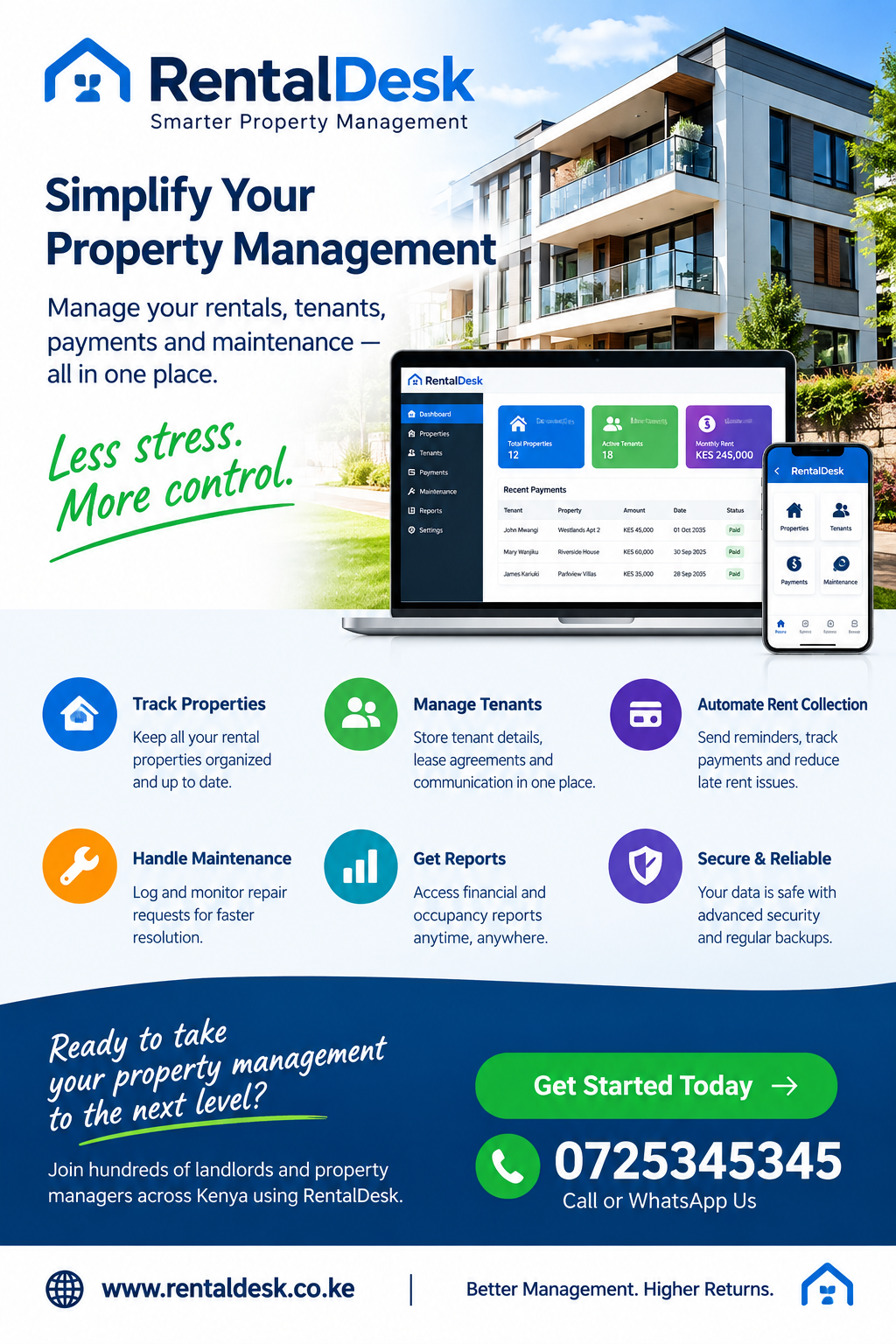
RentalDesk positions its lease-management functionality as part of a wider rental-management platform rather than as an isolated document system. Its lease feature tracks lease dates, rent terms, deposits, renewals and move-outs while connecting lease information to tenant and unit records.
Tenant Lease Management Software Kenya therefore makes most sense when viewed as one component of the wider rental workflow.
A typical process can look like this:
Property → Unit → Tenant → Lease → Invoice → Payment → Balance → Report
That relationship is important.
If the tenant is correctly attached to the unit, the lease can establish the rental terms. The billing system can then generate the relevant charges. Payments can be recorded against the tenant account. The remaining balance can be calculated, and reports can provide management visibility.
Tenant Lease Management Software Kenya can support this type of connected approach by bringing tenant, lease and rental information into a centralized platform.
M-Pesa and Lease Administration in Kenya
Mobile payments have become an important part of rental collection in Kenya. For a lease-management system to be genuinely useful locally, it should work alongside the payment processes landlords already use.
Tenant Lease Management Software Kenya can be particularly valuable when lease records are connected to payment records.
Consider a tenant whose monthly rent is KES 30,000.
The tenant makes a payment through M-Pesa. A well-structured rental workflow should make it possible to identify:
- Which tenant made the payment
- Which property the tenant belongs to
- Which unit is involved
- Which invoice the payment relates to
- How much remains outstanding
- Whether the tenant is fully paid for the relevant period
RentalDesk describes its Kenyan workflow around M-Pesa payment capture, reconciliation, receipts, tenant ledgers and arrears visibility.
Tenant Lease Management Software Kenya therefore should not be evaluated only on whether it stores lease documents. Kenyan landlords should also consider how lease data connects with their collection process.
Improving Lease Renewal Management
Lease renewal is one of the areas where digital records can make a noticeable difference.
Tenant Lease Management Software Kenya can help management identify upcoming lease expirations and prepare for the next stage of the tenancy.
A practical renewal process could include:
Step 1: Review upcoming expiries
Create a list of leases approaching their end date.
Step 2: Review tenant history
Check payment behaviour, outstanding balances, maintenance issues and other relevant records.
Step 3: Review the unit
Determine whether the unit requires repairs or improvements before renewal.
Step 4: Confirm commercial terms
Review rent, billing frequency, deposit arrangements and other applicable terms.
Step 5: Communicate with the tenant
Give the tenant appropriate notice and discuss the proposed renewal.
Step 6: Update the system
Record the renewed dates and agreed terms.
Step 7: Check billing
Ensure the new lease terms are reflected correctly in future invoices.
Tenant Lease Management Software Kenya can support this process by giving the team a centralized record to work from rather than relying on separate spreadsheets.
Benefits for Property Management Companies
Property management companies often handle properties belonging to multiple owners.
Tenant Lease Management Software Kenya can help organize information across multiple properties and units.
The benefits include:
- Better tenant visibility
- More consistent lease records
- Easier portfolio reporting
- Improved collection follow-up
- Centralized property information
- Reduced dependence on individual staff members
- Better visibility into lease expiries
- More structured owner reporting
RentalDesk states that its platform supports multi-property operations and portfolio-level reporting.
For an agency, this can be important because the quality of service depends partly on how quickly staff can retrieve accurate information.
Benefits for Individual Landlords
Individual landlords can also benefit from structured lease management.
Tenant Lease Management Software Kenya is not only relevant to large property management companies.
A landlord with ten or twenty units may already have enough administration to make manual tracking inconvenient. As the portfolio grows, the need for reliable records becomes greater.
A landlord can use a digital system to monitor:
- Occupied units
- Vacant units
- Active leases
- Upcoming expiries
- Rent collection
- Arrears
- Tenant history
- Property income
- Maintenance issues
Tenant Lease Management Software Kenya can therefore provide value even before a portfolio becomes very large.
Why Spreadsheets Eventually Become Difficult
Spreadsheets are useful tools, but they are not specifically designed to operate a rental portfolio.
Tenant Lease Management Software Kenya can replace some of the fragmented workflows that appear when a spreadsheet becomes the central rental-management system.
Common problems include:
- Duplicate records
- Incorrect formulas
- Accidental overwriting
- Outdated versions
- Limited automation
- Difficult access control
- Manual payment reconciliation
- Manual reporting
- Poor visibility into lease expiry dates
The issue is not that spreadsheets are inherently bad. The issue is that rental operations contain interconnected information.
Tenant Lease Management Software Kenya is designed around those relationships, allowing tenant, lease, unit, billing and payment information to work together.
Lease Management and Tenant Communication
Good lease management also improves communication.
Tenant Lease Management Software Kenya gives staff a reliable reference point when communicating with tenants.
Suppose a tenant asks:
When does my current lease end?
The manager should be able to retrieve the answer quickly.
A tenant may also ask about:
- Current rent
- Payment status
- Deposit
- Outstanding balance
- Invoice
- Previous payment
- Renewal status
Tenant Lease Management Software Kenya can make these interactions easier when the underlying records are centralized.
Clear records can also reduce disputes caused by conflicting information.
Reports That Help Landlords Make Decisions
Lease data becomes much more useful when management can turn it into reports.
Tenant Lease Management Software Kenya can contribute to reports such as:
- Active leases
- Expiring leases
- Vacant units
- Occupancy
- Rent collected
- Outstanding balances
- Tenant payment history
- Property income
- Lease status
RentalDesk’s reporting functionality is positioned around collections, balances, property performance and portfolio visibility.
For example, a landlord may discover that a particular property has several leases ending within the same quarter. That information can help with maintenance planning, marketing and cash-flow forecasting.
Data Accuracy Is Critical
Software cannot compensate for inaccurate data.
Tenant Lease Management Software Kenya works best when the initial tenant and lease records are entered carefully.
Before going live, review:
- Tenant names
- Contact details
- Unit assignments
- Lease dates
- Rent amounts
- Deposit values
- Billing frequencies
- Existing balances
- Payment history
- Lease status
A migration checklist can help prevent old spreadsheet errors from being transferred into the new system.
How to Choose the Right Software
Choosing software should start with the actual workflow, not the number of features listed on a website.
Tenant Lease Management Software Kenya should be evaluated against the problems your rental business needs to solve.
Ask these questions:
Does it support your portfolio size?
A five-unit landlord and a 500-unit property management company have different requirements.
Does it support multiple properties?
If you manage more than one building, portfolio-level visibility matters.
Does it support Kenyan payment workflows?
M-Pesa support can be important for local rental businesses.
Can it track lease dates?
The system should make active, expired and upcoming leases easy to identify.
Does it connect tenants to units?
Tenant records should not exist independently from property records.
Does it support billing?
Lease terms should ideally connect with invoices and recurring charges.
Can you see arrears?
Outstanding balances should be easy to identify.
Does it provide reports?
Management needs information that can support decisions.
Is access controlled?
Different employees may require different levels of access.
Can you migrate existing records?
Ask how existing tenant, property, lease and balance data can be imported.
Tenant Lease Management Software Kenya should ultimately be selected based on operational fit rather than marketing language.
Questions to Ask During a Software Demo
A demonstration should be practical.
Tenant Lease Management Software Kenya can be evaluated by asking the provider to demonstrate real scenarios.
For example, request a demonstration of:
- Adding a property.
- Adding a unit.
- Creating a tenant.
- Creating a lease.
- Recording rent terms.
- Recording a deposit.
- Generating an invoice.
- Recording an M-Pesa payment.
- Checking the tenant balance.
- Renewing the lease.
- Moving the tenant out.
- Generating a report.
This is more useful than watching a presentation focused only on feature names.
A Practical Example
Imagine a landlord has a 40-unit apartment building in Nairobi.
Tenant Lease Management Software Kenya can help structure the landlord’s records around the building and its individual units.
Suppose Unit A12 is occupied by a tenant paying KES 28,000 per month.
The system could contain:
Property: Nairobi Apartment
Unit: A12
Tenant: Registered tenant
Monthly rent: KES 28,000
Lease status: Active
Lease dates: Recorded in the tenant record
Deposit: Recorded
Invoices: Monthly
Payments: Recorded
Balance: Updated after payments
When the tenant pays through the configured payment process, the payment can be associated with the relevant tenant and account.
Tenant Lease Management Software Kenya can then support reporting around the unit, tenant and property.
If the lease approaches expiry, management can review the record and begin the renewal process.
This is much more structured than searching through a physical file, checking a spreadsheet and then looking through M-Pesa messages separately.
Security and Access Control
Rental records contain information that should be handled responsibly.
Tenant Lease Management Software Kenya should be evaluated for access controls and audit visibility.
Consider whether the system supports:
- User accounts
- Role-based permissions
- Secure authentication
- Activity records
- Controlled financial access
- Backup procedures
- Data export
- Clear ownership of account information
RentalDesk highlights role-based permissions and audit visibility as part of its platform approach.
Security should be part of the purchasing decision rather than an afterthought.
Cost Considerations
The cheapest software is not automatically the best option.
Tenant Lease Management Software Kenya should be assessed against the cost of the problems it is expected to solve.
Consider:
- Monthly subscription
- Number of units supported
- Number of users
- Payment integrations
- Setup costs
- Data migration
- Training
- Support
- Reporting
- Additional modules
A useful way to evaluate cost is to compare it with the time spent on manual administration.
If staff spend several days every month reconciling payments, preparing reports and checking lease records, software may provide value even if it introduces a monthly subscription.
RentalDesk currently publishes Kenya-shilling plans on its rental-management page, including a Free Lite option and paid plans, with pricing subject to the selected plan and portfolio requirements.
Common Mistakes to Avoid
Even good software can be poorly implemented.
Tenant Lease Management Software Kenya should be introduced with clear procedures.
Avoid these mistakes:
Importing inaccurate data
Do not migrate a spreadsheet without first checking it.
Creating duplicate tenants
Use consistent tenant records.
Assigning tenants to the wrong unit
Unit relationships should be reviewed carefully.
Ignoring old balances
Opening balances should be verified before going live.
Failing to update lease renewals
A renewed tenancy should be reflected in the system.
Giving everyone full access
Users should receive only the permissions needed for their work.
Not training staff
Employees need to understand the workflow.
Using software only for rent collection
The biggest benefits can come from connecting tenants, leases, billing, payments, maintenance and reporting.
How to Implement Lease Software Successfully
Implementation does not have to be complicated.
Tenant Lease Management Software Kenya can be introduced in stages.
Phase 1: Prepare your data
Collect tenant, property, unit and lease information.
Phase 2: Clean the records
Remove duplicates and correct obvious errors.
Phase 3: Set up properties and units
Create the portfolio structure.
Phase 4: Add tenants
Assign each tenant to the correct unit.
Phase 5: Add leases
Enter dates, rent terms, deposits and statuses.
Phase 6: Verify balances
Check opening balances against trusted records.
Phase 7: Configure payments
Set up the relevant collection workflows.
Phase 8: Test
Run several realistic tenant scenarios.
Phase 9: Train staff
Show users how to perform their daily tasks.
Phase 10: Monitor
Review the system after the first billing cycles and correct issues promptly.
Tenant Lease Management Software Kenya becomes much more effective when implementation is treated as an operational project rather than simply installing software.
RentalDesk for Kenyan Rental Operations
RentalDesk presents itself as a Kenya-first rental-management platform designed around landlords, property managers and rental businesses. Its platform combines tenant management, lease management, rent invoicing, M-Pesa payment workflows, arrears tracking, maintenance, owner reporting and property management.
Tenant Lease Management Software Kenya is therefore relevant to landlords who want lease administration to work together with the rest of their rental operations.
The platform’s lease-management feature specifically covers lease dates, rent terms, deposits, renewals and move-outs. It also connects lease information to invoices, balances, statements and reports.
For a Kenyan rental business, that connection can be important because the lease is only one part of the tenant lifecycle.
A useful rental workflow can be summarized as:
Acquire tenant → Assign unit → Create lease → Generate invoice → Collect rent → Reconcile payment → Track balance → Manage tenancy → Renew or move out
Tenant Lease Management Software Kenya supports the broader concept of treating lease administration as part of this complete lifecycle.
Who Can Benefit From Lease Management Software?
The solution can be relevant to several types of property businesses.
Tenant Lease Management Software Kenya may be useful for:
- Individual landlords
- Apartment owners
- Property management companies
- Real estate agencies
- Estate managers
- Commercial property owners
- Mixed-use property managers
- Investors managing multiple properties
- Rental businesses with growing portfolios
The specific value depends on portfolio size and operational complexity.
A landlord with three units may need only basic lease tracking. A property management company with several hundred units may need multi-property controls, user permissions, automated billing, payment reconciliation and comprehensive reporting.
Tenant Lease Management Software Kenya should therefore be matched to the actual scale and workflow of the business.
Lease Management and Business Growth
Growth creates administrative pressure.
Tenant Lease Management Software Kenya can help rental businesses create repeatable processes before portfolio expansion makes manual systems difficult to maintain.
Suppose a landlord grows from 10 units to 100 units.
The underlying work has increased substantially:
- More tenants
- More invoices
- More payments
- More leases
- More renewals
- More maintenance requests
- More arrears
- More reports
Without structured systems, the additional workload may require significant administrative effort.
Tenant Lease Management Software Kenya can help standardize recurring processes so the business does not depend entirely on manual follow-up.
Frequently Asked Questions
1. What does tenant lease management software do?
Tenant Lease Management Software Kenya helps landlords and property managers organize tenant records, lease dates, rental terms, deposits, renewals, move-outs and related financial information.
The best solutions connect lease information with units, invoices, payments and reports.
2. Is lease management software useful for small landlords?
Yes. Tenant Lease Management Software Kenya can be useful even for landlords with relatively small portfolios, particularly when manual spreadsheets and paper records are becoming difficult to maintain.
The main benefit is having structured and accessible tenant and lease information.
3. Can lease software track rent payments?
Yes, depending on the platform. Tenant Lease Management Software Kenya can be part of a rental system that connects lease information with rent invoices, payments and outstanding balances.
RentalDesk, for example, describes payment, tenant ledger and arrears workflows alongside its lease functionality.
4. Can it support M-Pesa rent collection?
A Kenya-focused rental platform can support M-Pesa-based workflows. Tenant Lease Management Software Kenya should be assessed based on the specific M-Pesa functionality offered, including payment capture, reconciliation and tenant-account matching.
RentalDesk specifically positions M-Pesa as part of its Kenyan rent-collection workflow.
5. Can lease management software track renewals?
Yes. Tenant Lease Management Software Kenya can help property managers identify upcoming lease expirations and update tenancy records when agreements are renewed.
A good workflow should connect the renewed lease to the tenant, unit and relevant billing information.
6. Can it manage multiple properties?
Many rental platforms support multiple properties. Tenant Lease Management Software Kenya can be especially useful for agencies and landlords who manage several buildings.
Before purchasing, confirm the number of properties and units supported by the specific plan.
7. Does lease software replace spreadsheets?
It can replace many spreadsheet-based rental workflows, although spreadsheets may still be useful for specific analysis or exports. Tenant Lease Management Software Kenya provides a more specialized structure for tenant, lease, billing and property operations.
RentalDesk explicitly positions its platform as an alternative to notebook and spreadsheet workflows for rent collection, arrears, tenant records, utilities, maintenance, reports and owner statements.
8. What should I check before choosing lease management software?
Look at lease tracking, tenant records, unit management, billing, payment collection, arrears, reporting, security, user access, M-Pesa compatibility, support and scalability. Tenant Lease Management Software Kenya should solve the problems your team actually faces rather than simply offering a long feature list.
9. How can landlords migrate from spreadsheets?
Start by cleaning existing records, removing duplicates, confirming tenant-unit relationships and verifying balances. Then import the validated information and test several complete tenant scenarios. Tenant Lease Management Software Kenya should be introduced gradually enough to ensure that the new records are accurate.
10. Is lease management the same as property management?
Not exactly. Lease management focuses heavily on tenancy agreements, dates, rental terms, renewals and tenant-unit relationships. Property management is broader and can include rent collection, maintenance, utilities, accounting, owner reporting and property operations. Tenant Lease Management Software Kenya is therefore best understood as one component of a broader rental-management system.
Final Thoughts
Lease administration is one of the foundations of an organized rental business. When lease dates, tenant records, rent terms and deposits are scattered across paper files and spreadsheets, it becomes harder to maintain accurate information as the portfolio grows.
Tenant Lease Management Software Kenya provides a structured approach to organizing this information and connecting it with the wider tenant lifecycle.
For Kenyan landlords, the strongest solution is not simply one that stores agreements. It should help connect leases with units, invoices, payments, balances, renewals and reporting. It should also fit local rental workflows, including the payment methods commonly used by tenants.
Tenant Lease Management Software Kenya can therefore play an important role in improving operational visibility and reducing manual administration.
RentalDesk’s current feature set is built around this broader workflow, with lease records connected to tenants and units and supported by rent invoicing, payment collection, reconciliation, arrears visibility and reporting.
For a landlord or property manager considering a new system, the best approach is to test realistic scenarios rather than judging software solely from a feature list. Create a sample tenant, assign a unit, enter a lease, generate an invoice, record a payment, check the balance, review the lease expiry and test a renewal or move-out.
Tenant Lease Management Software Kenya should make that entire process clearer and more manageable.
Ultimately, effective lease management is about having reliable information at the moment it is needed. A property manager should be able to answer who occupies a unit, what the tenant owes, when the lease ends, what rent applies and what action is required next without searching through several disconnected records.
Tenant Lease Management Software Kenya can provide the foundation for that level of visibility when it is implemented alongside accurate data and consistent rental procedures.
For Kenyan rental businesses looking to move beyond notebooks, scattered spreadsheets and disconnected payment records, a connected lease and rental-management workflow can make daily administration easier to control and easier to scale.
Tenant Lease Management Software Kenya is ultimately about turning lease information into useful operational information.
Tenant Lease Management Software Kenya can help keep tenancy records organized.
Tenant Lease Management Software Kenya can connect lease information with wider rental workflows.
Tenant Lease Management Software Kenya can support better visibility across growing portfolios.
Tenant Lease Management Software Kenya is the natural place to explore how these lease-management workflows fit into RentalDesk’s broader Kenya-focused rental platform.