
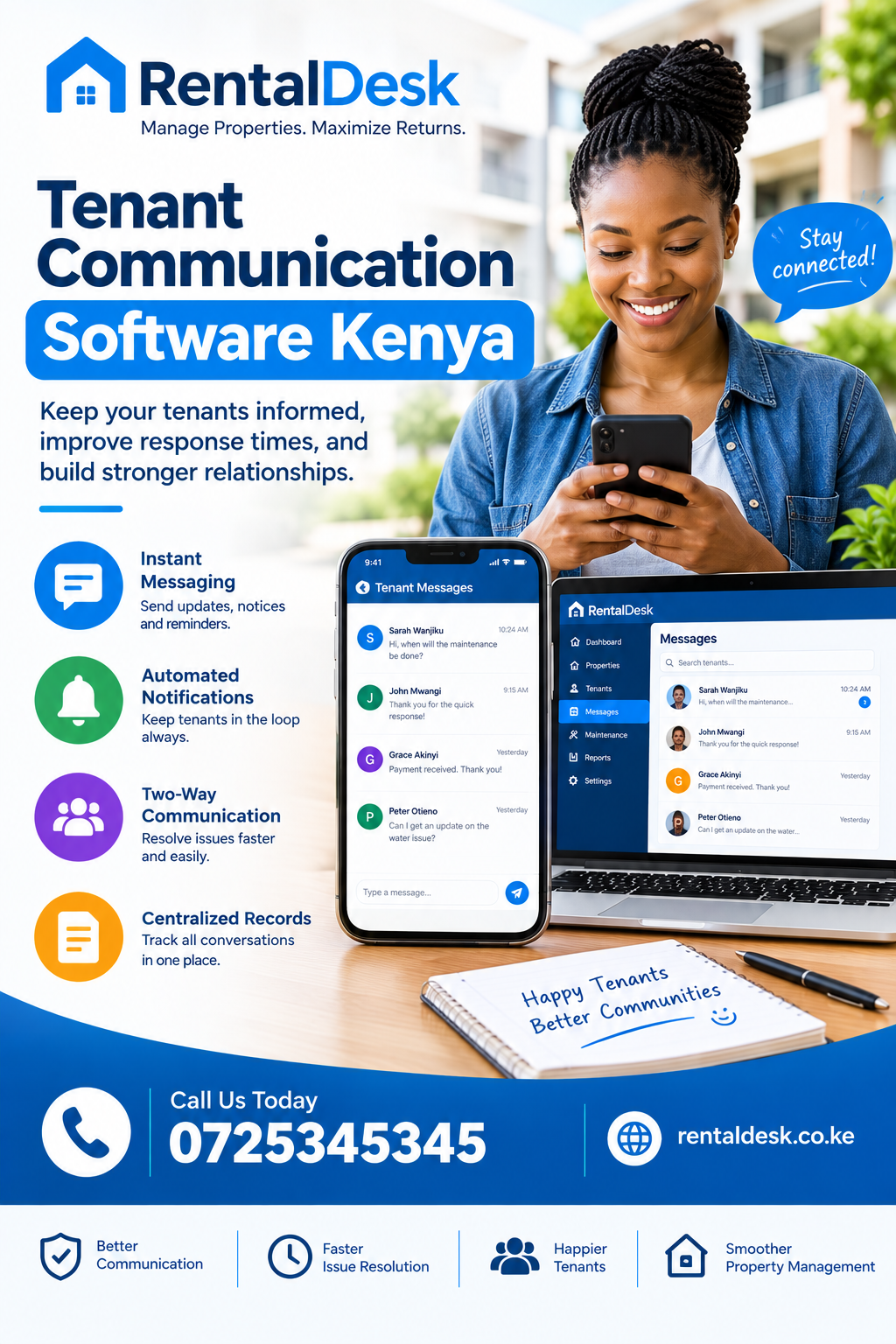
Tenant Communication Software Kenya: How Rental Businesses Can Improve Tenant Engagement
Managing rental properties is not only about collecting rent and arranging repairs. A large part of the work involves communicating with tenants clearly, consistently, and at the right time. For landlords, property managers, and rental agencies handling several units, Tenant Communication Software Kenya can provide a structured way to manage notices, maintenance updates, payment reminders, tenant questions, and important property information from one place.
The idea behind Tenant Communication Software Kenya is simple: replace scattered conversations with an organized communication process. Instead of depending on notebooks, personal phone messages, paper notices, or conversations that are difficult to track, a rental business can create a clearer record of what was communicated, when it was sent, and which tenant received it. This guide explains how the approach works, which features matter, how it can support Kenyan rental operations, what to consider before choosing a system, and how to implement it without making the tenant experience complicated.
What Is Tenant Communication Software?
Tenant Communication Software Kenya is a digital solution designed to help landlords and property managers communicate with tenants in an organized and traceable way. Depending on the platform, it may support announcements, reminders, maintenance messages, payment-related notifications, tenant requests, automated messages, and communication history.
The important distinction is that communication becomes part of the property management workflow rather than a separate activity. A property manager can connect a tenant, unit, lease, maintenance issue, or payment event to a message. That context makes communication more useful because staff do not have to reconstruct what happened from multiple conversations.
A good communication platform should not make tenants work harder. The goal is to give them clearer information and give property teams better visibility. The best setup therefore combines simple tenant-facing communication with useful internal records.
For a small landlord with a handful of units, this may simply mean keeping messages organized. For a growing property portfolio, the value becomes more obvious. When dozens or hundreds of tenants need updates, manual communication can become slow and inconsistent. Tenant Communication Software Kenya helps create repeatable processes while still allowing property managers to handle individual tenant situations.
Why Tenant Communication Matters in Property Management
Tenants judge a rental experience by more than the physical condition of a building. They also notice how quickly questions are answered, whether promised repairs are followed up, whether notices arrive on time, and whether payment or lease information is easy to understand.
Tenant Communication Software Kenya can help a property business make these interactions more consistent. For example, when a maintenance request is received, the tenant can receive confirmation that the issue has been logged. Once a technician is assigned, another update can explain what happens next. When the work is completed, the tenant can be informed rather than left wondering whether anyone is handling the problem.
Communication also reduces avoidable misunderstandings. A tenant may forget a date, misunderstand a notice, or assume that a request was ignored. A written communication trail provides useful context for both sides. It does not replace good customer service, but it creates a reliable foundation for it.
For Kenyan property managers, the need can be particularly relevant when portfolios contain tenants with different schedules, communication preferences, and levels of digital familiarity. A system should therefore support straightforward messages and avoid unnecessary complexity.
Common Communication Problems Faced by Kenyan Landlords
Before adopting Tenant Communication Software Kenya, it helps to understand the problems the software is expected to solve. Many communication difficulties are not caused by a lack of effort. They arise because information is spread across too many channels.
Messages are scattered across channels
A landlord may receive one tenant request by WhatsApp, another by phone call, another by SMS, and another in person. When several staff members are involved, important information can become difficult to locate.
Follow-ups are forgotten
A property manager may acknowledge a complaint but forget to return to it after contacting a plumber, electrician, caretaker, or supplier. Without a task or communication history, the original promise can disappear among newer messages.
Tenants receive inconsistent information
Different staff members may explain the same issue differently. This can create confusion about rent dates, maintenance schedules, access arrangements, or building notices.
Important notices are difficult to prove
When a notice concerns a scheduled inspection, maintenance shutdown, service interruption, or another property event, management may need a record showing what was communicated and when.
Communication takes too much staff time
Sending the same reminder repeatedly is inefficient. Staff should be able to automate routine messages while reserving personal attention for questions that actually require human judgment.
These problems show why Tenant Communication Software Kenya is more than a messaging feature. It is part of an operational process that can connect communication to tenants, units, leases, payments, and maintenance activities.
Key Features to Look For
Not every property business needs every feature. The right selection depends on portfolio size, staff structure, property type, and the channels tenants already use. However, several capabilities are especially useful.
1. Tenant profiles and contact records
A central tenant profile should contain accurate contact details and relevant rental information. This reduces the risk of sending a message to the wrong person or relying on outdated numbers. Tenant Communication Software Kenya becomes more useful when these records stay current.
The profile can also help staff understand context before responding. If a tenant asks about a repair, the team should be able to identify the relevant unit and previous requests without asking the tenant to repeat basic information.
2. Bulk announcements
Property managers often need to communicate the same information to many tenants. Tenant Communication Software Kenya can make this recurring work easier to organize. Examples include planned water interruptions, cleaning schedules, security notices, inspections, parking changes, and public-area maintenance.
Tenant Communication Software Kenya can make bulk communication more manageable by allowing staff to prepare a message once and send it to a defined group. Segmentation is important because a notice for one building should not automatically go to every tenant in a portfolio.
3. Automated reminders
Routine communication can consume hours when handled manually. Tenant Communication Software Kenya can reduce some of that repetitive workload. Automated reminders can support rent due-date notices, lease renewal prompts, inspection reminders, maintenance appointments, and other scheduled events.
Automation should be configurable. A tenant should not receive irrelevant reminders, and managers should be able to control timing, frequency, and message content.
4. Maintenance communication
Maintenance is one of the areas where communication has a direct impact on tenant satisfaction. Tenant Communication Software Kenya can keep the updates connected to the work being performed. A useful system can record the original request, acknowledge receipt, share updates, and confirm completion.
With Tenant Communication Software Kenya, the communication history can remain associated with the maintenance issue. This makes it easier for staff to answer questions such as when the request was received, who was assigned, and whether the tenant was updated.
5. Communication history
A searchable history is valuable when staff need to understand previous interactions. Tenant Communication Software Kenya gives the communication process a structured record to work from. Instead of relying on memory, staff can review earlier notices and responses.
The record should be easy to filter by tenant, property, unit, date, or communication type where possible. Clear records also help when staff responsibilities change.
6. Two-way communication
One-way announcements are useful, but tenants also need a practical way to ask questions or report issues. Two-way communication can reduce the need to switch between several tools.
The objective is not to create an endless chat stream. It is to create a channel where requests can be captured, assigned, and followed through.
7. Templates
Templates help standardize common messages without making every message sound robotic. Property teams can prepare templates for rent reminders, inspection notices, maintenance confirmations, lease renewal prompts, and general announcements.
Templates should remain editable. Different tenants and situations sometimes require a personalized explanation.
8. Staff access and permissions
A property management business may have owners, managers, accountants, caretakers, agents, and maintenance staff. Each person does not necessarily need access to every communication record.
Role-based access can help limit what each user can see or change. This is particularly important when communication includes personal or financial information.
How Communication Software Supports Tenant Retention
Tenant retention depends on many factors, including property quality, pricing, location, lease terms, and the overall rental experience. Tenant Communication Software Kenya addresses the communication part of that wider experience.
Tenant Communication Software Kenya can support retention by making tenants feel informed about issues that affect them. If a repair is delayed, silence can create frustration. A short update explaining the delay and next step is often more useful than no information.
The same principle applies to planned work. If a property team knows that water will be unavailable for several hours, early communication gives tenants time to prepare. If an inspection is planned, clear notice helps tenants understand when access is needed.
Communication should also be respectful. A system should make it easier to provide accurate information, not encourage landlords to send excessive reminders. Good tenant communication is timely, relevant, and purposeful.
Rent and Payment Communication
Rent collection creates frequent communication needs. Tenant Communication Software Kenya can help organize these recurring interactions. Tenants may need reminders about due dates, confirmation that a payment has been received, information about outstanding balances, or clarification of an account statement.
Tenant Communication Software Kenya can be useful when connected to a broader rental management process. For example, a payment event could trigger a confirmation, while an overdue balance could trigger a reminder based on rules configured by the property manager.
For Kenyan rental businesses, payment communication may also involve M-Pesa and other locally used payment methods. The important point is to keep the message clear. A payment reminder should state what is due, the relevant date, and how the tenant can resolve the balance without creating confusion.
Property managers should avoid sending automated notices without checking the underlying data. Automation works best when tenant records, lease information, and payment records are kept accurate.
Maintenance Requests and Service Updates
Maintenance complaints are often emotionally important because they affect a tenant’s daily life. Tenant Communication Software Kenya helps the property team keep communication around those issues visible. A leaking tap may be minor from an accounting perspective but disruptive to the person living in the unit.
Tenant Communication Software Kenya can structure the communication around a maintenance ticket. A tenant reports an issue, receives an acknowledgement, and can then be informed when a technician is assigned, scheduled, delayed, or completed.
A practical maintenance communication workflow may look like this:
- Tenant reports the issue.
- The system records the tenant, unit, date, and description.
- Management acknowledges the request.
- A staff member or contractor is assigned.
- The tenant receives an appointment or access message.
- The work is completed or rescheduled.
- Management confirms the outcome.
- The communication record remains available for future reference.
This process reduces the chance that a complaint disappears into a personal inbox.
Notices, Inspections, and Property Events
Rental properties generate many notices. Tenant Communication Software Kenya can help organize which tenants should receive each type of notice. Some are routine, while others are time-sensitive. Examples include inspection dates, cleaning schedules, repairs to common areas, pest-control visits, security updates, lift maintenance, parking arrangements, and utility interruptions.
With Tenant Communication Software Kenya, these notices can be planned and distributed according to the affected property or tenant group. That matters for managers who operate several buildings because a message intended for one block should not necessarily be sent to every property.
Inspection communication is another practical example. A tenant should know the purpose of an inspection, the proposed date, the expected duration where known, and any preparation or access requirements. Clear information can make the process smoother for everyone.
Improving Communication Between Landlords and Property Managers
In some rental businesses, the owner is not involved in daily operations. A property manager or agent handles tenant interactions on the owner’s behalf.
Tenant Communication Software Kenya can help keep communication records available to authorized staff. Instead of the owner asking the manager for a history of tenant complaints or notices, authorized staff can review the relevant records.
This can also help when a property manager leaves or responsibilities move to another employee. Communication knowledge is not trapped inside one person’s phone. The organization retains a structured record that can support continuity.
However, technology should not be used to avoid accountability. Staff should still have clear responsibilities for responding to tenant requests, resolving issues, and escalating serious matters.
Communication for Multi-Property Portfolios
The communication requirements of a five-unit property differ from those of a portfolio containing several apartment blocks, commercial spaces, or mixed-use developments. Tenant Communication Software Kenya should therefore scale with the portfolio.
As a portfolio grows, Tenant Communication Software Kenya can help organize communication by property, building, unit, tenant category, or event. Segmentation prevents unnecessary messages and makes reporting more useful.
Consider a manager overseeing three apartment blocks in Nairobi. A planned water shutdown affecting Block A should be communicated to Block A tenants. A security meeting for Block B should go only to the relevant residents. A portfolio-wide policy notice can be sent to everyone.
Without segmentation, staff may rely on manually maintained contact lists. That increases the chance of omissions and accidental messages.
Tenant Communication and Customer Service
Software cannot replace courtesy. Tenant Communication Software Kenya is most effective when it supports clear service standards.
Tenant Communication Software Kenya works best when communication standards are defined alongside the technology. A property business can decide, for example, that maintenance requests should be acknowledged promptly, urgent issues should be escalated immediately, and routine notices should be sent before a scheduled event.
A simple service standard might include:
- Acknowledging every maintenance request.
- Giving tenants a realistic next step.
- Updating tenants when circumstances change.
- Avoiding unexplained delays.
- Recording important commitments.
- Using plain language in notices.
- Escalating emergencies instead of relying only on automated messages.
The system supports these standards; it does not create them automatically.
Data Accuracy and Communication Quality
Poor data can undermine even a sophisticated platform. Tenant Communication Software Kenya depends on accurate tenant and property records. If a tenant’s phone number is outdated, a reminder may not reach them. If a tenant is attached to the wrong unit, staff may send incorrect information.
For Tenant Communication Software Kenya to work reliably, property teams should maintain clean tenant records. When tenants move in, move out, renew leases, or change contact details, records should be updated promptly.
It is also useful to establish a process for reviewing inactive tenant profiles. Former tenants should not continue receiving current property notices. Likewise, new tenants should be added to the correct communication groups.
Good data management is therefore part of good communication management.
Privacy and Responsible Use
Tenant communication can involve personal details, financial information, complaints, access arrangements, and other sensitive records. Property businesses should treat this information responsibly.
When evaluating Tenant Communication Software Kenya, ask how user access is managed, how data is protected, how accounts are secured, and what controls exist for staff permissions. The exact requirements will depend on the organization and applicable Kenyan laws and policies.
Practical safeguards include strong passwords, controlled staff access, timely removal of former employees, secure devices, and clear internal rules about what information should be shared through each channel.
A communication platform should also make it easier to avoid accidental disclosure. A bulk message, for example, should be configured carefully so that private tenant information is not unnecessarily exposed.
Choosing Software for a Kenyan Rental Business
Choosing Tenant Communication Software Kenya should start with the actual workflow of the property business rather than a list of impressive features. A careful Tenant Communication Software Kenya evaluation should focus on daily tasks.
Ask these questions before selecting a solution:
- How many properties and units need to be managed?
- How many staff members need access?
- Which communication channels do tenants already use?
- Does the system support two-way communication?
- Can messages be linked to tenants and units?
- Can staff automate routine reminders?
- Can the system maintain communication history?
- Does it connect with other rental management functions?
- Can users control permissions?
- Is the interface simple enough for everyday staff use?
- Can the business export or retrieve its records?
- What support is available when users need help?
The best fit depends on the answers. A small landlord may need a simple workflow, while a property management company may need deeper automation and reporting.
Integration With Rental Management
Communication becomes more valuable when it connects to other property management activities. Tenant Communication Software Kenya can be part of that connected workflow.
Tenant Communication Software Kenya can be part of a broader system that includes tenant records, lease management, rent tracking, maintenance, invoicing, accounting, property records, and reporting.
For example, a lease renewal workflow could identify tenants whose agreements are approaching their renewal dates. The system could prepare a reminder, allow a manager to review it, and record the communication.
Similarly, a maintenance module can provide communication triggers when a work order changes status. A rent module can provide payment information that supports appropriate reminders.
The benefit is less duplicate data entry. Staff do not need to copy the same tenant information into several unrelated systems.
Manual Communication vs Software-Assisted Communication
Manual communication still has a place. A landlord may personally call a tenant about an unusual situation, discuss a complex complaint, or meet a tenant face to face.
The purpose of Tenant Communication Software Kenya is not to eliminate personal communication. It is to reduce repetitive administration and create reliable records.
| Area | Manual approach | Software-assisted approach |
|---|---|---|
| Tenant reminders | Staff send individually | Rules and templates can assist |
| Notices | Lists may be maintained manually | Groups can be segmented |
| Maintenance updates | Follow-ups depend on staff memory | Status changes can support updates |
| Communication history | Spread across channels | Centralized records may be available |
| Reporting | Requires manual review | Communication activity can be easier to track |
| Staff handover | Knowledge may remain with one person | Shared records support continuity |
The most effective approach is often a combination. Automation handles predictable tasks while staff handle exceptions, sensitive issues, and conversations that require judgment.
Measuring Communication Performance
A rental business should measure whether its communication process is actually improving operations.
With Tenant Communication Software Kenya, useful measures may include response time, number of unresolved requests, overdue maintenance updates, message delivery rates where available, and tenant request volumes.
Do not measure communication simply by counting messages. Sending more messages is not automatically better.
Instead, ask:
- Are tenants receiving important notices on time?
- Are maintenance requests acknowledged?
- Are follow-ups being completed?
- Are repeated questions decreasing?
- Can staff find previous communication quickly?
- Are automated reminders reducing repetitive work?
- Are tenants contacting staff through manageable channels?
These measures provide a more meaningful view of communication quality.
Practical Example: A Nairobi Apartment Block
Imagine a property manager responsible for 80 apartments. Before adopting a structured communication process, tenants report issues through phone calls, WhatsApp messages, and visits to the office.
One tenant reports a leaking pipe. The manager promises to send a plumber, but the message is buried under several other conversations. The tenant calls again the next morning. Another staff member does not know the original details, so the tenant has to explain the problem again.
A structured Tenant Communication Software Kenya workflow changes the sequence. The request is recorded against the correct unit. The tenant receives confirmation. A maintenance worker is assigned. The tenant receives an update about the expected visit. Once the work is complete, the status is closed.
The system has not repaired the pipe. The plumber still does that. What changed is the coordination around the repair.
That distinction matters. Good software supports the people doing the work rather than pretending that technology itself solves every operational problem.
Practical Example: Rent Reminder Management
Consider a landlord with several properties and many tenants. Sending individual reminders every month can become repetitive.
A structured communication workflow can identify the relevant tenants, apply a predefined reminder schedule, and keep a record of what was sent.
Tenant Communication Software Kenya can therefore reduce administrative effort while making the process more consistent. Staff can still intervene when a tenant has already made a payment, agreed on a payment arrangement, or needs a different conversation.
This is particularly important because rent communication should be accurate and respectful. Automated messages should not create unnecessary conflict by sending an overdue notice when the underlying payment record is not current.
Practical Example: Planned Maintenance
Suppose a property manager knows that common-area painting will take place over a weekend.
A poor communication process might involve putting a notice on a board shortly before work begins. Some tenants may never see it.
A better process uses several appropriate channels and gives residents enough notice. Tenant Communication Software Kenya can support the planning of the announcement, distribution to the affected property, and retention of the communication record.
The message can explain the dates, areas affected, expected disruption, and contact point for questions. If the schedule changes, an updated message can be issued rather than leaving tenants to discover the change themselves.
Common Mistakes When Implementing Communication Software
Buying software is only the first step. Tenant Communication Software Kenya delivers value only when the team uses it consistently. Several implementation mistakes can reduce the value of the system.
Sending too many automated messages
Automation should reduce noise, not create it. Review templates regularly and remove unnecessary reminders.
Failing to clean old tenant data
Importing inaccurate records can cause immediate problems. Verify tenant names, unit numbers, contact details, and active status.
Using one channel for every situation
Different situations may require different communication methods. Emergency matters may need direct human contact, while routine reminders may be suitable for automation.
Ignoring staff training
Even simple software requires agreed processes. Staff should know how to record requests, send notices, update statuses, and escalate urgent matters.
Treating communication history as optional
If some staff record requests while others do not, the system becomes incomplete. Consistent recording should be part of the operating procedure.
Automating sensitive decisions
Messages about disputes, serious complaints, legal matters, or exceptional payment arrangements may require human review. Automation should support judgment rather than replace it.
A Simple Implementation Plan
A rental business can introduce Tenant Communication Software Kenya gradually instead of changing every process at once. A phased Tenant Communication Software Kenya rollout can make staff adoption easier.
Step 1: Map current communication
List the common messages your business sends and receives. Separate routine messages from exceptional conversations.
Step 2: Identify the biggest bottlenecks
Look for repeated tenant questions, missed follow-ups, delayed maintenance updates, or manual reminders.
Step 3: Clean tenant data
Create accurate records before automating communication.
Step 4: Create communication templates
Prepare clear drafts for routine situations. Keep them concise and easy to understand.
Step 5: Define responsibilities
Decide who handles tenant requests, who manages maintenance communication, who sends notices, and who reviews escalated matters.
Step 6: Start with a small workflow
For example, begin with maintenance acknowledgements and rent reminders before expanding to broader communication.
Step 7: Monitor results
Review response times, unresolved requests, tenant feedback, and staff workload.
Step 8: Improve the process
Remove unnecessary messages, adjust timing, and update templates based on real usage.
This approach makes Tenant Communication Software Kenya a practical operational improvement rather than a technology project that staff use only occasionally.
Cost Considerations
The cost of communication software varies according to the provider, number of users, properties, units, features, integrations, and support model. The cost of Tenant Communication Software Kenya should therefore be considered alongside expected operational benefits.
Consider the time staff spend on repetitive reminders, the cost of missed follow-ups, the administrative burden of searching old messages, and the impact of delayed tenant responses.
A system may also have additional costs for setup, training, integrations, messaging, or premium features. These should be understood before implementation.
For smaller landlords, a simple system may be sufficient. Larger property managers may need a more comprehensive platform because communication is closely connected to rent collection, maintenance, accounting, and reporting.
What Tenants Expect From Digital Communication
Tenants increasingly expect basic information to be easy to access. Tenant Communication Software Kenya can help property teams meet that expectation through more organized communication. They want to know whether a request was received, when a technician is expected, whether a payment has been recorded, and what is happening when a property disruption occurs.
Tenant Communication Software Kenya can support these expectations when the underlying processes are reliable.
However, tenants also value human contact. A digital message is useful for confirming an appointment, but a serious complaint may require a conversation. The strongest communication process gives tenants access to both convenience and human assistance.
Clear writing matters too. Avoid complicated language, unexplained abbreviations, and messages that contain too many unrelated instructions.
Mobile-Friendly Communication
Property management staff and tenants may interact with systems from phones rather than desktop computers. This makes mobile usability important.
A communication system should make routine tasks easy on smaller screens. Tenant Communication Software Kenya should be tested on the devices staff and tenants actually use. Staff may need to check a tenant record while walking through a property, and tenants may report an issue from their phone.
Tenant Communication Software Kenya should therefore be assessed from both sides: the staff experience and the tenant experience. A feature that looks impressive in a demonstration may still be inconvenient if common tasks require too many steps.
Communication During Emergencies
Emergency communication deserves separate treatment. A software platform can help distribute information quickly, but it should not be the only emergency response mechanism.
For events such as serious water leaks, fire risks, security incidents, or dangerous electrical problems, the property team should follow appropriate emergency procedures and use direct channels where necessary.
Tenant Communication Software Kenya can support emergency coordination by helping management send relevant updates, identify affected tenants, and maintain records. But emergency communication should always be based on the severity and nature of the situation.
A good emergency message should be concise and action-oriented. It should tell tenants what happened, what they should do, and where to obtain further information.
Future-Ready Communication Processes
Rental businesses change as their portfolios grow. A communication workflow that works for ten tenants may not work for several hundred.
Tenant Communication Software Kenya can provide a foundation for more organized communication as the business expands. The important consideration is scalability. Can the platform handle additional properties, users, tenant groups, and message volumes without creating more administrative work?
Integration also matters. If the business later introduces stronger accounting, maintenance, or reporting workflows, communication should remain connected to those processes.
The goal is not to buy the most complicated platform. It is to select a system that can support the business’s actual direction without becoming difficult for staff to use.
Questions to Ask a Software Provider
Before committing to a platform, property managers can ask practical questions such as:
- Which communication channels are supported?
- Can messages be sent to selected properties or tenant groups?
- Is two-way communication available?
- Can communication history be searched?
- Can staff create reusable templates?
- Are automated reminders configurable?
- Can maintenance updates trigger communication?
- How are user permissions managed?
- What happens when a tenant moves out?
- Can records be exported?
- What support is provided during setup?
- How are security and account access handled?
- Does the platform integrate with rent and property management functions?
- Are there additional charges for messaging or extra users?
The answers should be considered alongside the business’s size and workflow. A feature is useful only if the team will actually use it.
Benefits for Landlords
Individual landlords can also benefit from a structured approach. Even when the portfolio is small, Tenant Communication Software Kenya can reduce the need to remember every tenant interaction.
A landlord can keep routine reminders, maintenance conversations, and property notices organized. If the portfolio grows, those records can provide a useful foundation for moving toward a more formal property management process.
The main benefit is consistency. Tenants should not receive a different level of communication simply because the landlord is busy on a particular day.
Benefits for Property Management Companies
Property management companies handle communication at a larger scale. Staff may manage several owners and properties simultaneously.
Tenant Communication Software Kenya can support these businesses by centralizing tenant interactions and connecting them to property records. Managers can delegate tasks while retaining visibility into what has been communicated.
It can also improve handovers. If one employee is absent, another authorized employee can review the relevant history rather than asking the tenant to start from the beginning.
Benefits for Tenants
The tenant benefit is straightforward: better information.
Tenants can receive clearer notices, confirmations, reminders, and maintenance updates. They can have greater visibility into the progress of requests instead of repeatedly calling to ask for status updates.
A communication platform should also reduce unnecessary back-and-forth. If a message contains the relevant date, unit, appointment information, and next step, the tenant has less reason to contact the office simply to clarify basic details.
A Practical Communication Policy
Software works better when supported by a simple communication policy.
A rental company can document:
- Which matters require immediate human attention.
- Which routine messages can be automated.
- How quickly staff should acknowledge requests.
- Who handles different categories of tenant issues.
- Which information can be shared in bulk.
- How communication records should be maintained.
- When staff should escalate a matter.
- How former tenant records are handled.
- How tenant data should be protected.
This policy gives staff a consistent framework. The software then becomes a tool for executing that framework.
Frequently Asked Questions
1. What does tenant communication software do?
Tenant Communication Software Kenya helps landlords and property managers organize communication with tenants. Depending on the system, it can support notices, reminders, maintenance updates, tenant requests, communication history, templates, and automated messages.
2. Can communication software help with rent reminders?
Yes. A suitable system can support scheduled or automated rent reminders and payment-related messages. The exact capabilities depend on the platform and its integration with rental accounting or payment records.
3. Can tenants report maintenance issues through the system?
Many property management platforms allow tenants to submit maintenance requests. The request can then be assigned, updated, and closed while communication remains connected to the relevant tenant and unit.
4. Is Tenant Communication Software Kenya suitable for small landlords?
It can be, provided the software matches the landlord’s portfolio size and workflow. Small landlords should prioritize simplicity, accurate records, useful automation, and reasonable operating costs.
5. Can property managers send messages to many tenants?
Yes, platforms with bulk communication can allow staff to send announcements to selected tenant groups. Segmentation is important so that only relevant tenants receive a particular notice.
6. Does communication software replace WhatsApp or phone calls?
Not necessarily. A property business can continue using appropriate channels while using software to organize records and workflows. The right approach depends on the communication needs of the tenants and the platform’s capabilities.
7. How does software help with maintenance communication?
Tenant Communication Software Kenya can help record a maintenance request, acknowledge it, assign it, provide updates, and confirm completion. This can reduce missed follow-ups and give staff a clearer history of the issue.
8. What should I check before choosing a system?
Check communication channels, tenant records, automation, maintenance workflows, reporting, permissions, integrations, usability, support, and total cost. Test common tasks rather than relying only on a feature list.
9. Is tenant data safe in a communication platform?
Security depends on the platform’s technical controls and the property company’s own practices. Ask providers about access controls, account security, data protection, backups, and user permissions, and establish internal rules for responsible data handling.
10. How can a rental business improve communication without overwhelming tenants?
Use communication selectively. Automate routine, useful notices; keep messages concise; avoid unnecessary repetition; provide clear next steps; and make human assistance available for complex matters.
Conclusion
Effective tenant communication is a core part of professional rental management. Tenant Communication Software Kenya supports the systems and records behind that communication. Tenants need timely information about payments, maintenance, inspections, notices, disruptions, and other issues that affect their homes or businesses. Property managers, meanwhile, need a reliable way to keep track of conversations and follow-ups.
Tenant Communication Software Kenya can bring these activities into a more organized workflow. Its value comes from connecting communication with real property operations rather than treating messaging as an isolated task.
For Kenyan landlords and property managers, the right solution should be practical, easy to use, suitable for the size of the portfolio, and capable of supporting local rental workflows. It should help staff communicate more consistently without removing the human side of property management.
Before choosing a platform, map the communication problems your business already faces. Identify repetitive tasks, missed follow-ups, tenant information gaps, and areas where staff spend too much time searching for previous messages. Then evaluate systems against those specific needs.
A well-designed communication process can make rental operations clearer for staff and tenants alike. Tenant Communication Software Kenya can support that clarity when it is implemented around practical business needs. If your property business is ready to organize tenant interactions, explore how Tenant Communication Software Kenya can fit into a broader rental management workflow and use the evaluation questions in this guide to make a practical, informed choice.